Greenhouse films: choosing the right cover for your farm
Lebanon has approximately 2,815 hectares of greenhouse production, with more than 90% concentrated in Akkar, North, Mount Lebanon, and the South. That concentration creates no single national answer for greenhouse film selection.
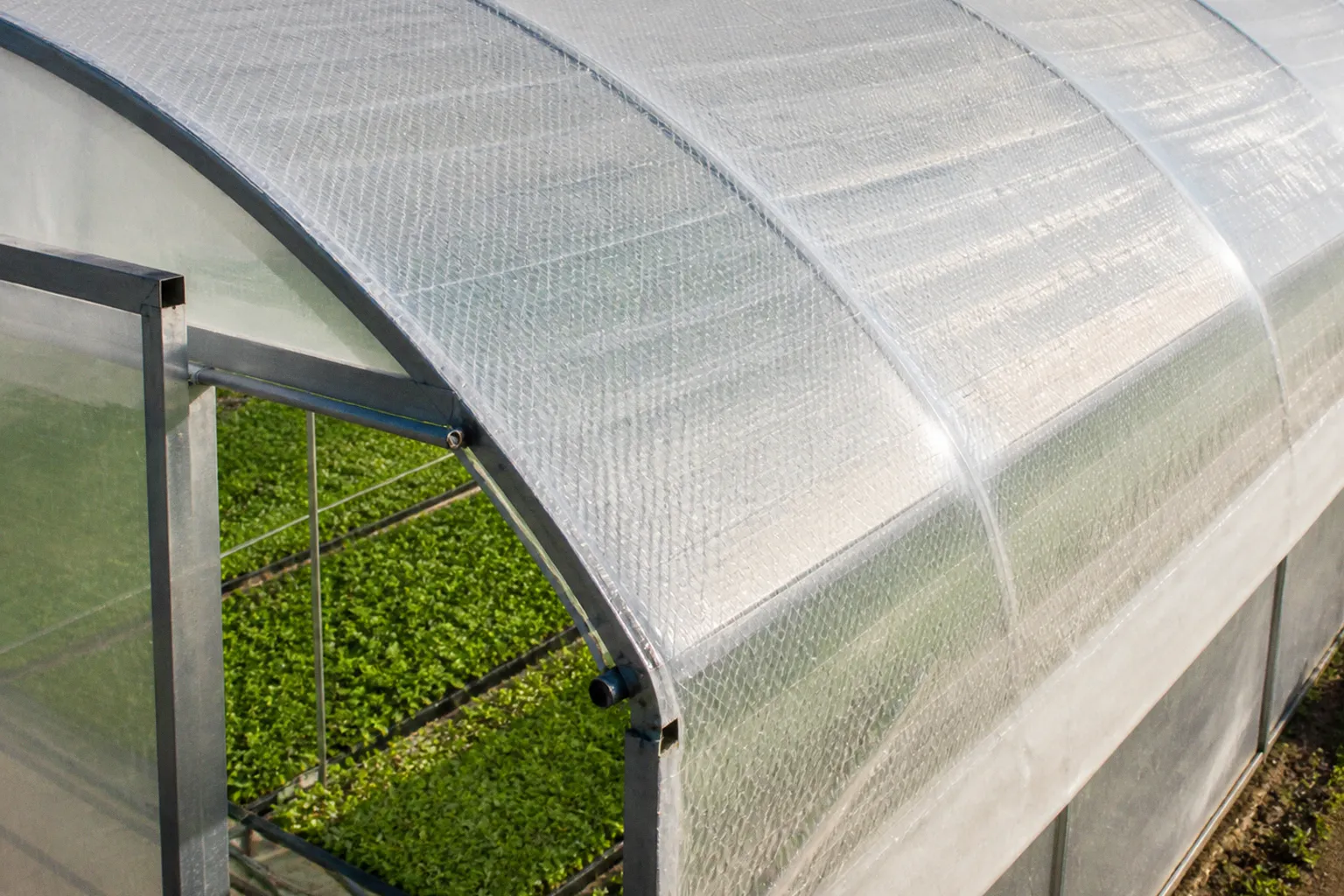
A coastal tunnel exposed to humidity and intense sun is operating under a different specification from a structure facing cold Bekaa nights.
The wrong cover creates a chain reaction: excess condensation, unstable night temperatures, crop scorching, premature film failure, or insufficient light. You then pay twice—first for the film, then for lost production and an emergency replacement cycle.
For Lebanese growers, greenhouse film selection starts with four specifications: thickness, light behavior, UV stabilization, and thermal performance. Add local wind exposure, tunnel width, agrochemical use, and replacement access. The result should be a technical match, not a product picked from a distributor’s shelf.
Start with the microclimate, not the product catalogue
The greenhouse cover is part of your climate-control system. It determines how much solar radiation enters, how quickly the structure loses heat after sunset, and how condensation behaves on the inner surface.
Use this decision logic:
- If the site is coastal or exposed to high humidity, prioritize anti-drip performance and a film structure that manages condensation. A cover that allows droplets to form and fall onto foliage can increase disease pressure and reduce usable growing hours.
- If the site is in the Bekaa Valley, prioritize thermal performance because sharp day-to-night temperature drops can stress crops and increase heating demand. Thermal covers reduce nighttime cooling and thermal inversion risks.
- If the crop is highly light-demanding and the structure has reliable ventilation, a high-transparency film may be appropriate.
- If the crop is vulnerable to leaf scorching or the tunnel receives uneven direct sun, consider a diffused film that distributes incoming light more evenly.
- If the farm uses frequent agrochemical treatments, confirm that the UV stabilization package is compatible with that chemical environment. UV life is not determined by calendar time alone.
The key point is operational: the same greenhouse plastic cover in Lebanon can perform well in one governorate and poorly in another. The cover is not working in isolation. It is interacting with altitude, humidity, ventilation, crop density, irrigation, pesticide use, and the orientation of the structure.
Choose the film for the night temperature, humidity load, and crop response—not for the label on the roll.
Before ordering, record the conditions around the structure:
- Location and elevation.
- Main crop and planting cycle.
- Winter minimums and summer heat exposure.
- Tunnel orientation and roof geometry.
- Existing ventilation openings.
- Irrigation method and daily humidity pattern.
- Frequency of pesticide and sulfur-based treatments.
- Available roll width and installation equipment.
- Whether replacement can be carried out before the next crop cycle.
This is a short field audit, but it prevents the most expensive mistake: ordering a technically sound film in the wrong configuration.
Thickness: durability is only one side of the calculation
Agricultural film thickness is measured in microns, or μm. In some markets it is also expressed in mils. A 150 μm film is approximately 6 mil, while 150 μm and 200 μm are common baseline options for commercial polytunnels and agricultural structures. Suppliers in Lebanon manufacture greenhouse films across a broader range, typically from 75 to 250 μm.
That range exists because structures and operating conditions vary. Thicker is not automatically better. It may improve mechanical durability, but the right choice depends on installation tension, frame condition, wind exposure, handling, and the replacement strategy.
How to compare common thickness bands
| Parameter | Lower-thickness film | 150 μm baseline | 200–250 μm film |
|---|---|---|---|
| Material use | Lower | Moderate | Higher |
| Handling during installation | Easier, but more vulnerable to damage | Practical for commercial structures | Heavier and more demanding |
| Mechanical resistance | More limited | Balanced starting point | Higher potential durability |
| Best use case | Protected structures or short cycles where conditions allow | General commercial polytunnel specification | High-demand structures, exposed sites, or longer planned service |
| Main risk | Early tearing, puncture, or replacement | Wrong additive package can still cause failure | Over-specification, installation strain, and unnecessary capital cost |
| Selection question | Can the structure protect a lighter film? | Does this match the farm’s climate and cycle? | Will the longer service justify the added material and handling? |
The practical selection rule is simple:
1. Start with the structure. A 250 μm film cannot compensate for sharp edges, loose wire, poor fastening, or damaged hoops.
2. Match thickness to exposure. Wind, abrasion, installation tension, and repeated maintenance affect service life.
3. Check the film width before approving the specification. Available agricultural film widths can range from 1.5 to 14 meters. The roll must fit the greenhouse geometry with an installation plan that avoids unnecessary seams.
4. Define the target replacement cycle. A film selected for one crop cycle has a different economic logic from a cover expected to remain in service for several years.
5. Do not confuse thickness with UV life. A thick film with the wrong stabilization package can fail before a thinner, correctly specified film.
The installation team also matters. Excessive tension, folding over sharp frame members, dragging the film across rough ground, or fixing it with unsuitable hardware can reduce the value of a higher-grade cover. Procurement and installation must be treated as one work package.
If-then protocol for thickness selection
- If the structure is temporary, well sheltered, and scheduled for a short production cycle, evaluate a lighter film—but only after checking wind and abrasion exposure.
- If the greenhouse is a standard commercial polytunnel with regular seasonal production, use 150 μm as a baseline for comparison, not as an automatic final answer.
- If the site is highly exposed or the farm needs a longer replacement interval, compare 200–250 μm options and calculate the cost over the intended service period.
- If the frame has corrosion, sharp welds, or loose fastening points, repair the structure before upgrading the film.
- If a supplier recommends thickness without discussing UV stabilization, light transmission, and thermal properties, the specification is incomplete.
Light management: transparent is not the same as productive
Light transmission is one of the most misunderstood greenhouse cover specifications. More light can increase crop potential, but uncontrolled direct radiation can produce heat stress, leaf scorching, uneven development, and difficult irrigation decisions.
Clear, high-transparency films can provide more than 90% light transmission. That is useful for high-light crops when the structure has enough ventilation and the local solar load is manageable.
Diffused films operate differently. They scatter approximately 35%–65% of incoming light, reducing hard shadows and distributing radiation more evenly through the crop canopy. This can be useful where direct sunlight creates hot spots or where the crop canopy is dense enough to leave lower leaves underlit.
Do not treat “clear” and “diffused” as a quality ranking. They are different light-management tools.
High-transparency film
Use a clear film when:
- The crop requires strong incoming light.
- The site has effective roof or side ventilation.
- The grower can manage heat accumulation.
- The structure does not create severe hot spots.
- Winter light is a major production constraint.
- The crop canopy benefits from direct radiation.
The risk is straightforward: high transmission can push the crop and the internal temperature beyond the useful range if ventilation and irrigation are not coordinated.
Diffused film
Use a diffused cover when:
- Direct radiation creates localized scorching.
- The greenhouse has uneven light distribution.
- The crop canopy is dense.
- Shadows from structural members affect crop uniformity.
- You need more even light penetration rather than maximum direct intensity.
The risk is the opposite: selecting a strongly diffused cover for a crop and site that already struggle with limited winter light. The specification must reflect the crop calendar, not only the summer conditions.
A practical crop-and-site comparison
| Operating condition | Higher-transparency film | Diffused film |
|---|---|---|
| High-light crop with strong ventilation | Often suitable | May be unnecessary unless hot spots are a problem |
| Coastal summer exposure | Requires strict heat and humidity management | Can reduce harsh direct-light effects |
| Cold Bekaa winter | Preserves strong incoming light, but thermal properties also matter | Evaluate carefully against seasonal light availability |
| Dense crop canopy | May leave lower layers less evenly lit | Can improve light distribution through the canopy |
| Scorch-prone crop | Higher risk if ventilation is weak | Often the more controlled option |
| Uneven structure shading | Does not correct the distribution problem | Helps soften shadows and hot spots |
The correct question is not, “Which film lets in the most light?” It is, “Which light pattern produces the most stable crop response in this structure?”
That distinction affects irrigation as well. A high-transparency cover may increase peak radiation and therefore change water demand during the hottest part of the day. A diffused cover can create a more even light field, but it still requires monitoring of humidity, crop transpiration, and temperature. Film selection does not remove the need for operational control; it changes the control problem.
Thermal films: the Bekaa problem is the night
Greenhouse managers often focus on daytime heat because it is visible and immediate. In the Bekaa Valley, nighttime cooling can be just as important. A sharp temperature drop after sunset affects crop stress, condensation, growth rate, and the timing of irrigation and ventilation.
Thermal greenhouse film is designed to reduce nighttime cooling and thermal inversion risks. That makes thermal performance particularly relevant for regions with strong day-night temperature variation.
Use this logic:
- If cold nights are limiting crop continuity, prioritize a thermal film over a cover selected only for daytime transparency.
- If condensation is accumulating overnight, combine thermal selection with anti-drip performance and a ventilation protocol.
- If the greenhouse is coastal and winter nights are moderate but humidity is high, anti-drip and humidity management may have greater operational value than maximum thermal retention.
- If the crop calendar crosses winter, compare the film’s thermal behavior with the cost and availability of supplementary heating.
- If the structure is poorly sealed, repair gaps first. A thermal film will not solve uncontrolled air leakage.
Thermal performance should be evaluated as part of the entire envelope. Check:
- Film-to-frame contact and fastening.
- Open seams and damaged sidewalls.
- Door gaps and poorly sealed ventilation points.
- Night ventilation practices.
- Condensation movement and drainage.
- Crop sensitivity to low nighttime temperatures.
A greenhouse cover that retains heat but creates persistent internal condensation can simply move the problem from temperature stress to disease pressure. That is why thermal and anti-drip specifications should be assessed together.
For Lebanese farms operating through colder periods, the film decision should also be tied to the crop schedule. If production ends before the coldest part of the season, paying for higher thermal performance may not be justified. If the greenhouse must carry a winter crop, the thermal specification becomes part of production continuity—not a decorative upgrade.
A cover earns its place when it stabilizes the crop’s operating window. Light alone is not an operating window.
UV stabilization: build the replacement cycle before the film arrives
A greenhouse cover exposed to Lebanese sun is consuming its UV protection every day. The expected operational lifetime of UV stabilization can range from one to five years, depending on geographic UV exposure and agrochemical usage.
That is a wide range. It should never be reduced to a generic statement such as “this film lasts five years.”
The correct service-life question is:
- What UV exposure will the film receive?
- What chemicals will contact the film?
- How often will those chemicals be applied?
- Will the film be cleaned, repaired, or mechanically stressed?
- Is the cover intended for one production cycle or several?
- Can the farm replace the film during a low-risk seasonal window?
Agrochemicals can affect film performance. The exact effect depends on the product, concentration, application method, and film formulation. Ask the supplier for compatibility information rather than relying on a verbal promise from a distributor.
Replacement planning protocol
1. Record the installation date and film specification. Keep the thickness, additive package, roll dimensions, and supplier details with the greenhouse maintenance file.
2. Set inspection points. Inspect after installation, after major weather events, and before the next high-value crop.
3. Look for early failure signals. Brittleness, discoloration, cracking, loss of flexibility, tearing around fasteners, and declining light conditions all justify a technical review.
4. Track chemical exposure. Note products applied near or onto the cover and identify whether the formulation has restrictions.
5. Order before failure. If replacement depends on a specific width or imported supply, waiting for a tear can push the work into the wrong crop window.
6. Replace by production logic, not by habit. A film may remain physically intact while its light or thermal performance has become unsuitable.
A one-year to five-year stabilization range is not a promise. It is a planning envelope. Your farm’s exposure and chemical program determine where inside that envelope the film belongs.
Do not approve a film using only the phrase “UV treated.” Request the stabilization target, expected service conditions, and any exclusions related to agrochemical use. If the supplier cannot explain those points, you do not yet have a procurement specification.
Co-extruded layers and film width: the infrastructure details that decide installation
Greenhouse film is not only a sheet of plastic. Co-extruded films can combine different functional layers, allowing the cover to address more than one requirement—such as mechanical performance, light transmission, thermal behavior, anti-drip treatment, or UV stabilization.
The layer structure matters because a film can be technically strong in one category and weak in another. A high-transparency cover may still be a poor choice if the greenhouse needs stronger condensation control. A thick film may still be unsuitable if its UV package conflicts with the farm’s chemical program.
Ask for the construction and functional properties in writing:
- Total thickness in μm.
- Available roll width.
- Light transmission.
- Diffusion or scattering range, where applicable.
- Thermal properties.
- Anti-drip treatment.
- UV stabilization period and exposure assumptions.
- Agrochemical compatibility.
- Recommended installation side or orientation.
- Storage and handling requirements.
Width is a practical constraint, not an administrative detail. Supplier ranges can extend from 1.5 to 14 meters, but your greenhouse may require a specific width to minimize seams, overlaps, and material waste.
Width selection protocol
- If the cover width is too narrow, you may create additional seams and weak points.
- If the roll is too wide for the structure and installation crew, handling damage becomes more likely.
- If the film must be folded or forced around the frame, the nominal thickness will not protect against poor installation geometry.
- If several tunnels share the same design, standardizing roll width can simplify inventory and replacement.
- If the greenhouse has irregular sections or mixed spans, calculate each section separately rather than ordering one universal roll.
Treat the film roll as a logistics unit. Confirm:
- Roll length.
- Roll diameter and weight.
- Loading and unloading method.
- Storage protection from direct sunlight and heat.
- Installation crew capacity.
- Planned installation date.
- Available fastening channels, clips, or profiles.
A film that arrives in the correct specification but cannot be safely handled on site is not an operational solution.
Compare greenhouse cover options by failure mode
A useful comparison does not ask which film is “best.” It asks which failure mode is most expensive for your farm and which specification reduces it.
| Primary risk on the farm | Film property to prioritize | What to avoid |
|---|---|---|
| Cold Bekaa nights | Thermal performance, supported by proper sealing | Selecting only for maximum daytime transparency |
| Coastal humidity and condensation | Anti-drip behavior and humidity-control compatibility | Ignoring overnight condensation patterns |
| Crop scorching | Diffused light management and adequate ventilation | Using high-transparency film without heat control |
| Short replacement window | Suitable UV stabilization and confirmed supply | Waiting for total failure before ordering |
| Wind or abrasion exposure | Appropriate thickness and sound frame preparation | Assuming thicker film fixes damaged supports |
| High agrochemical use | Chemical compatibility and UV package | Treating all UV-stabilized films as equivalent |
| Complex tunnel geometry | Correct roll width and installation plan | Ordering by nominal greenhouse area alone |
| Dense crop canopy | More even light distribution | Choosing purely for peak direct transmission |
This matrix should become part of your purchasing conversation. Give the supplier the site conditions and the dominant risk. Do not ask for a generic greenhouse film recommendation.
The procurement sequence that keeps the project moving
Use a disciplined sequence. It reduces delays and prevents a distributor from defining the specification for you.
1. Classify the site
Mark the greenhouse as primarily coastal, inland, Bekaa, or mixed-exposure. Note humidity, cold-night risk, wind, and summer radiation.
2. Classify the crop
Record whether the crop is high-light, scorch-sensitive, dense-canopy, winter-grown, or dependent on a narrow temperature range.
3. Select the light behavior
Choose between high-transparency and diffused performance based on crop response and ventilation capacity. Do not select by transmission percentage alone.
4. Set a thickness range
Use 150 μm as a commercial baseline for comparison, then move lower or higher only after reviewing structure, exposure, handling, and replacement objectives.
5. Define thermal and anti-drip needs
Thermal film should be part of the specification where nighttime cooling is a production constraint. Anti-drip behavior becomes critical where condensation repeatedly reaches the crop.
6. Confirm UV and chemical compatibility
Request the stabilization period, exposure assumptions, and treatment limitations. Match these to the farm’s actual spray program.
7. Confirm dimensions and installation
Approve roll width, length, fastening method, storage, handling, and installation timing before issuing the order.
8. Price the service period
Because current local price comparisons are not included here, do not rely on a fabricated per-square-meter benchmark. Compare supplier quotations using the expected service period, replacement labor, downtime risk, and crop calendar.
A cheaper roll can become the more expensive option if it fails during a production window or forces an unplanned import and installation job.
What to put on the supplier quotation
A usable quotation should identify the film as a technical product. Reject descriptions that say only “greenhouse plastic” or “UV film.”
Require the quotation to state:
- Film type and co-extruded layer configuration.
- Thickness in μm.
- Roll width and length.
- Clear or diffused light behavior.
- Light transmission or scattering performance.
- Thermal properties, if specified.
- Anti-drip treatment.
- UV stabilization target.
- Agrochemical compatibility notes.
- Manufacturing batch or product identification.
- Storage and installation instructions.
- Warranty terms and exclusions.
- Delivery schedule and replacement availability.
If two suppliers offer different prices, compare the specifications line by line. A 150 μm clear film and a 200 μm diffused thermal film are not interchangeable products. The lower quotation may simply be omitting the feature your site needs most.
For cooperatives, standardization can create additional value. Farms operating similar tunnels in the same district may consolidate compatible specifications, share replacement stock, and coordinate installation crews. But do not force one film across every site if the climate, crop, and structure differ. Standardize where the operating conditions match; customize where the failure risk changes.
Final position: specify the cover as infrastructure
Greenhouse film selection for Lebanese farms is not a cosmetic choice and not a one-line purchasing decision. It is infrastructure planning for light, heat, humidity, chemical exposure, and replacement logistics.
For a coastal greenhouse, the priority may be condensation control and disciplined heat management. For a Bekaa operation, nighttime thermal retention may decide whether winter production remains stable. For a high-light crop, more than 90% transmission can be useful—but only when the structure can control the resulting heat load. For a dense canopy or scorch-sensitive crop, 35%–65% diffusion may deliver a more even production environment.
The baseline specification should be built around the farm’s actual operating conditions:
- Site microclimate.
- Crop light response.
- Day-night temperature range.
- Film thickness.
- Clear or diffused performance.
- Thermal and anti-drip properties.
- UV stabilization period.
- Agrochemical exposure.
- Roll width and installation method.
- Planned replacement window.
Mandatory compliance checklist before ordering
- Site classified by climate and exposure.
- Crop light and temperature requirements documented.
- Clear versus diffused film selected for a defined reason.
- Thickness approved against structure, wind, abrasion, and service period.
- Thermal requirement assessed for cold-night production.
- Anti-drip requirement assessed for humidity and condensation.
- UV stabilization period confirmed in writing.
- Agrochemical compatibility reviewed.
- Roll width, length, and installation method confirmed.
- Storage and handling plan ready.
- Replacement timing aligned with the crop calendar.
- Quotations compared by specification, not headline price.
Sign the purchase order only when every box has an answer. A greenhouse cover is successful when it keeps the crop inside a predictable operating window—and when your team knows exactly why that cover was selected.