Greenhouse humidity: simple ways to prevent crop rot
Humidity is rarely the only cause of crop rot, but it is often the condition that allows the problem to accelerate.
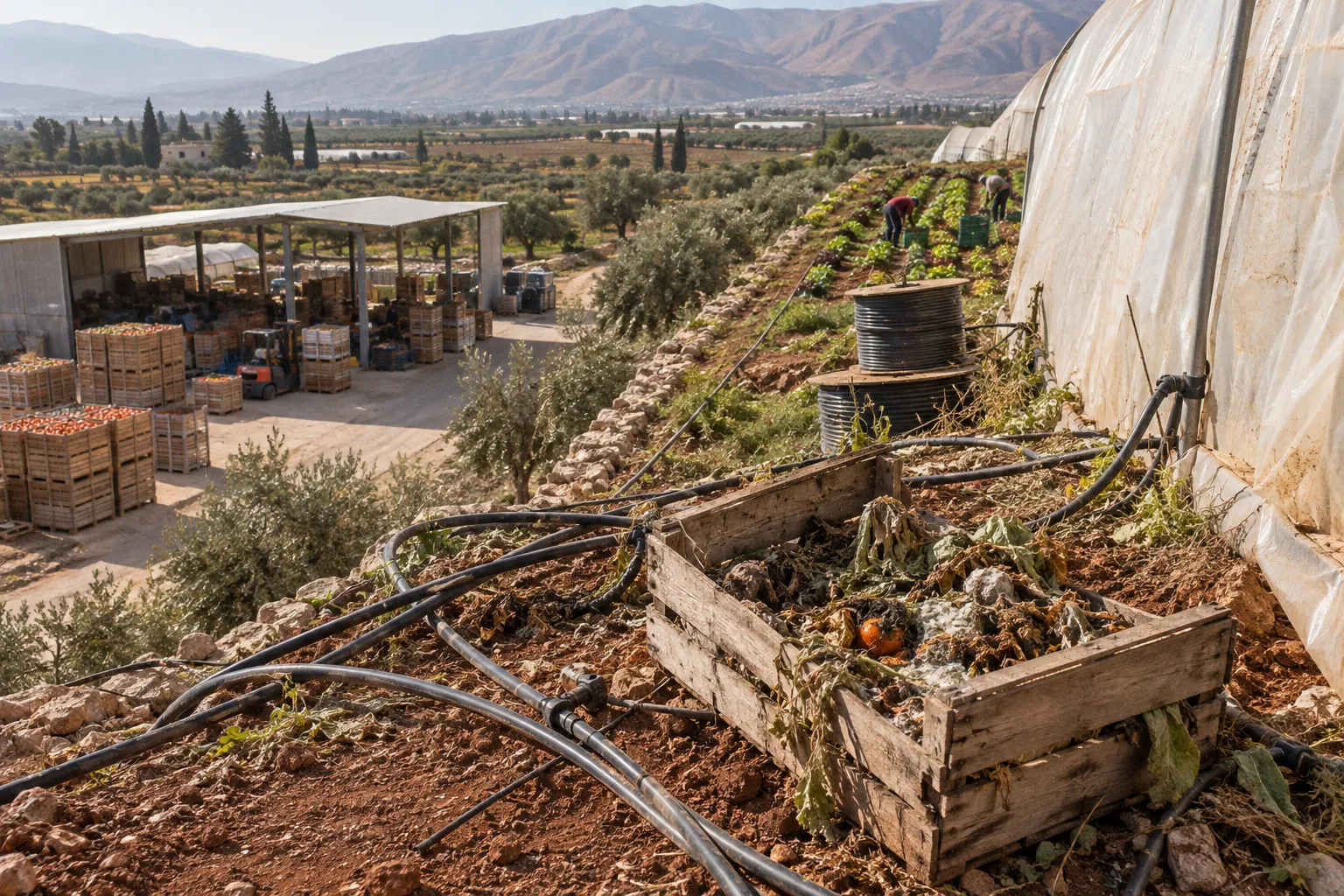
In a Lebanese poly-tunnel, a crop can look healthy at the end of the afternoon and still enter a high-risk period after sunset, when leaves cool, air movement slows, and moisture remains trapped inside the canopy.
The practical question is not whether humidity exists in the greenhouse. It is whether water is settling on plant tissue, how long the leaf stays wet, and whether the structure can remove moisture before fungal growth gets established. That makes greenhouse humidity control methods for Lebanese climate less about one expensive machine and more about coordinating temperature, ventilation, airflow, sanitation, and plant architecture.
Crop protection begins where moisture settles: on the leaf, inside the canopy, and against the coldest surfaces of the tunnel.
The Mechanics of Fungal Growth: Why 85% Humidity Is the Danger Zone
Relative humidity is a useful warning signal, but it is not the whole disease model. A sensor in the middle of a greenhouse may show acceptable conditions while leaves deep inside a dense canopy sit in a much wetter microclimate. The air immediately around a leaf can approach saturation even when the bulk greenhouse reading looks manageable.
Botrytis cinerea, the fungus associated with gray mold, is particularly dangerous when three conditions overlap:
- plant tissue remains wet or nearly saturated for a prolonged period;
- the canopy has limited air movement;
- infected debris, wounds, senescent leaves, or damaged fruit provide a place for the pathogen to establish.
The exact infection window varies with temperature, tissue condition, cultivar, and inoculum pressure. A fixed rule such as “the crop is safe below a particular humidity reading” is therefore misleading. A more useful approach is to treat sustained humidity above roughly 85% as a warning zone, especially during the dark period, and to combine that reading with observations of condensation and leaf wetness.
Powdery mildew behaves differently. It can develop under humid conditions without the same degree of free water on the leaf surface. A dry-looking canopy is not automatically protected if the relative humidity remains high and air circulation is poor. This is one reason why simply wiping condensation from the plastic cover, or opening the tunnel for a short period in the morning, does not solve the underlying problem.
Dew point matters more than a single RH reading
Dew forms when a surface cools to the dew point of the surrounding air. The dew point changes with both temperature and moisture content, so the gap between air temperature and dew point is not a fixed number across all humidity levels. It must be calculated from a current measurement or estimated with a suitable sensor.
This distinction matters in Lebanese production zones. Coastal tunnels may experience humid nights, while inland and higher-elevation sites can cool sharply after sunset. The same relative humidity reading can produce different risks depending on air temperature, leaf temperature, wind, irrigation timing, and the thermal behavior of the greenhouse covering.
A practical monitoring arrangement should include:
- one sensor in the central crop zone, positioned at canopy height;
- a second sensor near a sidewall, door, or ventilation opening;
- periodic checks of the coldest parts of the canopy;
- visible inspection of leaves and fruit shortly after sunrise;
- comparison between interior and exterior temperature and humidity.
Sensors should be shielded from direct sun, irrigation spray, and contact with foliage. They also need periodic checking against another instrument. A badly positioned or uncalibrated sensor can create false confidence: it may measure warm, moving air above the crop while the lower canopy remains wet.
The target is a dry canopy, not artificially dry air
Most crops do not need extremely dry greenhouse air. Excessive drying can increase plant stress, raise irrigation demand, and create its own management problems. The more realistic objective is to keep the canopy free of prolonged condensation, reduce the duration of very high humidity, and prevent stagnant pockets from forming.
During the day, ventilation can often bring humidity down as solar heating creates a temperature difference between the inside and outside air. At night, the strategy changes. The operator may need to combine limited ventilation, gentle air circulation, thermal buffering, and carefully timed irrigation rather than leaving every opening fully closed or fully open.
Thermal Management: Using Temperature Shifts to Regulate Moisture
Heating does not remove water from a greenhouse. It raises the air temperature, allowing the same amount of water vapor to represent a lower relative humidity. That can be useful when the crop is close to condensation, but only if the air is mixed properly and moisture is eventually exhausted from the structure.
The reverse process is just as important. When the tunnel cools rapidly after sunset, relative humidity rises. If the leaf surface cools faster than the surrounding air, condensation can begin on the canopy before a central sensor registers an obvious problem.
Use daytime heat, but do not trap it blindly
Solar gain can support passive humidity reduction for small farms, particularly when the outside air is drier than the air inside the tunnel. A common mistake is to treat every rise in greenhouse temperature as a problem and to shade or close the structure immediately. In some conditions, that removes the heat needed to drive buoyancy ventilation and leaves the tunnel both hot and humid later in the day.
A better sequence is to:
1. monitor interior and exterior temperature and humidity;
2. open roof or side vents when the outside air can accept more moisture;
3. allow warm, humid air to leave through high openings;
4. keep the crop from overheating by adjusting the opening gradually;
5. close or reduce ventilation when the outside dew point is higher than the interior dew point.
The last point is especially important for managing greenhouse condensation in Lebanon. Night ventilation is not automatically dehumidification. If humid outside air enters a cooler tunnel, the result can be more condensation rather than less. Decisions should be based on dew point or absolute humidity where possible, not on relative humidity alone.
Night heating is a conditional tool
A small heating system can reduce the chance of condensation during the most vulnerable part of the night. Its role is not to make the greenhouse warm for its own sake. The aim is to keep plant surfaces above the condensation threshold and maintain enough temperature difference for controlled air exchange.
The usefulness of heating depends on:
- the tightness and insulation of the structure;
- the crop’s temperature tolerance;
- the amount of moisture entering through transpiration and irrigation;
- the available power or fuel;
- whether fans can distribute the warmed air;
- whether the greenhouse can exhaust moisture the following day.
Heating a sealed, leaky, or poorly mixed structure can simply move moisture around. It may also create warm, humid pockets near the heater while leaves at the edges remain cold. A heater should therefore be evaluated as part of a system that includes circulation and a plan for daytime moisture removal.
Thermal screens and shading need to be used with judgment
Thermal screens can reduce radiant heat loss from the crop to the cold night sky. In some structures, that helps prevent leaves from becoming colder than the surrounding air. Screens also change the internal air volume and can interfere with natural air movement if they are installed or operated without attention to vent paths.
Summer shading presents a similar trade-off. Excessive shading lowers crop temperature and can reduce the thermal lift that supports natural ventilation. The correct level depends on the season, crop, cover material, orientation, and local weather. Rather than applying a fixed shading rule across Lebanon, operators should compare canopy temperature, outside conditions, and the duration of high humidity before changing the covering.
Strategic Airflow: Balancing Natural Ventilation and Forced Circulation
Ventilation and circulation are related but not interchangeable.
- Ventilation replaces greenhouse air with outside air.
- Circulation moves the existing greenhouse air from one part of the structure to another.
- Leaf-level airflow disrupts the saturated boundary layer that forms around plant tissue.
A tunnel can have open sidewalls and still contain stagnant air in the middle of a dense crop. It can also have fans running continuously while retaining too much moisture because no humid air is leaving the structure.
Natural ventilation: create a path, not just an opening
Roof vents, ridge vents, doors, and roll-up sidewalls work best when they create a continuous route for air. Warm air should be able to rise and exit through a high opening while replacement air enters through a lower opening. If both openings are on the same side, or if a screen, crop row, or neighboring structure blocks the intake, the exchange rate may be much lower than expected.
When assessing ventilation techniques for humid greenhouses, look at:
- the total opening area relative to the crop and structure;
- the height difference between intake and exhaust openings;
- the direction and strength of the wind;
- obstructions around the tunnel;
- insect screens and their resistance to airflow;
- whether the opening reaches the crop or only exchanges air above it;
- the time of day when humidity is highest.
Manual venting can work well in a small operation if someone is present to respond to weather changes. Automated actuators become more useful when the tunnel needs frequent adjustment or when night conditions change faster than a fixed schedule can handle. Automation should use temperature and humidity inputs, and ideally compare interior and exterior dew point. A timer alone cannot know whether opening the tunnel will remove moisture or introduce it.
HAF fans: mixing the tunnel without creating a draft
Horizontal airflow fans are useful when natural ventilation does not mix the crop evenly. Installed at an appropriate height, they can move air along the rows and return it through the tunnel in a loop. Their purpose is not to blast the plants with wind. It is to eliminate stagnant zones, reduce temperature differences, and disturb the humid boundary layer next to leaves.
Fan placement matters more than simply adding fan capacity. Check whether air is circulating around the entire tunnel or short-circuiting between a fan and a nearby opening. Tall crops, trellis wires, hanging irrigation lines, and dense foliage can all interrupt the intended path.
Run time should also follow the crop’s risk period. Continuous operation may be appropriate in some structures, while timed or sensor-based operation can be sufficient in others. Fans are particularly valuable around sunset and during the night when condensation risk rises, but they cannot substitute for moisture removal. They should work alongside a ventilation plan rather than hide the absence of one.
Choosing the right intervention
| Intervention | What it changes | Main limitation | Best starting point |
|---|---|---|---|
| Manual roof and side vents | Exchanges interior air with outside air | Depends on labor and weather judgment | Small tunnels with accessible openings |
| Automated vent actuators | Adjusts openings in response to conditions | Requires reliable sensors and maintenance | Structures where humidity changes quickly |
| Horizontal airflow fans | Mixes air and disrupts the leaf boundary layer | Does not remove moisture from the tunnel | Dense canopies and poorly mixed spaces |
| Night heating | Reduces condensation risk by raising crop and air temperature | Uses energy and can redistribute moisture without ventilation | Cold, humid nights where condensation is recurrent |
| Active dehumidification | Removes water from the air | Higher equipment and energy demand | Enclosed, high-value, or propagation spaces |
The sensible order is usually to improve openings and crop airflow before buying active dehumidification equipment. A dehumidifier cannot correct blocked vents, wet floors, leaking irrigation lines, or a canopy that is too dense for air to pass through.
Fans move moisture; vents remove it. Treating those functions as identical is one of the costliest mistakes in greenhouse humidity control.
Sanitation Protocols: Eliminating Pathogen Reservoirs in Poly-tunnels
Environmental control reduces the conditions that favor fungal growth, but it does not remove inoculum already present in the tunnel. Dead leaves, rejected fruit, old twine, weeds, soil splashes, and contaminated tools can keep disease pressure high between crop cycles.
Sanitation is most effective when it is treated as a sequence rather than a single cleaning day.
Start with end-of-cycle clearance
Remove crop residue promptly after the final harvest. Do not leave infected leaves or fruit beneath the crop while preparing the next cycle. The material should be taken out of the tunnel and handled in a way that does not return spores through compost, tools, workers, or irrigation water.
Pay attention to places that are easy to overlook:
- the lower edges of plastic covers;
- condensation points on structural members;
- plant clips and trellis lines;
- irrigation filters and drain channels;
- weeds at the tunnel perimeter;
- discarded trays, crates, and harvest containers.
A clean floor does not necessarily mean a clean structure. Disease reservoirs often remain above ground or along the edges of the tunnel.
Clean before disinfecting
Disinfectant works poorly when organic matter is still present. Wash or brush surfaces first, then apply a product approved for the intended use and follow its label concentration, contact time, compatibility, and safety requirements. Different materials react differently: some plastics, metals, fabrics, and irrigation components can be damaged by unsuitable products.
Tools should be cleaned between infected and healthy areas, not only at the end of the workday. Pruners and knives can spread contamination from one plant to another, especially when pruning wounds are fresh. Workers should avoid moving directly from a visibly diseased block into a clean block without changing gloves or cleaning tools.
Soil, substrate, and water management
Soil-based production adds another layer of risk. Splashing water can move spores from the ground onto lower leaves and fruit. Drip irrigation, mulch, careful drainage, and removal of lower foliage help reduce that pathway.
Where soil treatment is used, the method should match the available fallow period, local weather, soil condition, and crop schedule. Solarization can be useful under suitable conditions, but its performance depends on sealing, sunlight, soil moisture, and the depth that needs treatment. It should not be presented as a universal replacement for sanitation or crop rotation.
Substrate systems require attention to reused slabs, containers, emitters, and drainage channels. Replacing or properly treating contaminated material may be more reliable than attempting to clean it superficially.
Keep disease out of the next cycle
Before planting again, inspect the tunnel as a production system:
- Are there wet spots under the irrigation lines?
- Does water collect near the sidewalls?
- Are the vents opening fully?
- Do fans circulate air behind the crop?
- Are there weeds or volunteer plants around the structure?
- Are tools, trays, and harvest containers clean?
- Is the floor dry enough to avoid persistent evaporation into the canopy?
These questions connect sanitation with humidity control. A leak, puddle, or pile of decomposing leaves can undo a carefully adjusted ventilation schedule.
Optimizing Plant Spacing and Canopy Microclimates
Air cannot control humidity in a part of the canopy that it cannot reach. Dense foliage slows evaporation after irrigation, traps spores, and creates cooler internal pockets. The correct spacing depends on cultivar, training system, season, light, irrigation, and the ability of the structure to move air. There is no single Lebanese density that can be applied safely to every tomato or cucumber tunnel.
Build an open canopy deliberately
For tomatoes, regular pruning and trellising can keep leaves and fruit separated enough for air to move through the row. Cucumber training should prevent the lower canopy from becoming a continuous wall of wet foliage. In either crop, remove damaged or senescent tissue before it becomes a reservoir.
Pruning should be gradual and aligned with crop vigor. Removing too much leaf area at once can expose fruit to sun injury and stress the plant. Removing too little leaves the interior humid. The goal is not the smallest possible canopy; it is a functional canopy with enough leaf area for production and enough air penetration for disease management.
Useful interventions include:
- orienting rows to support the actual ventilation pattern of the tunnel;
- maintaining clear paths near sidewalls and vents;
- training plants vertically where the crop allows it;
- removing lower leaves that contact soil, mulch, or standing water;
- taking pruned material out of the tunnel immediately;
- avoiding dense volunteer plants at the ends of rows;
- checking whether trellis lines block fan circulation.
Row orientation should be decided from the structure’s openings and prevailing local airflow, not from a generic compass rule. A north-south layout may work in one tunnel and perform poorly in another if the vents, neighboring buildings, or windbreaks create a different airflow pattern.
Measure the canopy, not just the greenhouse
An infrared thermometer can reveal colder sections of the crop, but it does not directly measure humidity or leaf wetness. Use it as a screening tool, then investigate the cause with a canopy-level humidity sensor, visual inspection, or a temporary data logger.
Compare readings at:
- the center and edge of the tunnel;
- upper and lower canopy;
- near the entrance and far end;
- dense and recently pruned rows;
- before sunrise and after ventilation begins.
Patterns are more useful than a single reading. If one corner is consistently colder or wetter, the answer may be a blocked vent, an incorrectly aimed fan, a leak, excessive foliage, or a surface that radiates heat more rapidly at night.
A Practical Implementation Sequence for Lebanese Tunnels
Humidity control becomes easier when interventions are staged according to what they can actually solve. Begin with measurements and low-complexity corrections, then add equipment only where the remaining risk justifies it.
First: identify the moisture source
Check irrigation duration, drainage, floor wetness, leaks, fogging, condensation on the cover, and the amount of water entering through plant transpiration. If the tunnel is being watered late in the day, move the schedule earlier where crop and water availability allow. The purpose is to give foliage and surfaces time to dry before night, not to impose a universal irrigation hour.
Second: improve the air path
Open and inspect every vent. Repair torn plastic, clear blocked openings, and remove unnecessary obstacles around the intake and exhaust path. Observe the crop during a mild period of natural ventilation. Lightweight strips, ribbons, or smoke-free visual indicators can help reveal whether air is moving through the canopy, but avoid introducing contaminants or heat sources into the crop.
Third: add circulation where natural exchange is uneven
Install or reposition HAF fans so that they move air around the crop rather than directly out of an opening. Confirm that the far end of the tunnel receives movement. Reduce fan speed or adjust direction if leaves are being damaged or transpiration is becoming excessive.
Fourth: manage the night transition
The period around sunset often deserves more attention than the middle of the night. Reduce irrigation-related moisture before this period, keep gentle circulation running when appropriate, and use heating or thermal screens only when measurements show that condensation risk is recurring. Exterior conditions should determine whether a vent stays open, closes partially, or remains closed until the air becomes more favorable.
Fifth: automate carefully
A basic control system can use interior temperature and RH, but more advanced control compares interior and exterior dew point. Set alarms for prolonged high humidity rather than reacting to every short fluctuation. Keep manual override available: sensors fail, actuators stick, and unusual weather can make a normal program unsuitable.
Sixth: price the system honestly
The cost of a humidity retrofit depends on tunnel size, existing openings, electrical access, fan specification, heating fuel, sensor quality, installation labor, and local quotations. A small tunnel may need only repairs, better scheduling, and one or two circulation fans. Another site may require automated vents, electrical work, heating, or a drainage redesign.
Do not treat a generic equipment package or a broad dollar range as a guaranteed Lebanese installation price. Before committing funds, obtain current quotations and record the baseline losses that the intervention is intended to reduce. Compare the investment with the value of avoided crop loss only after accounting for yield, market price, labor, maintenance, energy, and the probability that disease would have occurred. Without those measurements, a payback claim is speculation.
The operating principle
There is no single humidity-control device that can compensate for a sealed tunnel, a wet canopy, poor sanitation, and stagnant air. The most reliable system is layered:
- remove excess water at the source;
- ventilate when outside air can accept moisture;
- circulate air through the canopy;
- prevent sharp overnight cooling where possible;
- keep plant spacing and pruning compatible with airflow;
- remove infected material quickly;
- use sensors at crop height and verify what they show.
For small farms, this sequence is often more valuable than immediately purchasing active dehumidification. For larger or higher-value operations, automation and supplemental heating may be justified, but only after the basic air path and crop architecture are working.
Greenhouse humidity control methods for Lebanese climate should therefore be evaluated as a site-specific operating system. Coastal and inland tunnels do not face the same night conditions; a shaded structure does not behave like a transparent one; and a dense crop does not respond like a recently pruned crop. Measure the moisture, find where the canopy stays wet, and correct the physical cause first. Crop rot is usually visible at the end of the process. The useful work happens several hours earlier, when air movement, temperature, and sanitation still have time to change the outcome.