Solar ventilation systems for Lebanese greenhouse cooling
In many Lebanese areas, the public grid may provide only 1 to 2 hours of electricity per day during severe grid crises. A greenhouse, however, does not stop accumulating heat when the grid stops working.
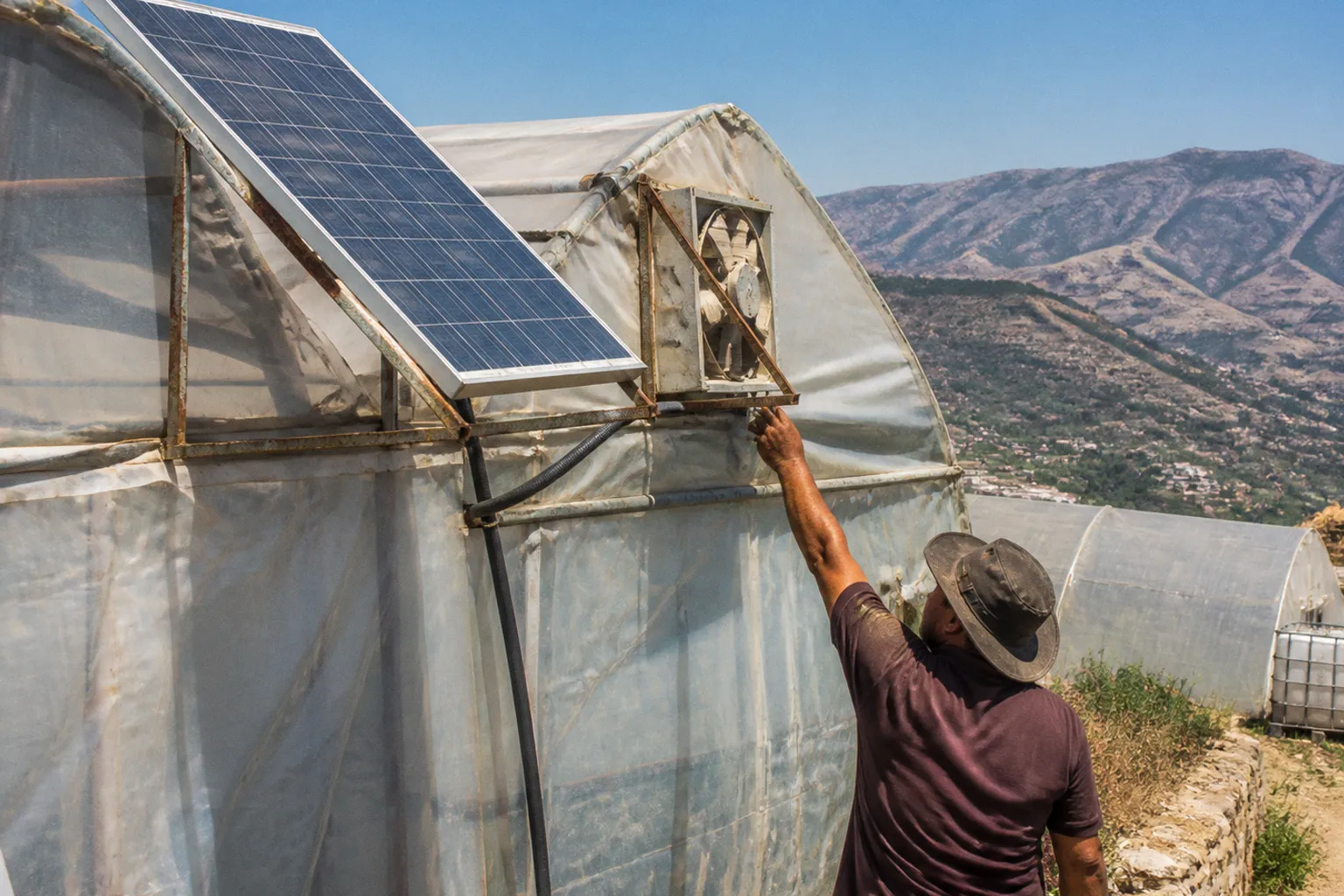
Under Mediterranean summer conditions, outdoor temperatures can approach 40°C, while a closed structure can create a more damaging combination of heat, stagnant air, and excessive humidity around the crop canopy.
That mismatch makes conventional greenhouse ventilation a weak point in the production system. Diesel generators can operate fans, but they add fuel cost, maintenance requirements, noise, and dependence on a supply chain already exposed to disruption. Solar powered greenhouse ventilation for Lebanese farms offers a more controlled alternative: direct-current exhaust fans connected to photovoltaic panels, supported by automated vents and, where necessary, battery storage.
The technology is not a complete climate-control system. It does not replace shading, passive ventilation, irrigation management, or crop-specific humidity control. Its value is narrower and more measurable: it converts available sunlight into airflow during the same period when solar heat creates the greatest ventilation demand.
Overcoming Lebanon’s Energy Crisis with Solar-Driven Airflow
The engineering case begins with the load profile, not with the photovoltaic panel.
Greenhouse cooling demand rises during daylight hours because solar radiation increases the internal temperature of the structure. That is also when a solar array produces its highest output. This temporal overlap is the main reason direct-drive solar ventilation can be practical for Lebanese farms. The system does not need to generate electricity continuously for every greenhouse function. It needs to deliver airflow when heat gain is active.
The alternative is usually a diesel generator or an unstable grid connection. Neither option aligns cleanly with the thermal behavior of the greenhouse:
- Grid electricity may be available for only a limited period during a deep supply crisis.
- Diesel generators can provide power after sunset, but fuel consumption continues even when ventilation demand is lower.
- Generator operation introduces a recurring operating expenditure rather than a fixed infrastructure cost.
- A fan system dependent on manual generator start-up may respond too slowly to rapid temperature increases.
- Poorly timed ventilation can allow crop stress to develop before the operator intervenes.
The solar system changes the operating logic. A photovoltaic array feeds DC brushless motors directly, with fan speed adjusting according to the available solar input. As irradiance rises, the system can increase airflow without waiting for a generator to be started or a grid circuit to return.
This direct connection also reduces conversion stages. A system that uses photovoltaic panels, a charge controller, batteries, an inverter, and conventional alternating-current fans contains more components than a direct-current arrangement. Every additional component introduces conversion losses, maintenance requirements, and another potential failure point. That does not make batteries or inverters unnecessary in all cases; it means they should be installed only for a defined operating requirement.
For daytime heat removal, the basic architecture can be relatively narrow:
1. Photovoltaic panels sized for the DC exhaust fan load.
2. A controller that regulates fan operation and protects the motor.
3. High-level exhaust fans or motorized vents.
4. Low-level intake openings for replacement air.
5. Temperature and, where required, humidity sensors.
6. Structural shading or passive heat-reduction measures to limit the load before mechanical ventilation begins.
Small-scale equipment can start with modest electrical demand. A 25W solar panel kit, for example, may be paired with a small 8-inch greenhouse exhaust fan. That figure should not be treated as a universal design standard. A small fan serving a limited structure has a different airflow requirement from a commercial greenhouse with dense crop rows, insect screening, high internal heat gain, or restricted intake area.
The correct question is not whether a 25W panel can run a fan. The correct question is whether the resulting airflow is sufficient for the greenhouse volume, crop density, external temperature, shading condition, and intake resistance.
Solar ventilation is not a substitute for reliable electricity in the abstract. It is a targeted way to match daytime cooling demand with daytime solar generation.
The energy crisis has also changed the capital-expenditure calculation. Since the financial collapse that accelerated in 2019, and with solar adoption increasing substantially from 2020 onward, Lebanese agricultural operators have had stronger incentives to reduce exposure to fuel and grid interruptions. The financial comparison should therefore separate two categories:
| Cost category | Generator-dependent ventilation | Solar DC ventilation |
|---|---|---|
| Primary operating input | Diesel fuel or unstable grid electricity | Solar radiation |
| Daytime response | Requires available fuel, grid power, or manual start-up | Starts automatically when irradiance and control conditions are met |
| Night operation | Possible while fuel is available | Requires battery storage |
| Recurring maintenance | Engine servicing, fuel handling, fan maintenance | Panel cleaning, wiring inspection, controller and fan maintenance |
| Capital expenditure | Generator and electrical distribution | Photovoltaic panels, DC fans, controls, mounting |
| Main operating limitation | Fuel cost and supply interruptions | Reduced output under low sunlight; no direct nighttime generation |
| Best use case | Continuous or emergency power across variable loads | Daytime ventilation with a defined solar cooling load |
This table does not establish that solar is cheaper in every installation. It establishes where the economic advantage can occur: a greenhouse that mainly needs airflow during sunny hours may avoid purchasing a larger energy system designed for loads it does not actually use.
Designing Passive Convection for Mediterranean Greenhouse Climates
Mechanical ventilation performs better when the greenhouse structure already supports air movement. A fan cannot compensate indefinitely for undersized intake openings, sealed walls, poor vent placement, or excessive solar gain.
The basic passive design principle is simple: warm air rises. Intake vents should be placed lower on the greenhouse envelope, while exhaust fans or high-level vents should be installed higher. This creates a path for cooler replacement air to enter and for heated air to leave. If both the intake and exhaust are positioned at similar heights, the system loses part of the natural convection effect and may move air through only a limited zone.
The airflow path must also pass through the crop canopy rather than short-circuiting around it. A high-level exhaust fan installed opposite a low-level intake can establish a useful pressure gradient, but the result depends on the internal arrangement of benches, trellises, plastic curtains, insect screens, and dense foliage. The greenhouse should be evaluated as a volume with obstructions, not as an empty box.
A practical passive-ventilation layout has five operating characteristics:
- Lower intake openings provide replacement air across the width of the structure.
- Upper exhaust points remove the hottest accumulated air.
- Intake and exhaust areas are distributed rather than concentrated at one small corner.
- Screens and shutters are selected for adequate airflow, because fine mesh can create significant resistance.
- The airflow path crosses the crop zone before reaching the exhaust point.
The Mediterranean climate introduces a second constraint. Ventilation reduces sensible heat, but it can also bring in hot external air. During a severe afternoon heat event, opening vents without shading may increase the volume of hot air entering the greenhouse while solar radiation remains high. The system therefore needs sequencing rather than a single on/off command.
A control sequence might prioritize the following order:
1. Deploy or maintain structural shading when solar radiation and internal temperature rise together.
2. Open lower intake vents to establish the air path.
3. Open upper vents or start exhaust fans.
4. Increase fan speed as internal temperature exceeds the selected baseline.
5. Reduce or stop mechanical ventilation when the temperature falls, while retaining enough airflow to prevent stagnant humidity.
6. Close vents partially during rain, strong wind, or conditions in which outside air would create a greater crop risk.
This is the operational distinction between passive ventilation design for greenhouses and a collection of isolated components. The vent, fan, sensor, and shade must operate as one control system. Installing a photovoltaic fan without correcting the airflow path can produce a functioning motor and an underperforming greenhouse.
Establishing baseline metrics before installation
A cooperative should collect baseline measurements before selecting equipment. The purpose is not to create a laboratory dataset. It is to identify the actual thermal and humidity behavior of each greenhouse type.
At minimum, measure:
- Internal air temperature at crop-canopy height.
- Temperature near the roof or highest internal point.
- External temperature in a shaded location.
- Relative humidity near the crop canopy.
- Time of day when the greenhouse first exceeds the crop’s acceptable temperature range.
- Duration of stagnant or visibly still air.
- Existing fan runtime, generator runtime, and fuel consumption where records exist.
- Crop symptoms associated with heat or humidity, including wilting, reduced growth, pest pressure, or disease development.
The vertical temperature difference is particularly useful. If roof-level air is substantially hotter than canopy-level air, high exhaust points may provide efficient heat removal. If the canopy itself remains hot despite a warm roof zone, the design needs better air distribution through the crop rather than only a stronger exhaust fan.
Measurements should be collected across representative weather conditions rather than on a single mild day. A greenhouse that performs acceptably in the morning may become unstable during the afternoon peak. The operator should also record whether the structure is empty, newly planted, or carrying a mature canopy, because crop density changes airflow resistance and transpiration.
These baseline metrics support a more defensible capital-expenditure decision. The target is not a vague promise of a cooler greenhouse. It is a reduction in the number of hours above a defined temperature threshold, a lower humidity duration during closed periods, or a reduction in generator runtime for ventilation.
Integrating DC Brushless Fans and Automated Vent Controls
Solar exhaust fans for agriculture are most useful when their electrical and mechanical specifications are treated as one design problem.
A DC brushless fan can connect directly to photovoltaic panels, avoiding the inverter required by an alternating-current motor. Fan speed may adjust automatically according to available sunlight, which creates a naturally variable operating profile. Output is higher during strong solar conditions and lower during weak conditions. That behavior is acceptable only if the greenhouse has been designed with passive ventilation and shading that reduce the peak load.
The fan selection should be based on airflow performance under resistance, not on motor wattage alone. A fan rated for a particular free-air condition may move considerably less air when fitted with insect mesh, louvers, ducts, or a restrictive exhaust opening. The relevant specification is the delivered airflow at the installed static pressure.
A procurement comparison should include:
- Rated airflow and airflow at operating resistance.
- DC voltage and controller compatibility.
- Motor protection against dust and moisture.
- Expected duty cycle during hot daylight periods.
- Noise and vibration behavior near structures or workers.
- Availability of replacement motors, controllers, and fan assemblies in Lebanon.
- Mounting requirements for plastic film, polycarbonate, or rigid greenhouse walls.
- Performance decline under low irradiance.
- Compatibility with temperature and humidity sensors.
- Cleaning access for dust accumulation on fan guards and photovoltaic panels.
The low-voltage DC architecture can simplify installation, but it does not eliminate electrical design requirements. Cable length, conductor size, voltage drop, panel orientation, junction protection, and disconnect access all affect reliability. A fan that receives insufficient voltage at the motor may appear to have a mechanical fault when the actual problem is undersized wiring or a poor connection.
Automated vents as load reduction
Automated vent openers can reduce the amount of fan operation required. They should not be considered decorative additions to an otherwise mechanical system. Their function is to lower the pressure and thermal load before the fan reaches maximum output.
A temperature sensor near the crop canopy can initiate opening as the internal temperature rises. A second sensor near the roof can help identify heat accumulation and verify whether the high-level exhaust path is working. Humidity control requires a separate logic layer because temperature and humidity do not always move in the same direction.
A simple temperature-only controller can create poor results. For example, if it opens vents at a fixed temperature during a humid night, it may admit damp air without resolving the crop-canopy humidity problem. Conversely, if it closes all vents to protect against rain, relative humidity near the leaves may approach 100% during nighttime or other closed periods. That level of humidity can increase the risk of disease and requires a different operating response from daytime heat removal.
The control system should therefore include at least two modes:
Daylight cooling mode: The system responds primarily to internal temperature, solar intensity, and the availability of photovoltaic power. Lower intakes open, upper exhaust fans operate, and fan speed increases as the greenhouse moves above its target baseline.
Humidity management mode: The system responds to relative humidity, canopy conditions, external weather, and battery state. Recirculation fans or controlled ventilation may be required even when solar production is absent.
The distinction matters because exhaust and recirculation solve different problems. Exhaust ventilation replaces internal air with outside air. Recirculation fans move air within the greenhouse, reducing stagnant zones and improving uniformity, but they do not remove heat or moisture from the structure by themselves.
A robust system can record fan runtime and sensor data. These records are useful for identifying whether the photovoltaic array is undersized, whether a vent is mechanically stuck, or whether the greenhouse is receiving excessive solar load that cannot be corrected through airflow alone.
Managing Nighttime Humidity and Thermal Stress in Closed Structures
Daytime heat is the visible problem. Nighttime humidity is the less obvious failure mode.
When vents close after sunset, the greenhouse can retain moisture released by the crop and growing medium. Relative humidity near the leaf canopy may approach 100%, particularly during cool nights, rainfall, or periods of limited air exchange. The resulting condensation risk can create conditions favorable to fungal and bacterial disease, even if daytime temperatures remain within an acceptable range.
Solar panels produce no direct power after sunset. This creates a strict boundary for system design. A direct-drive photovoltaic fan can provide daytime airflow, but it cannot be presented as a complete nighttime humidity-control solution without battery storage or another power source.
Battery-backed operation is therefore justified only when the humidity-management requirement is real and documented. The battery system must be sized for the intended nighttime load, not for an abstract goal of continuous operation. If the requirement is to run a small recirculation fan intermittently during high-humidity periods, the storage system can be designed around that duty cycle. If the requirement is to run several exhaust fans through the entire night, the capital expenditure will be materially higher.
A useful operating assessment separates four conditions:
| Condition | Main risk | Preferred response | Energy implication |
|---|---|---|---|
| Sunny, hot afternoon | Thermal stress and excessive evapotranspiration | Open intake vents, operate high exhaust fans, use shading | Direct solar operation is favorable |
| Cloudy daytime | Reduced solar output while heat may persist | Use passive vents first; reduce fan demand or draw from storage if available | Performance depends on array and battery design |
| Cool, humid night | Condensation and disease pressure | Controlled venting or recirculation based on humidity | Requires battery or an alternative power source |
| Rain with closed vents | High canopy humidity and limited air exchange | Use protected, controlled airflow where crop risk justifies it | Battery-backed operation may be required |
Thermal stress affects crop physiology through several channels. High temperatures can reduce photosynthesis, increase evapotranspiration, and raise pest and disease pressure. Ventilation alone does not restore water balance. If irrigation cannot keep pace with evaporative demand, a cooler canopy may still experience stress. The ventilation project should therefore be evaluated alongside irrigation scheduling, water availability, shading, and soil or substrate management.
This is where many technology projects become poorly specified. The operator purchases a fan to solve a heat problem, but the actual bottleneck is a combination of high radiation, insufficient shade, restricted root-zone water, and excessive nighttime humidity. The fan may run correctly while crop performance remains unstable.
Battery storage: where it belongs
Battery storage is most defensible in three cases:
1. Nighttime recirculation is needed to prevent stagnant canopy air.
2. Humidity-triggered ventilation is necessary during periods when photovoltaic output is unavailable.
3. Short-duration continuity is required during clouds or brief grid interruptions, and the crop value justifies the added capital cost.
Storage should not be added merely because the system is described as off-grid. Off-grid is an energy architecture, not a performance guarantee. A battery that is too small will provide only a brief operating window; a battery that is oversized increases capital cost without improving the daytime cooling function.
The design should document the required nighttime fan wattage, expected operating hours, permissible depth of discharge, battery temperature, replacement cycle, and maintenance access. These parameters determine the actual ROI more reliably than the nominal panel capacity.
A Sequential Implementation Plan for Lebanese Cooperatives
A cooperative has an advantage that an isolated smallholder may not: it can standardize equipment across several greenhouses, centralize spare parts, and compare performance between similar crop blocks. That makes phased deployment more rational than installing a large system across every structure at once.
Phase one: classify the greenhouse load
Begin by grouping structures according to size, crop density, covering material, orientation, shading, and current ventilation method. A lightweight plastic tunnel with a low crop canopy should not be assigned the same design as a dense commercial greenhouse with screened vents and high internal resistance.
For each group, record the baseline metrics:
- Peak internal temperature.
- Peak canopy temperature where possible.
- Relative humidity duration during closed periods.
- Current generator runtime.
- Existing vent area and fan location.
- Solar exposure and shading from adjacent structures.
- Water availability during the hottest operating hours.
The output of this phase should be a defined problem statement for each greenhouse group. For example, one group may need daytime heat extraction, while another primarily needs humidity reduction after sunset.
Phase two: correct passive airflow
Before purchasing a larger fan array, correct the physical airflow path. Clean blocked vents, repair torn screens, create lower-level intake capacity, and place exhaust points high enough to remove accumulated warm air. Where the structure has no practical intake path, additional fan capacity may produce limited benefit because the system cannot replace the extracted air efficiently.
This phase often has a lower capital cost than installing additional generation. It also reduces the electrical load required from the solar system. The objective is to remove avoidable resistance before sizing the photovoltaic array.
Phase three: install a controlled pilot
A pilot should cover a representative greenhouse rather than the easiest structure on the farm. Select a unit with the same covering, crop density, and exposure found elsewhere in the cooperative.
The pilot should include:
- DC brushless exhaust fans.
- A photovoltaic array sized to the selected fan load.
- Temperature sensing at canopy and roof levels.
- Automated intake or exhaust vent controls where practical.
- A clear manual override for maintenance and emergency operation.
- Data logging for temperature, humidity, fan runtime, and power availability.
A small system may use a 25W panel kit with an 8-inch fan, but only where the greenhouse volume and airflow requirement match that equipment. Treating a small kit as a standard solution for all Lebanese greenhouse types would be a design error.
The pilot should run through a representative hot period and include observations after sunset. The question is not only whether daytime temperature decreases. The cooperative should determine whether the system reduces the duration of thermal stress, whether humidity remains excessive at night, and whether the fan output falls below the required level during cloudy conditions.
Phase four: calculate the cost-benefit result
The financial model should include both capital expenditure and avoided operating expenditure. At minimum, calculate:
- Photovoltaic panels and mounting.
- DC fans and motor controllers.
- Automated vent openers.
- Sensors, wiring, protection, and installation.
- Battery storage, if nighttime operation is required.
- Replacement parts and planned maintenance.
- Diesel fuel avoided during the measured operating period.
- Generator maintenance avoided through reduced runtime.
- Crop losses or quality reductions potentially associated with heat and humidity, without assigning unsupported monetary values.
A basic payback calculation can compare the installed cost with verified annual operating savings. However, the model should not convert every crop symptom into a financial benefit without evidence. Use measured generator hours, documented fuel use, and actual equipment costs wherever possible. The value of improved crop quality may be real, but it needs a defined grading or sales basis to enter the ROI calculation.
Phase five: standardize and scale
If the pilot meets the baseline target, scale by greenhouse category rather than by land area alone. The correct unit is the thermal and airflow load. Two greenhouses with the same footprint can have different cooling requirements because of orientation, covering, crop height, screen resistance, and shading.
Standardization should cover:
- Fan models and mounting dimensions.
- Controller settings.
- Sensor placement.
- Spare motor and controller inventory.
- Cleaning intervals.
- Battery specifications where used.
- Maintenance responsibilities.
- Data records required from each greenhouse.
For a cooperative supplying fresh produce to demanding markets, this operational consistency has value beyond energy savings. More stable greenhouse conditions can support more predictable harvest timing and quality. That does not automatically satisfy export standards, but it reduces one source of variability in the production pipeline.
The scalable asset is not the panel alone. It is the operating standard: baseline measurements, repeatable controls, accessible spares, and verified energy savings.
Scaling Solar Infrastructure for Sustainable Crop Protection
The strongest case for solar powered greenhouse ventilation for Lebanese farms is not ideological independence from the grid. It is controlled risk reduction.
A greenhouse operator cannot command the public grid to follow crop physiology. The system must therefore be designed around the periods when power failure and thermal demand are most misaligned. Daytime solar ventilation addresses the most favorable part of that problem because sunlight is available precisely when solar heat is driving the cooling load.
The limits are equally clear:
- Solar output declines under cloud cover and disappears after sunset.
- Direct-drive fans cannot provide nighttime humidity control without storage or another power source.
- Ventilation cannot eliminate heat stress if solar gain remains excessive.
- Fans cannot correct irrigation shortages or root-zone water stress.
- Poor intake placement can reduce the benefit of a high-capacity exhaust fan.
- Fine insect screens and blocked openings can impose enough resistance to compromise airflow.
- Dust, moisture, wiring faults, and motor failure remain maintenance issues.
Agricultural cooperatives should also assess whether solar equipment can be maintained locally. A technology project becomes fragile when a failed controller requires a long import process or when no technician can diagnose voltage drop and sensor faults. The equipment specification should include replacement availability, not only rated performance.
Agrivoltaic arrangements may offer another avenue for combining electricity generation with crop protection, but they should be evaluated carefully. Panels positioned above or beside greenhouse structures can alter solar exposure, shade patterns, roof loading, and maintenance access. They may reduce heat gain in some configurations, but they can also reduce the light available for crops. The correct assessment requires crop-specific light measurements rather than a general assumption that more photovoltaic capacity improves greenhouse performance.
The same principle applies to automated greenhouse cooling systems in Lebanon as a category. Automation is useful when it acts on reliable baseline data and a defined control objective. A temperature sensor connected to a fan is not automatically an intelligent system. The system becomes operationally valuable when it can distinguish between heat removal, air circulation, humidity management, and energy availability, then apply different responses to each condition.
A practical performance dashboard
A cooperative can monitor a small set of indicators without building an excessive data infrastructure:
- Hours above the selected internal temperature threshold.
- Maximum canopy and roof temperatures.
- Relative humidity duration above the selected risk threshold.
- Fan operating hours by day and night.
- Solar generation and battery discharge, if storage is installed.
- Generator hours and diesel consumption.
- Crop rejection, quality downgrades, or disease events where records exist.
- Equipment faults and maintenance time.
These indicators convert the project from an equipment purchase into an infrastructure investment with measurable output. They also expose underperformance quickly. If fan runtime is high but canopy temperature does not improve, investigate airflow distribution, shade, and irrigation rather than purchasing more panels immediately. If temperature control is adequate but nighttime humidity remains excessive, the missing component may be battery-backed recirculation or a revised vent-control strategy.
The Numbers-Based Verdict
Solar greenhouse ventilation is technically justified for Lebanese operations where three conditions overlap: the greenhouse experiences significant daytime thermal stress, the existing grid or generator supply is unreliable or expensive, and the structure can support a clear lower-intake-to-upper-exhaust airflow path.
The most efficient first deployment is usually a daytime DC system built around high-level exhaust fans, automated vents, passive shading, and temperature-based controls. A small 25W photovoltaic kit and 8-inch fan may serve a genuinely small greenhouse, but larger structures require airflow and resistance calculations rather than equipment copied from a small installation.
Battery storage should be treated as a separate investment. It is necessary for nighttime recirculation or humidity-triggered ventilation, because photovoltaic panels provide no direct power after sunset. It should not be included automatically in a daytime cooling project.
The final decision should be based on measured reductions in thermal-stress hours, generator runtime, and humidity exposure, balanced against capital expenditure and maintenance capacity. In Lebanon’s current energy environment, solar ventilation is not a universal replacement for generators. It is a narrower and more defensible proposition: use solar power for the daytime cooling load, use passive convection to reduce the required fan capacity, and add batteries only where nighttime crop protection has been demonstrated as a real operating requirement.
That configuration does not remove every greenhouse risk. It does, however, align energy production with the thermal cycle of the crop. In infrastructure terms, that is the relevant advantage.