Fig packaging in Lebanon: paper tray transition
For Lebanese fig growers, packaging is no longer a final-season detail solved after the fruit has been picked. It now sits at the centre of export planning, alongside harvest timing, grading, cooling, and transport.
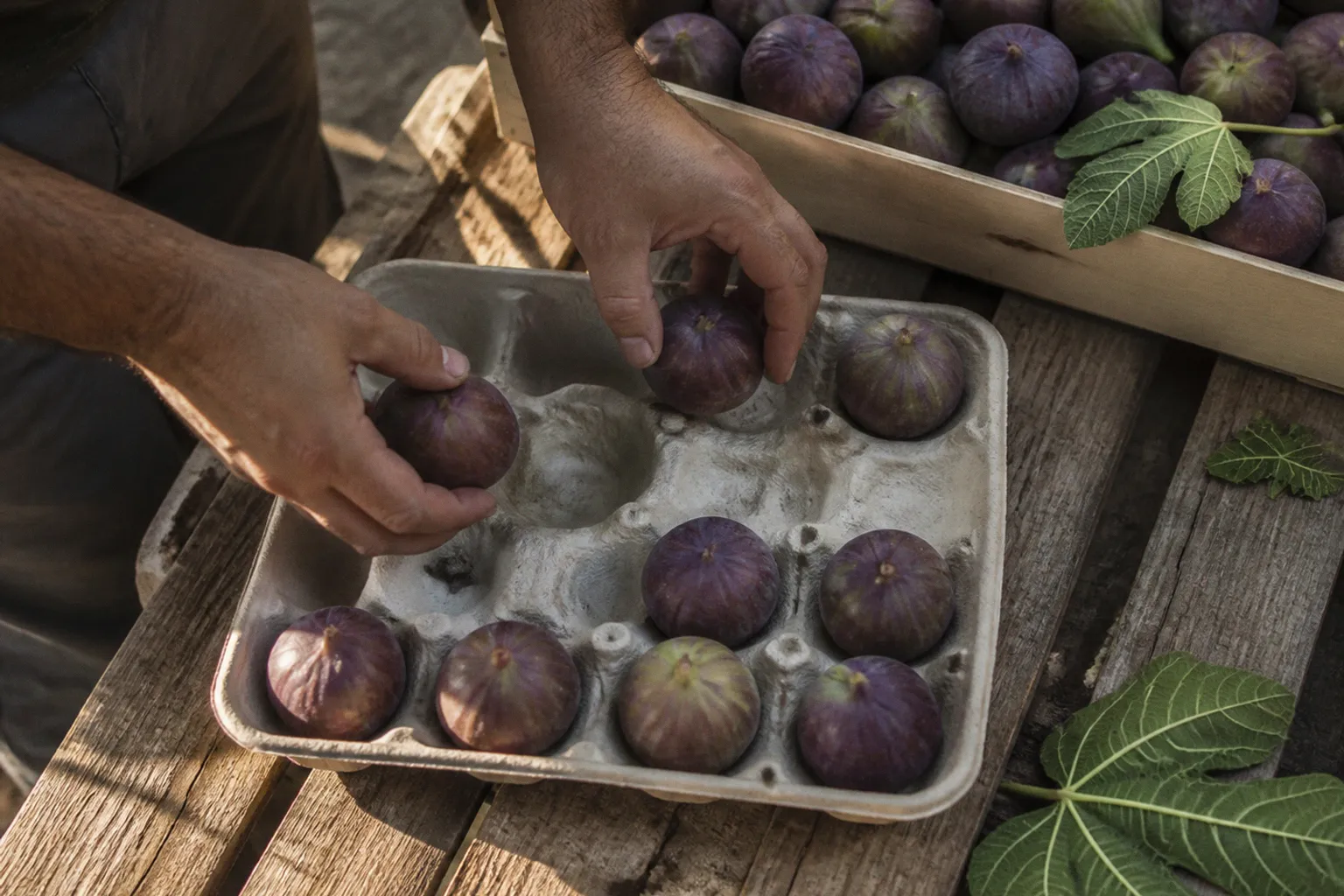
The reason is straightforward: fresh figs are soft, easily bruised, and highly sensitive to pressure, while the markets we are trying to reach are becoming less tolerant of packaging that cannot be recovered, recycled, or managed responsibly.
This is why Lebanese fig packaging materials are moving toward paper trays, molded pulp, and corrugated cardboard. The transition is not simply a matter of replacing one container with another. Our cooperatives must protect a delicate summer crop, comply with Lebanese export rules, prepare for European packaging requirements, and still keep the pack practical for growers, packhouses, wholesalers, and buyers.
The strongest solutions will come from collective planning. A single grower may be able to change a tray. A cooperative can change the pack standard.
The regulatory shift started before the EU deadline
Lebanon’s export rules already place limits on packaging for fresh produce. Ministry of Agriculture Decision No. 1/358, issued in 1997, prohibited polystyrene containers for fresh fruits and vegetables leaving Lebanese borders. An amendment, Decision No. 1/2, followed in 2000.
That history matters because the move away from polystyrene is not a sudden reaction to a European announcement. Lebanese exporters have been working within packaging restrictions for years, even if the market has not yet reached a single, uniform replacement standard.
The next pressure comes from the European Union’s Packaging and Packaging Waste Regulation, commonly known as the PPWR. From January 1, 2030, the regulation will prohibit single-use plastic packaging for fresh produce weighing under 1.5 kg at the point of entry into the European market.
For figs, that threshold reaches directly into the retail pack. Fresh figs are commonly sold in small trays containing eight to ten units or approximately 1 kg. Those formats are convenient for consumers, but they also fall within the weight range that makes packaging material a strategic export decision rather than a minor design choice.
The regulation does not mean that every plastic item associated with every agricultural shipment disappears immediately, nor does it establish that plastic trays are already completely illegal in Lebanon’s domestic market. The regulatory impact depends on the destination, the packaging format, and the specific conditions applying at entry. But for cooperatives planning an export programme, waiting until 2030 to reconsider the pack would leave too little time for trials, supplier coordination, and buyer approval.
The question is not whether our growers can replace a plastic tray once. The question is whether the whole supply chain can repeat the new pack reliably, season after season.
A cooperative that starts early has room to test how a paper-based tray behaves with ripe fruit, condensation, stacking, cold storage, loading, and retail handling. It can also identify which designs work for a 1 kg consumer unit and which are better suited to larger wholesale boxes.
Figs demand protection without suffocation
Packaging for fresh figs has to solve a difficult physical problem. The fruit is delicate, its skin can mark easily, and the soft flesh is vulnerable to crushing when trays are stacked or boxes shift during transport. At the same time, figs continue to respire after harvest. A package that holds moisture too tightly or restricts airflow can create a different kind of damage: condensation, softening, and deterioration.
This is why a tray that looks sturdy in an empty packhouse may perform poorly once filled with warm fruit. The useful test is not appearance. It is whether the pack maintains separation, supports the fruit, allows appropriate ventilation, and remains stable during the complete journey from orchard to buyer.
Traditional fig packs use several formats:
- field-ready plastic, cardboard, or wooden boxes;
- individual cell dividers that keep figs from pressing against one another;
- consumer trays containing eight to ten figs;
- trays holding approximately 1 kg;
- larger boxes with typical capacities of 4–5 kg or 10–12 kg.
Each format answers a different commercial need. A small retail tray presents the fruit clearly and gives the buyer a manageable quantity. A larger box may suit wholesale handling, but it must prevent the lower layers from carrying too much weight. A field-ready box may reduce repacking, although only if its dimensions and internal protection match the final market requirement.
The packaging material alone cannot prevent transit damage. A strong tray will not rescue fruit picked too soft, overheated before cooling, or packed with inconsistent sizing. Equally, excellent fruit can be damaged by a box that allows the top layer to move during loading.
For our growers, the practical lesson is to treat the pack as part of the post-harvest system:
1. Harvest for the intended route. Fruit destined for a longer export journey needs a different handling rhythm from figs sold quickly through a local market.
2. Grade before filling the final tray. Mixed sizes create uneven pressure, with larger fruit pressing into smaller pieces and empty spaces allowing movement.
3. Keep blemished or split fruit out of the export pack. A paper tray cannot compensate for fruit that is already leaking, bruised, or damaged.
4. Match the tray depth to the fruit. A shallow pack can expose figs to impact, while excessive depth encourages stacking pressure.
5. Check movement after closure. When a closed tray is gently handled, the fruit should remain separated rather than rolling into one another.
6. Coordinate packaging with cooling. Paper-based materials must be selected and tested with the intended cold-chain conditions; they should not be treated as a universal shelf-life solution.
That final point deserves emphasis. Paper packaging can support a cleaner export system, but it does not extend fig shelf life indefinitely. Cold-chain infrastructure, harvest maturity, hygiene, handling speed, and ventilation remain decisive.
Paper trays are not one material, but a family of solutions
When people say that the sector is moving from plastic to paper, they often make the transition sound simpler than it is. Paper trays, molded pulp trays, corrugated inserts, and folding cartons behave differently in contact with fruit and moisture. A cooperative should compare the complete pack rather than approve a material based on the label alone.
Molded pulp trays can provide formed pockets that separate individual figs and reduce direct contact. This is especially useful for retail packs, where the buyer expects to see intact, clean, blemish-free fruit. The shape of the pocket matters as much as the material: if it is too loose, figs move; if it is too tight, the sides of the fruit can be marked.
Corrugated cardboard offers more flexibility in outer packaging. It can be used for boxes, dividers, sleeves, and structural supports. F-flute profiles, produced for agricultural and food-and-beverage packaging, can provide a finer corrugated structure where a pack needs a balance of light weight, printability, and rigidity. Lebanese packaging manufacturer Gemayel Freres S.A.L., established in 1929, produces corrugated cardboard boxes and F-flute profiles and has a long history connected with paper recycling in Lebanon.
That local capacity is valuable because packaging development works better when suppliers can respond to the actual crop and not only to a catalogue specification. A fig cooperative may need a tray adjusted for a particular fruit size, a box that fits a standard pallet pattern, or a vent configuration that suits its cooling process. Local conversations can make those changes more practical.
A useful comparison looks like this:
| Packaging approach | Main strength | Main risk for fresh figs | Where it may fit |
|---|---|---|---|
| Plastic tray or clamshell | Familiar handling and consistent shape | Future restrictions for certain export formats; difficult transition risk | Existing channels where permitted, while alternatives are tested |
| Molded pulp tray | Individual separation and a paper-based presentation | Must be tested for moisture, compression, and pocket fit | Retail packs of eight to ten figs or approximately 1 kg |
| Corrugated cardboard box with dividers | Strong outer structure and adaptable dimensions | Poor internal design can allow movement or pressure | Wholesale and export boxes, including larger capacities |
| Wooden box | Traditional appearance and rigidity | Export rules restrict gum-tree boxes and repurposed crates; weight and hygiene may complicate handling | Only where the material and construction meet destination requirements |
| Paperboard tray with outer carton | Clear retail presentation and a coordinated paper system | Requires careful ventilation and stacking design | Branded or cooperative retail formats |
The table is a starting point, not a procurement decision. A tray that performs well with firm early-season figs may behave differently with softer fruit later in the summer. The same pack may also perform differently on a short domestic route and a longer export journey.
The outer box must be designed around the inner tray
A frequent mistake is to approve the consumer tray first and treat the outer carton as a secondary purchase. In reality, the two elements form one protective structure.
If the tray fits loosely inside the box, movement will increase. If the outer box is too shallow, the lid may press against the fruit. If the box is too deep, stacked layers may carry unnecessary weight. If the ventilation openings are poorly placed, cooling may be uneven. These are not cosmetic details; they affect the percentage of fruit that arrives with a clean skin and a saleable appearance.
For larger packs, the 4–5 kg and 10–12 kg capacities identified in current fig packaging practice should be treated as working formats rather than automatic standards for every cooperative. The correct capacity depends on fruit size, tray arrangement, the number of layers, the stacking pattern, and the handling system used by the buyer.
Our growers should ask suppliers to provide complete samples: filled trays, closed cartons, labels, dividers, and the intended pallet arrangement. An empty box tells us very little. A filled pack shows where the pressure points really are.
Standardization is the cooperative advantage
Fig quality varies naturally between orchards, varieties, harvest days, and even sections of the same orchard. Packaging cannot remove that variation, but a cooperative can organize it into consistent commercial grades.
This is where shared responsibility becomes practical. The grower, collection team, packhouse, packaging supplier, logistics provider, and buyer each control part of the outcome. If one link changes the agreed standard without communicating it, the package may fail even when every other step was well managed.
A cooperative packaging framework can assign responsibilities clearly:
- Growers deliver fruit at agreed maturity and keep field containers clean and suitable for the intended pack.
- Collection teams reduce waiting time in heat and prevent rough handling between orchard and packhouse.
- Packhouse staff grade by size and condition, fill the pockets consistently, and remove fruit that does not meet the export specification.
- Packaging suppliers maintain dimensions, material strength, ventilation details, and production consistency.
- Logistics partners protect the cartons from crushing, rain, and unnecessary temperature changes.
- Buyers confirm the retail weight, tray configuration, labelling, and destination requirements before the season begins.
This structure does not need to become a heavy administrative system. A one-page seasonal pack specification can be enough if everyone works from the same version. It should state:
- the target retail or wholesale weight;
- the number of figs per tray where applicable;
- the acceptable size range;
- whether individual pockets or dividers are required;
- the outer box capacity;
- the approved paper or molded-pulp components;
- the ventilation and closure arrangement;
- the stacking orientation;
- the destination market and applicable packaging requirements.
The purpose is not to turn a community operation into a factory. The purpose is to protect the value of collective harvests. When every grower sends a different size mix into a different box, buyers receive uncertainty. When a cooperative supplies a recognizable format with dependable grading, it gives the market something easier to order, handle, and trust.
A practical transition plan for Lebanese cooperatives
The best time to redesign fig packaging is before the harvest rush. Once fruit is arriving quickly and export bookings are already fixed, there is little room for meaningful experimentation. A staged approach allows the cooperative to protect the current season while building the next one.
1. Map the existing pack
Begin with the formats already in use. Record which boxes and trays serve domestic wholesalers, local retail, and export buyers. Note the quantities packed, the usual fruit size, the number of layers, and the points where damage is most often observed.
This does not require an elaborate laboratory. A careful packhouse review can reveal whether the main problem is crushing, movement, moisture, weak corners, poor closure, or inconsistent grading.
2. Choose two or three paper-based prototypes
Avoid testing a long list of materials at once. Select a small group that reflects the actual commercial need: perhaps a molded pulp tray for a 1 kg retail pack and a corrugated box with dividers for a larger export unit.
The prototypes should be close enough to the intended final design that the results are meaningful. A decorative sample with no production plan is not useful.
3. Fill the samples with real fruit
Use fruit from more than one harvest day if possible, because firmness and size can shift during the season. Pack the fruit using the same staff, grading decisions, and handling rhythm that will be used commercially.
Look at the tray immediately after filling and again after handling. Check whether figs remain separated, whether the pockets mark the skin, and whether the closure touches the upper fruit.
4. Test the full route
A packaging trial should follow the actual movement of the product as closely as practical: collection, sorting, filling, closure, stacking, loading, transport, unloading, and buyer inspection.
The most useful observations are often simple:
- Are the bottom layers compressed?
- Does the carton remain square when stacked?
- Do trays slide inside the outer box?
- Does condensation collect where fruit touches the paper?
- Are the figs still presentable when the buyer opens the box?
- Can workers pack quickly without forcing fruit into the pockets?
- Does the carton remain dry and stable through the intended cold-chain conditions?
5. Agree on one seasonal standard
After testing, choose a limited number of formats. Too many variations increase purchasing costs and create confusion at the packhouse. A cooperative may still need more than one pack, but each format should have a clear purpose.
The goal is not to find one universal box for every fig. It is to eliminate unnecessary variation while preserving the formats that genuinely serve different buyers.
6. Review the pack with the destination market in mind
An export package must satisfy more than the grower and the local packhouse. Importers may have requirements for retail weight, pallet dimensions, barcode placement, ventilation, labelling, and material composition. These details should be agreed before a large packaging order is placed.
Lebanese export rules also prohibit wooden boxes made from gum trees, repurposed crates, and wrappers that alter the taste of the produce. Even when a wooden component appears strong or traditional, it should not be adopted casually for an export programme.
Domestic sales and exports may not move at the same speed
The pressure to change packaging is strongest where produce crosses borders into markets with specific environmental and import requirements. Domestic retail and wholesale channels may move more gradually, and the exact legal position can differ from export rules. That does not make domestic packaging irrelevant. It means cooperatives should avoid presenting one market’s requirement as though it applies identically everywhere.
A Lebanese grower may sell part of a fig harvest through a local wholesale market, part through a small retail pack, and part to an exporter. Those channels can require different weights, levels of presentation, and degrees of internal protection. A single packaging policy may create unnecessary expense in one channel and insufficient protection in another.
The wiser approach is to separate the commercial functions while keeping the material strategy coherent. For example, a cooperative might use a simple corrugated transport box for a fast local route and a molded pulp tray within a stronger outer carton for export retail. Both can belong to the same paper-based transition, provided that the formats are specified and managed properly.
This also helps avoid a common misunderstanding: replacing plastic with paper does not automatically make a pack compliant. The regulation may apply to the weight and type of packaging, the destination, and the point of entry. A paper component may still fail in practice if it collapses under moisture, prevents adequate cooling, or causes fruit damage that makes the shipment commercially unacceptable.
Sustainable packaging only becomes a real improvement when the figs arrive crisp, intact, and ready for sale—not merely when the box looks different.
Cost has to be measured across the whole operation
A lower unit price is not necessarily a lower packaging cost. If a cheap tray requires slower filling, additional dividers, more rejected fruit, or stronger outer cartons, the apparent saving may disappear before the shipment reaches the buyer.
Cooperatives should compare the total pack system:
- tray or insert cost;
- outer carton cost;
- dividers, sleeves, and closures;
- labour time per packed unit;
- expected damage and rejection;
- storage space for packaging materials;
- pallet efficiency;
- transport weight;
- disposal or recycling considerations;
- ability to source the same design throughout the season.
Paper and corrugated packaging may also require different storage discipline. Moisture can weaken paper-based materials before they reach the packhouse, so cartons and trays need a dry, protected storage area. This is a practical investment, not an abstract environmental gesture. A well-designed package stored badly will still fail.
The cooperative should also discuss order timing with suppliers. A seasonal product needs packaging available before the first significant harvest, not delivered after the market window has opened. Shared purchasing can make it easier to place a consistent order, but only if the specifications are settled early.
The transition is an opportunity to improve the fruit story
Packaging carries more than fruit. It carries information about where the figs came from, how they were graded, and whether the cooperative can deliver the same quality again. A clean paper tray with careful spacing can make the harvest visible in a way that a crowded or damaged pack cannot.
That presentation should remain honest. The package should not suggest organic certification, special cultivation methods, or a uniformity that the cooperative cannot support. But it can communicate the useful facts buyers need: origin, weight, grade, harvest or packing information where required, and clear handling instructions.
For Lebanese cooperatives, the most meaningful branding may be consistency itself. When a buyer opens a carton and finds crisp fruit arranged in a stable, recognizable format, the cooperative has made a promise it can repeat. Over time, that reliability is more valuable than a decorative label.
The transition to paper trays is therefore not just a response to the EU’s 2030 requirement. It is a chance to strengthen the entire export pipeline: to align growers around grades, improve packhouse discipline, work more closely with Lebanese manufacturers, and design the route around the actual fragility of the fig.
Our growers already understand that quality begins in the orchard. The next step is to make sure the package respects that quality all the way to the market. A paper tray will not solve every post-harvest challenge, but a well-tested tray, paired with sound grading and cold-chain practice, can help Lebanese figs arrive as they should: distinct, carefully handled, and ready to earn their place on a wider table.