Fertigation systems: choosing the right injector for your farm
A fertigation injector is a small component with system-wide consequences. In a drip irrigation network, the choice between a Venturi injector and a water-powered proportional pump determines how…
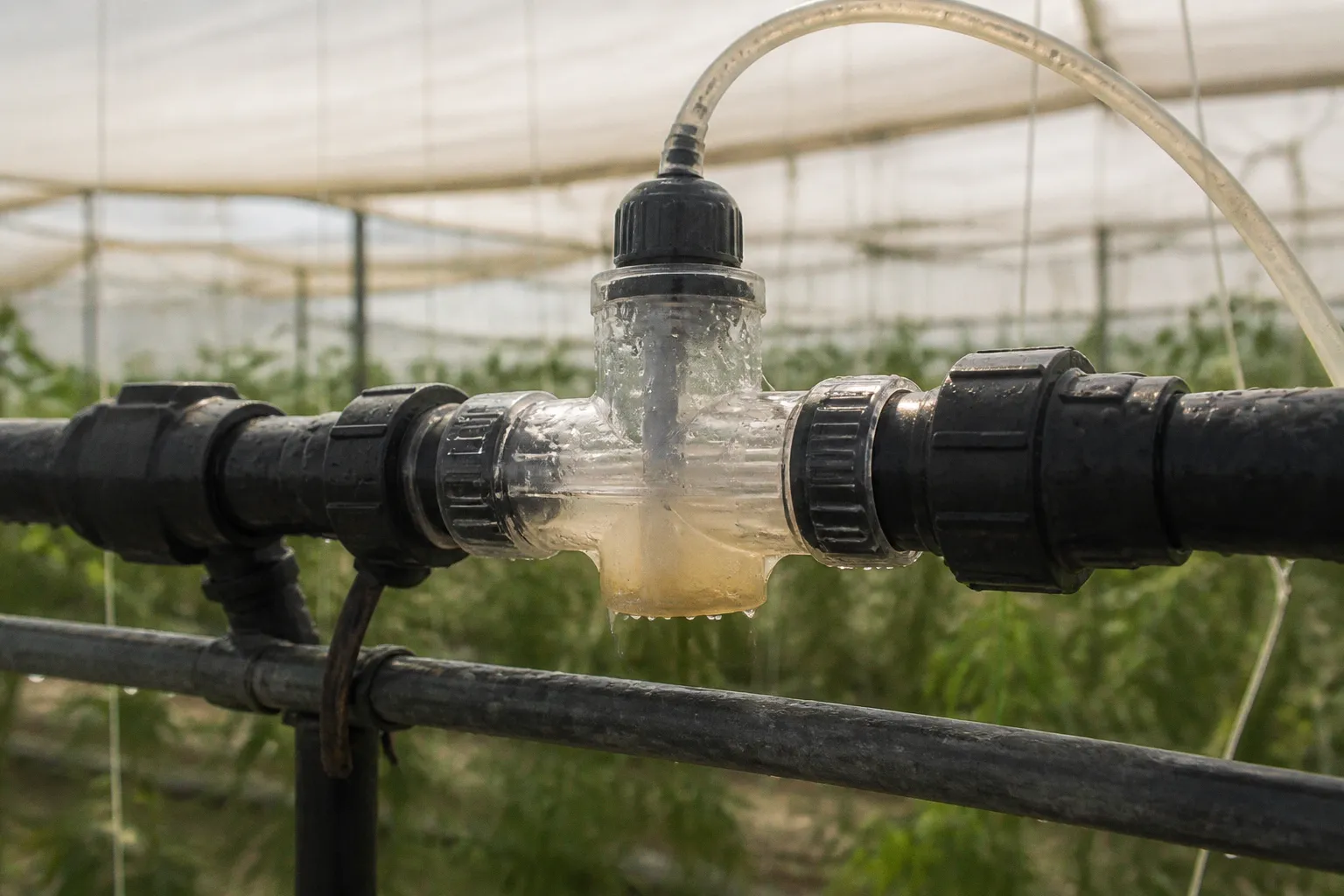
A fertigation injector is a small component with system-wide consequences. In a drip irrigation network, the choice between a Venturi injector and a water-powered proportional pump determines how much pressure is lost, how evenly nutrients are distributed, and whether fertilizer concentration remains stable when the hydraulic conditions change.
The performance gap is measurable. In a tested drip fertigation system, a water-powered proportional pump achieved 97.7% fertilizer distribution uniformity and reduced system pressure drop by 24% compared with a Venturi injector. That does not make the proportional pump the automatic choice for every Lebanese farm. It establishes a more useful point: injector selection is an infrastructure decision, not a minor accessory purchase.
The correct decision depends on four variables: farm scale, available operating pressure, required dosing precision, and capital budget. For a small block with stable pressure and limited automation requirements, a Venturi system may provide the lowest-cost entry point. For a larger cooperative, export-oriented greenhouse operation, or drip network with variable hydraulic conditions, proportional injection usually offers better control of the nutrient-delivery baseline.
The mechanics of Venturi systems: low-cost pressure differential
A Venturi injector has a relatively simple operating principle. Water passes through a narrowed section of the injector body, creating a pressure differential that draws concentrated fertilizer solution into the irrigation stream. The device requires no electricity and has no internal moving parts. Its appeal is therefore structural: low capital expenditure, uncomplicated installation, and limited mechanical complexity.
That simplicity is useful in farms where electrical supply is unreliable, where the fertigation point is distant from a control room, or where the irrigation network already has sufficient pressure available for injection. A Venturi unit can be integrated into a conventional drip fertigation setup with a suction line, a fertilizer tank, isolation valves, a filter, and the necessary pressure gauges.
The same operating principle creates its main limitation. The injector consumes pressure to create suction. As flow moves through the narrowed throat, part of the available hydraulic energy is converted into the pressure differential required to draw in fertilizer. The result is a pressure drop across the device. If the pump and distribution network have little pressure reserve, the injector can reduce the performance of downstream emitters.
This is not a theoretical inconvenience. Drip irrigation depends on a narrow operating envelope. Emitters require sufficient pressure to deliver their intended discharge, while excessive pressure can increase leakage, stress fittings, and distort application uniformity. A Venturi injector adds another hydraulic demand to a system that may already be operating close to its design threshold.
Where Venturi injection performs adequately
Venturi equipment remains technically appropriate under several conditions:
- The irrigation system has a reliable pressure surplus after filtration, valves, elevation changes, and lateral lines are accounted for.
- The farm uses a relatively stable irrigation schedule rather than frequent changes in flow rate.
- The operator can accept manual calibration and periodic adjustment of the suction rate.
- Nutrient concentration does not need to remain tightly controlled across substantial pressure fluctuations.
- The priority is low initial cost rather than maximum dosing precision.
- The farm has personnel who can observe pressure gauges and verify fertilizer uptake during each injection cycle.
For a small orchard, nursery, or greenhouse block with a compact hydraulic layout, those conditions may be realistic. The capital expenditure can remain modest because the injector itself does not require a motor, control cabinet, or electrical connection. However, the initial price of the injector is not the full system cost. If the pressure loss is significant, a booster pump may be needed.
A booster pump can compensate for the pressure drop created by a Venturi injector, but it changes the economic calculation. The installation then includes additional electrical or solar capacity, pump controls, pipework, and maintenance. The Venturi remains inexpensive as a component, but the complete injection assembly becomes more complex.
A Venturi injector is inexpensive because it uses the irrigation system’s pressure as its power source. That pressure is not free; it is removed from the delivery network.
The calibration problem
Venturi injectors do not automatically maintain an identical injection ratio when mainline pressure fluctuates significantly. Their performance is linked to the pressure differential across the device, which changes with system flow, filter loading, valve position, elevation, and the number of irrigation zones operating simultaneously.
This creates a common operational error: calibrating the injector once and treating the setting as permanent. A ratio that appears correct when one irrigation zone is open may change when two zones operate together. A partially blocked filter can alter the pressure profile. A pump running at a different point on its curve can change the suction rate. The fertilizer tank may also become more concentrated or diluted as the solution is withdrawn, depending on how it is mixed.
The correct approach is to establish a baseline under actual operating conditions. Measure inlet and outlet pressure, record the irrigation flow configuration, determine the time required to remove a known volume from the fertilizer tank, and repeat the check after changing the zone arrangement. These measurements are more valuable than relying on a dial position or a nominal injector ratio printed on the housing.
Precision dosing with water-powered proportional pumps
Water-powered proportional pumps use the irrigation flow itself to drive a metering mechanism. A defined volume of irrigation water activates the pump, which draws a corresponding volume of concentrated solution from the fertilizer tank and injects it into the mainline. Because the dosing ratio is mechanically linked to water movement, the system can maintain a more consistent concentration as flow conditions change.
This is the central distinction between the two technologies. A Venturi injector is governed primarily by pressure differential. A proportional pump is governed by a metered relationship between water volume and fertilizer volume.
Positive displacement injectors operate on a related principle. They deliver a fixed volume of concentrated solution per cycle, allowing the injection ratio to remain consistent despite fluctuating water pressures. The mechanism still contains seals and moving components, so it is not maintenance-free, but its dosing logic is more stable than that of a pressure-dependent suction injector.
Some water-powered injector models operate across a water pressure range of 15 to 125 psi, with adjustable feed ratios from 1:50 to more than 1:1000. Such a range is broad enough to cover very different fertigation programs, from relatively concentrated treatment batches to low-dose nutrient delivery over extended irrigation periods. The specific usable range still depends on the model, water quality, flow rate, fertilizer viscosity, and the manufacturer’s installation requirements.
The advantages are most visible when the farm operates multiple zones or varies the irrigation schedule. A proportional pump can continue to dose according to its selected ratio as the volume of water changes, provided the system remains within its operating range. The operator does not need to recalibrate the injector every time the mainline flow changes within normal limits.
Venturi versus proportional injection
| Parameter | Venturi injector | Water-powered proportional pump |
|---|---|---|
| Energy source | Pressure differential in the irrigation line | Irrigation water drives a metering mechanism |
| Electricity requirement | None for the injector itself | None for water-powered models |
| Moving parts | No internal moving parts | Seals, pistons, or other metering components require inspection |
| Dosing stability | Sensitive to pressure and flow changes | More consistent across normal pressure fluctuations |
| Pressure effect | Can create a significant pressure drop | A tested proportional pump reduced pressure drop by 24% compared with a Venturi injector |
| Distribution uniformity | Dependent on hydraulic stability and calibration | Achieved 97.7% uniformity in a tested drip fertigation system |
| Capital expenditure | Generally lower at component level | Higher initial equipment cost |
| Maintenance profile | Simple, but filters and suction lines require attention | More precise hardware with wear components and seal replacement requirements |
| Suitable operating model | Small or stable irrigation blocks | Larger, variable, precision-oriented fertigation systems |
| Main operational risk | Inconsistent injection ratio under changing pressure | Mechanical wear, chemical compatibility, and incorrect ratio selection |
The table should not be interpreted as a universal ranking. A proportional pump can be poorly installed, incorrectly sized, or exposed to fertilizer salts without adequate filtration. A Venturi injector can provide acceptable performance when the hydraulic design is stable and the operator verifies the dosing rate. The equipment is only one part of the fertigation system; the quality of the hydraulic baseline remains decisive.
Managing pressure fluctuations and system efficiency
Pressure management is the point at which fertilizer injection becomes an infrastructure problem. The injector sits between the water source and the crop, but its performance depends on everything upstream and downstream: pump capacity, pipe diameter, filter condition, elevation, valve configuration, lateral length, emitter type, and the number of active zones.
A practical fertigation assessment should begin with a pressure map rather than an equipment catalogue. Record the pressure at the pump discharge, after filtration, at the injector inlet, at the injector outlet, and at the most distant irrigation zone. If the system has substantial elevation change, include that in the hydraulic calculation. Pressure at the pump does not describe pressure at the last emitter.
The following baseline metrics are particularly useful:
- Inlet pressure: the pressure available before the injector under the actual irrigation flow.
- Outlet pressure: the pressure remaining after injection hardware and associated valves.
- Pressure differential: the loss created by the injector and adjacent fittings.
- Zone flow rate: the volume of irrigation water delivered by each active zone.
- Fertilizer uptake rate: the volume of concentrated solution removed from the tank over a defined interval.
- Distribution uniformity: the difference in nutrient and water delivery between the beginning and end of the irrigation network.
- Filter differential: the pressure loss across the filter, indicating when cleaning or replacement is required.
Without these measurements, the purchase decision becomes a comparison of product descriptions rather than system performance.
The interaction between injector and filtration
Fertilizer injection does not eliminate the need for filtration. It increases the importance of filtration because undissolved particles, precipitates, and fertilizer residues can obstruct emitters or damage metering components. The filter must be selected for the water source, the fertilizer formulation, and the emitter sensitivity of the network.
A filter that is adequate for irrigation water may not be adequate after fertilizer products are introduced. Some mixtures can form precipitates when their chemistry is incompatible or when the solution is prepared at excessive concentration. Calcium-containing products, phosphate fertilizers, and micronutrient formulations require particular attention to mixing order and solubility. The injector cannot correct a chemical incompatibility that begins in the fertilizer tank.
The fertilizer tank should also have a mixing procedure that produces a uniform solution before dosing starts. A proportional pump will deliver a consistent ratio of the solution entering its intake line; it will not make a poorly mixed tank uniform. The same applies to a Venturi injector. Mechanical precision does not compensate for weak preparation protocols.
Scaling a fertigation setup for Lebanese farm conditions
Fertigation system selection for Lebanese growers should be based on the hydraulic scale of the farm, not on whether a technology is marketed as modern or conventional. Agricultural operations in Lebanon can include small fragmented plots, cooperative-managed blocks, greenhouse clusters, orchards, and export-oriented packing networks. These configurations do not present the same pressure profile or labor model.
A small plot with one irrigation zone may benefit from a low-cost Venturi system if the pump provides adequate pressure and the operator can perform manual calibration. A cooperative serving several fields may need a more controlled architecture, particularly when different crops, soil types, or planting densities require separate nutrient programs.
The scale decision can be organized into three implementation phases.
Phase one: establish the hydraulic baseline
Before selecting the injector, document the irrigation network as it operates, not as it appears on the design drawing.
1. Measure pressure before and after filtration during normal irrigation.
2. Record the flow rate for each zone and identify which zones can operate simultaneously.
3. Determine whether the pump has pressure reserve when the system is working at maximum planned flow.
4. Check elevation differences between the water source, injector, and most distant irrigation blocks.
5. Inspect filter loading, valve condition, suction lines, and existing leaks.
6. Calculate the fertilizer volume required for each crop program and injection cycle.
This phase often reveals that the injector is not the primary constraint. A narrow mainline, undersized pump, clogged filter, or poorly balanced zone can create larger losses than the injection device itself.
Phase two: match the injector to operational variability
The key question is not simply how much fertilizer the farm needs. It is how much the irrigation system changes during operation.
A Venturi injector is more defensible when flow and pressure remain stable. A proportional pump becomes more defensible when the farm regularly changes zone configuration, operates several greenhouse compartments, or requires a defined nutrient concentration across varying water volumes.
For cooperative infrastructure, standardization has additional value. If several growers or fields share an irrigation service, a common injector specification and calibration procedure reduces the number of operating variables. A water-powered proportional pump may carry higher capital expenditure, but it can reduce the labor required to recalibrate each field after every hydraulic change.
The economic calculation should include:
- Injector purchase price.
- Additional pump capacity required to overcome pressure losses.
- Electrical or solar power requirements.
- Fertilizer tank, mixing, and filtration hardware.
- Installation and commissioning labor.
- Spare seals, valves, and metering components.
- Calibration labor during the production cycle.
- Cost of nutrient non-uniformity in under-irrigated or over-fertilized zones.
- Expected replacement interval for wear components.
The last two items are often excluded because they are difficult to place in a procurement spreadsheet. They should not be excluded from the engineering decision. A cheaper injector that creates inconsistent nutrient delivery can transfer cost into reduced crop uniformity, unnecessary fertilizer use, or corrective irrigation.
The relevant ROI is not the difference between two injector prices. It is the difference between two complete nutrient-delivery systems over their operating life.
Phase three: commission and verify
Installation should end with a commissioning record, not with the pump being switched on. The record should state the inlet pressure, outlet pressure, active zone, water flow, selected injection ratio, fertilizer concentration, and measured tank drawdown.
For a proportional pump, verify that the actual feed ratio corresponds to the selected setting under the expected flow range. For a Venturi injector, repeat the measurement at the operating conditions of each major irrigation zone. If the results differ materially, the system needs hydraulic balancing, a different injector setting for each configuration, or a change in equipment.
The first fertigation cycles should use a conservative concentration and a clearly measured volume of solution. The objective is to confirm delivery behavior before the system is exposed to a full nutrient program. Once the network is stable, operators can introduce crop-specific schedules and adjust injection duration.
Irrigation design and nutrient uniformity
An injector cannot be evaluated separately from the drip network. Uniform fertilizer distribution requires uniform water distribution first. If the last section of a lateral receives less water because of friction loss or inadequate pressure, it will also receive less dissolved nutrient, even if the injector maintains a perfect concentration at the pump outlet.
This is why 97.7% fertilizer distribution uniformity is a meaningful benchmark but not a guaranteed field result. The figure was achieved in a tested drip fertigation system under defined operating conditions. It demonstrates what a proportional pump can deliver when the surrounding system is properly designed and controlled. It does not mean that every proportional installation will achieve the same value.
The same caution applies to the reported 24% reduction in pressure drop. It is a comparison under a tested configuration, not a universal conversion factor for every Venturi and every proportional pump. Injector geometry, flow rate, pipework, pressure, and fittings all influence the result.
For growers evaluating smart irrigation in Lebanon, the useful lesson is methodological: use benchmark data to define the expected performance category, then verify the actual farm network through measurement. The technology should be selected for its ability to remain inside the required performance range, not for a headline specification detached from the hydraulic design.
Maintenance realities for fertilizer injection hardware
The maintenance profile of each injector is different, but neither system can be treated as install-and-forget equipment.
Venturi injectors have no internal moving parts, which reduces mechanical failure points. Their exposed components remain vulnerable to clogging, scale, fertilizer crystallization, air leakage, and damaged seals in the suction assembly. The suction filter must be cleaned, the injection line flushed, and the injector inspected for obstruction. If the pressure differential falls outside the required range, fertilizer uptake may decrease without an obvious visible failure.
The operator should periodically verify actual solution drawdown rather than assuming that suction indicates correct dosing. A Venturi can be drawing solution while delivering a ratio that is unsuitable for the crop because pressure or flow has changed.
Water-powered proportional pumps introduce a different maintenance requirement. Seals, pistons, diaphragms, and other moving components wear over time, especially when exposed to fertilizer salts, abrasive particles, or poorly filtered water. These components require inspection and eventual replacement. The pump’s advantage is dosing stability, not zero maintenance.
A practical maintenance schedule should include:
- Flushing the injector and injection line after each fertigation cycle where fertilizer residues can crystallize.
- Cleaning filters according to pressure differential rather than a fixed calendar alone.
- Inspecting seals and metering components for swelling, hardening, or chemical attack.
- Checking the fertilizer tank for sediment and undissolved material.
- Verifying the feed ratio at the beginning of each crop cycle.
- Recording pressure and flow changes that could indicate blockage or wear.
- Keeping replacement seals and critical fittings available during the production season.
Chemical compatibility requires the same level of attention as mechanical maintenance. Fertilizer formulations should be mixed according to their solubility characteristics, and concentrated products should not be combined casually in the same tank. The injection hardware may remain mechanically functional while the crop receives a precipitated or chemically unbalanced solution.
A capital decision, not a product preference
For a small, hydraulically stable operation, the Venturi injector is often the rational baseline. Its no-electricity design, absence of internal moving parts, and lower component cost align with farms that can tolerate manual calibration and modest pressure loss. It becomes less attractive when the system operates close to its pressure limit or when irrigation conditions change frequently.
For a larger farm, greenhouse cluster, or cooperative irrigation network, the water-powered proportional pump offers a stronger control architecture. Its higher capital expenditure can be justified when uniformity, repeatability, and labor reduction have measurable value. The 97.7% distribution-uniformity result and 24% pressure-drop reduction provide a defensible performance reference, although the installed system still requires field verification.
The decision can be summarized in operational terms:
- Select a Venturi injector when the irrigation network has pressure reserve, flow is stable, the fertilizer program is relatively simple, and the farm prioritizes minimum initial expenditure.
- Select a water-powered proportional pump when pressure and flow vary, nutrient concentration must remain consistent, multiple zones share infrastructure, or the cost of uneven application is material.
- Consider a booster pump with a Venturi system only after calculating the additional energy, installation, and maintenance cost against the price of a more precise injector.
- Treat positive displacement equipment as a precision option when fixed-volume dosing is required, while budgeting for wear components and chemical exposure.
- Do not approve any injector without a commissioning procedure that records pressure, flow, ratio, and fertilizer drawdown.
The definitive verdict is numerical rather than ideological. If the farm can provide stable hydraulic conditions and accepts manual calibration, a Venturi system can deliver adequate fertigation at lower capital cost. If the network experiences meaningful pressure variation or requires repeatable dosing across several zones, a proportional pump offers the stronger return through lower pressure loss and more uniform nutrient delivery. The correct fertigation system selection for Lebanese growers is therefore the one that preserves the irrigation baseline at the required scale, not the one with the lowest purchase price.