Fertigation Injectors: Choosing the Right Setup
A fertigation system can lose more performance through hydraulic mismatch than through fertilizer selection.
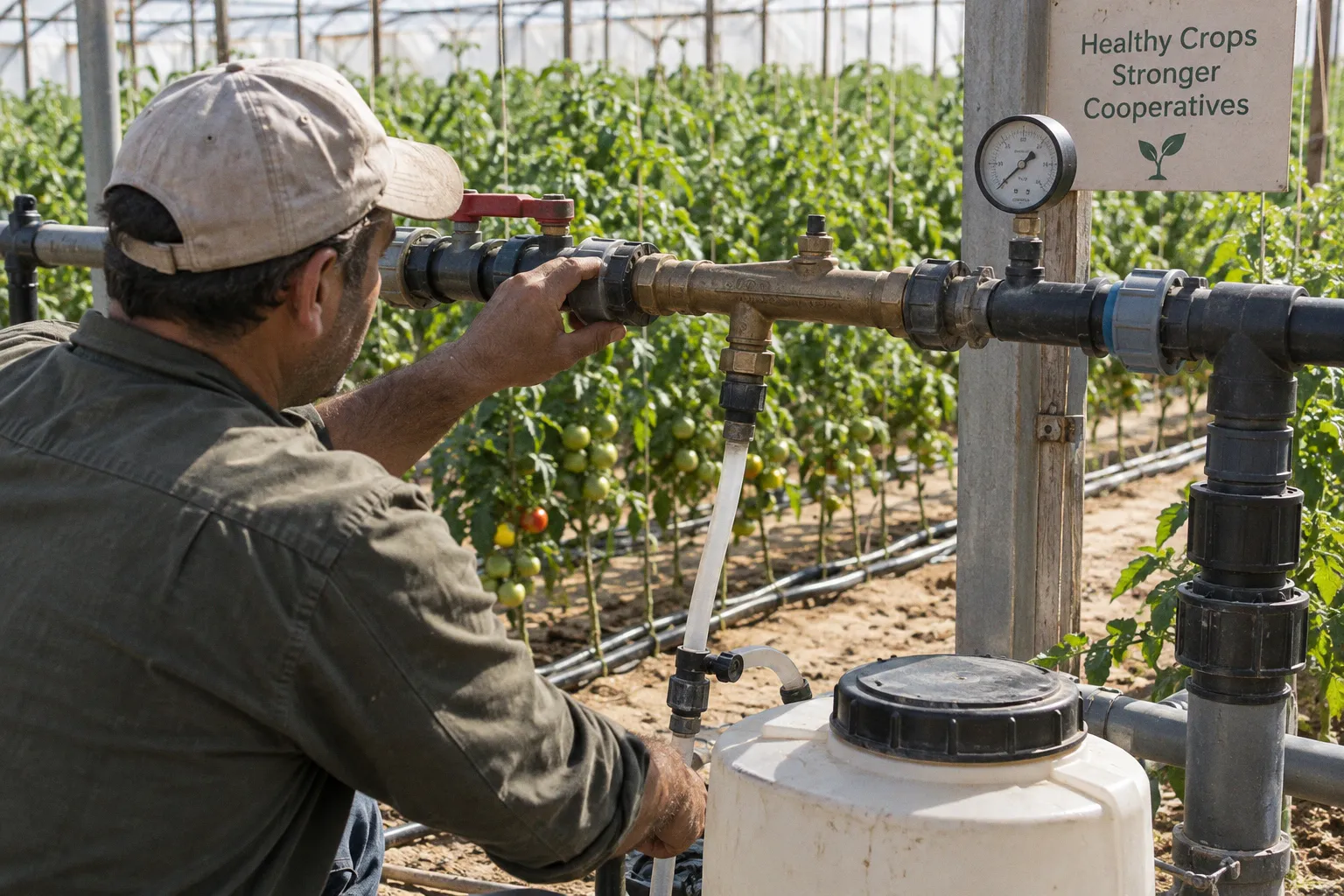
A Venturi injector may require a pressure drop of 20%–25% before it begins drawing concentrate, while the same device installed directly in a drip mainline can reduce downstream pressure by 20%–30%. In a system already operating near the minimum pressure required by its emitters, that is not a minor efficiency penalty. It is a distribution failure.
At the other end of the equipment range, electric positive-displacement pumps can deliver highly repeatable volumes independent of line-pressure changes, but they introduce electrical infrastructure, controls, calibration requirements, and a higher capital burden. Water-powered proportional injectors occupy the middle position: they use irrigation flow as their operating energy and adjust injection in proportion to water movement.
The correct choice among fertigation injector types for drip irrigation is therefore not a matter of selecting the most sophisticated product. It is a hydraulic and operational decision based on flow rate, pressure tolerance, dosing accuracy, power availability, maintenance capacity, and the value of uniform crop delivery.
Passive Pressure Systems: The Mechanics of Venturi Injectors
Venturi injectors are attractive because their operating principle is simple. Water passes through a constricted throat, increasing velocity and creating a pressure differential that draws fertilizer solution from a stock tank into the irrigation stream. The injector requires no electricity and has few moving parts. For farms where grid reliability is uncertain or solar power must be reserved for pumps and controls, that simplicity has practical value.
It is also the source of the device’s main limitation.
A Venturi injector does not create suction without consuming part of the available hydraulic pressure. A minimum pressure drop of approximately 20%–25% across the injector is generally required to initiate suction, while maximum suction capacity may require a differential approaching 50%. The energy is not free. It is taken from the same pressure budget needed to move water through filters, valves, laterals, elevation changes, and emitters.
The consequences depend on how the injector is installed.
Direct installation versus bypass installation
A Venturi placed directly in the mainline forces the entire irrigation flow through the restriction. This configuration is mechanically straightforward, but it can impose a typical system pressure loss of 20%–30%. If the drip network is short, the pump has substantial reserve pressure, and the flow demand is stable, the loss may be manageable. If the system has long laterals, uneven terrain, partially blocked filters, or low-pressure emitters, the downstream effect can be severe.
The more reliable arrangement is a bypass loop. A portion of the mainline flow is diverted through the Venturi, while the rest continues through the primary line. A throttling valve controls the pressure differential across the injector. In systems with inadequate available pressure, a booster pump may be added to the bypass.
This configuration costs more in fittings and installation time, but it separates dosing performance from the full hydraulic burden of the irrigation network. It also allows the operator to adjust suction without forcing every downstream emitter to operate through the injector’s restriction.
A basic Venturi installation should include:
- A bypass loop sized for the injector’s operating range rather than simply matching the mainline diameter.
- Isolation valves before and after the injector for maintenance and seasonal removal.
- A throttling valve to create the required pressure differential.
- Pressure gauges upstream and downstream of the injector.
- A filter on the fertilizer intake line to prevent undissolved material from entering the suction assembly.
- A non-return valve or equivalent backflow protection where required by the system design.
- A mixing tank with sufficient agitation to prevent nutrient stratification and sediment accumulation.
The relevant measurement is not the nominal pipe diameter. It is the pressure differential under actual operating flow. A large injector installed on a low-flow line may not generate useful suction. A smaller injector installed into an undersized bypass may create excessive restriction. Both arrangements can be described as technically installed while producing poor dosing.
A Venturi injector is not a zero-energy device. It replaces electrical energy with pressure consumption, and that pressure must come from somewhere.
Where Venturi injectors remain effective
Venturi systems are often appropriate for open-field production, small and medium cooperative plots, orchard blocks, and irrigation networks where dosing precision is moderate rather than laboratory-level. They are also useful as a low-complexity solution for farms with limited electrical infrastructure.
Commercial Venturi units cover a wide suction range, from roughly 0.5 GPH to more than 470 GPH depending on pipe size and pressure differential. That range is broad enough to cover very different operating conditions, but it should not be interpreted as a universal performance promise. Suction rate depends on the interaction between injector geometry, water flow, inlet pressure, outlet pressure, stock-solution viscosity, and the selected bypass setting.
The practical operating question is therefore not simply, “What is the injector’s maximum suction rate?” It is, “At the irrigation flow and pressure available on this farm, what injection rate can the unit sustain without starving the downstream network?”
Water-Powered Proportional Pumps for Consistent Dosing
Water-powered proportional injectors use the movement of irrigation water to drive a dosing mechanism. Instead of relying on a manually created pressure differential to draw a variable amount of concentrate, the injector meters fertilizer in direct proportion to water flow.
This distinction matters when irrigation demand changes.
A Venturi’s suction rate can change with pressure differential and flow conditions. A proportional injector is designed to maintain a target chemical concentration as the mainline flow changes within its operating range. If one irrigation zone requires less water than another, the dosing mechanism adjusts with the water volume rather than continuing at a fixed chemical feed rate.
For farms with multiple irrigation blocks, this is often the difference between a concentration target and a fixed-volume assumption.
The proportional operating principle
A proportional injector typically specifies a dosing ratio or concentration range. The equipment measures or mechanically responds to the volume of water passing through it, then injects a corresponding volume of stock solution. The result is a more stable nutrient concentration across variations in mainline flow and, within the equipment’s design limits, pressure conditions.
That makes this category particularly relevant to:
- Greenhouses with separate irrigation zones.
- Nurseries where crop containers have low tolerance for concentration errors.
- Cooperative farms operating several blocks with different emitter densities.
- Systems that alternate between low-flow and high-flow irrigation cycles.
- Fertilizer programs requiring repeatability across multiple operators or shifts.
The major benefit is consistency without a dedicated electrical supply. For facilities operating solar-powered irrigation pumps, a water-powered proportional injector can preserve electrical capacity for pumping, filtration, monitoring, and communications.
The limitation: water still has to move through the device
A water-powered injector is not independent of hydraulics. It requires an operating flow range, and it introduces its own pressure loss. If the irrigation system operates below the injector’s minimum flow, the dosing mechanism may not cycle correctly or may fail to maintain the intended ratio. If the flow exceeds the upper limit, the device may require a different model or a regulated installation.
The sizing process should therefore begin with actual zone flow, not the farm’s total water source capacity. A system drawing 4,000 gallons per hour during the full pump cycle may operate individual zones at substantially lower rates. The injector must be selected for the zone-level conditions under which fertigation actually occurs.
Pressure fluctuation also requires attention. Proportional injection can compensate for changing water flow because its drive mechanism follows the flow itself, but it cannot correct for a stock solution that is poorly mixed, obstructed, or chemically incompatible with the injector materials. The dosing ratio is only as reliable as the fluid path.
A practical installation should account for:
1. Minimum and maximum zone flow. The injector must remain within its operating envelope during every fertigation cycle.
2. Pressure loss across the injector. The pump and filtration system must retain enough pressure for the final emitter.
3. Stock-solution concentration. The tank must be mixed consistently, particularly when fertilizers have different solubility or settling behavior.
4. Chemical compatibility. Seals, check valves, tubes, and pump components must tolerate the fertilizer formulation.
5. Flush sequencing. Clean water should be available after injection to clear fertilizer from filters, valves, and laterals.
6. Measurement access. A conductivity or nutrient measurement point can reveal concentration drift that is not visible from the injector setting alone.
A proportional injector is often the most balanced option where the operator needs repeatable fertigation but does not need the control architecture of a fully automated greenhouse system.
Electric Positive-Displacement Pumps for High-Precision Greenhouse Needs
Electric positive-displacement dosing pumps use a motor to inject a defined volume of liquid. Piston, diaphragm, and peristaltic designs fall within this category. Unlike a Venturi, the pump does not depend on creating suction through a pressure restriction in the irrigation line. Unlike a water-powered proportional injector, it is not driven by the instantaneous water flow.
This gives the electric pump a different performance profile: the injection rate is determined by the pump’s control settings, stroke, speed, or operating cycle, and remains comparatively stable when line pressure changes.
That makes the technology suitable for high-value greenhouse production, hydroponic systems, propagation facilities, and fertigation programs where the nutrient recipe must be controlled with narrow tolerances.
Why electric dosing is more precise
Positive-displacement pumps move a defined volume per cycle or unit of operating time. With suitable calibration, the operator can set a target injection volume and integrate the pump with irrigation controllers, electrical conductivity sensors, pH monitoring, tank-level switches, and alarm systems.
This architecture supports several control strategies:
- Fixed-volume injection per irrigation event.
- Time-based injection at a controlled pump speed.
- Ratio-based dosing linked to a measured water flow signal.
- Feedback control using conductivity or pH measurements.
- Multi-channel injection for separate fertilizer concentrates.
- Automatic correction when a nutrient tank approaches a low-level condition.
The technology is more complex because it is intended to control more variables. A greenhouse operator may use separate channels for calcium nitrate, potassium-based fertilizer, acid, and micronutrient solutions, provided the system design prevents incompatible concentrates from mixing before dilution.
The term “precision” should not be confused with “maintenance-free.” A dosing pump can deliver a repeatable volume while the crop still receives the wrong concentration if the pump calibration is wrong, the stock tank is diluted incorrectly, an intake tube draws air, or the water-flow signal is inaccurate.
Calibration must be treated as a recurring operating task. The measured output should be compared against the programmed output, particularly after changes to pump tubing, diaphragm assemblies, stroke settings, or fertilizer formulation.
Capital expenditure versus operational control
Electric dosing pumps carry higher infrastructure requirements than passive systems. The installation may need:
- Stable electrical power or a properly sized solar-battery system.
- A control panel or irrigation controller.
- Pump protection against dry running.
- Chemical-resistant injection lines.
- Backflow prevention.
- Flow meters or pulse meters.
- Conductivity and pH sensors where feedback control is required.
- Spare tubing, seals, diaphragms, valves, and calibration vessels.
The total capital expenditure is therefore not the price of the pump alone. It includes the instrumentation and protection required to use the pump reliably.
In a low-value open-field crop with broad concentration tolerance, that investment may not produce an acceptable return. In a greenhouse crop where uneven nutrient delivery can affect uniformity, harvest timing, and marketable yield, the same infrastructure may be economically justified.
The decision should be based on the cost of non-uniformity, not on the equipment category in isolation. If the production system cannot monetize improved dosing accuracy, a high-precision pump becomes an underutilized asset. If the crop and market demand tight control, the lack of precision can become the more expensive option.
Managing Pressure Loss and Bypass Loops in Drip Irrigation
Pressure management is the central design issue in the Venturi injector comparison, but it also matters for proportional and electric systems. Every injector, filter, valve, check assembly, and injection point consumes some portion of the available pressure. The system must be evaluated as a chain rather than as a collection of individual products.
A drip irrigation network requires enough pressure to pass water through filtration, distribute it across the selected zone, and maintain emitter performance at the furthest and highest points in the block. If a fertigation component consumes the remaining pressure reserve, the system may continue to run while delivering an increasingly uneven application.
The pressure budget
A useful design review should map:
- Pump discharge pressure.
- Filter pressure loss when clean and when partially loaded.
- Pressure consumed by the injector.
- Elevation difference between the pump and irrigation zones.
- Mainline and submain friction loss.
- Pressure at the first and last lateral.
- Minimum pressure required by the selected emitters.
- Pressure changes during valve switching and zone transitions.
This calculation is more reliable than selecting an injector from a catalog flow range. Catalog data describes the injector under specified test conditions. The farm operates under its own hydraulic conditions.
For a Venturi system, the bypass loop should be adjusted until the injector receives enough differential pressure to draw the required stock solution while the mainline retains sufficient downstream pressure. The bypass valve is not merely an installation accessory. It is the component that balances dosing demand against irrigation continuity.
Why direct-line Venturi installation often fails
Direct installation is appealing because it uses fewer components. The failure appears later, when the pressure loss reaches the drip network. The first emitters may continue to discharge normally while distant emitters operate below their design pressure. On level ground, the result may be a gradual reduction in flow. On sloped terrain, the variation can be more pronounced.
A system can therefore show an acceptable average irrigation output while still applying different water and nutrient volumes across the same block. This is particularly problematic when fertigation is used to correct nutrient deficiencies. The injector may be dosing correctly at the entrance to the network while the crop receives unequal delivery at the lateral level.
A bypass arrangement reduces this risk because the injector’s pressure requirement is managed separately. It also makes troubleshooting more structured: the operator can compare upstream and downstream pressures around the injector, then compare the irrigation zone pressure before and during fertigation.
Filtration and flushing are part of the dosing system
Fertilizer injection changes the maintenance profile of a drip system. Even fully dissolved products can interact with source-water chemistry, particularly where pH, alkalinity, hardness, or iron content create precipitation risk. Undissolved particles can obstruct injector check valves and filters, while fertilizer residue can accumulate in laterals if the system is not flushed properly.
The injection system should therefore be designed with:
- A filtration stage appropriate to the irrigation water and fertilizer formulation.
- A stock tank large enough to prevent frequent concentration changes caused by poor mixing.
- A clean-water flush period after the fertilizer cycle.
- End-of-line flushing points on the drip network.
- Pressure gauges located where the operator can compare system conditions before and after injection.
- A written sequence for mixing, injecting, flushing, and cleaning.
These are operational controls, not optional refinements. A dosing pump cannot compensate for blocked emitters, and a proportional injector cannot maintain a target concentration when the stock solution has separated.
Selecting the Right Injector Based on Flow and Power Constraints
The practical selection process can be reduced to a sequence of engineering questions. The objective is not to rank injector technologies universally, but to eliminate systems that cannot satisfy the site’s hydraulic and operational constraints.
1. Establish the actual irrigation flow
Measure the flow of each irrigation zone during normal operation. Do not use the total farm water capacity unless the full system operates as one zone. Record the lowest and highest flow conditions, especially where valves open in stages or where several greenhouse compartments use different emitter densities.
The injector must operate across the real flow range. A device selected only for the maximum flow may become unstable during small-zone irrigation. A device selected for the minimum flow may restrict the system or underperform when several zones operate together.
2. Determine the available pressure reserve
Measure pressure before and after the filtration and injection points. The key question is how much pressure remains at the most hydraulically disadvantaged emitter after the injector is operating.
For Venturi systems, confirm that the installation can supply the required 20%–25% pressure differential for suction without reducing downstream pressure below the emitter’s operating requirement. If maximum suction requires a differential approaching 50%, the pump and distribution network must be evaluated against that higher demand.
3. Define the acceptable dosing variation
Not every crop requires the same level of control. A broad-acre field system may accept a manually adjusted injection rate if zone flow is stable and the fertigation schedule is straightforward. A greenhouse producing uniform, high-value crops may require multi-channel dosing and sensor feedback.
The acceptable level of variation should be defined operationally:
- Is the same concentration required across multiple zone flows?
- Does the fertilizer program use one stock solution or several?
- Are there crop stages requiring rapid recipe changes?
- Is the system managed by one trained operator or several rotating workers?
- Can the farm verify injection volume with a calibration vessel or flow meter?
The more demanding the control requirement, the less suitable a purely passive system becomes.
4. Assess power availability
Where electrical supply is unstable or unavailable, a Venturi or water-powered proportional injector may be preferable. Solar-powered irrigation can provide a viable energy base, but the available electrical budget should be allocated across the pump, controls, filtration, communications, and battery storage before adding electric dosing equipment.
Electric positive-displacement pumps become more practical when the site already has reliable power, a control panel, and trained maintenance support. If not, the theoretical precision may be offset by downtime and calibration failures.
5. Compare the system-level options
| Parameter | Venturi injector | Water-powered proportional injector | Electric positive-displacement pump |
|---|---|---|---|
| Operating energy | Uses irrigation pressure; no electricity required | Uses water flow as the drive source | Requires external electrical power |
| Dosing behavior | Suction changes with pressure differential and flow conditions | Adjusts injection in proportion to water flow | Maintains a controlled injection rate largely independent of line pressure |
| Pressure impact | Can create approximately 20%–30% system pressure loss when installed directly in line | Has its own hydraulic loss and flow-range requirements | Usually avoids Venturi-style suction loss but still requires proper injection plumbing |
| Minimum pressure condition | Requires approximately 20%–25% pressure drop to initiate suction | Requires sufficient flow and pressure for the drive mechanism | Depends on pump head, injection point, and system backpressure |
| Control precision | Moderate; strongly dependent on hydraulic stability | High for flow-proportional dosing within the rated range | Highest potential, especially with sensors and automation |
| Installation complexity | Low to moderate; bypass loop is preferred | Moderate; requires correct flow-range sizing | High; requires power, controls, calibration, and protection |
| Best application | Open-field blocks and lower-complexity systems | Variable-flow zones, greenhouses, and cooperative farms needing consistency | High-value greenhouse and hydroponic systems requiring recipe control |
| Principal risk | Downstream pressure starvation or unstable suction | Operation outside the rated flow range | Electrical, calibration, and component-maintenance dependency |
This table does not make the electric pump the default winner. It identifies the operating conditions under which each technology remains technically coherent.
A phased implementation model for Lebanese farms and cooperatives
For Lebanese agricultural cooperatives, the most defensible approach is usually phased deployment rather than immediate full automation. Irrigation infrastructure varies considerably between plots, and a centralized decision based on equipment type can conceal local hydraulic constraints.
Phase one: establish baseline metrics
Before purchasing an injector, document the existing system:
- Zone flow rate.
- Pump discharge pressure.
- Pressure at the beginning and end of representative laterals.
- Filter pressure loss.
- Irrigation duration by crop and zone.
- Fertilizer volume applied per cycle.
- Electrical availability and interruption frequency.
- Water-source quality and filtration condition.
These baseline metrics create a reference for evaluating whether a new injector improves distribution or merely adds another component to the network.
Phase two: install the least complex system that satisfies the hydraulic requirement
If the system has adequate pressure reserve and stable flow, a Venturi on a properly designed bypass may be sufficient. If zone flows vary and concentration consistency matters, a water-powered proportional injector may justify its higher installation complexity. If the operation already uses greenhouse controls and requires multiple nutrient recipes, an electric dosing system may be the logical endpoint.
The choice should follow the baseline data. Reversing the order produces predictable problems: equipment is purchased first, then the irrigation network is forced to accommodate it.
Phase three: instrument the system
Instrumentation does not need to begin with a complete sensor network. Pressure gauges on either side of the injector, a flow meter on the mainline, and a measured calibration check can reveal most basic faults.
For higher-value production, add conductivity and pH monitoring at a representative point downstream of injection. The location matters. Measuring only the stock tank concentration does not confirm what reaches the crop. The system should be verified after dilution, mixing, and transport through the distribution network.
Phase four: standardize operation across cooperative plots
A cooperative benefits when equipment settings and operating procedures can be repeated across farms. That requires standardizing:
- Stock-solution preparation.
- Injector start-up and shut-down.
- Flush duration.
- Filter cleaning intervals.
- Pressure and flow recording.
- Calibration frequency.
- Fault reporting.
- Spare-part inventory.
This is where a technically moderate system can outperform an advanced but poorly managed one. A proportional injector operated within its rated range and checked consistently will usually produce more dependable results than an electric dosing system with no calibration discipline.
The decision: Venturi versus dosing pump fertigation
The central comparison can be stated without marketing language.
Choose a Venturi injector when the irrigation pump has adequate pressure reserve, the system can accommodate a bypass loop, dosing precision requirements are moderate, and electrical simplicity has high operational value.
Choose a water-powered proportional injector when water flow varies between zones and the farm needs concentration consistency without installing a dedicated electrical dosing platform.
Choose an electric positive-displacement pump when the operation requires high dosing precision, multiple nutrient channels, sensor integration, or a stable recipe across changing hydraulic conditions, and when power and maintenance capacity are already available.
The wrong choice is not necessarily the cheapest device. It is the injector whose operating principle conflicts with the irrigation network.
A Venturi that consumes the pressure required by downstream emitters is inexpensive only at the procurement stage. A high-precision dosing pump without stable power and calibration support is a sophisticated failure point. A proportional injector installed outside its flow range is neither passive nor precise; it is simply undersized or oversized equipment.
For most field systems, the final decision should be based on three measurements: actual zone flow, available pressure differential, and required concentration consistency. If those values are known, the selection becomes relatively direct. If they are unknown, purchasing any injector is premature.
The numbers provide the verdict. Venturi systems convert pressure into suction and require at least a 20%–25% differential to begin operating. Direct-line installation can consume 20%–30% of system pressure. Proportional injectors improve concentration stability by tracking water flow. Electric positive-displacement pumps provide the highest control potential, but only with external power, calibration, and maintenance infrastructure.
In practical terms, the correct fertigation injector is the one that satisfies the crop’s dosing requirement while preserving the hydraulic conditions needed by the irrigation network. Anything else is equipment selection without system engineering.