Drip irrigation maintenance: a seasonal plan for Lebanese farms
A drip irrigation network can lose uniformity long before a grower sees a clear failure in the field.
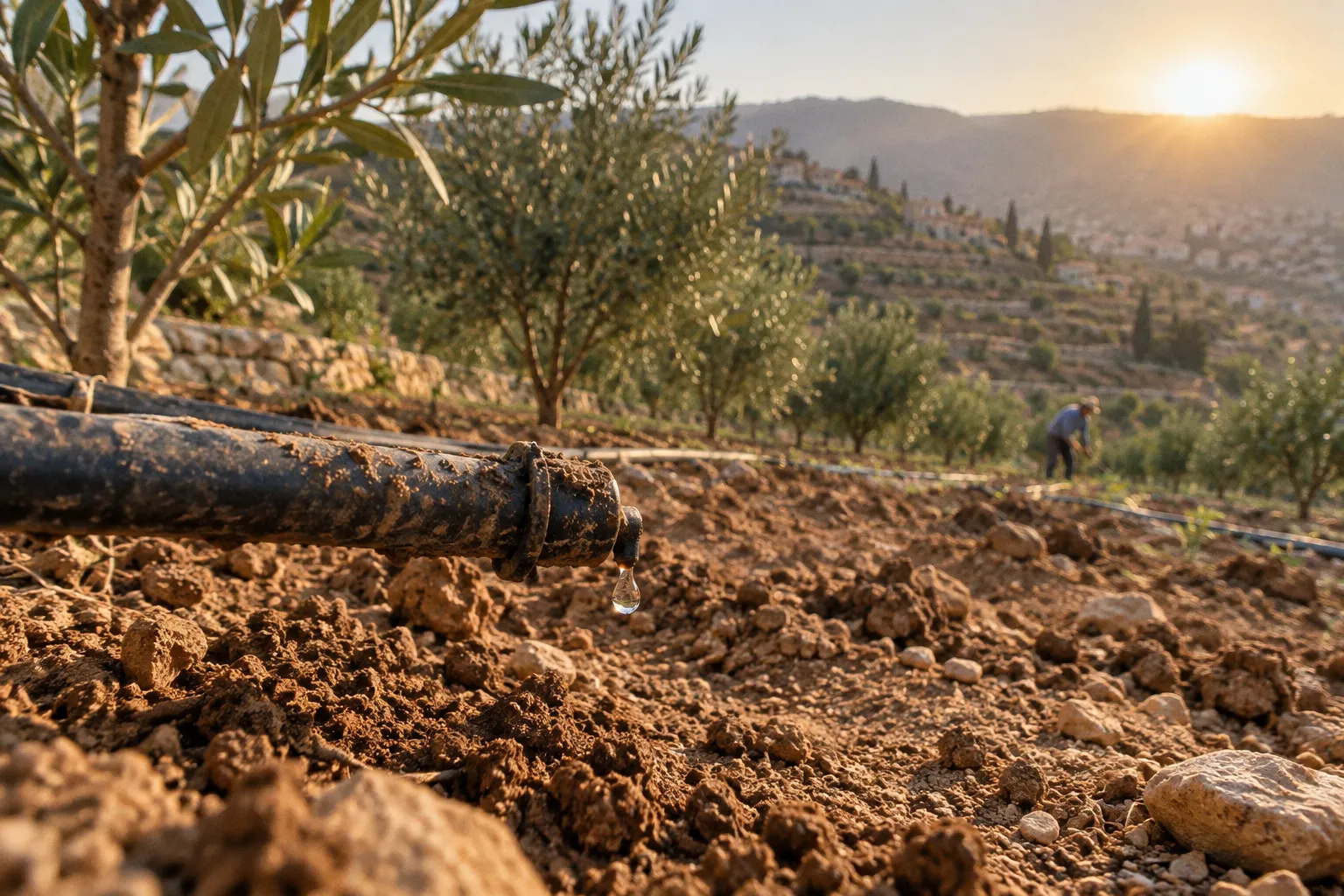
The usual sequence is measurable: a filter loads with sediment, pressure begins to drift, mineral deposits narrow emitter inlets, and the system’s total discharge falls. By the time crop stress becomes visible, the irrigation infrastructure has already been operating outside its design baseline.
For Lebanese farms, where water chemistry can vary materially between production areas and individual sources, a fixed calendar is not enough. A workable drip irrigation system maintenance schedule for Lebanese farms must combine seasonal tasks with measurements: differential filter pressure, line discharge, operating pressure, flow-meter readings, and the condition of the pump and injection equipment. Maintenance is not a cleaning ritual. It is a control system for protecting water distribution, energy consumption, and crop yield.
The first sign of a failing drip system is often not a blocked emitter. It is a deviation from the system’s original flow and pressure baseline.
The seasonal rhythm: from spring startup to winterization
A drip system should be treated as a seasonal asset with four distinct operating phases. Each phase has a different failure risk. Spring is the commissioning period; summer is the high-frequency monitoring period; autumn is the controlled shutdown; winter is the protection period.
The exact dates will depend on the crop cycle and elevation, but the sequence remains consistent.
| Season | Primary risk | Required control |
|---|---|---|
| Spring startup | Sediment, leaks, damaged seals, inaccurate pressure | Full flush, pressure audit, leak inspection, filter cleaning |
| Mid-season and summer | Emitter clogging, algae, mineral precipitation, pressure drift | Lateral flushing every 2–3 weeks, filter checks, daily flow monitoring |
| Autumn shutdown | Residual deposits, trapped water, neglected chemical treatment | Final flush, compatible acid treatment where required, line drainage |
| Winter off-season | Freeze damage, controller degradation, damaged valves and backflow devices | Drain exposed components, open manual drains, store sensitive equipment |
Spring startup: establish the baseline before planting pressure builds
The first irrigation cycle should not begin with normal crop delivery. It should begin with inspection.
Clean or service the primary screen, disc, or media filters before the system is placed under sustained load. Inspect gaskets, clamps, unions, valves, pressure regulators, injection points, and visible sections of mainline and submain. A minor leak at a fitting can become a pressure-control problem once multiple irrigation zones operate simultaneously.
The spring startup sequence should follow the hydraulic direction of the system:
1. Inspect the pump, intake, electrical connections, and control panel.
2. Confirm that the pump can reach the intended operating pressure without abnormal cycling or overheating.
3. Clean the primary filters and check that drain and backflush valves move freely.
4. Flush the mainline first.
5. Flush the submains after the mainline runs clear.
6. Flush each lateral network last.
7. Inspect the field for leaks, damaged lines, exposed tubing, and disconnected emitters.
8. Record pressure and flow readings for each representative irrigation zone.
The final step creates the baseline against which later degradation can be detected. A flow reading without a corresponding pressure reading is incomplete; the same flow reduction can result from a clogged filter, a failing pump, a closed valve, or a pressure regulator that is no longer functioning correctly.
The baseline does not need to be elaborate. A farm can begin with a written record containing:
- Pump discharge pressure during operation.
- Pressure at the beginning and end of a representative lateral.
- Total flow for each irrigation zone.
- Differential pressure across the primary filter.
- Water pH and electrical conductivity where testing is available.
- Date, duration, and crop stage of the measurement.
The value lies in repeatability. Measurements taken at approximately the same operating conditions reveal system drift more reliably than visual inspection.
Summer operation: shorten the interval between observation and correction
During the irrigation season, laterals should be flushed every two to three weeks. The objective is to remove suspended debris, biological material, and loose deposits before they accumulate at emitter inlets.
The interval should be treated as a control point rather than an exemption from observation. Water sources with elevated sediment, algae, or mineral content may require more frequent intervention. Conversely, a clean source does not eliminate the need for flushing; it only changes the rate at which the system reaches a critical condition.
Flow meters should be checked daily during the main irrigation period where the installation permits it. The purpose is not to collect data for its own sake. It is to identify a trend before crop delivery becomes visibly uneven.
A single abnormal reading can result from a valve position or a temporary pump condition. A repeated deviation is different. When total system discharge falls by approximately 5%, the network should be investigated for mineral scaling, filter loading, pressure loss, or obstruction in the laterals. The cause must be identified before selecting a treatment. Acid injection is not a substitute for diagnosis.
Mastering lateral line flushing
The flushing procedure is simple in concept and frequently performed in the wrong order. A drip network should be flushed from the largest upstream components toward the smallest downstream components:
1. Mainlines.
2. Submains.
3. Lateral driplines.
This sequence prevents accumulated sediment from the mainline or submain from being pushed into the smaller passages of the laterals. Flushing a lateral first while upstream sections remain contaminated only relocates the material.
Each section should run until the discharge becomes clear. The operator should observe the water rather than rely only on elapsed time. A fixed duration is not transferable between farms because line length, pipe diameter, source quality, flow rate, and accumulated material vary.
What to inspect during flushing
Flushing is also a diagnostic procedure. It can reveal:
- Dark or biologically active discharge, suggesting algae or bio-slime.
- Visible sand or suspended particles, indicating inadequate filtration or source disturbance.
- White or chalky deposits, consistent with mineral precipitation.
- Large variation in discharge between parallel sections.
- A lateral that clears slowly because of restricted inlet flow.
- Leaks that appear only when the line reaches operating pressure.
The operator should not close the line immediately after the water appears clear if other network sections remain upstream and unflushed. The sequence matters more than the speed of the individual action.
Flushing is not a replacement for filtration
Primary filters capture material before it enters the distribution network. Flushing removes material that has already entered the pipes. These functions are complementary.
A sand media filter may reduce suspended solids while leaving dissolved minerals unchanged. A disc or screen filter may protect against larger particles while biological material continues to develop downstream. Neither system eliminates the need for lateral flushing, and neither can correct pressure instability caused by an undersized or overloaded filtration assembly.
For farms with several irrigation zones, it is useful to record the discharge condition from the same flush points each cycle. The record does not require laboratory language. A simple classification such as clear, cloudy, sediment-bearing, or biologically colored can establish whether the cleaning interval is becoming too long.
Flushing should move contamination out of the network, not redistribute it from the mainline into the emitter passages.
Managing mineral buildup in hard water
Mineral precipitation is a separate failure mechanism from suspended sediment. The water may appear clear and still produce deposits inside the irrigation network.
When water pH is above 6.0 and electrical conductivity is high, calcium and magnesium salts can precipitate more readily. The deposits accumulate around narrow emitter passages and gradually reduce discharge uniformity. This is why a visual inspection of source water is an unreliable test for mineral risk. Water chemistry must be measured or assessed through recurring system behavior.
An acid treatment may be appropriate when:
- Total system discharge has fallen by approximately 5%.
- Emitter clogging recurs despite effective filtration and flushing.
- Chalky deposits are visible at line ends or emitter outlets.
- Water analysis indicates a mineral environment capable of scale formation.
- Seasonal inspection shows restricted flow without a corresponding filter-pressure event.
Hydrochloric, phosphoric, or nitric acid can be used in irrigation maintenance, but the selection depends on water chemistry, equipment materials, crop protection requirements, and the operator’s handling capability. The treatment should not be selected solely because it is available at the lowest purchase price.
A controlled acid-treatment sequence
Acid injection requires a defined operating procedure rather than an improvised addition to the fertigation routine.
First, establish the normal system condition. Record pressure, flow, and the affected zones before treatment. Confirm that the injection pump, non-return protection, valves, and tubing are compatible with the planned chemical. Isolate the treatment from any incompatible product. Acid should never be mixed casually with chlorine products or other chemicals; incompatibility can create hazardous reactions and can also reduce treatment effectiveness.
The system is then operated so the acid solution reaches the target lines. Maintenance treatments typically aim to reduce the water inside the irrigation lines to a pH between 2.0 and 4.0. The exact concentration and injection duration must be calculated for the system volume and the water’s buffering capacity. A nominal recipe copied from another farm is not a reliable engineering method.
Once the solution has reached the intended zone, it is allowed to react with the scale deposits. The reaction period may range from 4 to 24 hours, depending on the deposit, water chemistry, and treatment design. Crop exposure, soil conditions, and the risk of discharge into sensitive areas must be controlled during this period.
After the reaction, the network must be flushed thoroughly with clean water. This step is non-negotiable. Residual acid and loosened mineral material must be removed from the mainlines, submains, and laterals before regular irrigation resumes.
A practical treatment record should include:
- Water pH before treatment.
- Electrical conductivity where available.
- The chemical used and its concentration.
- The zones treated.
- Injection duration.
- Target pH inside the lines.
- Reaction time.
- Post-treatment flushing duration.
- Flow and pressure after treatment.
If discharge does not recover after treatment, the diagnosis should be reopened. The network may have a mechanical obstruction, inadequate pump capacity, a damaged regulator, biological clogging, or a filtration problem. Repeating acid treatment without identifying the mechanism increases chemical use without restoring performance.
Seasonal timing for chemical maintenance
Acid treatment is commonly performed once or twice during an irrigation season, or when system discharge declines by approximately 5%. It may also be appropriate before the final end-of-season flush, provided the treatment is compatible with the crop schedule and the system is subsequently flushed.
The water source must be considered separately for every farm. Groundwater composition can differ between areas, wells, and seasons. A maintenance plan developed for one source should not be transferred to another Lebanese production area without checking hardness, pH, electrical conductivity, and the actual response of the system.
Filter performance and pressure regulation
Filters are the first hydraulic control point after the water source. Their condition affects pump loading, pressure stability, emitter performance, and the frequency of downstream maintenance.
Screen and disc filters should be checked daily or before any long irrigation shift. A filter can appear structurally intact while its effective open area is being reduced by sediment or organic material. The operational indicator is differential pressure: the pressure before the filter compared with the pressure after it.
Media and disc filters should be backflushed when the differential pressure exceeds 5 psi, approximately 0.35 bar. Waiting for a visible collapse in downstream pressure creates unnecessary stress for the pump and reduces the uniformity of water delivery. Backflushing too early, however, can waste water and interrupt irrigation without removing a meaningful load. The pressure threshold provides a repeatable trigger.
A basic filter-control table can be built into the farm’s maintenance log:
| Observation | Likely condition | Corrective action |
|---|---|---|
| Differential pressure below the backflush threshold | Filter operating within the current load | Continue monitoring |
| Differential pressure above 5 psi / 0.35 bar | Filter loading is restricting flow | Backflush and inspect discharge |
| Pressure drops after filter but pump remains stable | Filter obstruction or undersized filter | Clean, service, or reassess filter capacity |
| Pressure fluctuates before the filter | Pump intake, source level, or suction problem | Inspect pump and intake conditions |
| Pressure remains normal but zone flow declines | Lateral clogging, valve restriction, or mineral buildup | Flush and compare zone-level measurements |
| Filter clears quickly but loads again immediately | High sediment or biological loading upstream | Investigate source and filtration design |
Pressure regulation is a system property
A pressure regulator cannot compensate for every hydraulic defect. If the pump is underperforming, the regulator receives insufficient inlet pressure. If a filter is blocked, the regulator may be supplied with unstable flow. If zone valves are not opening fully, the downstream pressure reading may misrepresent the condition of the network.
Pressure should therefore be measured at more than one point: near the pump or filter assembly, at the beginning of the zone, and at the end of a representative lateral. The difference between these points identifies where the loss occurs.
The pump should also be checked under the same conditions used for baseline measurement. A decrease in discharge pressure may indicate wear, suction restriction, electrical problems, impeller damage, or a change in water level. It should not automatically be treated as an emitter problem.
For installations powered by solar equipment, the measurement window matters. Pump output can vary with available power, controller behavior, and operating conditions. A pressure comparison is meaningful only when the pump and zone are operating under comparable conditions.
Monitoring system health: flow drops, leakage, and non-uniform delivery
A drip system fails gradually because it is a distributed network. One blocked emitter is usually a local fault. A persistent flow decline across an entire zone is a system fault.
The most useful monitoring approach compares three variables:
- Total zone flow.
- Pressure at the zone inlet.
- Pressure at the end of a representative lateral.
The combination is more informative than any single value.
If flow falls while inlet pressure also falls, investigate the pump, filter, upstream valve, or mainline. If inlet pressure is stable but end-of-lateral pressure declines, inspect submains, laterals, and internal restriction. If pressure remains stable while flow falls, mineral buildup, emitter clogging, or a measurement problem becomes more likely.
Leakage requires the opposite interpretation. A major leak can reduce downstream pressure while increasing pump runtime. Buried leaks may not produce an obvious wet area, especially in soil with high infiltration. Comparison of expected and measured zone flow can reveal the problem before the field does.
A useful inspection routine includes:
1. Confirm that the correct irrigation zone is open.
2. Record pump and filter pressures.
3. Record zone inlet pressure.
4. Check flow-meter output.
5. Walk the accessible line network for leaks, disconnected tubing, and damaged emitters.
6. Inspect the end of selected laterals during flushing.
7. Compare readings with the spring baseline.
8. Record the correction and the post-maintenance result.
This is a small amount of data, but it converts maintenance from visual guesswork into trend analysis.
The winterization phase
At the end of the irrigation season, the network should receive a final flush before it is drained. The purpose is to remove residual sediment and chemical products while the system can still be operated under controlled conditions.
Manual drain valves should be opened, and exposed lines should be emptied. Sensitive timers, controllers, and above-ground electrical components should be disconnected where appropriate and stored in a protected location. Backflow preventers and other vulnerable components need protection from freezing conditions.
Winterization is not limited to preventing frost damage. A drained system is easier to inspect, repair, and recommission. Leaving water and deposits inside closed sections allows mineral residue to harden and makes spring startup more expensive.
The final shutdown record should state which zones were flushed, which valves were opened, which components were removed, and whether any repairs were deferred. A system that enters winter without a documented condition will return to service with an unknown baseline.
A maintenance plan that can be implemented
A practical farm schedule can be organized around frequency rather than calendar labels:
- Before the irrigation season: clean filters, inspect seals and valves, flush the full network, check pump performance, and record baseline pressure and flow.
- Before long irrigation shifts: inspect the primary filters, verify pressure, and confirm that the pump and controller operate normally.
- Every two to three weeks during the season: flush mainlines, submains, and laterals in that order.
- Daily during peak irrigation: review flow-meter readings and investigate repeated deviations rather than isolated anomalies.
- When differential pressure exceeds 5 psi: backflush the relevant filter assembly.
- When total discharge falls by approximately 5%: diagnose the cause and consider a compatible acid treatment if mineral buildup is confirmed.
- At season end: perform the final flush, drain lines, open manual drains, and protect controllers and backflow equipment.
- During winter: store sensitive components correctly and document repairs required before spring startup.
The schedule is deliberately conservative about chemical intervention and aggressive about measurement. Flushing, filter maintenance, and pressure checks are routine controls. Acid treatment is a targeted response to a confirmed mineral problem, not a universal seasonal shortcut.
The economic logic is direct. A few pressure and flow readings can identify a restriction before the farm commits additional pump runtime, chemical treatment, or crop water stress. Conversely, a system that appears functional but has lost uniformity can continue consuming energy while delivering less water to the crop.
For Lebanese farms, the correct objective is not to maintain every drip network in the same way. It is to maintain each network against its own water chemistry, hydraulic design, and measured baseline. A system that is flushed every two to three weeks, backflushed at the 5 psi differential threshold, treated for scale when discharge falls by approximately 5%, and properly drained before winter is being managed by operating evidence rather than assumption.
That is the decisive standard. Drip irrigation maintenance becomes economically defensible when the farm can show that pressure, flow, filtration, and seasonal condition are being measured—and that each intervention restores a defined performance level.