Drip irrigation clogging: 4 ways to prevent it
Drip irrigation systems deliver water with theoretical efficiencies approaching 90%, but those numbers collapse when emitter openings—measuring only 0.3 to 1.0 mm across—become obstructed by sediment, mineral scale, or biological growth.
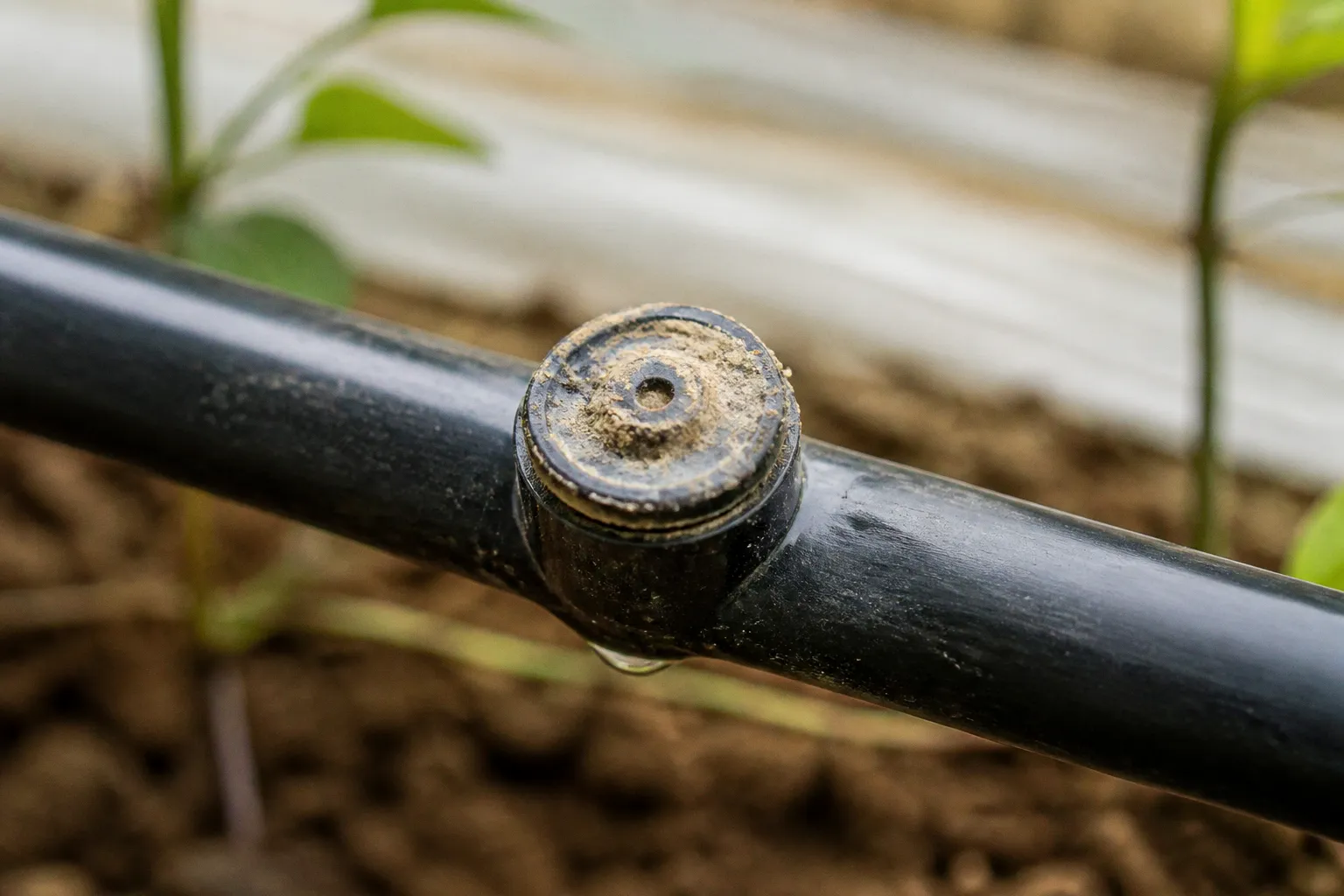
Drip Irrigation Clogging: 4 Methods to Prevent Emitter Blockage
In the carbonate-rich groundwater zones that supply much of Lebanon's coastal agricultural belt, a clogged emitter does not announce itself with a visible leak or a pressure drop at the pump. It delivers less water to its assigned plant, redistributes fertilizer unevenly, and shifts block-wide yield curves in increments too small to diagnose from the field margin.
The four operational methods that prevent this cascade—physical filtration, acid injection, chlorination, and routine lateral flushing—are not interchangeable. Each addresses a distinct failure mode, and the cost of skipping any one of them shows up in the next as accelerated wear on the others.
A 0.5 mm emitter tolerates almost nothing: a single grain of coarse sand, a flake of calcium carbonate, or a strand of bacterial slime is enough to halve its discharge.
Physical Filtration: The First Mechanical Barrier
Physical clogging originates in the water source itself: suspended sand, silt, clay particles, and organic debris carried through wells, surface intakes, or reservoir storage. The mechanical defense is an in-line filtration unit, sized to the emitter specification of the system it protects and to the contaminant profile of the source water.
Drip emitters operating at the low end of the 0.3–1.0 mm window require filtration at or finer than 200 mesh; coarser emitters tolerate disc or screen units of larger aperture. Four filter architectures dominate field deployment:
| Filter Type | Mechanism | Best Suited For | Maintenance Trigger |
|---|---|---|---|
| Screen | Woven or perforated mesh traps particles on the surface | Low-organic, low-algae water sources | Visible buildup or pressure differential rise across the unit |
| Disc | Stacked grooved discs create a three-dimensional filtration depth | Moderate sediment loads with organic content | Pressure differential exceeding manufacturer threshold |
| Media (sand) | Layered graded sand traps fine particulates through depth filtration | High organic load, surface water sources | Periodic backflush based on volume throughput |
| Hydrocyclone | Centrifugal separation removes dense sand and silt | Wells with high sand content, typically as a pre-filter stage | Periodic purge of sediment collection chamber |
For cooperatives drawing from boreholes in sandstone or limestone aquifers, a hydrocyclone pre-filter followed by a disc or screen secondary unit is a standard two-stage configuration. The hydrocyclone removes the bulk of sand before finer filtration, extending service intervals on the more expensive secondary element.
A common operational error is treating filtration as set-and-forget. Pressure differential across the filter must be monitored; once the differential rises into the manufacturer's specified cleaning range—typically a fraction of a bar above the clean baseline—flow restriction has already begun, either bypassing contaminants past stressed sealing surfaces or, more insidiously, reducing discharge uniformity across the block without triggering visible alarms.
Mineral Precipitation: Controlling Scale With Acid Injection
Chemical clogging operates on a different mechanism. Dissolved calcium, magnesium, iron, and manganese—present at elevated concentrations in much of Lebanon's groundwater—precipitate as carbonate or oxide scale when pH rises, water temperature increases, or pressure drops at the emitter outlet. The result is a gradual narrowing of the flow path that no mechanical filter can address, because the mineral is already in solution when it enters the system.
Acid injection lowers water pH to keep those minerals dissolved. The standard field approach uses sulfuric acid or hydrochloric acid injected through a chemical dosing pump upstream of the filtration stage, targeting a pH range that prevents carbonate precipitation while remaining compatible with system components and crop root zones.
Chemical clogging cannot be filtered out—only dissolved out.
The dosage required is not a fixed number. It depends on bicarbonate concentration, target pH, and the buffering capacity of the source water—all of which must be determined through laboratory analysis before any injection rate is set. Operators should not rely on default manufacturer rates; a single irrigation water test run through a competent agricultural laboratory produces a recommendation that prevents both under-dosing (no scale control) and over-dosing (crop injury, infrastructure corrosion).
In practice, injection is scheduled on a calendar basis tied to source-water quality trends: more frequently during peak irrigation season, less often during low-demand periods, or continuously where source water consistently trends toward high bicarbonate and carbonate hardness. The cost line item is straightforward—acid concentrate, dosing pump electricity, and periodic pump calibration—but the capital expenditure on laboratory analysis should be treated as a fixed operational cost, not a discretionary expense.
Biological Growth: Chlorination and Biofilm Control
Algal mats, bacterial slimes, and biofilms develop inside laterals wherever water sits, light penetrates, and nutrient loading is present. Fertigation through the irrigation line accelerates the process by feeding microbial populations directly into the pipe network. The end-state is a gelatinous occlusion downstream of the filtration stage—outside the reach of any mechanical filter.
Chlorination is the established countermeasure. Continuous low-dose injection at the system periphery suppresses microbial growth; periodic higher-concentration shock treatments dislodge established biofilm. Calcium hypochlorite and sodium hypochlorite are the common delivery forms, each with handling requirements that demand basic operator training and PPE compliance.
The residual target at the most distant emitter depends on source-water organic load and pH. Waters with high organic content consume free chlorine rapidly; waters with elevated pH shift the chlorine species equilibrium toward less-active forms. A free chlorine residual measurement at the most distant lateral—using a standard field test method—is the practical confirmation that treatment is reaching the system periphery at an effective concentration.
For cooperatives operating open reservoirs as part of their supply chain, biological control extends upstream: covered storage, periodic reservoir treatment, and intake screen cleaning all reduce the biological load entering the distribution network.
Lateral Flushing: Maintaining Velocity at the Line End
Filtration, acid, and chlorine control what enters the system and what accumulates chemically or biologically. Flushing removes what settles regardless of upstream control—fine sediment, mineral flakes, organic fragments—and it is the most frequently neglected of the four methods.
The hydraulic requirement is specific. To sweep settled material out of a drip lateral, water at the open end of the line must move at a minimum velocity of 1 foot per second (approximately 0.3 m/s). Below that threshold, fine particles settle rather than discharge; above it, the velocity gradient is sufficient to mobilize accumulated material out of the line.
Translating velocity into flow rate depends on the lateral's internal diameter:
| Lateral Diameter | Required Flushing Flow Rate |
|---|---|
| 5/8 inch (16 mm) | 1 gallon per minute (≈3.8 L/min) |
| 7/8 inch (22 mm) | 2 gallons per minute (≈7.6 L/min) |
Practical flushing procedure follows a fixed sequence: open the flush valve at the lateral terminus, allow flow until the discharge runs clear (visually evaluated for sediment color and particulates), then close the valve and move to the next lateral. The procedure is repeated for every lateral in the block—not a sample, not a subset.
Flushing frequency depends on source-water sediment load and upstream filtration performance. A baseline schedule of once per week during the irrigation season is a reasonable starting point; systems with elevated sediment input or marginal filtration typically require flushing twice weekly. Each flushing event takes minutes per lateral; the cumulative labor is measured in hours per hectare per month, not days.
Implementation Sequence and Cost Logic
The four methods are deployed sequentially in the head control unit, not in parallel:
1. Filtration at the pump station, sized to emitter specification.
2. Acid injection downstream of the pump, upstream of the filter.
3. Chlorination downstream of the filter, upstream of the sub-main.
4. Lateral flushing at the block terminus, executed on schedule by field labor.
Capital costs concentrate in stages 1 through 3: filter units, chemical dosing pumps, injection lines, and storage tanks for acid and chlorine concentrates. Operational costs shift toward chemical consumption, periodic laboratory water analysis, and labor for flushing and filter cleaning.
Capital expenditure for a small cooperative operation typically falls in the low five-figure USD range, depending on existing pump station infrastructure and source-water quality. Annual operational cost runs as a small fraction of capital, dominated by chemical consumption and field labor. Both figures vary with irrigated area and water chemistry; operators should treat them as planning estimates and refine them against actual consumption data after the first full irrigation season.
Verdict
Drip irrigation clogging is not a single failure—it is four failure modes, each governed by a different physical or chemical mechanism, each requiring a specific countermeasure. Mechanical filtration blocks sediment. Acid injection holds minerals in solution. Chlorination suppresses biological growth. Flushing velocity removes what accumulates regardless. Skipping any one stage redistributes its failure load onto the others, accelerating emitter wear, shortening filtration media life, and eroding the distribution uniformity that defines a precision system.
The numbers that govern the protocol—0.3 to 1.0 mm emitter tolerance, 1 foot per second flush velocity, 200-mesh filtration threshold—are not guidelines but operational constraints defined by the physics of low-volume irrigation. Treating them as optional converts a precision tool into a maintenance liability. Deployed in sequence and maintained on schedule, the four-method protocol recovers and preserves the distribution uniformity that drip irrigation was specified to deliver in the first place.