Clogged drip emitters: fast fix for Lebanese farms
Walking a drip-irrigated block on a hot July morning in the Bekaa, you learn to read the field by what is missing. A healthy tomato row under pressure-compensating tape should show a continuous dark line of moisture along the root zone.
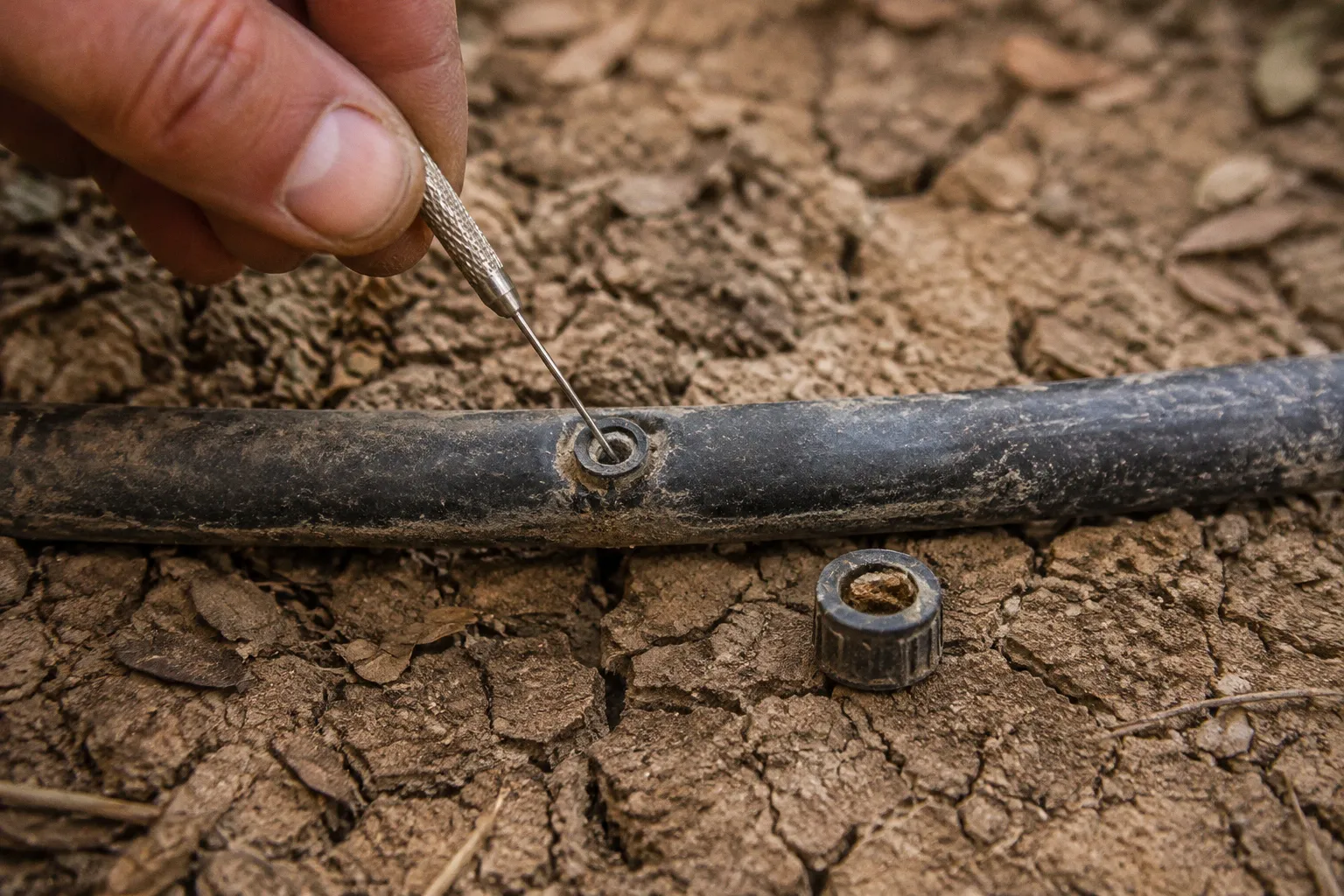
When dry patches break that line—two adjacent plants wilting while their neighbors stand firm—the cause is often upstream, in the emitters themselves. And in Lebanon, where summer irrigation windows shrink and every cubic meter of well or municipal water counts toward an export-grade harvest, a clogged emitter is not a minor maintenance issue. It is a yield issue.
Drip systems are precise by design, which also makes them unforgiving. The same emitters that deliver water and nutrients within a narrow tolerance band become the narrowest point in the entire hydraulic network. Anything entering the supply—dissolved minerals, suspended sediment, organic matter, or biological growth—can eventually collect at the emitter.
The fix is rarely a single product or chemical. It is a diagnostic habit followed by the right intervention in the right sequence: identify the obstruction, flush the system hydraulically, treat the material that remains, and flush again before returning the block to normal irrigation.
Diagnosing the Source: Why Your Emitters Are Failing
Most emitter problems fall into four practical categories: mineral deposits, physical sediment, biological growth, and fertilizer precipitation. The symptoms overlap, but the treatment does not. Acid can dissolve carbonate scale; it will not solve a badly loaded sand filter. Chlorine can control biological slime; it will not remove a chunk of gravel sitting in the labyrinth of a drip emitter.
| Clog type | Approximate share | Tell-tale signs |
|---|---|---|
| Mineral scale, including calcium and iron deposits | ~40% | White, yellow, or reddish crust on the emitter; deterioration in hard-water areas |
| Physical sediment | ~30% | Grit at line ends, cloudy flush water, blocked filters or well-screen problems |
| Biofilm and algae | ~20% | Rubbery or stringy slime inside the line; common in warm, sun-exposed tubing |
| Fertilizer precipitation | ~10% | Cloudy or chalky deposits appearing after fertigation cycles |
These proportions are useful as a field orientation, not as a laboratory diagnosis. The water source, filtration equipment, crop program, and line layout matter more than any generic percentage. A block fed from a limestone-rich well behaves differently from one supplied by a mountain spring. The same farm can also move between regimes when a cooperative blends sources during the season.
A simple flow check is the fastest way to establish whether the problem is local or systemic. Measure discharge at the beginning, middle, and end of a lateral, ideally using the same collection time and enough emitters to avoid judging the entire line from one unusual outlet. Compare the readings with the design flow and with one another. A large difference between the head and tail of the line points toward pressure loss, sediment movement, or partial blockage along the lateral. A similar reduction across the whole block suggests a filter, pump, pressure-regulator, or water-quality issue upstream.
If readings vary from design specification by more than roughly 5–10%, the system is signaling that a treatment—not just a quick end-of-line flush—may be needed. The pattern matters:
- Low flow mainly at the end of laterals often points to inadequate flushing, settled sediment, or a pressure problem in the submain.
- Low flow across the entire block calls for inspection of the filter, injection equipment, pump, and pressure-control devices.
- Irregular flow from one emitter to the next is more consistent with local clogging or damage than with a single pressure problem.
- A sudden change after fertigation raises the possibility of chemical precipitation, especially if stock solutions were mixed in the wrong order or without a compatibility check.
- Slime, odor, or recurring cloudy discharge suggests biological growth rather than mineral scale alone.
For Lebanese operations drawing from limestone-rich aquifers in the Bekaa, karst springs in the north, or municipal supplies that mix sources throughout the year, mineral scale is a common and stubborn culprit. Calcium carbonate deposits can narrow the emitter passage gradually until the discharge becomes visibly uneven. Iron deposits may appear yellow, orange, or reddish and can combine with organic matter to form a harder mass.
Biofilm thrives in warm, sun-exposed polyethylene lines that run across fields all summer. It is particularly persistent where water remains in the line between irrigation sets, where the system cycles irregularly, or where algae enter through an inadequate intake or filtration arrangement. Sediment, by contrast, usually points to a problem before the dripline: a loaded filter, a damaged well screen, insufficient separation, or a flushing routine that is too short for the amount of material entering the network.
Fertilizer precipitation has a different signature. It often follows a fertigation event and may appear as a cloudy suspension or pale solid inside filters, manifolds, and emitter passages. The cause may be the order of mixing, excessive concentration in the stock tank, unsuitable water chemistry, or a product combination that was never tested for compatibility. Do not treat every white deposit as scale. A deposit that appears immediately after a fertilizer cycle deserves a review of the fertigation recipe and mixing procedure before anyone reaches for acid.
If you diagnose by symptom alone, you will spend the season treating the wrong problem.
The Sequential Flush: Clearing Main, Submain, and Lateral Lines
Once you know what you are flushing for, flush in the right order. Otherwise, material from an upstream section can be pushed into smaller downstream passages and make the original problem worse.
The sequence is simple:
1. Flush the main line.
2. Flush the submain supply lines.
3. Flush the lateral driplines.
4. Inspect the discharge and repeat the check if the water is still carrying material.
Open the flush valves at the end of the main line first. These are usually full-port ball valves sized to pass the system's design flow. Run the line until the water is visibly clear. The required time depends on system size, line length, and contamination level, so the water coming out is a better guide than an arbitrary timer. Once the main is clean, close those valves and move to the submains.
The lateral lines come last. Manually open their ends or remove the end-caps and allow each section to discharge until the water is clean and free of visible sediment. In a cooperative system with many blocks, it is worth recording which sections produce the most material. A repeated pattern can reveal a problem in one branch, one filter station, or one water source rather than in the entire network.
Pressure matters. Flushing works best at the system's designed operating pressure or slightly above it—enough to create turbulence and carry settled particles away, but never enough to exceed the pressure rating of the tubing, fittings, or tape. A vigorous, steady discharge at the flush point is useful. A weak trickle is not.
If the flow at the lateral end is weak, check for:
- closed or partially closed valves;
- kinked or crushed tubing;
- blocked submain filters;
- a malfunctioning pressure regulator;
- insufficient pump capacity;
- air trapped in the line;
- a blockage at the entrance to the lateral.
Increasing pump pressure without finding the restriction is not a substitute for diagnosis. It can damage fittings, split tape, or force debris into an emitter passage that was only partly restricted. The goal is controlled velocity through an open line, not maximum pressure at the pump.
Look at the flush water in two ways. Some material is obvious while it is moving: sand, leaves, algae, or visible flakes. Fine silt may only become apparent after the water settles in a bucket. Both observations matter. If the bucket reveals a fine layer after the water appears clear, the system may need improved filtration or a change in the well and intake arrangement, not simply a longer flushing session.
For surface drip systems, a routine seasonal flush is the cheapest insurance a cooperative can buy. For subsurface drip, where the lines cannot be inspected easily, it becomes even more important. Scale and biofilm can build out of sight until an entire section loses flow and a row suddenly wilts in the middle of a block.
A flush also gives the operator a baseline. Measure the discharge before treatment, flush the network, and measure again. If the flow improves substantially, the problem was at least partly hydraulic and physical. If the flow remains low despite clean discharge water, the restriction may be bonded to the emitter or hidden inside the labyrinth. That is the point at which a chemical treatment becomes reasonable.
Acid Shock Treatments for Persistent Mineral Scale
Mechanical flushing moves loose sediment and debris. It does little against mineral scale that has cemented itself to the emitter diaphragm or the labyrinth walls inside a pressure-compensating emitter. For that, an acid treatment may be appropriate.
The standard treatment lowers irrigation-water pH to between 2.0 and 3.0 for half an hour to two hours, or, in severe cases, uses a longer soak before a thorough clean-water flush. The exact treatment depends on the product, concentration, water chemistry, line material, crop risk, and equipment. Acid dissolves carbonate and some iron deposits back into solution so they can be removed from the system rather than continuing to narrow the emitter passage.
This is not a treatment to apply blindly. Before injection, confirm the source of the deposit and test the procedure on a limited section if the system material or water chemistry is unfamiliar. Check the manufacturer's guidance for the dripline, emitters, valves, seals, and injection equipment. A treatment strong enough to remove scale can also damage components or create a root-zone problem if it is not followed by a complete flush.
There are two practical paths for Lebanese operations:
- Injection-grade mineral acids, typically hydrochloric or sulphuric acid diluted for irrigation systems, work quickly but require a calibrated injection pump, pH monitoring, suitable protective equipment, and trained operators. They are more appropriate for larger cooperatives operating a central fertigation skid.
- Citric acid, at around a 1% solution, is a more forgiving option for smaller operations. It can dissolve certain iron and carbonate deposits and is easier to handle with less specialized equipment, although it should still be treated as a chemical hazard and used according to the product instructions.
The aim is not to create the strongest possible acid solution. The aim is to reach the required pH at the treatment point and maintain adequate contact time throughout the affected lines. pH should be checked at the far end of the line, not only in the injection tank. A reading in the tank tells you what entered the system; it does not prove that the treatment reached the tail of every lateral.
A practical acid-flush procedure is:
1. Flush the main, submains, and laterals with clean irrigation water.
2. Isolate the block that will be treated and confirm that the injection equipment is functioning correctly.
3. Prepare the diluted solution in accordance with the product label and the equipment manufacturer's instructions.
4. Add acid to water slowly, never water to acid.
5. Inject while monitoring pH at the farthest practical point in the block.
6. Allow the solution to remain in contact for the specified treatment period.
7. Flush every section thoroughly with clean water.
8. Recheck pH and emitter discharge before returning the block to fertigation or normal irrigation.
The rule about dilution is non-negotiable: always add acid to water, never water to acid. Concentrated acid generates heat when diluted. Adding water to acid can cause localized boiling and splash concentrated material back toward the operator.
Do not assume that an acid treatment is compatible with a fertilizer program simply because both products are used in irrigation. Before combining an acidification step with any fertilizer injection, check the fertilizer label, the acid label, the irrigation-equipment guidance, and the supplier's compatibility recommendations. If there is any uncertainty, keep the treatments separate and run clean water between them. A jar test can reveal visible precipitation, but it does not replace professional compatibility advice or the product label.
After the treatment, continue flushing until the discharge pH matches the supply water or the range specified by the treatment protocol. Acid left in the line can damage components and carry an unintended chemical load into the root zone. It can also disrupt the biological balance of the soil around the emitters, which matters for a cooperative managing a fertility program across multiple blocks.
Managing Biofilm and Organic Slime with Targeted Chlorination
Where scale is primarily a mineral problem, biofilm is a biological one. Bacterial colonies and algae produce a polysaccharide matrix that adheres to tubing walls and gradually narrows emitter passages. In Lebanon's hot summers, water in black polyethylene lines can become very warm during the day, and biological growth accelerates in lines that sit full between irrigation cycles.
A chlorination program can control this growth when it is correctly dosed, monitored, and followed by flushing. The draft approach used by many irrigation teams is intermittent treatment with free chlorine at 5–10 ppm for two to four hours, followed by clean water. The actual concentration and contact time must be adjusted for the product's active ingredient, water demand, pH, line volume, and the manufacturer's instructions. Chlorine that is consumed immediately by organic matter will not provide the same treatment as chlorine that remains measurable throughout the line.
Hydrogen peroxide is another option, commonly used at roughly three to five times the chlorine concentration. Its breakdown products are water and oxygen, but it is not automatically harmless at concentrated strength. It still requires correct dosing, suitable equipment, protective clothing, and compliance with the label and local handling requirements.
For either treatment, verify the chemistry at the end of the line. Injection-tank concentration alone is not enough. The far end of the system may receive a weaker treatment because chlorine has reacted with organic material, or because the contact time is shorter than expected. The operator should know what residual or endpoint the product guidance requires before opening the block to normal irrigation.
Chlorination is most effective after physical cleaning. If a line is full of sediment, algae mats, or loose organic material, the chemical will be consumed by the material it is supposed to remove. Flush first, treat the remaining biological growth, then flush again. If the slime returns quickly, investigate the cause: sunlight entering open tanks, poor intake protection, long periods of stagnation, inadequate filtration, or irregular operating cycles.
An export-oriented cooperative should document the treatment in its maintenance log. The record does not need to become an administrative performance. It should show which block was treated, which product was used, the concentration or target residual, the start and end time, the operator, and the post-treatment flush. That information helps distinguish a recurring water-source problem from an isolated event and gives the agronomist something more useful than a memory of a tank being added sometime last month.
A monthly treatment during the heavy irrigation season may be appropriate for some systems, with additional attention after stagnation or a biological incident. It should not be treated as a universal calendar rule. Water quality, temperature, crop sensitivity, filtration, and previous test results should determine the interval.
Document the chemistry, not just the calendar—auditors read logs the way agronomists read soil.
Critical Safety Protocols for Chemical Handling and Mixing
The most dangerous mistake in drip-line maintenance is mixing acid and chlorine in the same tank, or sending one through the line immediately after the other without a complete fresh-water flush. Acids and chlorine products can react and release chlorine gas. Exposure can cause serious respiratory injury, and in an enclosed pump house, valve pit, or poorly ventilated manifold room, the consequences can be fatal.
Chlorine products also must not be mixed with ammonium compounds, including ammonium-containing fertilizers or other products that contain ammonium. That combination can produce hazardous chloramine gases. Keep chlorine treatment separate from ammonium fertilizers and do not rely on dilution in the irrigation line as a safety measure.
The same discipline applies to fertilizer compatibility more broadly. Before injecting fertilizer with an acid, chlorine product, peroxide, or any other treatment chemical, follow the fertilizer and chemical labels and the irrigation-equipment manufacturer's compatibility guidance. Check the order of mixing, required dilution, water-quality limitations, and whether a separate injection event is required. If compatibility is not clearly established, do not combine the products. Run them separately with a complete clean-water flush between treatments.
The non-negotiables for a chemical maintenance session are straightforward:
- Never combine acid and chlorine-based products in the same tank, injection line, or container.
- Never mix chlorine products with ammonium compounds, including ammonium-containing fertilizers.
- Do not combine treatment chemicals with fertilizers unless the relevant labels and compatibility guidance specifically allow it.
- Run one treatment, flush completely with clean water, and only then consider a separate treatment.
- Always add acid to water slowly, with stirring and appropriate protective equipment.
- Wear chemical-resistant gloves, splash-proof goggles, a long-sleeved shirt, and closed footwear. Larger operations should follow the respirator and ventilation requirements specified for the particular product.
- Store acids, chlorine products, peroxide, and fertilizers separately, in their original labeled containers, away from direct sun and incompatible materials.
- Ventilate pump houses and enclosed manifold rooms during preparation and injection. Leave the area immediately if a strong chlorine odor or respiratory irritation appears.
- Keep clean water and emergency washing facilities available near the chemical-handling point.
- Plan the discharge. Acidic, chlorinated, or otherwise treated flush water should not enter open surface drains, livestock water sources, or neighboring plots without following the applicable disposal and neutralization requirements.
Personal protective equipment is the last layer of protection, not the first. The first layers are separation, labeling, correct dilution, ventilation, and a written procedure. No operator should have to guess whether the product in a faded container is acid, chlorine, or a fertilizer additive.
For Lebanese cooperatives running centralized irrigation systems, a chemical-handling SOP signed by the irrigation lead and posted near the injection point catches many errors before they become incidents. It should identify the product, mixing order, target concentration or pH, required contact time, PPE, emergency contacts, and post-treatment flushing procedure. The few minutes spent writing it down are cheaper than a single exposure, damaged pump, or contaminated block.
A Practical Sequence for the Season
The maintenance sequence is not complicated, but it has to be respected:
diagnosis → hydraulic flush → targeted chemical treatment → thorough post-flush → discharge check
Diagnosis comes first because the treatment depends on the clog. Flush before chemicals because sediment and organic debris left in the lines will consume treatment capacity, obstruct the passage, and make the result difficult to interpret. Use acid for confirmed or strongly suspected mineral scale. Use chlorine or another approved biological treatment for biofilm. Do not combine incompatible treatments, and do not add fertilizers to the process unless the compatibility guidance allows it.
A cooperative can make the process more reliable by assigning one person to take measurements and another to operate valves and injection equipment. The first operator records emitter discharge, pressure, pH, and visible material. The second follows the line sequence and confirms that each section has actually been opened and flushed. This prevents a common failure: the chemical reaches the mainline, but one branch remains isolated by a closed valve.
Before returning the block to production, confirm that:
- all lateral ends have been flushed;
- the discharge is visibly clean;
- the pH or residual is back within the required range;
- filters have been inspected and cleaned;
- pressure has returned to the normal operating range;
- emitter discharge is more uniform than before treatment;
- no treated water is being discharged toward livestock, workers, drains, or neighboring plots.
Keep the records tied to the block rather than to the farm in general. A well with hard water may require a different maintenance pattern from a municipal connection. One greenhouse or field edge may receive more sunlight and develop biofilm faster. One submain may have a pressure problem that cannot be solved by dosing the whole network. Block-level notes turn maintenance from a recurring emergency into a pattern that can be managed.
For most Lebanese cooperatives, this sequence can be organized as a half-day session per block, depending on the size of the installation and the level of contamination. The expense is mainly water, treatment product, equipment, and operator time. That is small compared with the value of a uniform harvest that meets an export contract's grade and weight requirements.
The deeper point is that drip maintenance is a seasonal rhythm, not a corrective chore. Emitters clog slowly, then fail all at once. A block that has quietly lost part of its design flow for three weeks may show no obvious leaf-color change until the stress becomes difficult to reverse. Walk the rows, measure the discharge, inspect the filters, and read the system before it stops talking to you.
A clogged emitter does not always need a stronger chemical. It may need a cleaner filter, a longer flush, a corrected mixing order, or a pressure check at the far end of the line. The fastest reliable fix is the one that identifies the obstruction first and treats only what is actually there.