Cucumber bitterness prevention: the quick watering fix
The first serious heat of summer can change a cucumber crop faster than a grower expects. The vines may look healthy in the morning, with new flowers opening and fruit setting along the trellis.
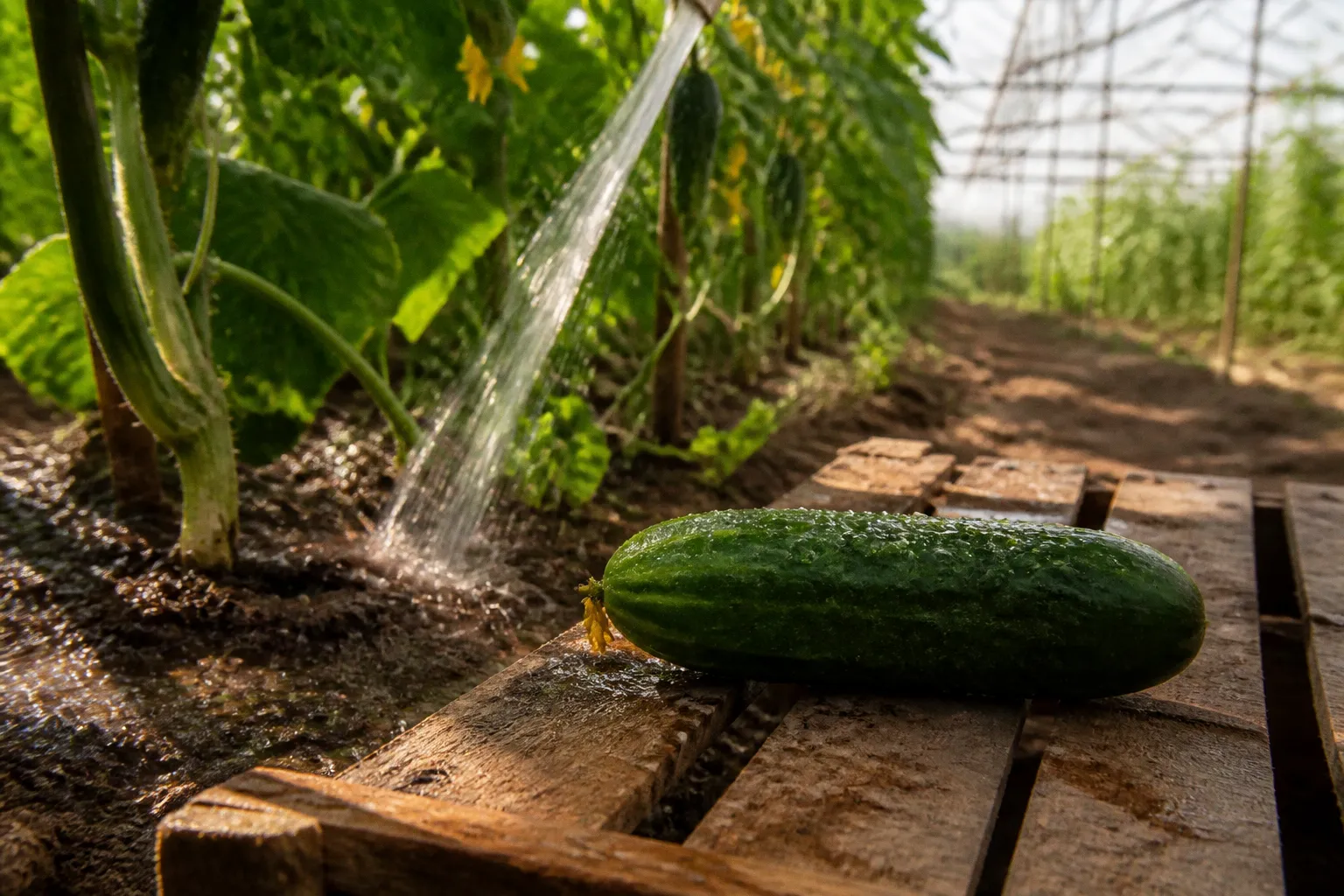
After several days of hot, dry wind and uneven soil moisture, however, the next cucumbers can develop a sharp taste, often strongest at the stem end.
For growers supplying fresh produce markets, that is more than a kitchen complaint. Bitterness can downgrade an otherwise sound lot, complicate sorting, and weaken a buyer’s confidence in the next delivery. The response is not to pour water over a stressed crop once and hope the problem disappears. Cucumber bitterness prevention during heat stress depends on acting early, keeping moisture steady, and protecting the root zone from repeated temperature swings.
This matters across smallholder groups, family plots, and community farms. The practical work is simple enough to share across a cooperative, but it has to be coordinated: irrigation should not stop at the edge of one plot, and sorting should not begin only after a buyer has found the problem.
Bitterness is not simply a taste problem at the table. It is often a stress signal from the vine, and the useful moment to respond comes before the fruit is fully formed.
The science of bitterness: why cucurbitacins spike under stress
The sharp taste in a bitter cucumber comes from cucurbitacins, a group of naturally occurring compounds produced by cucurbit plants. They are part of the plant’s defensive chemistry. Under ordinary growing conditions, the compounds are found mainly in the leaves, stems, and other vegetative parts, while the fruit remains mild enough for eating.
That balance can change when the plant is under severe stress. Heat, drought, dry wind, root damage, irregular irrigation, and sudden changes between very dry and very wet soil can all put pressure on the vine. In some plants, that stress is associated with higher cucurbitacin levels in the fruit. Variety also matters: some cucumber types are more prone to bitterness than others, so watering is not a substitute for choosing suitable seed.
The most common field pattern is a combination of heat and interrupted moisture. A cucumber plant loses water through its leaves during the hottest part of the day. If the root zone cannot replace that water, the plant begins to close its stomata and reduce growth. Flowers may abort, young fruit may stop expanding, and the plant’s defensive metabolism can become more active.
The bitter taste is often noticed near the stem end or beneath the skin, but that does not mean every affected cucumber can be made acceptable by cutting away one small section. The distribution varies from fruit to fruit. A cucumber that tastes bitter at the stem end deserves to be checked through the center before it is sent into a fresh-market lot.
This is also why a single visual inspection is not enough. A stressed vine may continue to look green while its developing fruit has already been affected. Leaves can remain upright in the morning and wilt only later in the day. By the time the crop shows obvious damage, the most useful prevention window may have passed.
Stress is not the same as ordinary heat
Cucumbers can grow in warm weather. The problem is not a warm afternoon by itself. The problem is heat combined with a root zone that cannot supply water consistently.
Several conditions make that combination more likely:
- shallow or compacted soil that holds little usable moisture;
- sandy soil where water drains quickly;
- mulch that has not been replenished after it breaks down;
- blocked or uneven drip emitters;
- irrigation that wets only the soil surface;
- exposed field edges with strong afternoon wind;
- roots damaged by cultivation, disease, or excessive traffic;
- a sudden change from dry soil to heavy irrigation.
A grower who responds only to the air temperature may miss the more important measurement: whether the soil around the active roots is still moist. Cucumber roots need oxygen as well as water, so the goal is not saturated ground. It is a stable root zone that does not swing repeatedly from dry to flooded.
The 48-hour window: how hydraulic shock triggers defensive metabolites
The phrase “48-hour window” is useful as a field reminder, not as a promise that every plant follows an exact clock. After acute heat or moisture stress, the plant can begin changing its water-use and defensive responses quickly. In practical terms, the earlier a grower corrects dry root-zone conditions, the better the chance of protecting fruit that has not yet reached its final size.
This is where hydraulic shock becomes important. A plant that has been short of water for several hot days is not helped by creating another extreme: a brief surface splash followed by more drying, or a sudden flood that runs off compacted soil. The roots need a gradual, thorough recharge of the active soil layer. Irrigation should restore moisture without washing soil away or leaving the crown submerged.
The fruit already harvested is a separate matter. Once bitterness is present in mature flesh, extra watering cannot reliably reverse it. The intervention is aimed at the vine and the fruit that will develop next. That distinction should be clear in every field protocol and every conversation with a grower.
A useful response sequence during a heat event is:
1. Check the root zone, not only the leaves. Dig or probe below the dry surface layer near the drip line. Soil that looks dry on top may still contain moisture lower down, while a thin wet layer can conceal dry soil beneath it.
2. Restore moisture slowly and deeply. Use a long enough irrigation cycle for water to move into the active root zone rather than spreading several short surface applications.
3. Inspect the delivery system. Compare emitters at the beginning and end of the row. Uneven pressure can leave one section stressed while another receives too much water.
4. Reduce evaporation. Refresh mulch and protect exposed rows from the worst afternoon heat where practical.
5. Separate new fruit from affected fruit. Mark the date of the stress event and inspect the following harvests rather than assuming the entire crop is lost.
The aim is not to sweeten the cucumber already in the hand. It is to protect the next fruit the vine is preparing to set.
Irrigation strategies: maintaining the 1 to 1.5 inch weekly standard
For actively growing cucumbers, a commonly used starting point is roughly 1 to 1.5 inches of water per week, including rainfall. The figure is a planning standard, not a fixed prescription. Actual demand changes with soil type, plant size, wind, humidity, canopy cover, and fruit load.
During a heatwave, the weekly amount may need to be divided into two or more applications so that the soil does not move from saturated to dry between irrigations. In cooler or heavier soils, one thorough application may hold moisture longer. In sandy soils, smaller intervals can be necessary because water moves beyond the root zone more quickly.
The word “deep” matters. Short daily watering may keep the surface dark while the deeper root zone dries out. It can also encourage roots to remain close to the surface, where they are more exposed to heat and evaporation. A slower application that wets the root zone evenly is usually more useful than repeated sprinkling that never moves beyond the top layer.
Drip irrigation is well suited to this crop, but only when the system is checked rather than assumed to be working. Emitter output can change with pressure, clogging, slope, and spacing. A simple container placed near the emitters can show how much water is being delivered in a set period. The purpose is not to create a laboratory calculation; it is to discover whether the end of the row is receiving something close to the beginning.
For hand-watered plots, apply water at the base of the plant and allow it to soak in. Watering in the early morning is generally the easiest way to reduce immediate evaporation and give the foliage and soil time to dry. If a second session is needed during extreme heat, it should still be aimed at the root zone rather than sprayed over the leaves at the hottest point of the day.
A practical watering rhythm
| Field condition | Practical approach | What to watch |
|---|---|---|
| Moderate warmth and well-retaining soil | One thorough irrigation may be sufficient within the weekly target | Check moisture below the surface before delaying the next watering |
| Sustained heat and dry wind | Divide the weekly amount into two or more slower applications | Avoid long dry gaps followed by runoff |
| Sandy or fast-draining soil | Use shorter intervals while keeping each application deep enough to reach the active roots | Make sure water is not moving below the root zone |
| Heavy or compacted soil | Irrigate more slowly and allow time for infiltration | Watch for ponding, root suffocation, and runoff |
| Recovery after a hot, dry period | Rehydrate the soil gradually and reassess after the first cycle | Do not assume one heavy application has corrected the whole profile |
There is no benefit in chasing a number while ignoring the field. A soil-moisture check, a working emitter, and a note about wind or recent rainfall are often more useful than a schedule copied from another farm.
Soil pH also affects nutrient availability and root function, but it should not become a distraction from the immediate problem. If a field has a known pH issue, it deserves a planned soil-management response. Adding more water will not correct poor drainage, root disease, salinity, or a badly unbalanced soil.
What not to do during a heatwave
Several emergency responses feel active but do little to prevent bitter cucumbers:
- Do not rely on a light surface sprinkle. It may cool the topsoil briefly while leaving the roots dry.
- Do not flood a compacted bed. Runoff can carry water away from the plant and create wet conditions around the crown.
- Do not irrigate only the healthiest-looking rows. Plants on field edges or at the end of a drip line may be under greater stress while still appearing green.
- Do not increase fertilizer to compensate for stress. A stressed root system is not necessarily able to use additional nutrients, and excess salts can make water uptake more difficult.
- Do not wait for bitter fruit to become the first warning. Soil moisture and irrigation performance should be checked before harvest quality declines.
Thermal management: mulching and shading against 90°F+ heat
Watering and temperature management work together. If the soil surface heats up quickly and loses moisture soon after irrigation, the plant experiences the same cycle again. Mulch helps by slowing evaporation, moderating soil temperature, and reducing the speed of wet-dry fluctuations.
A layer of straw, chopped leaves, or clean grass clippings can work well when applied over moist soil. The layer should be thick enough to cover bare ground without becoming a wet, compacted mat. Organic material settles and decomposes, so it may need to be topped up during the season.
Keep the mulch away from direct contact with the stem. A small open ring around the crown improves air movement and lowers the chance of persistent dampness at the stem base. This is especially important where nights are humid or irrigation is heavy.
Mulch is most useful when it is part of a sequence:
1. Check and correct the moisture in the root zone.
2. Apply mulch over the wetted soil.
3. Check again after the next hot spell rather than assuming the mulch has solved the problem.
4. Repair gaps along the row, particularly where wind has moved the material.
For exposed fields, temporary shade can reduce heat load during the most dangerous part of a heatwave. Lightweight shade cloth installed above the canopy is preferable to fabric pressed against the leaves. A moderate shade level can protect the crop without turning the row into a dark, stagnant tunnel. The exact material and density should be chosen according to local light, wind, and crop conditions.
Shade is a heatwave tool, not automatically a permanent crop cover. Cucumber vines still need sufficient light for photosynthesis, flowering, and fruit development. Remove or reduce temporary shade when the extreme conditions have passed, and make sure the structure is secure before a strong wind arrives.
Heat also affects pollination and fruit set. Very high temperatures can reduce flower performance, increase flower drop, and contribute to misshapen fruit. That means a heat-management plan protects more than flavor. It can help preserve the next flush of flowers and keep the crop from losing momentum after a hot spell.
Managing exposed plots
The most vulnerable areas are often predictable:
- south- or west-facing slopes;
- field margins next to bare soil, walls, or paved surfaces;
- rows where the wind dries the canopy and soil;
- the upper end of sloping ground where irrigation pressure is weak;
- young plantings with limited canopy cover;
- beds where mulch has been displaced or has not yet been applied.
These areas should receive earlier inspection during hot weather. A cooperative can assign a field worker or irrigation lead to check representative points rather than trying to treat every row identically. If one section repeatedly dries first, the answer may be a system adjustment, a different mulch depth, a shorter irrigation interval, or a change in planting layout next season.
Watering before the hottest part of the day is generally more effective than trying to cool the crop at midday. Wetting foliage under intense sun does not replace water at the roots and can increase disease pressure when leaves remain damp later. The priority is to have usable moisture in the soil before the plant reaches the peak of its daily demand.
Salvage tactics: identifying and trimming affected fruit
A bitter cucumber should not be disguised as a normal one. Cutting, peeling, cooking, or mixing affected fruit into a large box does not create a reliable quality-control system. The better approach is to test, separate, and route the harvest honestly.
Start with a small sample from each lot, especially after a heat event or a period of irrigation failure. Taste the stem end first, then check a slice from the middle. If the stem end is noticeably bitter, do not assume the rest of the load is unaffected. Sample more than one cucumber because stress may be uneven across the field.
For mildly affected fruit intended for household use, thorough peeling and removal of the stem end may reduce the unpleasant taste. That is a salvage option, not a guarantee. If bitterness remains in the center or is strong enough to dominate the flavor, the fruit should not be placed in a fresh-market lot.
Sorting at the packing shed is more efficient than expecting every grower to make a separate marketing decision while rushing to harvest. The categories can remain simple:
- Fresh-market fruit: mild, firm, properly sized, and free of detectable bitterness.
- Household or processing use: fruit with minor cosmetic defects or slight localized bitterness that can be assessed and used appropriately.
- Reject or compost: fruit with strong bitterness, decay, severe damage, or uncertain quality.
The exact routing depends on the buyers available to the cooperative. What matters is that the standard is consistent. A single mixed load can make a buyer question the entire shipment, including the cucumbers that were perfectly sound.
The cooperative response
Cucumber bitterness prevention is partly an irrigation issue and partly a coordination issue. A shared plan turns scattered observations into an early warning system.
Individual growers can:
- inspect the root zone during heatwaves rather than judging only by leaf color;
- report blocked emitters, low pressure, or dry sections of a row;
- flag fruit that tastes bitter before the main harvest is packed;
- record the timing of heat, irrigation, and the first signs of stress;
- avoid sending suspect fruit into a mixed lot.
Irrigation leads can:
- coordinate watering times across neighboring plots;
- check whether the shared system can maintain pressure during peak demand;
- compare the first and last emitters in each line;
- prioritize young, exposed, or fast-draining sections when water is limited;
- make sure a heatwave schedule is understood by every grower.
The field team can:
- keep mulch materials available before the hottest weeks;
- maintain basic measuring tools and a shared weather log;
- inspect vulnerable field edges and sloping rows;
- help growers distinguish dry soil from poor drainage;
- record which varieties and planting locations show repeated bitterness.
The packing shed team can:
- sample incoming lots consistently;
- keep fruit from stressed blocks identifiable until it has been checked;
- separate fresh-market cucumbers from salvageable product;
- report quality patterns back to the field instead of treating every rejection as an isolated event.
This division of work is not bureaucracy for its own sake. It prevents the common failure in which everyone notices the same problem but assumes someone else has already acted. A cooperative does not need a complicated digital system to begin. A dated notebook, a field map, a few agreed thresholds for reporting, and a person responsible for following up can make the response much more reliable.
Building a heat-stress protocol that works in real fields
The best protocol is one growers can use while harvesting, irrigating, and dealing with the rest of the season. It should fit the crop and the available equipment.
Before a heatwave:
- inspect drip lines, filters, connectors, and emitters;
- repair gaps in mulch and apply it before the soil becomes severely dry;
- identify rows with poor pressure or fast drainage;
- prepare temporary shade for the most exposed areas;
- agree on who records the weather and irrigation response.
During the heatwave:
- check soil moisture at root depth in several locations;
- irrigate deeply enough to wet the active root zone;
- divide applications when one large irrigation would cause runoff or prolonged saturation;
- inspect flowers and young fruit for heat-related damage;
- avoid unnecessary cultivation around shallow roots;
- sample early fruit from stressed sections before packing the main harvest.
After the heatwave:
- continue checking the following flushes of fruit;
- remove fruit that is clearly bitter or damaged;
- review whether the problem was caused by insufficient water, uneven delivery, poor soil cover, or an unsuitable planting site;
- repair the system before the next hot period;
- update the cooperative’s notes while the sequence of events is still clear.
The point of keeping records is not to create false precision. It is to make next season’s decisions less dependent on memory. A note that one row dried first, one emitter line under-delivered, or one variety handled heat better can be more valuable than a generalized instruction to water more.
A season’s quality is built before the harvest reaches the shed
There is no single input that guarantees a bitter-free cucumber crop. Irrigation cannot correct a variety that is naturally prone to bitterness, and mulch cannot compensate for a blocked drip line. Shade will not replace water, while extra water will not solve poor drainage or root disease.
The quick watering fix is therefore best understood as the first move in a broader response. Check the soil early, restore moisture evenly, protect the root zone, and watch the next fruit rather than waiting for the problem to appear in a packed box. When the crop is grown across several plots, share the observations and keep the quality standard consistent from field to shed.
For growers facing a heatwave, the priorities are straightforward:
1. Check moisture below the surface near the active roots.
2. Correct dry conditions with a slow, thorough irrigation rather than a brief sprinkle.
3. Keep the weekly water supply within the crop’s needs, adjusting the interval for soil and weather.
4. Refresh mulch over moist soil and keep it clear of the stems.
5. Use temporary shade on the most exposed rows when temperatures remain extreme.
6. Sample fruit from stressed areas before combining the harvest.
7. Separate questionable cucumbers instead of risking the quality of the whole lot.
8. Record what happened so the next heat event is met with a prepared response.
Heat will remain part of summer production. The practical advantage comes from removing the avoidable shocks: a dry root zone, a broken emitter, bare soil under a strong sun, or a bitter fruit that reaches the buyer because nobody sampled the lot.
That work is repetitive and not especially dramatic. It is also where fresh-produce quality is won. Stable water, covered soil, timely observation, and disciplined sorting give the vine a better chance to keep its defensive chemistry where it belongs and give the cooperative a better chance to deliver cucumbers that buyers can trust.