Compost types for Lebanese farms: a selection guide
Lebanese agriculture accounts for approximately 60–70% of the country’s annual freshwater diversions, while the country generates an estimated 3,500 tons of municipal solid waste every day.
Between 50% and 70% of that waste is organic, equivalent to roughly 1,500–2,100 tons daily. The apparent contradiction is operational rather than theoretical: farms need more stable soil moisture, while cities and processing industries generate large volumes of organic residues that are often poorly separated.
This is the central case for compost selection for Lebanese farms. The question is not whether organic matter should be added to soil. In a Mediterranean production system with a dry summer lasting approximately four to six months, the question is which amendment can improve water retention without introducing pathogens, excess phosphorus, heavy metals, salts, or an unstable carbon load.
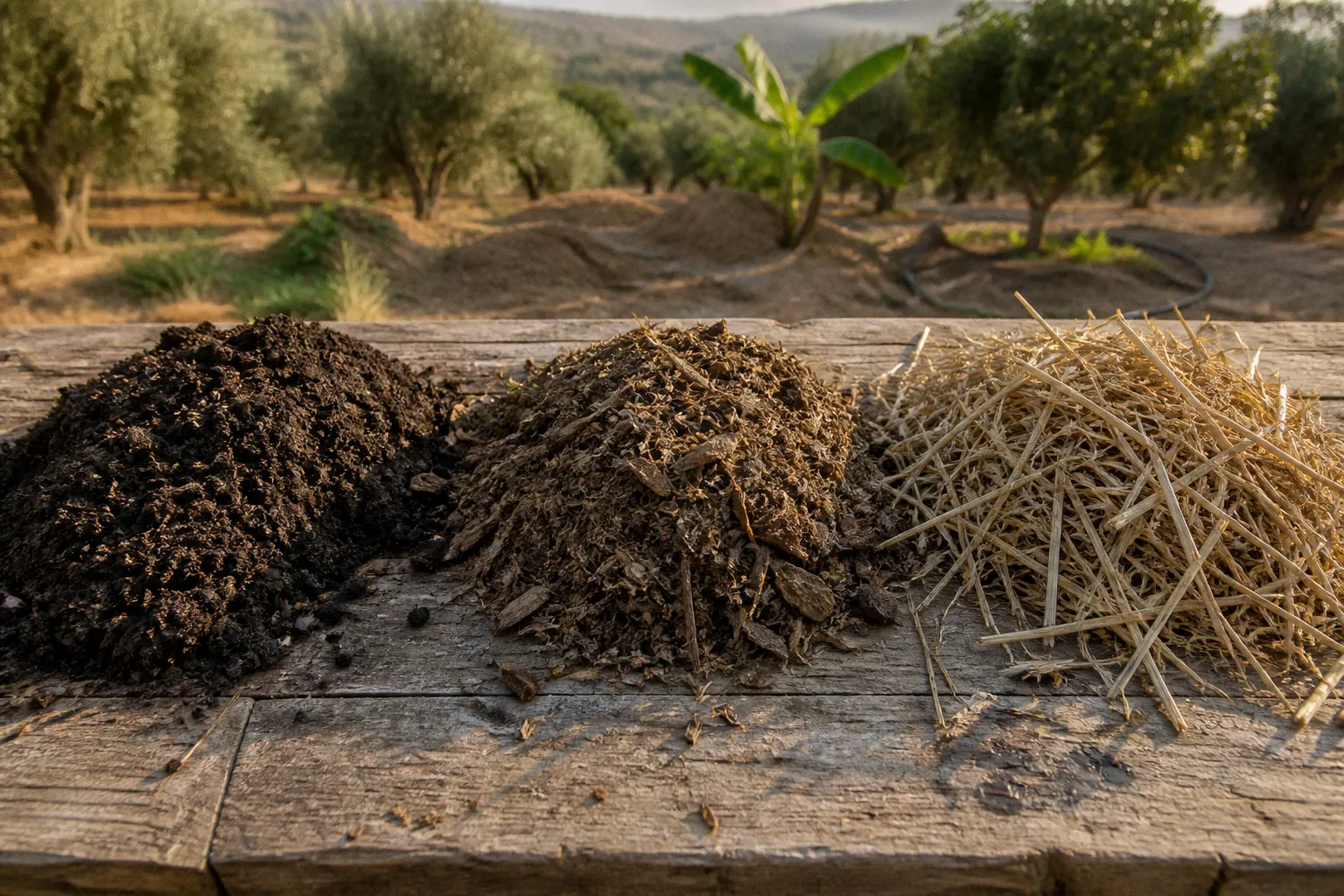
The answer depends on feedstock, processing method, soil condition, crop, irrigation system, and the level of quality control available to the cooperative. Olive-mill pomace, livestock manure, municipal organics, vermicompost, and biochar are not interchangeable products. They have different nutrient profiles, different contamination risks, and different capital requirements.
The critical role of organic matter in Lebanese water management
A compost program should begin with a soil-water problem, not with the availability of a waste stream.
In Lebanon, the practical value of compost is linked to the soil’s ability to retain water between irrigation events. Organic matter can improve aggregation, reduce surface sealing, increase infiltration, and provide a more stable root-zone environment. These effects are particularly relevant in the Bekaa Valley and other agricultural areas where summer irrigation must compensate for a prolonged period with limited rainfall.
However, compost is not a substitute for irrigation infrastructure. It does not correct a leaking distribution network, compensate for excessive application rates, or eliminate the need to measure soil moisture. Its role is to modify the soil’s hydraulic behavior so that available water remains useful for longer.
The performance variables are therefore measurable:
- Soil organic matter before and after amendment.
- Electrical conductivity, especially in protected cultivation and irrigated fields.
- Soil pH and available phosphorus.
- Infiltration rate and surface runoff after irrigation or rainfall.
- Volumetric soil moisture at defined depths.
- Irrigation frequency and total applied water.
- Crop yield and marketable yield, not merely total biomass.
- Incidence of nutrient deficiency, salinity stress, or root-zone disease.
A cooperative that applies compost without recording these baseline metrics is not operating a soil-health program. It is moving material from one location to another and hoping that the chemistry is favorable.
In Lebanese conditions, compost is valuable because it changes the water budget of the root zone. It is not valuable merely because it is organic.
The amendment must also be matched to the soil texture. Sandy soils may benefit from stable organic matter that improves water-holding capacity. Heavy clay soils may benefit from mature compost that improves aggregation and drainage, but excessive application of fine, wet, or poorly stabilized material can reduce aeration. Calcareous soils create another constraint: high pH and carbonate content can limit the availability of certain micronutrients, so compost should not be treated as a universal correction for iron, zinc, or phosphorus availability.
For farms in the Bekaa, the operational sequence is straightforward:
1. Sample the soil at a consistent depth and from representative production blocks.
2. Record irrigation volume or runtime, crop type, and recent fertilizer applications.
3. Test the amendment independently before spreading it.
4. Apply a controlled rate to a defined area rather than distributing an unmeasured load across the farm.
5. Repeat soil and crop observations during the following production cycle.
6. Adjust the amendment strategy based on changes in moisture, salinity, nutrient balance, and yield.
This is slower than applying raw manure by visual estimation. It is also the only method that can separate an improvement in soil structure from a temporary nutrient flush.
Feedstock determines the product
The word “compost” conceals too much. Two products can both be dark, friable, and sold under the same label while having materially different nutrient concentrations and contamination profiles.
The first screening variable is feedstock separation. Clean agricultural residues, livestock manure, and properly managed olive-mill by-products are fundamentally different from mixed municipal waste. The latter may contain plastics, glass, treated materials, batteries, and other sources of physical or heavy-metal contamination. A finished product that resembles compost is not automatically suitable for food production or organic certification.
The Lebanese Compost Ordinance of 2004 established national standards for compost quality. That regulatory foundation is relevant, but a standard is useful only when the input stream, processing conditions, testing, and traceability are controlled. European waste-management practice places particular emphasis on source separation because contamination is difficult and expensive to remove after mixed waste has entered the processing line. The same principle applies to Lebanese cooperatives.
Comparison of major amendment types
| Amendment type | Primary value | Main risks | Best operational use |
|---|---|---|---|
| Mature plant-based compost | Broad improvement in soil structure and organic matter | Immaturity, weed seeds, variable nutrient content | Field incorporation before planting and routine soil-conditioning programs |
| Treated livestock manure compost | Nitrogen, phosphorus, organic matter, and local availability | Pathogens, excess phosphorus, ammonia loss, salt loading | Controlled use after composting and nutrient analysis |
| Olive-mill pomace compost | Converts a major agro-industrial residue into a soil amendment; contributes carbon | Phenolic compounds, salinity, poor decomposition, inconsistent mixing | Blended and matured compost, not direct application of untreated residue |
| Vermicompost | Fine, biologically active amendment with useful nutrient availability | Higher labor and infrastructure requirements; feedstock sensitivity | Nursery production, transplant zones, high-value crops, and targeted applications |
| Biochar | Persistent carbon structure, water-holding support, and nutrient-retention potential | High variability by feedstock and pyrolysis conditions; can immobilize nutrients initially | Blended with compost and deployed in defined soil blocks |
| Compost from mixed municipal organics | Potentially large volume and urban waste diversion | Heavy metals, plastics, glass, pathogens, unclear traceability | Only where source separation, testing, and end-use compliance are demonstrable |
The distinction between raw material and finished amendment is decisive. Olive-mill pomace, or jeft, can be a useful carbon feedstock, but untreated residues may contain compounds that inhibit germination or interfere with soil biology. The correct intervention is controlled composting or blending, not direct dumping under the assumption that all organic residues are beneficial.
The same applies to banana residues, corn cobs, straw, and other crop biomass. Their value depends on particle size, moisture, carbon-to-nitrogen balance, aeration, and residence time in the composting system. A cooperative should document these variables rather than rely on color or odor as a proxy for maturity.
Traditional compost, vermicompost, and the question of scale
The comparison between vermicomposting and traditional composting in Lebanon is often presented as a choice between a superior biological process and an inferior conventional one. That framing is incorrect. The two systems solve different logistical problems.
Traditional aerobic composting is generally better suited to larger and more heterogeneous volumes. It can process manure, straw, crop residues, and olive-mill by-products when the mixture is correctly balanced and regularly managed. Its major requirements are space, drainage control, aeration, moisture management, and a monitoring routine that identifies overheating, anaerobic zones, and incomplete stabilization.
Vermicomposting requires a more controlled feedstock. Earthworms are sensitive to excessive heat, salinity, ammonia, acidity, and unsuitable particle size. The resulting material can be valuable, particularly for nurseries, transplant production, and intensive vegetable systems, but the process is not a direct replacement for a high-throughput composting platform.
The practical distinction is capacity versus precision:
- Traditional composting handles bulk organic matter and is compatible with cooperative-scale residue management.
- Vermicomposting produces a more refined amendment but requires tighter process control and a narrower operating envelope.
- Traditional composting is better for rebuilding a field’s organic matter across larger areas.
- Vermicompost is better used where the economic value of each kilogram of amendment is higher, such as seedling production or high-value crops.
- Vermicomposting does not eliminate the need for pre-composting when the input material is fresh manure or a heat-generating mixture.
- Neither system should be evaluated without testing the finished product for maturity, salinity, pathogens, and nutrient concentration.
A sensible Lebanese farm system can use both. Bulk residues can pass through an aerobic composting stage, while a selected fraction of mature material is refined through vermicomposting for nursery and transplant applications. This layered model reduces the pressure to make one process perform every function.
A practical selection matrix
| Farm condition | Preferred starting amendment | Reason |
|---|---|---|
| Sandy or rapidly draining soil | Mature compost with stable organic matter, potentially blended with biochar | Supports water retention and aggregation without relying solely on soluble nutrients |
| Heavy soil with poor infiltration | Mature, structurally stable compost applied at a controlled rate | Can improve aggregation; excessive wet or immature material may worsen aeration |
| High phosphorus from repeated manure use | Low-phosphorus plant compost or residue-based amendment | Reduces further phosphorus loading while maintaining carbon inputs |
| Nursery or transplant production | Screened vermicompost blended into a tested growing medium | Provides a fine-textured amendment suited to high-value, controlled applications |
| Olive-growing region with access to jeft | Mature compost made from treated olive-mill residue and complementary nitrogen material | Uses a local residue while reducing the risks of untreated pomace |
| Farm with uncertain municipal waste supply | Do not use the material until traceability and laboratory results are available | Appearance cannot establish food-production safety |
| Drought-exposed field blocks | Mature compost plus measured irrigation and soil-moisture monitoring | Addresses both water retention and application efficiency |
The best compost for Bekaa Valley soil is therefore not a single branded category. It is the amendment that solves the dominant constraint without creating a larger one. If phosphorus is already accumulating, manure-heavy compost is a poor default. If irrigation water is saline, a compost with elevated soluble salts can intensify the problem. If the field has low carbon but acceptable nutrient levels, a stable carbon amendment is more rational than another nutrient-rich input.
Quality control is the difference between soil amendment and waste disposal
Compost quality begins before the windrow is built. Source separation is the first control point, because heavy metals and physical contaminants cannot be reliably corrected through ordinary biological decomposition.
A cooperative receiving organic residues should establish an intake record for each batch. At minimum, the record should identify:
- Feedstock origin and collection date.
- Proportion of manure, crop residues, olive-mill waste, and other inputs.
- Presence of plastic, glass, treated wood, or mixed municipal waste.
- Moisture condition at intake.
- Composting start date and turning or aeration schedule.
- Temperature history where monitoring equipment is available.
- Maturation period and screening process.
- Laboratory results for pH, electrical conductivity, organic matter, nitrogen, phosphorus, potassium, and relevant contaminants.
The temperature profile is useful for evaluating pathogen reduction and process performance, but a warm pile is not automatically a finished product. A compost pile can reach elevated temperatures and later remain immature, phytotoxic, or chemically unstable. Maturity is better assessed through a combination of process history, odor, texture, respiration or stability tests where available, and crop response.
Raw manure presents a specific risk in livestock-dense areas such as the Bekaa and Baalbek-Hermel. Repeated application can accumulate phosphorus beyond crop demand, increasing the risk of runoff and nutrient loss. Fresh manure can also carry pathogens and create ammonia losses. This is not an argument against livestock manure. It is an argument for treatment, testing, and nutrient accounting.
The cooperative should calculate nutrient inputs from all sources, including compost, manure, mineral fertilizer, irrigation water where relevant, and crop residues. An amendment application that appears modest by volume can still be substantial in phosphorus or soluble salts if the material is nutrient-dense.
For farms pursuing organic certification, the compliance question is even narrower. Organic origin does not guarantee certification eligibility. Mixed municipal waste compost, even when described as organic, may be unsuitable because contamination and chain-of-custody requirements are not satisfied. The input stream must be traceable, the processing system documented, and the final product consistent with the applicable certification rules.
A compost label describes intent. A laboratory result describes the material.
Olive-mill waste: a local resource with a narrow operating window
Lebanon’s olive sector produces residues that can support a more circular agricultural system, but olive-mill waste is not a ready-made soil conditioner.
Jeft and related pomace materials are carbon-rich and can be integrated into composting systems with manure, green residues, straw, or other nitrogen-bearing inputs. Their use requires attention to moisture, aeration, decomposition rate, and the chemical characteristics of the residue. Direct application of fresh or poorly processed pomace can create uneven decomposition and may expose crops to phytotoxic compounds.
The appropriate model is a controlled blend:
1. Characterize the olive-mill residue before mixing.
2. Combine it with complementary feedstocks rather than composting it as a single material.
3. Maintain an aerated, adequately moist pile.
4. Monitor the process until the material is stable and no longer behaves like fresh residue.
5. Test the finished compost for salinity, maturity, nutrient concentration, and contaminants.
6. Apply it first to a limited field block.
7. Compare soil and crop metrics against an untreated or conventionally managed block.
The advantage is local availability and the potential to reduce disposal pressure around olive-processing areas. The limitation is variability between mills, harvest periods, extraction processes, and storage conditions. A cooperative that aggregates jeft from multiple sources should not treat the material as homogeneous. Batch-level records are necessary.
This is also where biochar can enter the system. Crop residues such as corn cobs, straw, and woody biomass can be converted through pyrolysis into a more persistent carbon material. Biochar’s performance depends on feedstock and production temperature, so the term alone does not establish quality. A high-ash material with elevated pH may behave very differently from a porous, stable biochar produced from a cleaner feedstock.
Biochar should be integrated, not romanticized
Biochar is often described as a permanent solution for soil carbon, water retention, and nutrient efficiency. The technically accurate description is narrower: biochar is a variable carbon material whose value depends on its physical structure, chemical composition, and interaction with the receiving soil.
Fresh biochar may have a high surface area and can retain nutrients, but it may also temporarily immobilize nitrogen or alter pH. This is why blending biochar with mature compost before application is usually more rational than applying unconditioned biochar directly to a crop root zone. The compost supplies nutrients and biological activity; the biochar contributes a more persistent structure.
A Lebanese cooperative considering biochar should assess four inputs:
- Feedstock: crop biomass, woody material, manure-derived material, or mixed residues.
- Production conditions: pyrolysis temperature, oxygen limitation, and process consistency.
- Product chemistry: pH, ash content, electrical conductivity, carbon stability, and contaminant profile.
- Soil response: moisture retention, nutrient availability, root development, and yield.
Biochar has a stronger strategic case in soils where the amendment can remain in place for multiple seasons and where water management is already measured. It has a weaker case when the cooperative lacks basic compost maturity testing, applies irrigation by schedule rather than soil demand, or cannot distinguish changes in yield from seasonal variation.
The capital expenditure is also different from ordinary composting. A biochar system may require pyrolysis equipment, feedstock preparation, energy management, emissions controls, operator training, and maintenance. Those costs should be compared with the value of the residue being processed and the expected duration of the soil benefit. A low-cost feedstock does not make a processing unit economically efficient by itself.
The most defensible deployment is a controlled pilot on defined plots, not a farm-wide conversion. Measure soil moisture, electrical conductivity, nutrient availability, and marketable yield over more than one crop cycle where possible. If the system cannot produce a traceable, consistent product, its apparent sustainability advantage is not yet an operating advantage.
Building a cooperative compost system in phases
A cooperative should not begin by purchasing the largest available machine. The first investment should be information infrastructure.
Phase one: establish the baseline
Map the available residues and the receiving farms. Record seasonal quantities of manure, olive-mill waste, crop biomass, and separated green waste. At the farm level, divide fields according to soil texture, crop, irrigation method, and known nutrient issues.
Collect baseline samples before application. A minimum dataset should include soil organic matter, pH, electrical conductivity, available phosphorus, and a basic nutrient profile. Where water retention is the stated objective, add soil-moisture measurements at consistent depths.
This phase has low capital expenditure and high decision value. It prevents the cooperative from building a processing system around a feedstock that is chemically unsuitable or seasonally unavailable.
Phase two: standardize feedstock and process controls
Create acceptance rules. Reject or isolate loads containing visible plastic, glass, treated materials, or mixed waste of uncertain origin. Separate manure, crop residues, olive-mill waste, and municipal organics rather than combining everything at intake.
Document pile construction, moisture, aeration, temperature, and maturation. The equipment can remain simple if the process is disciplined. A loader, screened storage area, drainage controls, and basic monitoring tools may produce more reliable results than automated equipment operated without batch records.
The output should be sold or distributed by tested batch, not by color or volume alone. Every batch should have a basic product sheet with origin, processing date, test results, and recommended use.
Phase three: match products to farms
Do not distribute one universal compost to every member farm. Create product classes based on feedstock and analytical results.
A mature plant-residue compost may be suited to field incorporation. A manure-rich compost may require phosphorus limits and lower application rates. Vermicompost may be reserved for nurseries and high-value crops. Biochar-compost blends may be tested in drought-exposed plots rather than applied indiscriminately.
This product segmentation improves the potential return on investment because it links the amendment to a defined agronomic function. It also reduces the risk that a nutrient-dense product will be over-applied to a field that needs carbon but not additional phosphorus.
Phase four: evaluate performance in agricultural terms
The cooperative should calculate benefits using farm metrics rather than waste-diversion volume alone:
- Reduction in irrigation events or applied irrigation volume.
- Change in marketable yield.
- Reduction in mineral fertilizer purchases.
- Decline in crop losses associated with poor soil structure.
- Cost of transport, turning, screening, testing, and storage per unit of usable amendment.
- Percentage of each batch rejected or downgraded.
- Labor and equipment hours required per production cycle.
- Revenue from compost, vermicompost, or biochar products where a market exists.
A compost project that diverts organic waste but increases salinity, phosphorus loading, or crop disease is not sustainable. The system boundary must include the receiving soil.
The cost-benefit equation is broader than purchase price
For Lebanese agricultural cooperatives, the financial decision has three layers.
The first is direct capital expenditure: composting pads, drainage, storage, screening, loaders, monitoring equipment, laboratory analysis, vermicomposting beds, or biochar processing units.
The second is operating expenditure: labor, transport, turning, water management, feedstock preparation, testing, rejected loads, and product handling. Transport can dominate the economics when bulky organic residues move over long distances. Local processing near olive mills, livestock areas, or cooperative aggregation points is therefore more defensible than centralized processing without a transport model.
The third is agronomic return: water savings, yield stability, reduced input purchases, improved product quality, and reduced waste-disposal costs. These returns may appear over multiple seasons rather than within a single harvest.
A simple return-on-investment model should therefore compare the amendment system with the existing baseline:
Net return = value of measurable agronomic gains + avoided disposal or input costs − capital expenditure − annual operating expenditure
The model should use measured or conservative assumptions. It should not assign a financial value to vague claims such as “better soil biology” unless that claim is connected to a measurable reduction in irrigation, fertilizer, crop loss, or labor.
For a cooperative with limited capital, the priority order is usually clear:
1. Source separation and intake controls.
2. Basic soil and compost testing.
3. Reliable aerobic composting infrastructure.
4. Covered maturation and storage.
5. Screening and batch traceability.
6. Vermicomposting for targeted high-value applications.
7. Biochar production after feedstock and market viability are demonstrated.
This sequence is less technologically impressive than beginning with a pyrolysis unit, but it has a stronger probability of producing usable data and stable agricultural returns.
A decision framework for Lebanese farms
The most appropriate amendment can be selected through five questions:
- What is the dominant soil constraint: low organic matter, poor infiltration, rapid drainage, salinity, phosphorus accumulation, or nutrient deficiency?
- Is the feedstock separated and traceable from source to finished product?
- Has the material been tested for maturity, salinity, nutrient content, pathogens, and contamination?
- Does the farm have the irrigation and soil-monitoring capacity to detect a response?
- Can the cooperative process, transport, store, and apply the amendment at a cost lower than its measurable agronomic value?
If the answer to the second or third question is no, the material should not be applied to food-production fields merely because it is locally available. If the answer to the fourth question is no, the cooperative may still use compost, but it will not be able to calculate its water-management benefit. If the answer to the fifth question is no, the program requires redesign before expansion.
For regenerative farming in Lebanon, soil health is not a branding layer placed over conventional input use. It is a resource-accounting system. Carbon enters the farm through manure, crop residues, pomace, compost, and biochar. Nitrogen and phosphorus enter through those same pathways. Water is retained or lost according to soil structure, organic matter, irrigation practice, and weather. Every input has a downstream effect.
The numbers-based verdict
For most Lebanese farms, mature, source-separated aerobic compost is the rational first-line amendment. It has the broadest application range, can use local agricultural residues, and requires less specialized infrastructure than vermicomposting or biochar production. Its performance still depends on testing and process control; untreated manure and unprocessed olive-mill waste are not equivalent substitutes.
Vermicompost is best treated as a precision product for nurseries, transplant zones, and high-value crops rather than as the primary solution for rebuilding organic matter across large fields. Biochar has a credible role in drought adaptation and long-term carbon management, but only when feedstock quality, pyrolysis conditions, blending, and plot-level measurement are controlled.
The strategic opportunity is substantial: Lebanon’s estimated 1,500–2,100 tons of organic municipal waste per day and its agricultural residues could support a more circular soil-amendment economy. The operational constraint is equally substantial: mixed waste, inconsistent processing, untreated manure, and weak batch traceability can convert a waste-reduction program into a soil-contamination program.
The definitive selection rule is therefore simple. Choose the amendment with the clearest feedstock history, the most complete laboratory profile, and the strongest connection to a measured soil constraint. For a cooperative, reliable data and controlled application will produce a higher return than the most advanced technology deployed without them.