Apple exports to Egypt: a phytosanitary compliance plan
Egypt can be an attractive nearby market for Lebanese apples, but the short sea distance does not make the shipment simple.
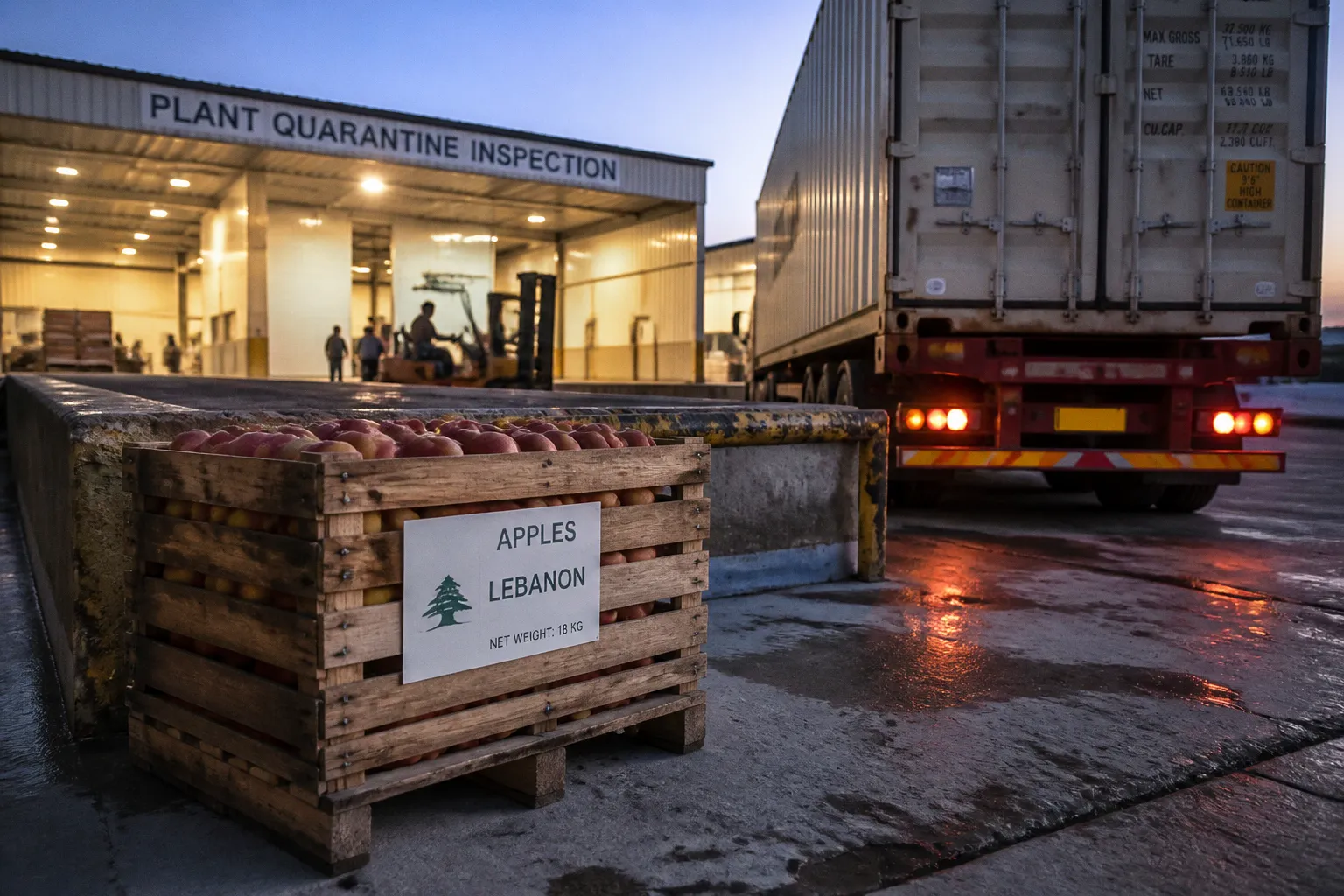
A container can leave Beirut with a clean commercial margin and arrive at Alexandria or Damietta carrying a very different calculation: customs valuation, port charges, documentation delays, sampling, storage, and any corrective action required by the authorities.
A working cost model often used by exporters places the customs tariff at 40% of the CIF value, with a 3% administration charge and a 1% surcharge added to the customs stack. That produces a headline burden of 44% of the declared CIF value before port handling, cold storage, inland delivery, or financing costs are counted. The rates and application basis must be confirmed for the shipment and product classification before contracting, but the commercial lesson is stable: compliance is not an administrative detail added after the apples are packed. It is part of the landed-cost calculation from the beginning.
A phytosanitary discrepancy, an incomplete import file, or a late Nafeza submission does not necessarily mean automatic re-export. The consignment may instead be placed on hold, sent for further document review, sampled again, subjected to an approved treatment, refused entry, or directed toward re-export or destruction under the applicable Egyptian procedure. Every one of those outcomes can consume the freshness margin and generate costs. The exporter needs a plan for avoiding the problem, and the buyer needs a clear plan for managing it if the authorities stop the shipment.
A held apple container is not just a customs problem. It is a race between regulatory clearance, cold-chain cost, fruit condition, and the patience of the buyer.
Orchard-to-port: the phytosanitary certification lifecycle
The Lebanese apple export phytosanitary requirements for Egypt begin in the orchard, well before a reefer booking is confirmed. The Phytosanitary Certificate is issued for a specific consignment, but the evidence behind that certificate is built through the production and packing cycle. If the orchard records are incomplete, the certificate stage becomes a late attempt to reconstruct events that should have been documented as they happened.
The process is best treated as a series of connected control points rather than a single inspection at the port.
1. Orchard surveillance and production records
Every orchard block intended for export should have a clear identity and a corresponding record set. The file normally includes field observations, pest-monitoring notes, pesticide application records, harvest information, and the identity of the grower or cooperative responsible for the block.
The spray diary needs to be more than a list of product names. It should identify the active ingredients, application dates, rates used, the treated block, and the applicable pre-harvest interval. Those details matter later when the packhouse creates lots and when a laboratory result has to be matched to the production history.
For a cooperative, block-level traceability is particularly important. Fruit from several growers may be consolidated into one shipment, but the exporter should still be able to identify which orchard blocks contributed to each lot. Mixing fruit too early and trying to rebuild the origin after a port query creates avoidable uncertainty.
2. Pre-harvest inspection
The Plant Quarantine Service of the Lebanese Ministry of Agriculture may require field inspection or other controls before the consignment is certified. The timing should be coordinated with the cooperative, growers, and packhouse because an inspection window that does not match the harvest schedule can disrupt the entire shipment.
The purpose is not simply to confirm that the trees look healthy on the day of the visit. Plant-health controls address the presence or absence of pests and diseases of quarantine concern, as well as the reliability of the production records. A block with a pest issue may require additional measures, segregation, or a decision not to include its fruit in the export lot.
That decision should be made before packing. Once fruit from several blocks has entered the same commercial lot, isolating a problem becomes more expensive and sometimes practically impossible.
3. Packhouse intake and lot traceability
The packhouse is where orchard records become export records. At intake, the facility should record the grower, orchard block, harvest date, delivery quantity, lot number, and any treatment or storage information needed for the shipment.
Fruit intended for Egypt should remain traceable through sorting, grading, packing, palletisation, container loading, and sealing. The lot reference on the packing documentation must correspond with the physical labels and the records held by the packhouse. Container and seal numbers should be checked against the final shipping file rather than copied forward from an earlier booking.
The facility itself also matters. Exporters should use a packhouse with the required registration and operating approvals, and they should confirm that the registration remains current for the shipment period. A packhouse can be technically capable of handling apples and still have a documentation problem if its registration details are outdated or do not match the exporter’s file.
4. Final inspection and certificate issuance
The final phytosanitary inspection is tied to the actual consignment. Depending on the applicable procedure, the shipment may be inspected and sampled at the packhouse, port, or another approved location. When the consignment meets the Lebanese and destination requirements, the Ministry of Agriculture issues the Phytosanitary Certificate for the relevant lot.
The certificate should be checked line by line before the container sails. The exporter should reconcile the botanical or commercial description, quantity, packaging, lot references, origin, container details, and destination information with the invoice, packing list, and transport documents. A small inconsistency can create a large delay when the Egyptian importer submits the file for clearance.
The Certificate of Origin serves a different purpose. It supports the origin claim and may be relevant to customs treatment, but it does not replace the Phytosanitary Certificate and does not by itself clear plant quarantine.
The timing is commercial as much as regulatory. If a required inspection slot is missed, the next available opportunity may not align with the vessel schedule. The result can be a cancelled booking, a late arrival, additional storage, or fruit that reaches the buyer outside the planned sales window.
Facility licensing and Ministry of Agriculture documentation
A reliable shipment begins with a facility file that is complete before the first export lot is assembled. The packhouse, exporter, and cooperative should agree in advance on who owns each record and who responds when the Egyptian importer requests a correction.
The core Ministry of Agriculture and commercial documents for a Lebanese apple shipment generally include:
- Phytosanitary Certificate issued for the specific consignment by the relevant plant-quarantine authority.
- Commercial invoice showing the product description, value, tariff classification, quantity, and agreed Incoterm.
- Packing list showing cartons or packages, net and gross weight, pallet information, lot references, container number, and seal number.
- Certificate of Origin issued through the appropriate Lebanese commercial authority.
- Packhouse health registration or facility approval details, together with the exporter’s required licensing information.
- Treatment and temperature records where a specific protocol has been agreed with the buyer or required for the shipment.
- Laboratory reports and supporting spray records where residue testing forms part of the export-control plan.
The documents must describe the same shipment. If the invoice refers to one quantity, the packing list another, and the phytosanitary certificate a third, the importer may have to stop the file and request clarification. The problem is not always fraud or a substantive plant-health breach; sometimes it is simply a failure to reconcile the paperwork before submission. At the port, however, both types of problem can consume time.
Facility registration should also be treated as an active compliance obligation. Changes to layout, equipment, storage arrangements, water sources, pest-control systems, or operating responsibility may require notification, review, or re-inspection. A registration number printed on an old template is not enough if the underlying facility details have changed.
For cooperatives, the cleanest system is a shared master file with controlled access. Each grower keeps the field records; the cooperative maintains the grower and lot map; the packhouse maintains intake and packing records; and the exporter owns the final shipping reconciliation. That division makes it possible to answer a query without sending the parties in search of different versions of the same document.
The certificate is issued at the end of the process, but its credibility is earned in the orchard, the packhouse, and the record trail between them.
Navigating Egyptian import regulations and Nafeza registration
Egypt’s Nafeza platform is part of the import-clearance process and should be handled before the vessel sails. The Lebanese exporter cannot treat it as a formality that the buyer will resolve after arrival. The Egyptian importer, customs broker, freight forwarder, and exporter need to exchange consistent shipment data early enough to correct discrepancies before the cargo is at the terminal.
The buyer or importer normally leads the Egyptian-side filing, but the exporter supplies much of the information needed to create and reconcile the record. That may include the commercial invoice data, packing details, transport information, origin documents, and phytosanitary documentation. The exact document and data requirements should be confirmed with the Egyptian importer and broker for the shipment, because platform procedures and commodity controls can change.
The practical rule is simple: do not allow the container to sail until the importer has confirmed that the required pre-registration has been made and that the submitted data matches the final shipping file. A draft invoice with an estimated weight is not a safe substitute for a final, reconciled document set.
What happens when a shipment is stopped
A documentation or plant-health issue can lead to different regulatory responses. The shipment may be:
- held while the authorities or importer provide missing information;
- referred for additional inspection or sampling;
- subject to an approved treatment or other corrective measure;
- refused entry;
- released only after a specific condition is met; or
- directed toward re-export or destruction where the competent authority determines that the consignment cannot enter the market.
The financial effect depends on the response, the duration of the hold, the condition of the apples, and the contract between the parties. Demurrage and reefer electricity may continue while the file is under review. A buyer may also have to find a new sales channel if the fruit misses its programme. Re-export is therefore a serious possible outcome, but it should not be presented as an automatic consequence of every missing document or non-compliant result.
The same caution applies to responsibility. Egyptian authorities apply their own import and plant-quarantine rules; the sales contract allocates commercial responsibilities between seller and buyer. Those two systems are related, but they are not identical.
Pesticide residue limits and Codex Alimentarius
Residue compliance is often described too loosely in export conversations. A shipment does not normally fail because all detected residues are added into one general total and compared with a single cumulative threshold. Maximum residue limits are generally assessed by active ingredient and commodity, with the applicable regulatory framework determining the relevant limit and enforcement approach.
That distinction changes how an orchard and exporter should manage the programme. The objective is not merely to produce one reassuring laboratory number. It is to control every authorised application, observe the pre-harvest interval, preserve the records, and test a representative lot against the active ingredients that may be relevant to the crop protection programme.
Where Egyptian rules do not provide a specific limit for an active ingredient, the applicable reference may depend on the regulatory provisions in force and the hierarchy recognised for that commodity. Codex Alimentarius may be relevant, with other international or national references used where the applicable Egyptian framework provides for them. The exporter should confirm the current requirement with the Egyptian importer, competent authority, or specialist laboratory rather than assume that a fixed Codex-to-EU-to-US sequence applies to every substance and every shipment.
The operational controls remain concrete:
- Build a spray programme around the destination market. Before the season, identify the active ingredients that may be used and check their status for apples in the destination market.
- Record active ingredients, not only trade names. A commercial product name may conceal several actives or change formulation. The export file needs the substance-level information.
- Respect the pre-harvest interval. Late applications are not automatically prohibited, but harvesting before the required interval has elapsed can create a direct compliance problem.
- Keep each lot linked to its orchard blocks. If testing identifies a residue issue, segregation and investigation are possible only when the supply chain retains its identity.
- Use a laboratory panel that reflects the spray programme. A narrow test that omits relevant active ingredients gives false comfort rather than meaningful control.
- Sample representative fruit. The sample should reflect the lot being shipped, including the growers and blocks that contributed to it.
- Reconcile the laboratory report with the records. A detected residue should be explainable through the spray history, while an unexpected result should trigger an investigation before loading.
The most credible way to prevent an MRL problem is not to describe it as a vague accumulation of harmless residues. It is to manage each active ingredient against its applicable limit and to investigate combinations, uses, or regulatory requirements where the relevant authority specifically treats them as a concern. Several residues may be detected in one sample, but each result still needs to be interpreted against the correct substance-specific requirement.
Testing also has a timing problem. If the result is needed before the final inspection or loading decision, the sample must reach the laboratory early enough for the exporter to act on an adverse finding. Testing a retained sample after the vessel has sailed may be useful for investigation, but it cannot repair a shipment that was released without adequate control.
Contract terms, customs liability, and the landed-cost model
Incoterms are frequently used as a shortcut for discussing customs responsibility, but they do not decide every tax or duty question. CFR and CIF require the seller to arrange and pay for carriage to the named destination port; CIF also includes insurance. Under both terms, delivery and risk transfer are governed by the Incoterm rules, while Egyptian import clearance, duties, and taxes generally remain matters for the importer under local law unless the contract or a special arrangement says otherwise.
FOB does not automatically mean that every destination-side cost belongs to the buyer either. It places the seller’s delivery obligation at the agreed port of shipment and transfers risk according to the rule, but the parties still need to specify who will handle documentation, inspection costs, port charges, and exceptional expenses. If the commercial intention is that the seller will bear import clearance and duties, that needs to be expressed through an appropriate term and contract structure rather than inferred from CFR or CIF.
For a shipment modelled at a 40% customs tariff, 3% administration charge, and 1% surcharge applied to the same declared CIF base, the arithmetic looks like this:
| Charge | Working rate | Potential application |
|---|---|---|
| Customs tariff | 40% | Declared customs value, often linked to CIF valuation |
| Administration charge | 3% | Confirm the statutory base before calculation |
| Surcharge | 1% | Confirm the statutory base before calculation |
| Illustrative total | 44% | Only if all three charges use the same base |
The last line is important. A simple addition is useful for a first commercial model, but charges do not always share the same legal base or calculation method. The importer or customs broker should confirm the current tariff classification, valuation rules, exemptions, and additional charges before the exporter commits to a price.
A shipment declared at USD 100,000 CIF would produce an illustrative USD 44,000 customs-related burden if all three percentages applied directly to that same base. That is a planning figure, not a substitute for an Egyptian customs assessment. Port handling, storage, inspection, inland transport, broker fees, and financing costs sit outside that headline calculation.
The contract should address more than the named Incoterm. It should state:
- who provides and pays for import-clearance documents;
- who pays duties, taxes, broker fees, and inspection charges;
- who bears demurrage during a regulatory hold;
- who decides whether a rejected shipment is treated, re-exported, sold elsewhere, or destroyed;
- how the parties share the cost if the cause is a document mismatch, a plant-health finding, or a transport failure; and
- which party must notify the other when the authorities issue a hold or request additional information.
Without that language, a shipment can be legally handled by the importer while the commercial dispute remains with the exporter.
Cold chain and transit windows
The short Lebanon-to-Egypt route is an advantage, but it is not a substitute for temperature discipline. Apples may tolerate refrigerated transport better than many fresh products, yet quality still declines when fruit is loaded warm, the reefer is poorly prepared, or the container waits without reliable power.
The operating plan should be agreed with the buyer and matched to the variety, maturity, packaging, and intended sales window.
At the packhouse
Fruit should be cooled to the agreed shipping condition before stuffing. Pre-cooling the container alone does not remove field heat from the apples. The exporter should also confirm pallet airflow, carton ventilation, load pattern, and the position of temperature sensors.
The set point should follow the buyer’s specification and the product protocol. A broad instruction such as “keep it cold” is not enough. The parties need an agreed temperature range, acceptable excursions, ventilation settings, and a process for reviewing the data if the container arrives outside specification.
During loading and sailing
The temperature recorder should be activated at the agreed point, with its serial number and start time included in the shipment file. Seal numbers, container numbers, and recorder details should be checked against the final packing list and transport documents.
If controlled atmosphere or another specialised setting is used, the exporter should confirm that the container equipment, fruit condition, and destination handling are compatible. A technology added without a clear operating protocol can create more uncertainty than protection.
At the Egyptian port
The forwarder and importer should confirm in advance how the reefer will be handled on discharge and where it will receive power. A container waiting for documentation may remain commercially sound if the cold chain is stable, but a hold without reliable temperature management turns a paperwork problem into a quality claim.
The exporter should avoid promising an arrival condition that depends on uninterrupted terminal handling unless the buyer has confirmed the operational arrangement. In a dispute, the temperature record, inspection record, and terminal timeline will matter more than a general assurance that the route is short.
The shipment file before sailing
The final review should be a controlled reconciliation, not a last-minute tick-box exercise. Before the vessel sails, the exporter, packhouse, forwarder, and Egyptian importer should be able to answer the following questions from the same file:
- Does the packhouse hold the current registration or approval required for the shipment?
- Is the exporter properly licensed for the commercial export of fresh produce?
- Can every packed lot be traced to orchard blocks, growers, harvest dates, and treatment records?
- Has the pre-harvest or other required plant-health inspection been completed?
- Does the residue-testing programme cover the active ingredients actually used?
- Are the results interpreted against the applicable substance-specific limits?
- Does the Phytosanitary Certificate describe the exact consignment being shipped?
- Do the invoice, packing list, Certificate of Origin, certificate, and transport documents show matching quantities, lot references, and container details?
- Has the Egyptian importer completed the required Nafeza pre-registration before sailing?
- Do the Nafeza submission and the final documents contain the same commercial and transport data?
- Are the buyer’s import permissions and commodity-specific requirements confirmed?
- Has the reefer been pre-cooled, loaded according to the agreed airflow plan, and fitted with a functioning temperature recorder?
- Is the discharge-port power and handling arrangement confirmed?
- Does the contract state who pays duties, clearance costs, demurrage, treatment, re-export, or destruction if the authorities stop the shipment?
The exporter should also keep a contingency file. It should contain the buyer’s broker contact, the packhouse manager’s contact, copies of all submitted documents, laboratory contacts, insurance details, and written instructions on who may authorise a change in destination or disposal. That file does not guarantee release, but it reduces the time lost while the parties work out who has the authority to respond.
A narrow lane, managed as a system
Exporting apples from Lebanon to Egypt is not won by finding one perfect certificate or one low freight quote. It is won by keeping the orchard record, residue programme, packhouse lot, Ministry documentation, Nafeza submission, customs model, and reefer operation aligned.
The commercial arithmetic deserves the same discipline. A 44% illustrative customs burden can reshape the price before logistics are added, but the exact liability cannot be assigned simply by choosing CFR, CIF, or FOB. Incoterms govern delivery, cost, and risk in defined ways; Egyptian law and the sales contract determine how import duties and exceptional clearance costs are handled.
The regulatory arithmetic also needs precision. A residue result must be judged active ingredient by active ingredient against the applicable limit, not described as a generic cumulative exposure problem. And a non-compliant shipment may be held, reviewed, treated, refused, re-exported, or destroyed depending on the finding and the authority’s decision. That uncertainty is precisely why the control system has to begin before harvest.
For Lebanese cooperatives and exporters, Egypt is close enough to reward operational discipline and unforgiving enough to expose weak links. The best shipment is not the one that reaches the port fastest. It is the one whose fruit, documents, traceability, temperature record, and commercial responsibilities all tell the same story when the file is opened on the Egyptian side.