Lebanese apple export: a four-stage phytosanitary project
Walk through the Bekaa Valley orchards in late September and the export question is already hanging over the crop.
Branches carry Gala, Golden Delicious, Granny Smith and other commercial varieties, while growers and cooperatives are calculating whether the fruit will meet the requirements of the markets they are targeting.
Lebanon produces between 180,000 and 200,000 metric tons of apples annually, and historically around 70 percent of that volume has been directed toward export markets. That dependence on external buyers makes the compliance chain unusually important. A good harvest is only the starting point. The shipment must also be supported by laboratory results, traceable storage records, an appropriate phytosanitary certificate and documentation that the destination authorities can assess.
The process associated with Lebanese apple export phytosanitary certification is not a single inspection at the port. It is a sequence of connected stages: regulatory oversight, laboratory testing, cold-storage compliance and final shipment documentation. The order matters. A problem identified late in the process is harder to correct, especially when the export window is narrow and the fruit is already packed.
The details vary with the destination market and the consignment, but the underlying principle is consistent: the orchard, the laboratory, the cold store and the certificate must describe the same shipment.
Regulatory Framework for HS Code 08.08.10: The Ministry’s Role
Apples exported under Harmonized System code 08.08.10 fall within the regulatory authority of Lebanon’s Ministry of Agriculture. The Ministry is the authority responsible for issuing the phytosanitary certificate. The Ministry’s Import, Export and Plant Quarantine Service has an oversight and administrative role within this framework, but it is more precise to describe the certificate as a Ministry-issued document rather than attributing issuance exclusively to the named service.
That distinction matters because the certificate is not simply a commercial form attached to an invoice. It confirms that the consignment has been assessed under the applicable plant-health requirements and that the information supplied by the exporter can be connected to a defined shipment. Importing countries and their plant-protection authorities may apply different conditions, so the certificate should be understood as part of a destination-specific compliance process rather than as a universal guarantee of acceptance.
In practical terms, the Ministry’s role sits at the end of a chain that begins before packing:
1. The exporter identifies the destination market and its plant-health and residue requirements.
2. The crop and the intended shipment are linked to records from the orchard and the storage facility.
3. Representative samples are submitted for the relevant laboratory analysis.
4. The exporter assembles the supporting documentation for the Ministry.
5. The Ministry reviews the file and issues the phytosanitary certificate where the requirements for that consignment have been met.
The Ministry’s decision should not be reduced to a single laboratory number. LARI results are an important part of the evidence, but certification also depends on the completeness and consistency of the shipment documentation, the applicable import conditions and the plant-health status of the consignment.
Lebanon’s phytosanitary system is also connected to the wider framework of International Standards for Phytosanitary Measures, or ISPMs, developed under the International Plant Protection Convention. Lebanon’s IPPC contact point was formally registered in mid-2023, a development that reflects the country’s participation in the international plant-health system. For exporters, alignment with ISPM principles is not abstract. It affects how certificates are prepared, how plant-health information is communicated and how importing authorities evaluate the documentation.
The destination country remains the decisive reference point. A certificate issued by Lebanon does not remove the importer’s obligation to meet the rules of the receiving market. The Gulf, European and North African markets may differ in their treatment of pests, residues, packaging and supporting documents. This is particularly relevant for Egypt-Lebanon agricultural trade, where the commercial route may be familiar but the shipment still has to satisfy the requirements applied by the Egyptian authorities.
The phytosanitary certificate is not a form completed at the port. It is the final regulatory expression of work that begins in the orchard and continues through testing, storage and shipment preparation.
The port is therefore a control point, not the place where export readiness is created. Phytosanitary inspection at Beirut port may identify a documentation or consignment problem, but it cannot replace records that should have been established earlier.
LARI Laboratory Testing and Phytosanitary Certification Protocols
The Lebanese Agricultural Research Institute, known as LARI, provides laboratory testing that supports the Ministry’s certification process. For an apple exporter, this is where general claims about crop quality become evidence that can be attached to a particular batch.
Two areas are especially important:
- Plant-health analysis, which addresses pests or organisms that could create a biosecurity concern for the importing country.
- Pesticide-residue analysis, which assesses whether residues are consistent with the maximum residue limits, or MRLs, applied by the destination market.
These are related but different questions. An apple may look clean and marketable while still requiring residue analysis. Conversely, a residue result does not answer every plant-health question. The exporter needs to know which analyses are required for the intended market and which samples represent the shipment being prepared.
Sampling is therefore more than a laboratory formality. The sample must be connected to the orchard blocks, cultivar, harvest period, storage lot or other identifiers used in the exporter’s records. If a cooperative combines fruit from different growers, the internal traceability system becomes especially important. The cooperative should be able to explain which members supplied the fruit, when it was harvested, where it was stored and how the final consignment was assembled.
The historical residue record shows why this stage deserves attention. A study covering 2012 to 2016 examined 212 Lebanese apple samples and reported pesticide residues in 77 percent of them. It also reported that 61 percent of the samples exceeded the MRLs applied by destination markets. Those findings identify a significant compliance problem during the period covered by the study. They do not, by themselves, establish that every orchard or every later harvest followed the same pattern, nor do they prove a single cause for the results.
The useful lesson is narrower and more practical: a cooperative cannot infer export compliance from appearance, reputation or past acceptance. It needs current records and testing appropriate to the market it intends to serve.
MRLs are not interchangeable across all destinations. The relevant limit may depend on the active ingredient, the commodity, the market and the regulatory framework used by the importing authority. A residue result that is acceptable for one destination may require further review for another. For that reason, the cooperative should identify the intended markets before finalising the crop-protection programme, rather than choosing the market only after harvest.
This is where the export cultivars also become operationally relevant. Gala, Red Delicious, Golden Delicious, Granny Smith and Scarlet Spur may differ in harvest timing, storage plans, pest pressure and market destination. The laboratory does not treat a cultivar name as a substitute for analysis, but the cooperative’s agronomic planning should take those differences into account.
What an exporter should be able to document
A serious file for an export consignment will normally need a clear connection between:
- the grower or cooperative supplying the fruit;
- the orchard blocks and harvest period;
- products applied during the season;
- application dates and relevant pre-harvest intervals;
- the sampled lot and laboratory results;
- the cold-storage facility and inventory records;
- the final quantity and destination of the shipment.
The exact documents and procedures depend on the Ministry and the destination authority. The point is not to create paperwork for its own sake. It is to prevent a result from becoming unusable because nobody can show which fruit it represents.
An MRL result above the applicable destination threshold should be treated as a compliance issue requiring assessment. It may lead to further sampling, a review of the affected lot, a change in destination or a decision not to ship that consignment. It is not accurate to state that any exceedance automatically means the Ministry will refuse the phytosanitary certificate in every case. Certification depends on the applicable rules, the complete file and the authority’s assessment of the specific shipment.
That qualification does not make MRL management less important. It makes the exporter’s responsibility more precise. The cooperative must know which result belongs to which fruit and what the importing market requires before it commits the consignment to a shipping schedule.
Cold Storage Compliance: Managing Inventory for Export Readiness
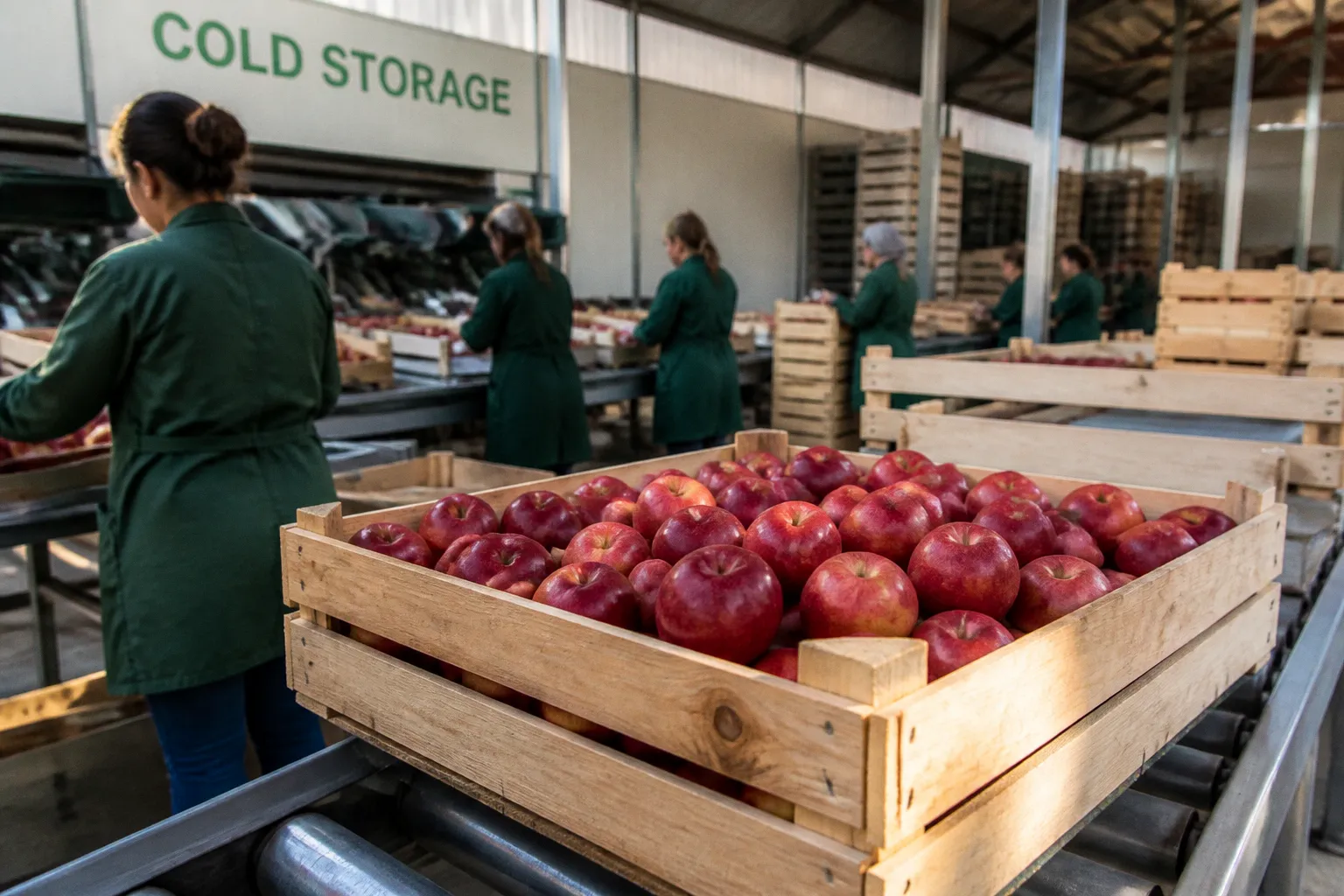
Cold storage is often discussed as a quality issue: temperature, humidity, shelf life and appearance. For export, it is also a regulatory and traceability issue.
Cold-storage warehouses handling apples destined for export must be registered with the Ministry of Agriculture. Registration creates continuing obligations. Facilities are expected to maintain records of incoming quantities, outgoing quantities and remaining inventory, measured in tons, and to submit the required monthly information to the Ministry’s Service of Cooling and Packing.
These records give the authorities a way to follow the movement of the crop. They also give the cooperative a way to reconcile what was harvested, what entered storage, what left the facility and what was finally packed for export. If those figures do not match, the discrepancy can become a documentation problem even when the fruit itself is satisfactory.
The relationship between storage records and certification is straightforward. The phytosanitary application concerns a specific consignment. The Ministry must be able to assess that consignment as an identifiable quantity, not as an untraceable portion of a warehouse’s general inventory. A missing monthly report, an expired registration or an unexplained change in quantity can make that assessment more difficult.
| Compliance element | What the exporter needs to establish | Why it matters |
|---|---|---|
| Facility registration | The cold store is registered and its status is current | Export-bound fruit should be handled through an authorised facility |
| Monthly inventory reporting | Incoming, outgoing and remaining quantities are recorded and reported as required | The records support reconciliation and traceability |
| Lot identification | Storage lots can be linked to growers, harvests and packing records | The sampled fruit and the shipped fruit must be connected |
| Temperature records | Handling and storage conditions are monitored and documented | Quality loss can undermine an otherwise compliant shipment |
| Dispatch reconciliation | The quantity leaving storage matches the packing and shipping documents | The certificate application should describe a defined consignment |
The cold chain itself remains the physical backbone of apple shipping from Lebanon. Apples continue to respire after harvest. Temperature fluctuations can accelerate softening and reduce the appearance and texture expected by buyers. A shipment may therefore be technically eligible for export but commercially weakened by poor storage management.
There is also a difference between a cold store that keeps fruit cold and a cold store that is ready to support export documentation. The latter must preserve a usable record of every movement. When fruit from several growers is consolidated, the facility needs procedures for maintaining those distinctions or documenting the approved consolidation. When fruit is repacked, the new carton or pallet identifiers must still connect to the original lot.
The most useful internal control is a reconciliation before the certificate application is submitted. The cooperative should compare the orchard and harvest records with the cold store’s intake records, current inventory, packing lists and planned shipping quantity. Any difference is easier to investigate before the shipment reaches the port.
Addressing MRL Challenges: Lessons from Historical Residue Data
The residue findings from 2012–2016 should neither be ignored nor overinterpreted. The study’s figures are important because they show that residue compliance has been a documented challenge for Lebanese apples. They do not establish that the same rates apply to current production, and they do not demonstrate that every producer used the same methods.
What they do show is why export planning cannot rely on a last-minute test. Residues are influenced by the products selected, application rates, timing, weather, crop conditions and the interval between the final application and harvest. A laboratory result is therefore the outcome of decisions made throughout the growing season.
For a cooperative, a residue-aware programme has several practical components:
- Market selection before treatment planning. The cooperative should identify the destination markets it is realistically able to serve and obtain the relevant MRL requirements.
- Complete spray records. Records should include the product, active ingredient where available, application date, treated block and the person or farm responsible for the application.
- Pre-harvest discipline. The relevant pre-harvest interval must be respected, and harvest planning should take account of the time needed for the fruit to meet the intended market’s requirements.
- Representative sampling. Testing should reflect the lots that will actually be sold, rather than being limited to a convenient or unusually clean section of the crop.
- Separation of affected lots. If a result raises a concern, the cooperative should be able to isolate the relevant fruit instead of treating the entire warehouse as one undifferentiated batch.
- Communication with the buyer. The destination, specifications and testing expectations should be agreed before the shipment is committed.
The comparison between Gulf destinations and European Union buyers is useful, but it should be handled carefully. The EU is widely regarded as having a stringent MRL framework, while other markets may apply different limits or procedures. That does not mean every Gulf market is lenient or that every EU shipment is automatically at risk. It means a Lebanese exporter must work from the rules of the specific destination rather than from a general regional assumption.
Historical residue data is a warning about the cost of weak controls, not a substitute for current testing of the shipment that is actually being exported.
The cooperative also needs a response plan for an unfavourable result. A result above the relevant MRL should trigger a documented review: confirm the sample and lot, check the analytical report, compare the result with the destination requirement and consult the responsible technical or regulatory contacts. Depending on the circumstances, the lot may require additional analysis, a different commercial destination or removal from the export programme. None of these options should be promised in advance; they depend on the applicable rules and the authority’s decision.
The same principle applies to pest findings. A plant-health concern may be managed through additional inspection, treatment or other measures where the destination rules allow them, but the exporter should not assume that a certificate will follow automatically. The Ministry assesses the consignment under the relevant phytosanitary requirements.
This is also where the cooperative model can add value. Individual growers may record applications differently, store fruit in different facilities or work to different market assumptions. A cooperative can establish a common reporting format, coordinate sampling and prevent one weak record from obscuring the identity of an otherwise suitable lot. That is an organisational advantage, not proof of a guaranteed reduction in rejection rates or an automatic increase in export value.
Digital Transformation in Export Documentation and ISPM Standards
Lebanon has also moved toward electronic phytosanitary certification through a Lebanese-Italian initiative to develop a digital platform. The project points toward closer integration with the IPPC’s ePhyto framework, in which phytosanitary information can be exchanged electronically between the issuing authority and the plant-protection organisation of the importing country.
The advantages are clear in principle. Electronic records can reduce the physical movement of documents, make verification faster and limit errors caused by copying information between forms. They may also improve the visibility of the certification process for exporters, freight forwarders and buyers.
Digital certification will not solve a weak traceability system. If the cooperative’s orchard records are incomplete, an electronic platform will transmit incomplete information more efficiently. If the cold store cannot reconcile its quantities, the problem will remain after the paper form disappears. The transition therefore requires internal preparation as well as a functioning government platform.
A cooperative preparing for digital documentation should make sure that:
- grower and orchard identifiers are consistent across all records;
- lot numbers are used from harvest through storage and packing;
- quantities are recorded in a way that can be reconciled at each handoff;
- laboratory reports can be retrieved against the relevant lot;
- staff know who is responsible for entering, checking and approving information;
- paper records are retained during the transition where the existing procedure still requires them.
The digital platform described in the initiative should not be treated as fully operational unless the Ministry confirms the relevant procedures and timelines. Exporters should continue to follow the current paper-based protocols and verify any changes through official channels. The correct approach is preparation without assumption: organise the underlying data now, but do not present an announced digital direction as a system already available for every shipment.
Putting It Together: The Four Stages of an Export Season
The four stages are best understood as a connected project rather than four isolated administrative tasks.
Stage 1 — Orchard and input management
The export process begins months before harvest. The cooperative identifies its intended markets, reviews the applicable MRLs and aligns its crop-protection records with those requirements. It should preserve the identity of each orchard block and record the treatments applied there.
This stage also determines how flexible the cooperative will be later. A crop managed for one destination cannot necessarily be redirected to another market without checking the applicable limits and documentation. Market choice, agronomy and compliance are linked from the beginning.
Stage 2 — Pre-harvest testing and LARI submission
Representative samples are submitted to LARI for the required pest and residue analyses. The timing should leave room to review the results before fruit is packed and committed to a vessel or truck. Testing immediately before dispatch may reveal a problem when the cooperative has few practical options left.
The result must be attached to a recognisable lot. If the cooperative cannot identify which growers or orchard blocks supplied the sample, the laboratory report loses much of its operational value.
Stage 3 — Cold storage and inventory control
Before fruit enters storage, the cooperative confirms that the facility’s registration and reporting obligations are current. Incoming quantities, storage movements, packing activity and remaining inventory should be recorded consistently.
Temperature monitoring protects the commercial value of the apples, while inventory reconciliation protects the credibility of the export file. Both are part of export readiness.
Stage 4 — Ministry certification and shipment
Once the laboratory evidence and storage records are assembled, the exporter submits the application and supporting documents to the Ministry of Agriculture. The phytosanitary certificate is issued by the Ministry where the consignment satisfies the applicable requirements and the documentation supports the application.
The final shipment documents should use the same lot identifiers, quantities and destination information found in the laboratory and cold-storage records. At Beirut port, the exporter should be prepared for the documentation and inspection requirements that apply to the shipment. A certificate is essential, but it does not override the importing country’s authority to inspect or assess the fruit on arrival.
The strongest export systems are not necessarily the ones with the most paperwork. They are the ones in which each record answers the same basic questions: where did the apples come from, what was applied to them, which lot was tested, where were they stored, how much is being shipped and which market is receiving them?
That is the practical meaning of Lebanese apple export phytosanitary certification. The certificate is important, but it is only as reliable as the chain of evidence behind it. For Lebanese cooperatives, the opportunity is to build that chain early enough that testing, storage and documentation support the commercial plan rather than interrupt it at the last minute.
The fruit may leave from the same orchards and travel through the same port, but export readiness is created through disciplined coordination: accurate orchard records, appropriate LARI testing, registered cold storage, careful inventory control and a Ministry-issued certificate prepared for the requirements of the destination market. That is what turns a harvest into an exportable consignment.