Apple orchard IPM transition: pest control before and after
In Lebanese apple orchards, pesticide reduction is no longer a question of choosing between conventional farming and an idealized version of organic agriculture.
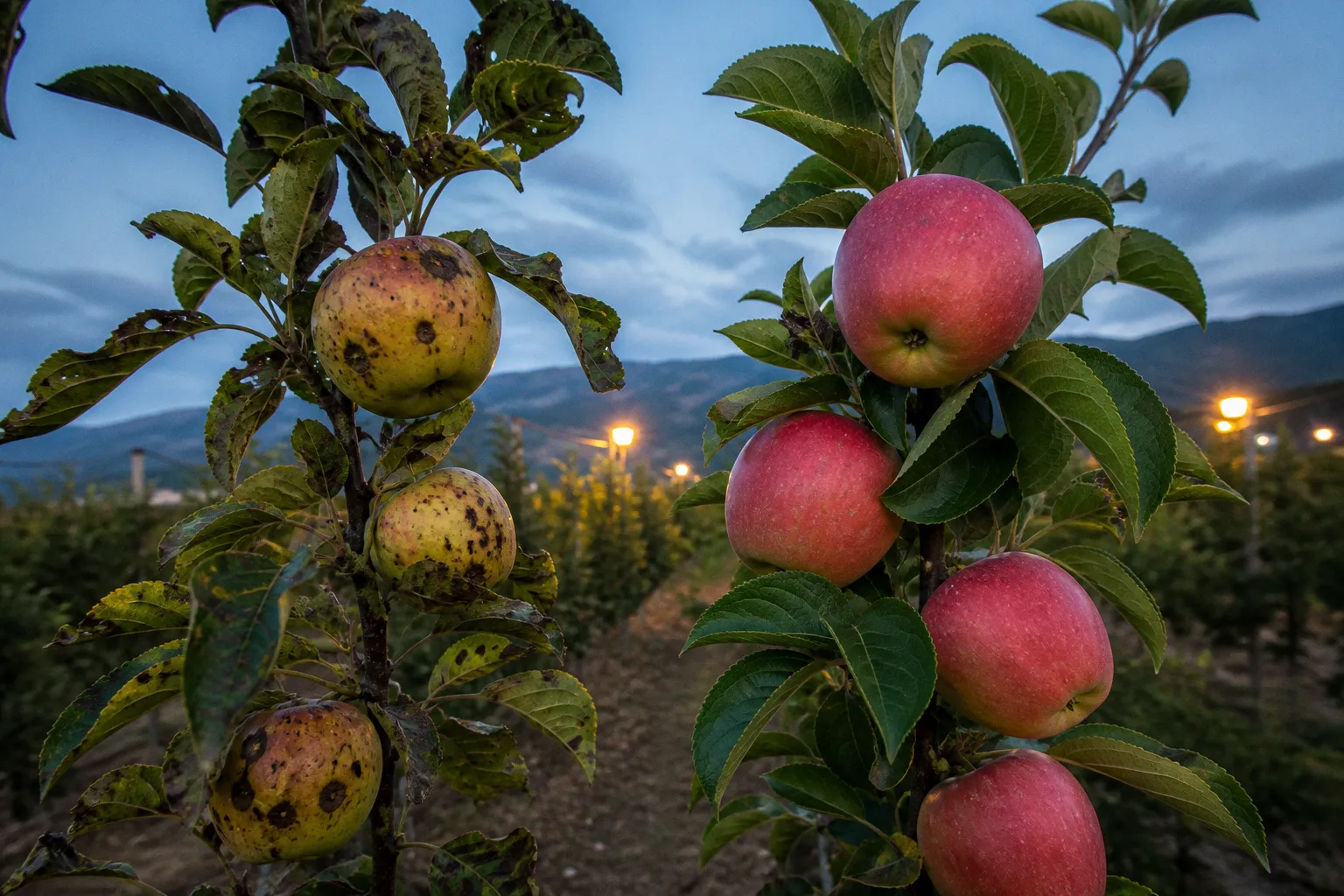
It is a practical response to two pressures that are becoming harder to separate: orchard ecology is under stress, and export markets are less tolerant of residue mistakes.
The evidence is serious. An analysis of 212 Lebanese apple samples collected between 2012 and 2016 found pesticide residues in 77% of the samples, while 61% exceeded Maximum Residue Limits. Chlorpyrifos appeared in 142 of the samples. These figures do not mean that every Lebanese apple fails export requirements, nor that every orchard follows the same spray program. They do show what happens when pest control is organized around repeated broad-spectrum applications rather than around pest monitoring, thresholds, and timing.
Lebanon produces approximately 200,000 tons of apples each year. When a large crop meets weak market access, residue-related export barriers, expensive imported inputs, and climate stress, the orchard cannot be managed as if the only problem were insects. Soil condition, water availability, pest biology, harvest timing, and certification requirements all become part of the same production system.
Integrated Pest Management, or IPM, offers a more disciplined transition. It does not mean abandoning every pesticide immediately. It means using synthetic products, biological agents, pheromones, cultural practices, and monitoring in an order that allows the orchard to rely less on routine chemical intervention.
The goal of IPM is not to spray less by guesswork. It is to make each treatment answer a measured pest problem.
Before and after: what changes in the orchard?
The most useful way to understand an IPM transition is to compare the decisions made before and after the system is established. The difference is not simply the number of spray applications. It is the point at which the grower decides that action is justified.
| Orchard decision | Conventional chemical reliance | IPM-based management |
|---|---|---|
| When to treat | According to a calendar, past habit, or visible damage | According to pest monitoring, crop stage, and action thresholds |
| Main pest-control tool | Repeated broad-spectrum insecticides | Pheromone trapping, mating disruption, biological control, selective products, and targeted treatments |
| Codling moth monitoring | Often limited or absent | Delta traps, trap counts, degree-day tracking, and inspection of fruit damage |
| Effect on beneficial insects | Non-selective sprays can remove predators and parasitoids along with pests | Selective interventions aim to preserve useful organisms |
| Input decisions | Imported chemicals purchased and applied as the default response | Inputs are chosen for a defined pest, timing, and risk |
| Residue management | Risk increases when products are repeated or used too close to harvest | Pre-harvest intervals, product selection, and treatment records become central |
| Soil and water role | Often treated as separate from pest control | Soil and water testing support broader orchard resilience |
| Export position | A contaminated lot may be delayed, rejected, or diverted to a weaker market | Traceable, threshold-based management supports more reliable compliance |
This comparison is not an argument that IPM produces a chemical-free orchard overnight. Selective pesticides and biopesticides may still be needed, especially during a transition or when pest pressure crosses an economic threshold. The important shift is that treatment becomes one component of a managed system rather than the system itself.
That distinction matters particularly in Lebanon, where the cost of imported synthetic pesticides rose sharply during the economic crisis and the devaluation of the Lebanese pound. When inputs become unaffordable, farmers cannot simply maintain the old program at a higher price. They need a method that reduces unnecessary applications without leaving the crop unprotected.
The codling moth problem starts with timing
Codling moth, Cydia pomonella, is the primary pest around which many apple IPM programs are built. Its larvae enter the fruit, and once the damage is visible, the commercial value of the apple has already been reduced. A late response is therefore expensive: the grower may see the symptom only after the most useful intervention window has passed.
Traditional spraying often fails for three connected reasons.
First, a calendar spray does not necessarily match the pest’s actual development. Weather influences insect development, so the same date does not represent the same biological stage every season. Second, broad-spectrum products can affect beneficial insects that help suppress other pests. Third, repeated exposure to the same chemical groups can contribute to resistance, leaving the grower with a more expensive product program and fewer reliable options.
An IPM program begins by making the pest visible before it becomes visible in the fruit. Delta traps baited with codling moth pheromone help establish whether the pest is present and how its activity changes. Trap counts are combined with temperature-based degree-day monitoring, orchard scouting, and attention to crop development. This creates a more precise question than whether it is time to spray: Is the pest population developing toward a level at which intervention will protect the crop?
The answer must be interpreted locally. A trap does not provide a universal treatment date for every orchard in the Bekaa or elsewhere in Lebanon. Elevation, exposure, orchard structure, temperature, and the surrounding landscape all influence pest pressure. Monitoring is useful because it connects the treatment decision to the orchard actually being managed.
Pheromone tools: prevention rather than rescue
Two pheromone-based strategies are especially relevant.
Mass trapping uses pheromone traps to capture male moths and reduce the likelihood of successful mating. Mating disruption places pheromone throughout the orchard so that males have difficulty locating females. Both methods work best when deployed as part of a planned program rather than as emergency tools after fruit damage has appeared.
Their value is ecological as well as operational. They target the pest’s reproductive behavior instead of exposing the whole orchard to a broad-spectrum insecticide. They can also reduce the selection pressure associated with repeated chemical use. But they require correct placement, sufficient coverage, and monitoring. A pheromone device cannot compensate for poor orchard observation, unmanaged neighboring sources of infestation, or a pest population that has already caused substantial damage.
Biological control and selective products
Cydia pomonella granulovirus, commonly referred to as CpGV, is one biological tool used against codling moth. It is more specific than a general insecticide and fits the logic of IPM: use a control that is directed at the target pest, applied at the susceptible stage, and integrated with monitoring.
Selective biopesticides and other biological agents may also have a role, depending on the pest complex and the products available to the grower. The phrase “biological” should not be treated as a guarantee of perfect performance. These products still depend on timing, coverage, storage, weather conditions, and correct application. They are tools with a mode of action, not an exemption from agronomy.
The same principle applies to selective synthetic treatments. If a monitored population crosses the relevant threshold, a targeted product may be the most responsible choice. An orchard that uses one well-timed selective treatment is not necessarily less sustainable than an orchard that applies an unsuitable biological product repeatedly and still loses the crop.
Building a Bekaa Valley IPM program from the ground up
Collaborative IPM programs involving the Lebanese Agricultural Research Institute, GATE Lebanon, and international agencies have introduced tools including mass trapping, biological control, and soil and water testing in demonstration plots in the Northern Bekaa. The useful lesson is not that every orchard should copy a single package. It is that pest management becomes more dependable when it is linked to the physical condition of the farm.
A practical transition has several layers.
1. Map the orchard before changing the spray program
Record the varieties, tree age, elevation, irrigation arrangements, drainage problems, and areas with recurring pest damage. Mark orchard edges and locations near unmanaged or abandoned trees. These details help explain why one block may require intervention while another does not.
The map does not need to be sophisticated. A farm notebook, printed plan, or phone-based record can show where traps are placed, where damage appears, and which treatments were used. Without a record, it is difficult to distinguish a genuine improvement from a good season.
2. Install monitoring before reducing treatments
Reducing pesticide use before establishing monitoring is not IPM; it is simply reducing protection and hoping weather will cooperate.
For codling moth, monitoring should include pheromone delta traps, regular trap checks, and notes on the timing of captures. Degree-day information helps estimate development, while fruit inspections confirm whether the biological picture matches what is happening in the trees. The goal is to identify the vulnerable period before larvae enter the fruit.
This is also where training matters. A trap only helps if somebody checks it consistently and understands what the count means. Cooperative structures can make this easier by coordinating scouting, interpretation, and purchasing across several farms.
3. Start with the orchard floor and tree environment
Pest control is not separate from the orchard’s growing conditions. Water stress can reduce tree resilience, while excessive vigor may create dense canopy conditions that complicate spray coverage and monitoring. Poor sanitation can leave damaged fruit or pest sources in the orchard.
The IPM transition should therefore include practical cultural measures:
- Remove or manage damaged and fallen fruit so it does not continue the pest cycle.
- Keep irrigation consistent enough to avoid severe stress, while avoiding waste and prolonged waterlogging.
- Maintain a canopy structure that allows air movement, observation, and adequate coverage when treatment is necessary.
- Use soil and water testing to identify constraints that cannot be solved with more fertilizer or more pesticide.
- Review nitrogen inputs, because excessive vegetative growth can alter the orchard microclimate and make management more difficult.
- Preserve flowering margins or non-crop habitat where appropriate, provided these areas do not become unmanaged pest reservoirs.
These measures do not replace pest-specific controls. They make the orchard easier to observe and less dependent on emergency intervention.
4. Replace broad-spectrum routines with targeted decisions
A grower moving away from conventional chemical reliance should not ask only which product to remove. The better question is what function that product was meant to perform.
Was it intended to control codling moth, aphids, mites, or several pests at once? Was it applied because of a trap count, or because it was the usual date? Was the product selected for a specific life stage? Could a pheromone tool, biological agent, or selective treatment address the same risk with less disruption?
This review often reveals that one application was doing several jobs poorly. A broad-spectrum product may suppress the target pest for a period, but it can also remove natural enemies and complicate later decisions. A more selective program may require closer observation, yet it gives the grower a clearer understanding of what is happening in the orchard.
The economics of pesticide reduction in Lebanon
The financial case for IPM is not as simple as saying that fewer chemical sprays always mean lower costs. The transition requires labor, monitoring equipment, training, recordkeeping, and sometimes a different timing of purchases. Pheromone traps and mating disruption products have an upfront cost. Biological products may require careful storage and more precise application. Scouting takes time that is often invisible in a conventional budget.
Still, the old system has costs that are easy to overlook:
- repeated purchases of imported chemicals priced in a devalued currency;
- applications made when pest pressure is low;
- resistance that reduces the useful life of familiar products;
- loss of beneficial insects and the secondary pest problems that can follow;
- rejected or diverted fruit when residue levels exceed market requirements;
- wasted harvest value when fruit damage appears too late to correct.
The strongest economic argument for IPM is therefore not that every input bill will immediately fall. It is that the grower gains more control over where money is spent. A monitored orchard can prioritize labor and products around genuine risk instead of treating every block as though it has the same pest population.
For cooperatives, this distinction is particularly important. Shared scouting teams, group training, common purchasing, and coordinated records can reduce the burden on individual farms. A cooperative can also create a consistent harvest and residue-management protocol, which is more credible to buyers than isolated assurances from farms using different methods.
In a cooperative, IPM becomes more than a farm technique. It becomes a shared quality system, from trap count to packing line.
MRL compliance begins well before harvest
Maximum Residue Limits are not a final administrative hurdle added after production. They are shaped by decisions made throughout the season: which product was used, at what rate, against which pest, and how long before harvest.
The historical Lebanese sampling data should be read as a warning about system design. When 61% of tested samples exceed MRLs, the problem is not necessarily one careless application. It may reflect repeated use of high-risk products, incomplete records, poor understanding of pre-harvest intervals, or the difficulty of coordinating spray decisions across fragmented production.
An IPM program improves the compliance position in several ways.
First, fewer unnecessary applications reduce the number of opportunities for residue accumulation. Second, targeted products allow the grower to select an intervention suited to the pest and the market destination. Third, monitoring and records create traceability. A buyer or certification body can see how the crop was managed rather than receiving only a claim that the apples were produced sustainably.
This is where sustainable apple farming and export readiness meet. Ecological health is not a decorative addition to a certification file. Soil structure, water management, biodiversity, and reduced disruption of beneficial organisms support a production system that is easier to monitor and defend in a demanding market.
IPM is not identical to organic certification. An orchard may use IPM while applying approved synthetic products, and an organic orchard still requires careful pest monitoring. The systems overlap in their interest in prevention and selective control, but their input rules and certification requirements are not interchangeable.
A seasonal transition plan for Lebanese apple orchards
The change is easier to manage when broken into seasonal decisions rather than treated as a single conversion.
Dormant season: establish the baseline
Before the new crop develops, review the previous season’s spray records, pest damage, residue concerns, input costs, and harvest destinations. Identify which products were used repeatedly and which pests actually justified treatment.
This is the time to prepare a block map, order monitoring materials, repair irrigation, address drainage, and plan soil and water tests. If a cooperative is involved, agree on common recording forms and scouting responsibilities before flowering.
Flowering and early fruit development: protect the monitoring system
Install pheromone traps at the appropriate point in the crop cycle and begin regular observations. Avoid unnecessary broad-spectrum applications during periods when pollinators and natural enemies are active. The objective is to build a biological picture of the orchard while protecting the organisms that contribute to it.
For codling moth, this period is also when degree-day tracking and trap information begin to guide the timing of interventions. A calendar date can be noted, but it should not replace the pest’s actual development.
Fruit growth: intervene at the vulnerable stage
Use trap counts, temperature accumulation, scouting, and fruit inspections together. If mating disruption or mass trapping is part of the program, check that the system is functioning rather than assuming installation alone is sufficient.
When intervention is justified, select the narrowest effective tool available for the pest and life stage. Rotate modes of action according to sound resistance-management practice, follow the approved label and pre-harvest interval, and record the application. IPM reduces chemical reliance through better decisions; it does not make label compliance optional.
Pre-harvest: protect the market destination
As harvest approaches, review all applications and intervals. The destination market matters because buyer requirements may be stricter than a grower expects, and residue compliance depends on the permitted use of each product.
Maintain separate records by block when management differs. Do not assume that a compliant result in one orchard proves compliance in another. Sampling, where available, should support—not replace—accurate records and disciplined timing.
Post-harvest: measure the transition
After harvest, compare treated blocks with the original baseline. Look at pest damage, number and type of applications, input costs, labor, fruit quality, and any residue results. The first season may reveal gaps rather than deliver a finished system. That is useful information if the cooperative records it and adjusts the next cycle.
The unknowns should remain visible. There is not enough reliable information to state a single national percentage of Lebanese apple acreage that is certified organic, and farm-level yield changes during the first and third years of IPM transition will vary by region and management quality. A credible transition plan leaves room for measurement instead of promising a universal result.
What “before and after” should mean
The real before-and-after comparison is not chemical farming versus no chemicals. It is reactive control versus observed control.
Before IPM, the orchard may be organized around product availability, routine dates, and the fear of losing the crop. After IPM, the grower still carries responsibility for protecting yield and marketability, but the decisions are anchored in pest biology, orchard conditions, and market requirements.
That change has consequences beyond codling moth. Lower disruption can help preserve beneficial organisms. Better water and soil observation can strengthen resilience during climate stress. More accurate records can support cooperative marketing and export certification. And a reduction in unnecessary inputs can matter financially when imported pesticides are expensive and access to working capital is limited.
Climate projections already point to additional pressure on Lebanese apple production, with potential losses estimated at 10% to 30% by 2050 under climate stress. Pest management cannot solve warming, water scarcity, or market fragmentation on its own. But an orchard with healthier soil, better monitoring, more diverse control tools, and disciplined records has more room to adapt than one dependent on repeated broad-spectrum sprays.
The practical path is seasonal and cumulative: map the orchard, monitor before treating, protect beneficial life, target codling moth at the vulnerable stage, record every decision, and review the result after harvest. That is the work behind pesticide reduction in Lebanon’s apple orchards—and the difference between a sustainability claim and a production system that can withstand scrutiny.