Soil salinity in Lebanese greenhouses: a 5-stage recovery plan
A greenhouse can be protected from rainfall, pests, and temperature volatility while still losing productivity to a less visible constraint: salt concentration in the root zone.
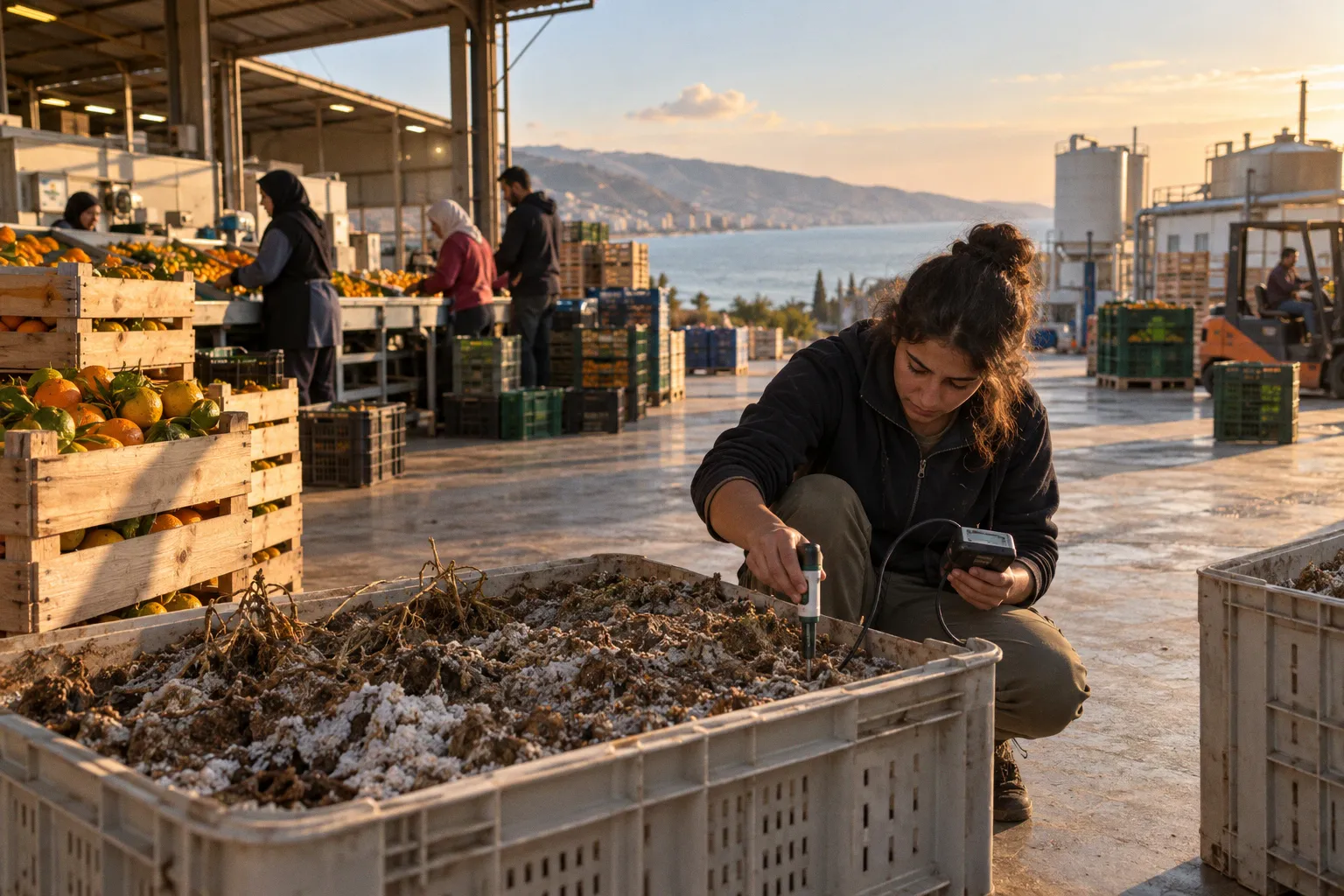
In coastal Lebanese production areas, groundwater has been measured at roughly 3 dS m⁻¹, while soil salinity inside some greenhouses has reached 15–20 dS m⁻¹. The formal threshold for saline soil is 4 dS m⁻¹ at 25 °C.
That difference is not a minor operating variance. It indicates that salts are entering the production system faster than irrigation and drainage are removing them. The mechanism is cumulative: saline water contributes dissolved ions, fertilizer inputs add further chloride and other salts, and insufficient drainage leaves the residues concentrated in the active root zone.
Soil salinity management in Lebanese greenhouses therefore cannot be reduced to replacing a water source or applying a corrective product. Recovery requires a controlled sequence: measure the problem, identify the dominant ions, restore drainage and leaching, rebuild soil structure, and then redesign fertigation so the same accumulation does not return.
Stage 1: Establish the salinity baseline before changing inputs
The first capital decision is not a desalination unit, a calcium amendment, or a new fertilizer contract. It is a measurement system. Without a baseline, the grower cannot distinguish between a temporary salt pulse, a contaminated irrigation source, a structurally damaged soil profile, and chronic over-application of soluble nutrients.
The minimum diagnostic program has two separate targets:
- Irrigation water, tested for electrical conductivity and sodium-related risk.
- Soil, tested for electrical conductivity, chloride concentration, and sodium adsorption risk.
Electrical conductivity, or EC, provides a practical estimate of the total dissolved salt load. It does not identify every ion, and it should not be treated as a complete water-quality profile. However, it is the most useful first-line metric for comparing irrigation water, drainage water, and soil extracts over time.
The second variable is sodium adsorption ratio, or SAR. Two water sources with similar EC can have different effects on soil structure if their sodium content differs. Elevated sodium risk can reduce aggregate stability, restrict infiltration, and convert a salinity problem into a combined salinity-and-sodicity problem. Once infiltration falls, the grower may apply more irrigation without achieving effective leaching. The result is higher water use with less salt removal.
Build a sampling grid, not a single number
A single composite soil sample can conceal the operating problem. Greenhouse salinity is rarely distributed uniformly because water movement follows irrigation lines, bed geometry, slope, drainage outlets, and compacted layers.
A useful baseline separates at least:
1. The upper root-zone layer where most feeder roots are active.
2. A deeper layer below the principal root zone, showing whether salts are moving downward or remaining concentrated.
3. Areas near emitters, where fertilizer concentration can be highest.
4. Areas between emitters, where dry zones may accumulate salts through evaporation.
5. Low points and drainage edges, where salts may collect after irrigation events.
The same locations should be sampled after corrective measures. Consistency matters more than excessive sampling frequency. A cooperative managing several greenhouse blocks can create a simple register containing block identification, crop, irrigation source, EC, SAR, soil EC, chloride level, drainage status, and fertigation formula. That converts isolated laboratory results into a management dataset.
A salinity reading is not a diagnosis. It is a baseline against which water movement, fertilizer loading, and crop response can be measured.
For Lebanese production systems, the baseline should also reflect geography. Coastal wells in areas including Choueifat, Jieh, and Rmeileh have shown salinity fluctuating around 3 dS m⁻¹, consistent with moderate to injurious contamination associated with seawater intrusion. Inland production is not automatically protected. In the Hermel-Qaa region, more than 52% of sampled agricultural sites were categorized as slightly saline or saline according to soil ECe measurements.
The operational conclusion is straightforward: coastal and inland cooperatives require the same diagnostic architecture, even if the source of the salts differs.
Stage 2: Separate seawater intrusion from fertilizer-induced chloride loading
The phrase “saline water” often becomes a convenient explanation for every salinity problem. It is incomplete. Irrigation water quality is a major variable, particularly in coastal areas, but fertilizer selection and fertigation concentration can produce substantial secondary accumulation even when the water source is partially corrected.
In tested Lebanese greenhouses, chloride accounted for 68% of measured soil salinity. That finding points to a fertilizer contribution alongside saline groundwater. Potassium chloride is particularly relevant because it supplies potassium together with chloride. If the crop does not remove the applied ions and the irrigation system does not move them below the root zone, the chloride remains in the soil solution and becomes increasingly concentrated as water is lost through crop transpiration and evaporation.
This is the distinction the recovery plan must preserve:
| Salinity driver | Diagnostic signal | Corrective direction | Failure if ignored |
|---|---|---|---|
| Saline irrigation water | Elevated source-water EC and potentially elevated SAR | Identify alternative source, blend where technically suitable, improve drainage and leaching | Salt enters with every irrigation cycle |
| Potassium chloride loading | High chloride in soil relative to the broader nutrient profile | Recalculate potassium supply and replace chloride-bearing inputs where agronomically appropriate | Fertilizer continues rebuilding the salt pool |
| Inadequate drainage | Drainage water absent, delayed, or highly concentrated | Repair outlets, remove compacted barriers, verify downward movement | Leaching water redistributes salts without exporting them |
| Excessive fertilizer concentration | High EC in fertigation solution or drainage return | Reduce unnecessary soluble input and divide applications | Root-zone EC rises between irrigation events |
| Evaporation and dry zones | Salt crusting or higher EC between emitters and near bed margins | Improve distribution uniformity and maintain appropriate moisture continuity | Salts concentrate outside the visibly wet area |
The objective is not to eliminate all dissolved minerals. Plants require nutrient ions, and a productive fertigation system must deliver them in a form and concentration that matches crop uptake. The objective is to prevent the root zone from becoming a storage chamber for ions that are neither absorbed by the crop nor removed through drainage.
Recalculate potassium rather than simply removing it
Potassium remains a necessary macronutrient. Replacing potassium chloride with another potassium source should therefore be based on nutrient accounting, crop stage, water analysis, and total cost per delivered unit of potassium. A substitution that lowers chloride but produces excessive EC through another soluble salt is not a complete solution.
The correct sequence is:
- Determine the crop’s potassium requirement by growth stage.
- Quantify potassium already present in the irrigation water and soil.
- Identify how much potassium is supplied by each fertilizer component.
- Calculate the accompanying chloride load.
- Rebuild the fertigation recipe around the nutrient requirement rather than the available product inventory.
This is an infrastructure decision as much as an agronomic one. A cooperative purchasing fertilizer for multiple greenhouse members should standardize the calculation method, not merely negotiate a lower price per bag. The cheapest input can become an expensive soil-reclamation program if its residual salt load is ignored.
Stage 3: Manage the leaching fraction as an engineered process
Leaching is the mechanism that moves salts below the root zone. It is not synonymous with heavy irrigation. A large irrigation volume can produce little useful leaching if the water remains in the upper profile, exits through preferential channels, or is applied to soil with insufficient drainage capacity.
The leaching requirement depends on the salinity of the irrigation water, the crop’s tolerance, the target root-zone EC, the existing soil concentration, and the effectiveness of drainage. Because these variables change between greenhouse blocks, there is no universal irrigation volume that can be applied safely across a cooperative.
Measure whether leaching is actually occurring
A workable monitoring sequence compares three points:
1. Applied water EC at the irrigation source or fertigation outlet.
2. Root-zone soil EC within the active crop profile.
3. Drainage or drainage-water EC after a controlled irrigation event.
If the drainage fraction is negligible, the system is not exporting salts. If drainage EC is substantially higher than applied-water EC, the water is dissolving accumulated salts, which is expected during recovery but requires observation. If the soil EC remains high despite repeated irrigation and drainage, the problem may involve compacted layers, poor distribution, blocked drains, or a salt source that exceeds the removal rate.
A sensor array does not need to be sophisticated to be useful. Portable EC meters, fixed moisture sensors, emitter-flow checks, and repeated soil sampling can provide a better decision system than a costly automation platform operating without a baseline. Technology should reduce uncertainty; it should not disguise the absence of measurements.
Distribution uniformity controls the economics of leaching
Greenhouse irrigation systems often fail at the emitter level before the failure becomes visible at the crop level. Pressure variation, clogged emitters, mismatched line lengths, and uneven filtration can create a pattern in which some plants receive excess water while others remain in a concentrated salt zone.
Before increasing irrigation duration, verify:
- Emitter discharge at the beginning and end of each lateral.
- Pressure at representative points in the block.
- Filter condition and backflush performance.
- Drainage outlet flow after irrigation.
- Moisture penetration below the surface layer.
- Accumulation at bed margins and low points.
Leaching water that bypasses the root zone has a negative return on investment. It consumes pumping energy, raises demand on solar-powered irrigation systems, and may mobilize salts into an already contaminated drainage pathway without correcting the crop’s immediate environment.
The correct leaching question is not how much water was applied. It is how much salt left the root zone.
For cooperative operations, leaching should be scheduled by block rather than treated as a single farm-wide event. Greenhouses with different soil textures, crop ages, drainage conditions, and water sources will not have the same leaching requirement. A shared irrigation protocol can still exist, but it should contain block-level thresholds and response rules.
Stage 4: Use calcium amendments and salt-removing rotations to restore the profile
Once the water movement problem is understood, the soil profile can be treated. Calcium amendments are relevant where sodium-related dispersion or structural decline is limiting infiltration. Calcium can help displace sodium from exchange sites, but it does not remove the displaced salts by itself. The resulting ions must be transported out of the root zone through adequate water movement and drainage.
This is why a single amendment cannot permanently solve greenhouse salinity. If the soil remains poorly drained, the amendment may change the chemical balance without delivering a durable improvement in crop conditions.
The treatment sequence should connect chemistry to hydraulics:
1. Confirm the salinity and sodium-risk profile through soil and water testing.
2. Identify compacted or impermeable layers restricting drainage.
3. Select a calcium amendment based on the soil condition and local agronomic guidance.
4. Incorporate or apply it using a method compatible with the greenhouse beds.
5. Supply enough water for the amendment to react and for displaced salts to move downward.
6. Measure soil EC and infiltration after the treatment rather than assuming success from application alone.
The appropriate amendment rate depends on soil properties and the measured exchange chemistry. It should not be inferred from the greenhouse area alone. Applying more product is not a substitute for calculating the problem.
Phytoremediation is a rotation tool, not a quick flush
Crop rotation adds a biological phase to soil reclamation. Field experiments in Lebanon found that Jew’s mallow, Corchorus olitorius, grown after tomatoes effectively removed residual salts from the soil profile. The value of this approach is not that the crop magically neutralizes salinity. It provides a crop phase with different water-use and ion-uptake characteristics, allowing the production plan to interrupt the repeated tomato-fertigation cycle.
Rotation must be integrated with removal. If the salt-removing crop is grown and then incorporated without considering the salts contained in its biomass, part of the extracted load may return to the soil. The agronomic handling of the crop residue therefore matters. The rotation should also be evaluated against market demand, greenhouse timing, disease cycles, and the opportunity cost of suspending the primary cash crop.
A practical rotation decision includes:
- The residual EC after the main crop is removed.
- The duration available before the next commercial planting.
- The crop’s tolerance to the measured salinity.
- The quantity of irrigation needed to sustain the rotation.
- Whether biomass is removed, composted under controlled conditions, or incorporated.
- The next crop’s sensitivity to salinity.
Phytoremediation is most defensible when it is part of a measured recovery program. It is not a replacement for drainage, and it should not be marketed as a biological shortcut around poor irrigation-water quality.
Stage 5: Rebuild fertigation around crop uptake and salt balance
The final stage determines whether the recovery is durable. A greenhouse can return to acceptable soil EC and then deteriorate again within a few production cycles if the fertigation program continues to apply more soluble material than the crop and drainage system can process.
The control variable is not simply fertilizer quantity. It is the relationship between:
- Nutrient concentration in the irrigation solution.
- Crop uptake at each growth stage.
- Irrigation frequency and duration.
- Source-water EC.
- Drainage fraction.
- Root-zone EC trend.
- Chloride and sodium accumulation.
High-frequency fertigation can be efficient when the system has accurate dosing, uniform application, stable water quality, and sufficient drainage. It becomes counterproductive when the grower uses it to compensate for poor distribution or uncertain soil moisture. In that case, the system applies repeated nutrient pulses while the root zone remains chemically concentrated.
A useful operating dashboard
A cooperative can manage the system through a small number of recurring indicators:
| Metric | What it reveals | Decision use |
|---|---|---|
| Source-water EC | Salt load entering the greenhouse | Compare wells, storage tanks, blending options, and seasonal changes |
| Soil ECe | Salt concentration in the root zone | Track recovery and identify blocks requiring separate treatment |
| SAR or sodium-related indicators | Risk of structural decline and reduced infiltration | Determine whether calcium and drainage interventions are required |
| Chloride concentration | Contribution from water and fertilizer inputs | Review potassium chloride and other chloride-bearing materials |
| Drainage EC | Salts being exported from the profile | Confirm whether leaching is functioning |
| Emitter discharge uniformity | Whether the applied program reaches plants evenly | Repair irrigation before increasing application volume |
| Crop response by block | Agronomic effect of the salt balance | Link chemistry to yield and planting decisions |
The dashboard does not require continuous telemetry at every bed. It requires consistent measurements at decision points. Sensor arrays become economically rational where they control a high-value greenhouse cluster, a constrained water source, or a cooperative network with repeated salinity failures. In smaller installations, scheduled manual sampling can provide an adequate baseline if the sampling locations and methods remain stable.
Prevent secondary accumulation during recovery
Several management errors repeatedly undermine reclamation:
1. Increasing fertilizer to compensate for weak crop growth.
Salinity can restrict water uptake and produce symptoms that resemble nutrient deficiency. Adding more soluble fertilizer may intensify the root-zone EC and reduce water availability further.
2. Using a low-EC water source without correcting drainage.
Better water helps, but salts already stored in the soil still require an exit pathway.
3. Applying a flush and immediately returning to the old fertigation recipe.
A one-time reduction in EC is not a stable recovery if chloride loading continues.
4. Treating the greenhouse as chemically uniform.
Soil texture, slope, emitter performance, and previous crop history create different salinity profiles inside the same structure.
5. Selecting fertilizers by unit price rather than ionic load.
The relevant cost is not only the purchase price. It includes pumping, leaching water, yield loss, drainage repair, and the opportunity cost of taking a greenhouse out of production.
A nutrient budget should therefore include chloride, not only nitrogen, phosphorus, and potassium. Where chloride contributes materially to soil salinity, fertilizer procurement becomes part of soil-health management. This is especially relevant for Lebanese cooperatives that centralize input purchasing: a shared procurement policy can prevent individual growers from recreating the same chemical imbalance at different points in the production cycle.
Turning the five stages into a cooperative operating plan
The technical sequence is clear, but implementation depends on assigning ownership. A cooperative does not need every grower to purchase the same equipment. It needs a shared measurement and response system.
A practical deployment can proceed in phases:
Phase one: map the production system
Register each greenhouse by location, crop, water source, irrigation design, soil type where known, drainage condition, and recent fertilizer history. Mark low points, blocked drainage areas, and blocks with repeated yield decline. This creates the infrastructure map required for later comparisons.
Phase two: create the baseline dataset
Collect water and soil measurements using repeatable methods. Separate coastal wells from inland sources rather than blending them into one cooperative average. Record soil sampling depth and location. A result without sampling metadata has limited value for trend analysis.
Phase three: repair water movement
Correct filter failures, pressure variation, emitter blockage, and drainage restrictions before commissioning an intensive leaching program. The objective is to make the irrigation system predictable enough that a change in soil EC can be attributed to a real intervention.
Phase four: treat and rotate selectively
Prioritize the blocks with the highest soil EC, the strongest chloride signal, or the most severe infiltration decline. Use calcium amendments where the chemistry and structure justify them. Schedule salt-removing rotation crops, including Jew’s mallow where agronomically suitable, after the main crop rather than applying the same intervention to every greenhouse.
Phase five: lock in the new fertigation standard
Revise fertilizer recipes using crop uptake, water analysis, and chloride loading. Set trigger points for additional testing or leaching. Review soil EC at the end of each production cycle. The recovery plan becomes an operating system only when measurements alter decisions.
This phased approach also clarifies capital expenditure. The first investments are usually diagnostic and hydraulic: meters, laboratory testing, filtration, pressure control, emitter maintenance, drainage repair, and storage or blending capacity where appropriate. Advanced automation can follow once the underlying water and nutrient flows are understood. Automating an unstable system merely produces more precise instability.
The numbers-based verdict
The salinity thresholds define the scale of the problem. Soil above 4 dS m⁻¹ is formally saline. Coastal groundwater around 3 dS m⁻¹ can provide a substantial salt load before fertilizer is added. Greenhouse soil reaching 15–20 dS m⁻¹ is not a marginal deviation; it is evidence of sustained accumulation. A chloride contribution of 68% makes fertilizer selection a central control variable, not a secondary detail. In Hermel-Qaa, the finding that more than 52% of sampled sites showed elevated salinity confirms that the issue is not confined to one coastal strip.
The most defensible recovery strategy is therefore sequential:
- Measure EC, SAR-related risk, chloride, and drainage performance.
- Distinguish saline water from fertilizer-generated accumulation.
- Apply a verified leaching fraction through a functioning drainage system.
- Use calcium amendments only where soil chemistry and structure support them.
- Introduce a salt-removing rotation where the production calendar allows it.
- Rebuild fertigation around crop uptake and total ionic loading.
The engineering verdict is unambiguous: soil salinity management in Lebanese greenhouses is a balance-sheet problem for water, ions, and drainage. If salt entering the root zone consistently exceeds salt leaving it, no crop variety, additive, or automation package can produce a durable recovery. The system improves only when the measured salt balance turns negative and remains negative across successive production cycles.