Saline soil: 5 drainage methods for Bekaa farms
The Bekaa Valley holds 42% of Lebanon’s cultivated land and more than 70% of its national potato acreage.
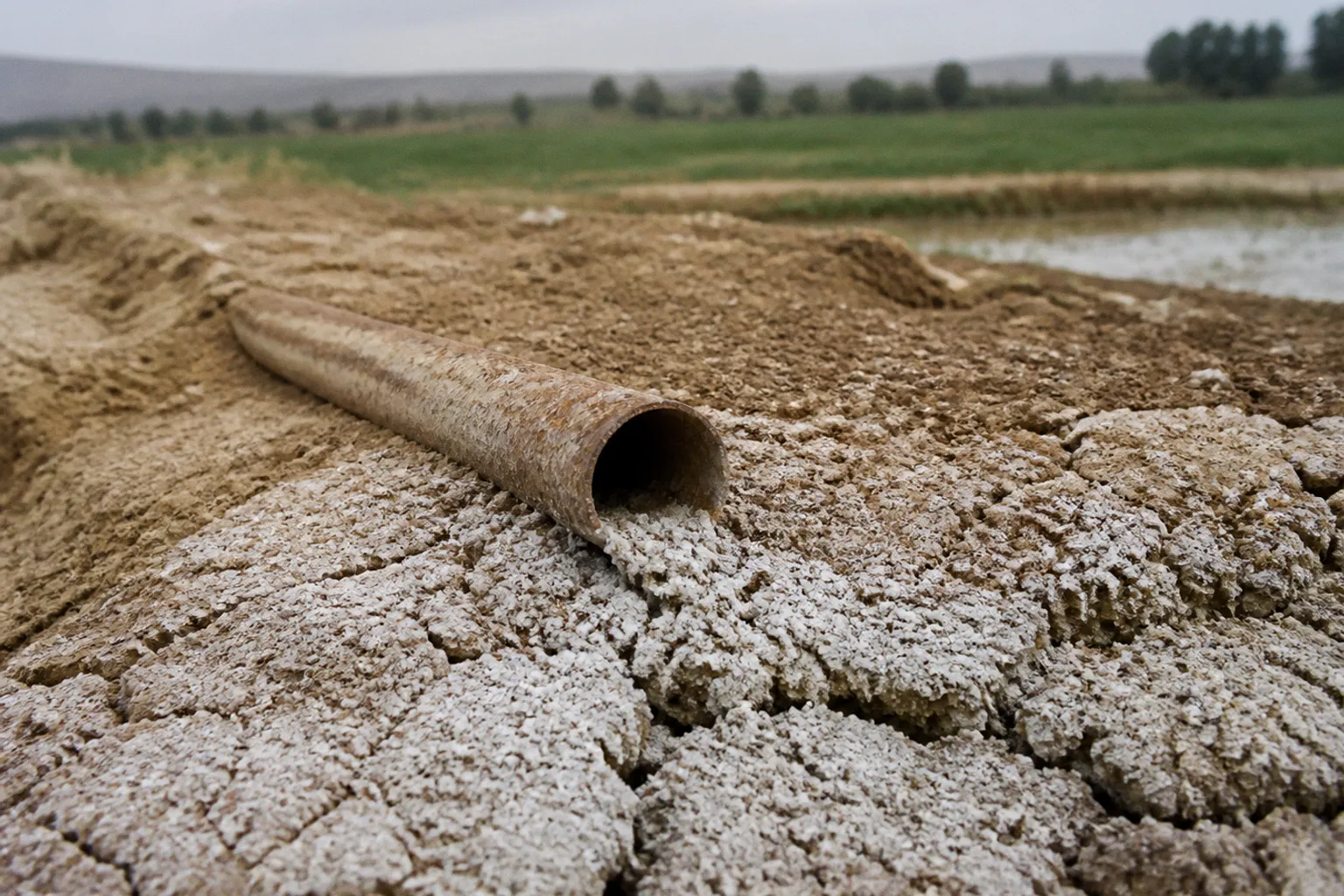
The Bekaa salinity baseline: what the numbers actually show
Across that footprint, more than 52% of Lebanon’s open agricultural fields reportedly register electrical conductivity (EC) at or beyond the slightly saline band. In parts of the Bekaa Plain, groundwater levels have also fallen by more than 15 metres over a five-year period of intensive well pumping. These are not separate problems. They form one coupled water-management system.
As the aquifer falls and around 65% of regional irrigation continues to draw from groundwater, the volume of water moving through the root zone becomes harder to manage. Where irrigation water carries dissolved salts, repeated evaporation leaves more of those salts behind. Sodium, chloride and sulfates accumulate near the surface, particularly when the water table is shallow or when irrigation is applied without a functioning route for drainage.
The result is easy to misread in the field. A saline soil can look adequately watered. It may even feel wet when sampled by hand. Yet the dissolved salts raise the osmotic pressure around the roots, making it more difficult for plants to take up water. The crop is exposed to a form of salt-induced drought, not simply a shortage of irrigation.
The commonly used FAO reference threshold for saline soil is an EC of 4 dS/m, measured at 25°C. That threshold is not a universal switch between productive and unproductive land: crop tolerance, soil texture, irrigation water quality, drainage depth and growth stage all change the practical impact. Potatoes and many vegetable crops are less forgiving than genuinely salt-tolerant species. A field measuring 6–8 dS/m therefore needs more than additional water. It needs a plan for moving salts below the active root zone and, crucially, out of the field.
A saline field is not simply a thirsty field. It is a field without a reliable path for water and salts to leave the root zone.
This is the central principle of saline soil management in the Bekaa Valley. Leaching is useful only when the water carrying the salts has somewhere to go. Otherwise, the intervention may shift the salts temporarily, raise the water table, or move the problem toward a lower part of the same block.
How it works: five drainage methods for Bekaa farms
No single method fits every Bekaa field. The appropriate choice depends on soil texture, field slope, depth to the water table, quality of the irrigation source and the existence of a functioning outlet. The five methods below are best understood as parts of a drainage toolkit rather than as competing universal solutions.
1. Subsurface pipe drainage
Subsurface pipe drainage is the most complete engineered option where the field has a usable outlet and the cooperative can support the installation and maintenance cost. Perforated HDPE or PVC laterals are installed below the cultivated layer and connected to collector mains. The laterals intercept excess water, lower the local water table and provide a route for leached salts to leave the root zone.
Typical design parameters may place laterals at roughly 0.8–1.4 metres below the surface, with spacing determined by soil hydraulic conductivity, drainage depth, crop rooting depth and the required rate of water-table control. The figures are not a prescription for every Bekaa block. A spacing that works in a permeable loam may be ineffective in heavy clay, while a system installed too shallow may interfere with cultivation or fail to control the deeper saturated zone.
The system usually includes more than pipe. Trenching, filter material, collector mains, inspection points, outlet structures and protection against sediment entry all affect performance. If the outlet is higher than the water that needs to be evacuated, or if the collector discharges into a blocked ditch, the pipe network cannot perform as intended.
Subsurface drainage can be highly effective at reducing root-zone salinity, but the rate of improvement is site-dependent. Soil permeability, the salinity of the irrigation water, the volume of water available for leaching and the initial salt load all matter. A cooperative should measure EC by depth before installation and then repeat the measurements at agreed intervals. A single surface sample can conceal a salt front that has moved deeper into the profile.
The economic case must also be treated as a field calculation, not a general promise. The installation may protect productive acreage over a long service life, but the result depends on crop value, affected area, pumping and outlet costs, maintenance, land fragmentation and the cost of replacing or repairing damaged sections. There is no defensible universal payback period for the Bekaa without a site survey and a cooperative-level budget.
2. Deep open-ditch drainage
Open ditches remain one of the most visible drainage assets in the Bekaa and, in some sub-regions, the only available outlet infrastructure. They can lower the water table when they are deep enough, correctly positioned and kept clear of sediment, vegetation and collapsed banks.
A ditch network cut at approximately 1.5–2.5 metres may serve as a collector, but depth alone does not make it effective. Spacing has to reflect soil permeability and the distance over which water can move laterally. In heavy soils, a widely spaced ditch may leave the centre of the block saturated. In more permeable soils, the same arrangement may provide adequate hydraulic influence.
Open drainage has clear disadvantages. It occupies productive land, interrupts machinery movement, creates safety and erosion issues, and loses water through evaporation. It can also become a pathway for weeds and sediment. Most importantly, a neglected ditch gradually stops functioning as a drainage system. If its bed rises with silt or its outlet is obstructed, the ditch may retain water instead of removing it.
For a cooperative, the realistic question is rarely whether every open ditch should disappear. The better question is which sections should be retained, deepened, graded or connected to piped collectors. A maintained open ditch can provide a relatively accessible outlet for subsurface laterals or mole drains. In other locations, converting selected reaches into closed collectors may recover land and reduce maintenance, but that decision requires hydraulic and construction planning.
Open ditches are therefore a low-entry-cost option with a recurring maintenance obligation. They are not automatically a low-cost solution over the life of a farm network.
3. Drip irrigation with managed leaching
Drip irrigation is often introduced to reduce water use and improve application uniformity. It can also support salinity management, but only when the system is designed and operated with the movement of salts in mind.
A drip line wets a limited volume of soil around each emitter. As irrigation continues, the wetting front moves downward and outward. Dissolved salts can be pushed toward the edge or bottom of that wetted volume, away from the most active roots. This creates a useful salt-distribution pattern during the season, but it also creates a risk: if the wetted zone is too small, the next irrigation may move salts back toward the roots, especially as the soil dries.
The relevant concept is the leaching fraction, not a multiplier greater than one. Leaching fraction is the portion of applied irrigation water that passes below the root zone as drainage. It is expressed between 0 and 1. A value such as 0.1 means that approximately 10% of applied water is intended to move below the root zone, subject to the accuracy of the water balance and field measurements.
A separate calculation may express seasonal irrigation as a multiple of crop evapotranspiration. Applying 1.2 or 1.5 times crop evapotranspiration is not the same as saying that the leaching fraction is 1.2 or 1.5. The required application depends on crop demand, rainfall, irrigation-water salinity, soil storage, drainage conditions and the target salt balance. In a field with very saline irrigation water, a larger share of the applied water may be needed for leaching; in a field with a shallow water table and no outlet, adding that water may worsen the problem.
This distinction matters operationally. Drip irrigation can deliver a planned excess beyond crop demand, but that excess is useful for salinity control only if it can move below the root zone and leave the field. A subsurface collector, a functioning open ditch or another verified outlet is therefore part of the drainage design.
Fertigation does not inherently lower soil salinity. Dissolved fertilizers add ions to the irrigation solution and can increase electrical conductivity if the concentration and application rate are not controlled. Fertigation may improve nutrient placement and reduce unnecessary fertilizer application, but it is not a salt-removal mechanism. Its salinity-management value is indirect: precise drip delivery can help maintain a more stable moisture regime, and fertilizer scheduling can avoid excessive nutrient and salt loading. The actual removal of salts depends on managed leaching and drainage.
Drip without drainage can move salts very precisely without removing them.
Filtration, emitter uniformity and pressure management are also part of the salinity question. Blocked emitters create dry spots and uneven leaching. Excessive pressure can distort application rates. A system that performs well at installation may develop a patchwork of wet and dry zones if water quality and maintenance are ignored.
4. Mole drainage for heavy clay
Mole drainage is a specialist method for heavy clay soils with enough cohesion to hold an unlined channel. A mole plough forms channels below the cultivated layer, commonly around 0.5–0.7 metres deep, and the channels are laid toward a collector such as an open ditch or a subsurface main at the field boundary.
The method has a simple appeal: it does not require the trenching, pipe material and envelope filter associated with a conventional subsurface network. But its success depends on conditions that cannot be assumed from a field’s appearance. The clay must be structurally stable, the moisture content at installation must be suitable, and the channels need a sufficient gradient toward a working outlet.
Mole drains are not appropriate for every clay soil. If the subsoil is too sandy, gravelly, dry or unstable, the channel can collapse soon after formation. If the mole is pulled through soil that is too wet, it may smear the channel walls and reduce water movement. If there is no collector at the lower end, the channel has no meaningful drainage function.
The service life is also temporary. Depending on soil structure, traffic, wetting and drying cycles and installation quality, channels may remain functional for several years before re-formation is needed. That makes mole drainage a recurring field operation rather than a permanent capital asset.
For the Bekaa, this method is best considered in heavy-clay sub-districts where the cooperative already has a reliable outlet and can coordinate the timing of installation. It may complement a collector main, but it should not be treated as a substitute for the collector.
5. Bio-drainage with salt-tolerant crops
Bio-drainage uses vegetation with substantial transpiration capacity to remove water from the soil profile and, in some settings, lower a shallow water table. Salt-tolerant plants can occupy land where conventional cropping is already constrained, while their biomass may provide forage, fodder or seed depending on the species and the management system.
The method is deliberately limited. Plants remove water through transpiration, but they do not make salts disappear. Salts can accumulate in plant tissue, remain in the soil, or be redistributed as residues decompose. The system is therefore most useful as a gradual land-use strategy for marginal blocks, not as a rapid replacement for engineered drainage where the salt load is high.
Barley and sorghum varieties with salt tolerance may be considered in appropriate rotations, alongside selected Atriplex or quinoa lines. The choice must be made locally. Salt tolerance is not a single trait, and a variety that survives in saline soil may still produce poor-quality forage or unacceptable yields under the field’s water and climate conditions.
Bio-drainage also requires monitoring. A field may appear to improve near the surface while salts accumulate deeper in the profile. Conversely, a crop may fail to transpire enough water to affect the water table during a cool or short season. EC should be tracked by depth, and the system should be evaluated against a defined land-use purpose: forage production, soil cover, gradual transition or protection of adjacent productive land.
For heterogeneous cooperative acreage, this can be a rational use of the worst-affected tail-end blocks. It is not a reclamation promise. Improvement, if it occurs, should be expected over multiple seasons and judged against the cost and feasibility of other drainage options.
Practical details: how to sequence the investment
The most common drainage mistake is to choose the equipment before understanding the water movement. In a cooperative, that mistake becomes expensive because one poorly designed intervention can affect several adjacent parcels.
Start with a salinity map, not a single sample
EC should be measured at more than one depth and at points that represent the field’s actual variation. A high reading near the surface may indicate evaporative accumulation. A higher reading at depth may point to a salt front moving through the profile. The lower end of a block, areas beside ditches and zones irrigated by uneven emitters often behave differently from the field average.
A useful survey records:
- EC at several depths, including the main root-zone layers;
- soil texture and visible layering;
- irrigation-water EC and, where possible, its principal salt composition;
- depth to the water table during the irrigation season;
- field elevation and the location of existing outlets;
- crop history, yield variability and areas that repeatedly show stress.
The purpose is not to create a beautiful map for its own sake. It is to distinguish a uniform drainage problem from a patchwork of hydraulic and agronomic problems.
Find the outlet before buying the pipe
Every method that depends on moving water below the root zone needs a discharge route. That route may be an open ditch, collector main, pumping point or another approved outlet, but it has to be physically and hydraulically available.
The outlet investigation should establish whether water can flow by gravity, whether the receiving channel remains open during the relevant season, and whether the discharge could create a problem for neighbouring land or downstream users. Where the outlet elevation is too high, a pumping solution may be technically possible but will add energy, maintenance and reliability costs.
This is why outlet infrastructure should be treated as the gating constraint. A field with excellent laterals but no functioning discharge route has an expensive irrigation installation, not a complete salinity-control system.
Match the method to the soil profile
Soil texture is more than a laboratory label. It controls infiltration, lateral movement, capillary rise, drainage response and the stability of any mole channel.
| Field condition | More plausible first options | Main limitation |
|---|---|---|
| Heavy, cohesive clay with a working outlet | Mole drainage, open-ditch improvement, or pipe collectors | Mole channels may collapse or smear if installed under unsuitable moisture conditions |
| Loam or clay-loam with accessible outlet | Subsurface pipe drainage combined with controlled irrigation | Design depth and spacing must reflect actual hydraulic conductivity |
| Productive block with uniform drip infrastructure | Drip with measured leaching and a verified collector | Extra irrigation can worsen salinity if drainage is absent |
| Marginal saline acreage with limited capital | Salt-tolerant rotation or bio-drainage | Improvement is gradual and does not remove a large salt load quickly |
| Existing ditch network with heavy sediment or weeds | Grading, desilting and selective connection to collectors | Maintenance must be financed and scheduled, not postponed indefinitely |
These categories are starting points, not final designs. Adjacent fields can have different textures, depths and drainage responses even within the same cooperative boundary.
Concentrate capital where the constraint is strongest
Uniform investment is politically simple but technically weak. If the worst salinity is concentrated in a few blocks, spreading the budget evenly may produce small changes everywhere without creating a usable drainage response anywhere.
A more defensible sequence is to identify the blocks where three conditions overlap: salinity is high, the crop value justifies intervention, and an outlet can be reached at reasonable cost. The cooperative can then install monitoring points and test the selected drainage combination before expanding it.
That approach does not guarantee reclamation within one or two seasons. The time required depends on the initial salt inventory, water quality, soil permeability, drainage capacity, weather and crop management. Some fields may respond during the first irrigation cycles; others may require repeated wetting and drainage over several seasons. A block should be considered improved only when EC measurements at relevant depths show a sustained change and crop performance remains stable under ordinary irrigation.
What to watch before and after installation
Irrigation water can undermine the drainage design
A drainage system cannot compensate indefinitely for highly saline irrigation water applied without a salt budget. The cooperative needs to know not only how much water is available, but also what the water contributes to the soil over time. If the irrigation source changes between wells or seasons, the salinity balance can change with it.
The practical response may include blending sources, adjusting the leaching requirement, changing the crop sequence or reserving better-quality water for sensitive stages. None of these measures removes the need for an outlet.
Sodium is not the same problem as total salinity
EC indicates the overall concentration of dissolved salts, but it does not describe every soil hazard. Sodium can damage soil structure and reduce infiltration even when the immediate EC reading does not appear extreme. A field may therefore need both salt leaching and attention to sodicity, with amendments considered only after testing and agronomic advice.
If infiltration is declining, applying more water may become counterproductive. The water may pond, run off or remain above a dense layer instead of reaching the intended drainage depth.
Root-zone salinity changes during the season
A single post-irrigation measurement can give a misleading impression. Salts move with water, and the location of the highest concentration can change as the soil dries. Sampling should be consistent in depth, location and timing. The question is not whether one reading has fallen, but whether the root-zone salt balance is improving without creating a deeper accumulation that will return later.
Maintenance is part of the capital decision
Open ditches require desilting and vegetation control. Subsurface pipes need inspection points and protection from sediment. Drip systems need filtration, flushing and emitter checks. Mole drains need re-formation when their channels lose continuity. Bio-drainage requires crop management, harvesting and a plan for the biomass.
A cooperative that budgets only for installation has not budgeted for drainage. The maintenance responsibility should be assigned before construction, including who can access shared collectors and who pays when a blockage affects multiple parcels.
Avoid measuring success only through yield
Yield is influenced by planting date, seed quality, pests, fertilization, heat and water availability. A yield change after drainage may be encouraging, but it does not prove that salinity has been controlled. Conversely, EC may improve before the crop shows a clear economic response.
A stronger evaluation combines:
- EC by depth over time;
- water-table depth during irrigation;
- irrigation-water quality;
- infiltration and ponding behaviour;
- crop establishment and visible stress;
- yield and quality, interpreted alongside weather and crop management;
- operating and maintenance costs.
This is also why direct claims about recovered potato or vegetable yield should be avoided without block-level records. Drainage creates the conditions for improvement; it does not guarantee a fixed yield increase.
The numbers verdict
The Bekaa’s salinity problem is not solvable by a single method. It requires combinations selected for the hydraulic and soil conditions of each block.
Subsurface pipe drainage remains the most complete engineered option where capital, outlet elevation and maintenance capacity align. Open ditches remain useful where they can be maintained, graded and connected to a functioning network. Drip irrigation can support salinity control when it is paired with measured leaching and a real drainage outlet; fertigation improves nutrient delivery but does not inherently reduce salinity and may raise solution EC when mismanaged. Mole drainage has a narrower role in stable heavy clay. Bio-drainage belongs on marginal saline acreage where gradual transition is more realistic than rapid reclamation.
The right leaching target must be calculated from the crop, soil, irrigation water and drainage capacity. A leaching fraction is a proportion between zero and one, not an application rate of 1.2 or 1.5. Applying water at 1.2–1.5 times crop evapotranspiration may be part of a seasonal irrigation strategy, but it does not automatically produce the desired leaching fraction.
Nor can the economics be reduced to a universal payback window. Costs vary with field layout, land fragmentation, outlet construction, pumping, energy, pipe depth, maintenance and the value of the crop being protected. The same applies to reclamation timelines: a severely saline clay block with poor-quality irrigation water will not respond on the same schedule as a moderately affected loam with a reliable collector.
For Bekaa cooperatives, the sound sequence is straightforward even when the engineering is not: map salinity, test the water, identify the outlet, match the method to the soil, concentrate the first investment on viable high-risk blocks and monitor the result by depth. Leaching is not the destination. It is the movement of salt toward an exit. Without that exit, the field may receive more water while the salinity problem remains in place.