Reefer Container Setup: A 5-Stage Lebanese Produce Guide
A reefer container will not rescue warm produce. Its refrigeration unit is built to maintain the temperature of correctly pre-cooled cargo, not to pull field heat out of pallets during a sea passage.
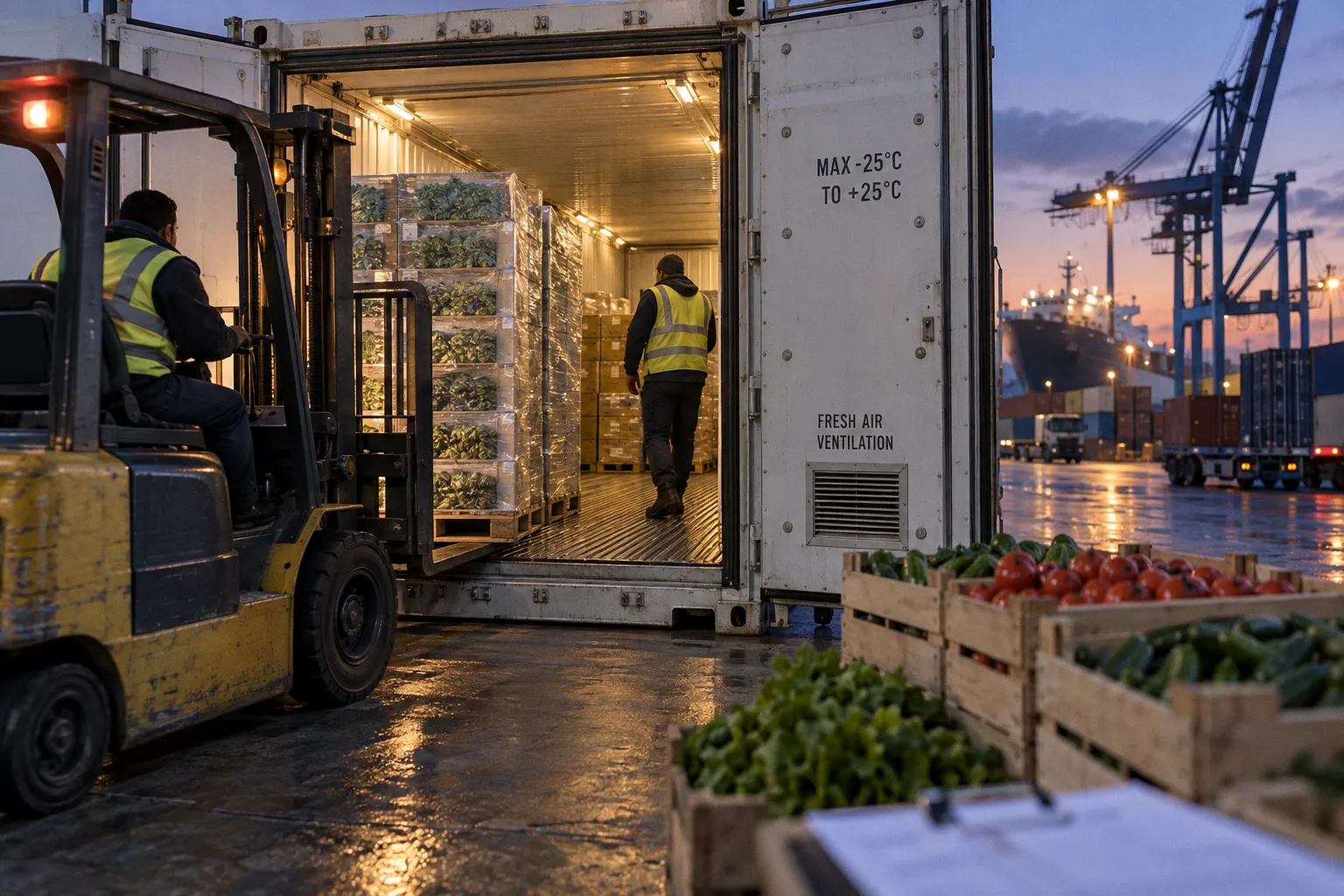
Load tomatoes, citrus, leafy greens, or stone fruit above their target range and you have already compromised the shipment before the container leaves Lebanon.
For Lebanese exporters, the operating problem is straightforward: protect the cold chain from the farm gate to the port of Beirut, then keep the container within the correct temperature, humidity, airflow, and ventilation parameters through the transit window. Reefer container preparation for Lebanese fresh produce is not a single loading task. It is a five-stage control process.
The sequence is:
1. Inspect the reefer before loading.
3. Set the environmental parameters.
4. Stack pallets for airflow.
5. Monitor the container continuously.
Miss one stage and the rest of the setup becomes harder to defend. Miss several and the cargo may arrive with quality loss that cannot be reversed.
Stage one: clear the reefer before it reaches the loading bay
Start with the equipment, not the cargo. A reefer unit can display a target temperature and still have a blocked airflow path, a damaged door gasket, a contaminated floor, or a control problem that will surface only after the container is sealed.
Your pre-trip inspection should cover the container, refrigeration machinery, power connection, and data-recording system. The objective is simple: prove that the unit can hold the required conditions before you commit export cargo.
The physical inspection
Check these points before loading:
- Container interior: It must be clean, dry, and free from strong odors, residue, standing water, and visible contamination.
- T-bar floor: The floor channels must be clear. Chilled air moves under the cargo and rises through the load; blocked channels interrupt that circulation.
- Door seals: Inspect the full gasket perimeter for cuts, deformation, gaps, or compression failure.
- Door locking system: Both doors must close and lock evenly. A minor gap becomes a major heat-intrusion point during a long transit.
- Ceiling and side panels: Look for damage, holes, condensation marks, or repairs that could affect insulation.
- Drainage points: Confirm that drains are not blocked. Water accumulation can damage packaging and create a hygiene problem.
- Evaporator area: Keep the air outlet and return path clear of packaging, film, straps, and loose debris.
- External condition: Record dents or structural damage before the container enters the loading process.
Do not treat a clean interior as proof of readiness. Cleaning removes contamination; it does not confirm thermal performance.
The machinery inspection
Test the refrigeration unit before stuffing. Confirm that:
- the unit starts correctly;
- the display responds to setpoint changes;
- the power supply and plug connection are sound;
- alarms are clear or documented;
- the temperature probe appears functional;
- the data logger or monitoring device is active;
- the unit can operate on the intended power source at the loading site and terminal.
Marine reefer units generally operate across a range of approximately -25°C to +25°C. That range describes equipment capability, not the correct setting for every commodity. Fresh produce commonly moves in chilled conditions between 0°C and +5°C, but the exact setpoint must follow the product, maturity, packaging, and destination requirements.
Do not select a setpoint because it is familiar. Select it because the commodity requires it.
Record the inspection
Create a container-specific record before loading. Include:
- container identification;
- inspection date and time;
- empty-container temperature;
- target setpoint;
- humidity setting, where available;
- ventilation setting;
- alarm status;
- floor and door condition;
- pre-cooling confirmation;
- seal number after loading.
This is not administrative decoration. It gives you a traceable handoff between the cooperative, exporter, haulier, terminal, carrier, and consignee.
A reefer inspection is a release decision: if the container cannot demonstrate control while empty, do not load it with cargo.
Stage two: pre-cool the produce before stuffing
Pre-cooling is the point where many export plans fail. The container may be cold, the setpoint may be correct, and the power connection may be stable. None of that changes the fact that warm produce enters the box with field heat.
Fresh fruits and vegetables remain biologically active after harvest. They respire, generate heat, release moisture, and may produce ethylene. The warmer the product, the faster these processes can accelerate. A reefer loaded with warm pallets must spend its limited cooling capacity fighting the cargo itself. That increases the risk of uneven temperatures, condensation, quality deterioration, and delayed stabilization.
Build a product-specific cooling instruction
Do not use one pre-cooling instruction for an entire cooperative unless the cargo is genuinely uniform. The protocol should identify:
- commodity;
- variety;
- harvest date;
- maturity level;
- packaging format;
- pallet configuration;
- target pulp temperature;
- acceptable loading temperature range;
- cooling method;
- maximum time between cooling and stuffing.
The target must be measured in the product, not guessed from room temperature. A cold warehouse does not automatically mean cold produce. Measure pulp temperature at representative points inside cartons or crates, including the warmest pallet positions.
For mixed loads, assume complexity until proven otherwise. Different commodities may require different temperatures, humidity levels, ventilation rates, and sensitivity controls. If the cargo cannot share one safe operating profile, do not force it into one reefer merely to fill capacity.
Cooling methods and timing
The cooling method depends on the commodity and packaging. Forced-air systems can pull heat through vented cartons more effectively than passive room cooling. Hydrocooling may work for suitable crops but requires control of water quality, sanitation, and post-treatment drying. Room cooling is slower and depends heavily on package design and pallet spacing.
The operational rule is consistent:
- cool the product before stuffing;
- measure the product temperature;
- keep the cold chain intact during transfer;
- minimize the time between removing cargo from pre-cooling and closing the container.
A reefer is not a substitute for a cooling room.
Protect the cold chain between the cold room and the port
The most vulnerable period is often the transfer. Product may leave the cooperative’s cold store, sit on a loading dock, move in a non-refrigerated vehicle, wait at the terminal, and then enter the reefer after the planned departure schedule has already tightened.
Control that handoff:
1. Pre-cool pallets before the truck arrives.
2. Stage the loading team and documents in advance.
3. Keep doors closed until the container and cargo are ready.
4. Load in the shortest practical window.
5. Connect the reefer to power immediately after sealing.
6. Confirm the first temperature record before the unit leaves the site.
If a delay pushes cargo outside its approved loading window, stop and reassess. Do not hide the delay by changing the setpoint.
Stage three: set temperature, humidity, ventilation, and alarms
Temperature is the headline setting, but it is not the whole environment. Fresh produce requires coordinated control of temperature, relative humidity, fresh-air exchange, and, for some commodities, ethylene exposure.
Temperature: set the cargo requirement, not the equipment maximum
A general chilled range of 0°C to +5°C covers many fresh-produce movements, but it is not a universal instruction. Some products suffer chilling injury at temperatures that are safe for others. Others need tighter control because maturity, skin condition, or packaging increases their sensitivity.
Use the commodity specification as the primary reference. Then align:
- setpoint;
- expected pulp temperature at stuffing;
- transit duration;
- destination handling conditions;
- carrier operating limits;
- alarm thresholds.
Avoid aggressive low-temperature settings as a quick fix for warm loading. A lower setpoint does not compensate for insufficient pre-cooling and may expose sensitive cargo to chilling damage.
Humidity: prevent water loss without creating a wet load
Reefer systems commonly manage relative humidity in the range of roughly 60% to 85%, while newer specialized units may reach lower settings. Fresh fruits and vegetables often require higher humidity, commonly around 80% to 95%, depending on the commodity.
The correct value is a balance:
- too low, and the produce loses water, weight, firmness, and visual quality;
- too high, and condensation, surface moisture, decay, and package deterioration become more likely.
Humidity is affected by the product, packaging, ventilation, temperature stability, and loading density. Do not assume that setting the highest available humidity is automatically protective. A wet carton is not a successful cold chain.
Ventilation: respiration does not stop at stuffing
Fresh produce continues to respire during transit. It generates heat, moisture, and gases, including ethylene. Fresh-air ventilation helps remove accumulated gases and manage the container atmosphere.
Set ventilation according to the commodity and carrier instructions. Keep the ventilation path open. Do not allow cartons, plastic film, or pallet wrap to cover the return-air or fresh-air points.
Controlled atmosphere equipment is a separate system. Do not confuse ordinary reefer ventilation with a controlled atmosphere program. If the buyer requires oxygen or carbon dioxide management, that specification must be arranged before booking and loading.
Alarms and setpoint changes
Define alarm limits before the container is sealed. Assign responsibility for reviewing alerts. A monitoring system that sends notifications to nobody is not a control system.
Avoid casual setpoint changes during transit. If the temperature trends outside the approved range, investigate the cause:
- cargo entered warm;
- airflow is blocked;
- doors were opened;
- power was interrupted;
- the unit has a mechanical fault;
- the sensor is incorrectly positioned;
- the cargo is producing more heat than expected.
Changing the setpoint without identifying the cause can conceal the problem while leaving the cargo exposed.
Stage four: stack for airflow, not maximum cubic utilization
A reefer is an airflow system. The floor channels move chilled air beneath the cargo; the air must then pass through the load and return to the refrigeration unit. Pallets that block the T-bar floor or reach into restricted zones can create temperature pockets even when the display shows the correct setpoint.
The target is uniform circulation, not the highest possible fill.
Use the floor correctly
Load pallets so that the T-bar channels remain open. Follow the container’s marked loading limits and keep the base of the cargo aligned with the airflow design. Do not place loose cartons, plastic, boards, or damaged packaging across the floor channels.
Where the packaging system is designed for vertical airflow, keep the carton vents aligned. A sealed carton with no usable vent path can isolate the product from the circulating air.
Keep the return path clear
The air must complete a circuit. Avoid loading above the permitted height line or pressing cargo against the ceiling. Keep the upper return-air space open. Do not allow stretch wrap, straps, or collapsed cartons to obstruct the rear return path.
These details matter because the coldest air is not necessarily reaching the center of the load. A container can have a normal supply-air reading and still contain warm product in poorly ventilated pallet cores.
Manage pallet and carton geometry
Before loading, confirm:
- pallet dimensions match the container plan;
- cartons are stable and not leaning into airflow spaces;
- vent holes are not covered by labels or wrap;
- pallet wrap is tight enough for stability but not so complete that it seals the cartons;
- cargo weight is distributed safely;
- fragile or high-respiration product is positioned according to the loading plan;
- no cargo can shift into the evaporator or door zone.
Do not improvise a mixed-load arrangement inside the container. Prepare a loading diagram for each recurring product configuration. It does not need to be complicated. It needs to show pallet count, orientation, clearance, and any restricted zones.
Mixed loads require a compatibility decision
If you are loading several Lebanese products into one reefer, make the compatibility decision before harvest planning and booking.
Use one container only if the products can share:
- a safe temperature range;
- a compatible humidity range;
- a compatible ventilation profile;
- similar transit tolerance;
- packaging that supports the same airflow pattern;
- no significant ethylene conflict.
If one product needs a materially different profile, split the load or use separate temperature-controlled equipment. A full container is not efficient if the cargo cannot survive the same environment.
| Loading factor | Operational requirement | Failure risk |
|---|---|---|
| Product temperature | Pre-cool cargo before stuffing and verify pulp temperature | Reefer spends transit removing field heat |
| T-bar floor | Keep under-pallet airflow channels open | Warm zones and uneven cooling |
| Carton vents | Align vents with the planned airflow path | Cooling bypasses the product |
| Upper clearance | Stay within the marked loading height | Restricted return air and heat buildup |
| Pallet wrap | Stabilize without sealing airflow | Condensation or blocked ventilation |
| Mixed commodities | Combine only compatible cargo | Chilling injury, dehydration, or accelerated decay |
Stage five: monitor from stuffing to delivery
The container is not controlled when the doors close. It is controlled when the temperature history, power status, alarms, and handoffs remain visible through the full route.
That route may include a farm or cooperative collection point, a cold store, inland transport, the port of Beirut, vessel loading, sea transit, transshipment, destination terminal, and final delivery. Each handoff creates a potential break in the cold chain.
Use more than the reefer display
The reefer controller shows the unit’s operating information. It does not necessarily show the temperature at the warmest or most vulnerable point in the cargo.
Use independent data loggers where available. Position them deliberately:
- one near the supply-air side;
- one in the center of the load;
- one near the return-air side;
- one in a historically vulnerable pallet position.
The exact arrangement should follow the monitoring plan and commodity risk. The purpose is to identify gradients, not to create a decorative dataset.
Record events that explain the data:
- loading start and finish;
- pre-cooling completion;
- container connection;
- seal application;
- terminal gate-in;
- power interruptions;
- inspection openings;
- transshipment;
- delivery and unloading.
A temperature excursion without an event log creates an argument. A temperature excursion linked to a documented power interruption or door opening creates an operational diagnosis.
Protect the first hours after loading
The first period after stuffing is critical. The cargo is transitioning from pre-cooling to transport control. Confirm that:
- the reefer is connected to power;
- the setpoint is correct;
- the unit is in the correct operating mode;
- the return and supply readings are moving as expected;
- no alarm is active;
- the seal number is recorded;
- the monitoring platform is transmitting.
If the unit is not stabilizing, escalate immediately. Waiting for the vessel to sail removes options.
Prepare for inspections without losing control
Agricultural export cargo may require inspection, documentation checks, and phytosanitary clearance. Those processes are part of the export plan, not surprises to be managed after stuffing.
Prepare the documentation package before the container arrives at the port:
- commercial invoice and packing information;
- product and lot identification;
- origin and cooperative records;
- phytosanitary documentation where required;
- buyer specifications;
- container and seal details;
- cold-chain records;
- any applicable Lebanese agricultural compliance documents.
For the regulatory side, align your facility and handling procedures with the relevant Lebanese requirements, including Ministry of Agriculture Decision No. 1/87 concerning technical specifications for cold-storage warehouses used for fresh agricultural products prepared for export or local distribution. Do not assume that a cold room is export-ready merely because it can reach a low temperature. Hygiene, construction, handling, and record controls also matter.
For a broader view of the equipment side, this reefer container operating overview can help frame the difference between temperature maintenance and cargo cooling. Use it as technical context, not as a substitute for the commodity-specific loading instruction or carrier requirements.
The operational protocol for Lebanese exporters
A cooperative or exporter should turn the five stages into a release protocol. The rule is simple: no release without evidence.
If the cargo is warm at the planned stuffing time
Stop loading. Keep the cargo in controlled conditions and extend pre-cooling. If the schedule cannot absorb the delay, decide whether to rebook, split the shipment, or downgrade the cargo plan. Do not load warm pallets into a reefer and expect the transit system to repair the decision.
If the reefer fails inspection
Reject the unit or request a replacement. Do not accept a damaged gasket, blocked floor, active alarm, or unclear temperature probe because the vessel cutoff is approaching. A late container is visible. A damaged shipment may remain disputed for weeks.
If the load contains incompatible commodities
Separate the cargo. If that is not possible, revise the product mix before loading. Commodity compatibility is a planning question, not a forklift question.
If the container loses power
Record the time, temperature, alarm condition, and responsible handoff. Escalate to the carrier and terminal immediately. Do not alter the records or reset the system without documenting the event.
If the data logger shows a temperature gradient
Inspect the loading pattern, product temperature at stuffing, airflow clearances, and package vents. A gradient may indicate blocked channels, poor pallet geometry, or an incorrect sensor position. Treat it as a loading-system problem until proven otherwise.
If the buyer asks for a lower setpoint
Confirm that the product can tolerate it. Buyer preference does not override commodity physiology, packaging limits, or the approved transport specification. Get the revised instruction in writing before loading.
The minimum release checklist
Use this at the loading bay. Keep the completed record with the shipment file.
- Container ID recorded.
- Interior clean, dry, and odor-free.
- T-bar floor channels clear.
- Door seals and locks inspected.
- Drainage and panels checked.
- Reefer powers on without unresolved alarms.
- Temperature probe and monitoring device confirmed.
- Commodity-specific setpoint approved.
- Humidity and ventilation settings approved.
- Produce pre-cooled before stuffing.
- Pulp temperature measured and recorded.
- Pallets aligned for underfloor airflow.
- Carton vents and return-air path unobstructed.
- Mixed-load compatibility confirmed.
- Loading time recorded.
- Container connected to power after sealing.
- Initial supply and return readings recorded.
- Seal number recorded.
- Export and phytosanitary documents matched to the lot.
- Responsibility for alarm review assigned.
- Handoff contacts confirmed for the port of Beirut and destination side.
The result you are trying to achieve
A successful reefer shipment from Lebanon is not defined by a cold container at the port. It is defined by a controlled product temperature from pre-cooling through delivery, supported by airflow, humidity management, ventilation, clean documentation, and an unbroken record of what happened.
The five-stage setup gives you a practical operating sequence:
1. Verify the equipment.
2. Remove field heat before loading.
3. Set the environment for the commodity.
4. Build the load around airflow.
5. Monitor every handoff and act on deviations.
That sequence is the difference between shipping a box of produce and shipping a defensible cold-chain consignment. In fresh produce export, the container is only one component. The system starts before the truck leaves the cooperative and ends only when the consignee accepts the cargo.