Potato sprout prevention: the quick mint oil method
There's a moment every storage season when a crate of beautiful, blemish-free potatoes goes from asset to liability — and it usually happens quietly.
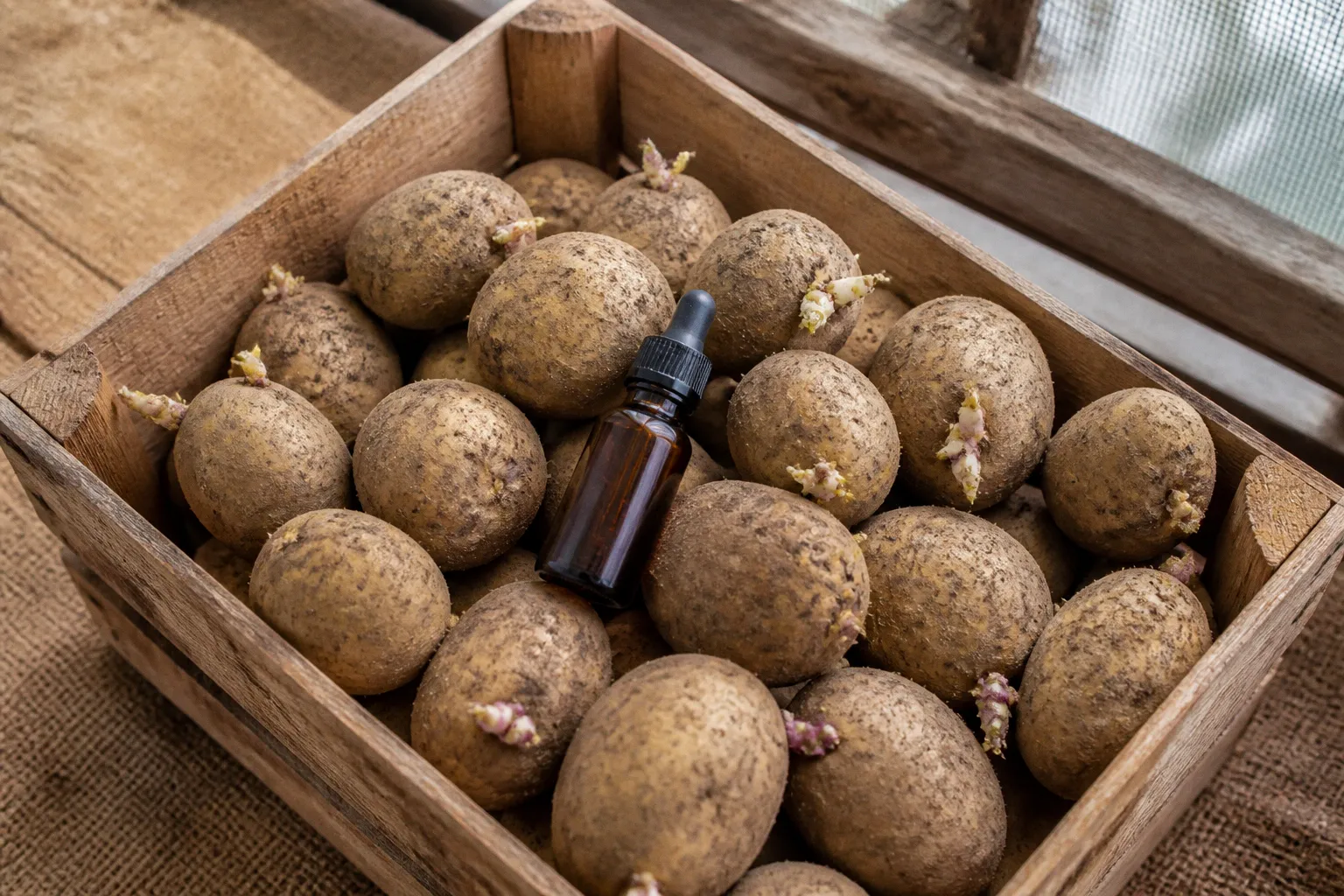
A single pale tendril pushing through the skin, no bigger than a thumb, signals the start of a chain reaction. Weight drops. Visual grade slips. Buyers start calling them "field-run" instead of "premium." For our growers in the Bekaa and the northern storage hubs, that moment has been getting closer every year, because the old chemical tools are disappearing from the toolbox.
After the EU and UK halted the renewal of chlorpropham (CIPC) around 2020, the post-harvest landscape for table and processing potatoes changed substantially. CIPC had been the workhorse sprout inhibitor for decades — inexpensive, long-lasting, easy to fog into a storeroom. Its withdrawal left warehouse managers looking for something that could step into the same role without the residue profile of a synthetic pesticide. Spearmint oil, applied as a thermal fog, has become one of the most widely adopted answers. It is bio-rational, leaves no long-term chemical residue, and fits inside the kind of storage infrastructure our cooperative halls already run. Understanding how it actually works — and what it doesn't do — is the difference between a successful storage season and one where we lose the crop we worked so hard to grow.
The Science of Mint Oil: How R-Carvone Disrupts Sprout Growth
Spearmint oil is not a sprout inhibitor in the chemical sense. That distinction matters, and it shapes every decision we make about timing, frequency, and storage temperature.
The active compound is R-carvone, a monoteriod ketone that gives spearmint its characteristic cool scent. When R-carvone contacts actively growing sprout tissue, it does not quietly arrest cell division the way CIPC did. It physically burns back the sprout. The tissue shrivels, dries, and falls away during the next grading or handling step. The mechanism is described in the trade literature as a disruption of the apical meristem — the growing tip of the sprout — through cellular damage at the bud surface.
What it does not do is prevent new sprouts from ever forming. This is the limit we have to respect. A potato eye that has not yet broken dormancy will stay dormant on its own schedule, governed by storage temperature, cultivar physiology, and the natural rest period of the tuber. Mint oil does not extend dormancy; it cleans up sprouts that have already begun. So the strategy becomes: slow emergence with cold, catch the first wave with fog, and stay ahead of the next one before it visibly damages the lot.
Mint oil doesn't pause the clock — it prunes what the clock has already started.
For our cooperatives, that translates into planning rather than treating. We watch the storeroom, not the calendar. The first pale tip in a sample crate is the cue. By the time we see it across multiple bins, we have already lost a week of clean appearance.
Thermal Fogging Techniques for Commercial Potato Storage
Application is the part that looks simple from the outside and reveals its complexity quickly. Commercial spearmint oil products like Biox-M are essentially 100% spearmint oil formulated for thermal dispersion. They are introduced into a sealed potato storage facility using hot fogging equipment — a thermal fogger heats the oil into an extremely fine mist that drifts through the air space and settles as a thin film across every surface, including the skin of every tuber in the room.
The fog has to reach the potatoes evenly, which means the room must be sealed during application and for a contact period afterward. Ventilation is then restored. Most operations schedule fogging overnight or during a planned pause in handling, so the mist can settle without being immediately disturbed by forklift traffic or door openings. The equipment is not exotic, but the protocol is non-negotiable: an unsealed room simply dilutes the dose into the outside air.
A few practical points our growers have learned to treat as standard:
- Box integrity matters. Gaps around doors, ventilation shafts, and loading hatches need to be checked before every application. Even a small leak pulls fog out of the room and pulls uneven results in.
- Air circulation helps. Most modern storage halls already run fans for temperature and humidity management. Running those fans during the contact window distributes the fog more evenly across the stack.
- Dose rates are cultivar-sensitive. Heavier-skinned, later-dormancy varieties tolerate higher concentrations and respond with cleaner burn-back. Thin-skinned early cultivars can scorch or carry flavor notes if over-applied.
- Personnel safety is part of the protocol. The fog is a respiratory irritant during application. Operators wear appropriate protection, and re-entry timing follows the product label.
The thermal fogging step itself takes minutes. The sealing, contact, and ventilation cycle takes hours. That's the rhythm we build our storage weeks around.
Managing Sprout Suppression Cycles: The 2 to 5 Week Window
A single application of mint oil gives us a suppression window of roughly two to five weeks, depending on cultivar and storage temperature. That is the central planning fact of the entire season. It is not a season-long solution; it is a recurring operation.
The right way to think about it is as a maintenance rhythm, similar to how we think about irrigation intervals or foliar spray rotations. We are not "treating" the storage once. We are scheduling repeated fog events at intervals calibrated to the dormancy profile of the variety in the room and the temperature at which we are holding it.
Here's how the cycle tends to play out across a typical storage season:
1. Cool and hold. Potatoes come in from harvest, are cured briefly to heal skinned surfaces, then dropped to holding temperature. During this first stretch, dormancy is largely doing the work for us.
2. First visible sprouting triggers the first fog. We sample bins weekly. Once we see consistent 1–2 mm sprouts across a representative sample, the room gets fogged.
3. Two-to-five-week reapplication interval. After fogging, we monitor weekly. When new sprouts reappear at tolerance length, we fog again. The interval expands in colder rooms and contracts in warmer ones.
4. Late-season slowdown. As we approach the planned shipping window, the cycle either ends naturally (we ship before the next fog would be due) or we adjust downward in dose to avoid flavor carryover into the cooked product.
The two-millimeter tolerance is worth pausing on. Most fresh packing operations hold a maximum sprout length of about 2 mm before grade drops. Processing potatoes can tolerate slightly longer sprouts because they go directly to peeling and cutting, but table stock cannot. That 2 mm threshold is the visual alarm that drives most of our reapplication timing.
Two to five weeks is a rhythm, not a result — schedule the next fog before you need it.
One operational consequence worth naming: the labor and energy cost of repeated fogging is real. Each cycle requires sealed-room time, equipment setup, and a re-ventilation window during which the room is effectively out of service for grading or shipping. We have found that aligning fogging with planned grading or rotation days reduces downtime. The fog event becomes part of a handling day rather than a separate interruption.
Balancing Cold Storage Temperatures with Natural Inhibitors
Temperature is the silent partner of every sprout control program. Mint oil is dramatically more effective when the room is cold, and dramatically less necessary when the room is already cold enough to keep sprouts from initiating in the first place.
For fresh table potatoes, holding the room in the range of roughly 3°C — the cold-store benchmark cited across the industry — suppresses sprouting pressure enough that we extend our intervals and reduce total applications per season. Processing potatoes, which are typically stored warmer (around 8°C to 10°C) to preserve fry color and reduce sugar accumulation, face much higher sprouting pressure and require more frequent fogging cycles.
A simple way to frame the trade-off for our cooperative boards:
| Storage profile | Typical temperature | Sprouting pressure | Mint oil frequency | Practical note |
|---|---|---|---|---|
| Fresh table stock | ~3°C (range 2.5–5°C) | Low to moderate | Longer intervals between applications | Cold does most of the suppression; fog handles what cold misses |
| Processing stock | ~8–10°C | High | Shorter intervals; more applications per season | Warmth drives rapid emergence; plan budget and labor around more fog cycles |
| Transitional/cured | 10–15°C during early storage | Very high | Not recommended as primary tool | Best handled with ventilation and quick turnover, not repeated fogging |
The cold-plus-fog combination is the heart of a clean season. Cold alone, held consistently, will carry table potatoes a long way. Mint oil alone, in a warm room, becomes a constant operational drain. The two together give us the result we actually want: a blemish-free, sprout-free lot that holds its grade through the shipping window.
For cooperatives running mixed storage — some halls at table-stock temperatures, others at processing temperatures — the implication is that fogging schedules cannot be pooled. Each room runs on its own cycle, and the manager who tries to "treat them all on the same day" usually ends up over-treating the cold rooms and under-treating the warm ones.
Organoleptic Considerations: Managing Taste and Aroma in Treated Crops
The honest conversation we have with our members before any mint oil program begins is about flavor. Spearmint oil at full commercial concentration is, after all, a strongly scented essential oil. The question is whether any of that scent survives into the cooked potato.
The answer, from the trade literature and our own observation, is: sometimes, and predictably. The factors that determine carryover are dose, timing relative to cooking, and — most importantly — cultivar. Thin-skinned varieties and those processed at higher doses can retain a faint mint note in the cooked product. Heavier-skinned processing cultivars, fogged at standard rates and held for several weeks before use, generally do not.
A few practical guidelines have emerged from working through this with our growers:
- Schedule the last fog well before shipping. The longer the interval between the final application and the cook pot, the lower the residual carryover. Two to three weeks is a comfortable buffer for table stock.
- Match dose to end use. A lot headed directly to a peeling and chipping line within days tolerates a heavier dose than a lot headed to retail shelves and a baking pan at home.
- Run a cook test on new cultivars. Before committing a new variety to a mint oil rotation, we cook-sample a few tubers post-treatment. The test is simple — bake or boil, then smell and taste. A detectable mint note at this stage is a signal to adjust the dose or the interval.
- Communicate downstream. If our cooperative is selling into a market that values a "clean" flavor profile — and most retail markets do — the buyer's quality team should know that the lot has been mint-oil treated. It is not a defect, but it is information they will want.
A predictable, documented treatment is something you can put on a spec sheet — and a reason a buyer trusts your lot.
This last point matters more than it might seem. The shift away from CIPC has left some buyers nervous about residue and about what replaced it. A cooperative that can speak clearly about its sprout control program — what was applied, when, at what dose, with what interval before shipping — is a cooperative that holds its customer relationships through the season.
Bringing the Season Home
The mint oil method is not magic, and it is not a permanent fix. It is a bio-rational tool that does a specific job: it cleans back sprouts that have already begun, buying us two to five clean weeks per application, in a system that needs no long-term chemical residue and fits inside storage halls we already operate. The work it requires — sealed-room discipline, weekly sampling, careful scheduling around cultivar and temperature — is real, but it is the kind of work that a cooperative does well, because it is shared work, planned work, work that benefits from the kind of coordination that an organized group can provide and a lone warehouse rarely can.
For our growers, the path is straightforward. Decide the storage temperature profile for each hall before the season opens. Build a sampling routine into the storage calendar. Train at least two people per site on the fogging protocol so coverage holds when someone is sick or on rotation. Document every application: date, dose, cultivar, room temperature, intended shipping window. And review the season with the full group at the end — what worked, what carried flavor, what the interval pattern looked like — so the next season starts ahead of where this one began.
That is how a sprout suppression method becomes a collective capability. Not a single treatment, but a rhythm we run as a community of growers who have decided that the potatoes coming out of our storerooms in March will look and cook the way we said they would.