Pheromone traps in apple orchards: pest control shifts
For Lebanese apple cooperatives, pest control is rarely a question of choosing one product and applying it across every orchard. Our growers work across different elevations, soils, microclimates, and market requirements, often within the same cooperative.
A spray calendar that looks manageable on paper can quickly become too broad in the field: pests emerge at different times, fruit matures unevenly, and a treatment aimed at one insect may do little for another.
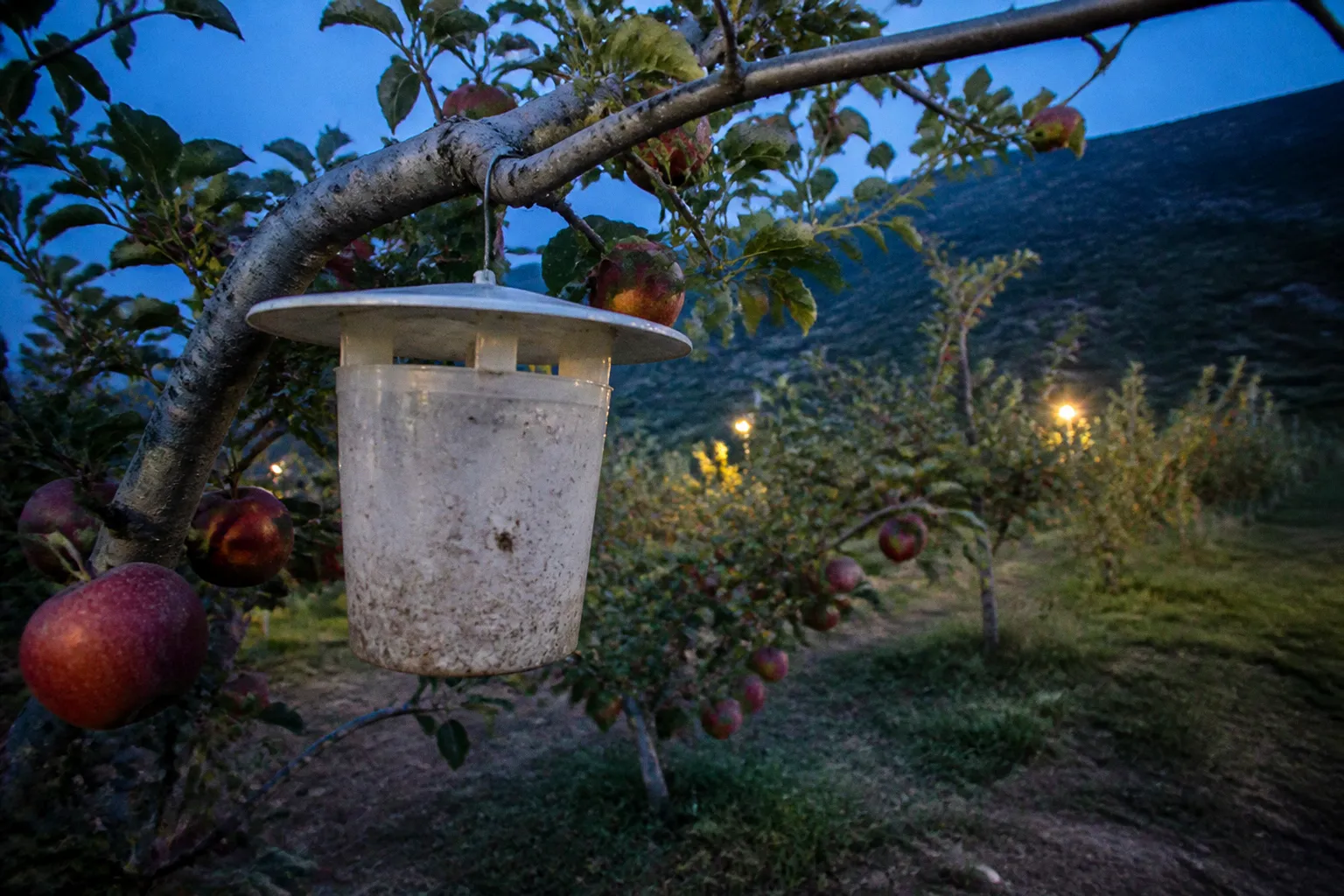
Pheromone traps offer a more precise starting point. Used for monitoring, mass trapping, or mating disruption, they help us see what is actually moving through the orchard before we decide how to respond. That shift—from treating by habit to treating according to pest activity—can support cleaner fruit, lower pesticide pressure, and a more resilient production system.
This is especially relevant for the Bekaa Valley and Lebanon’s higher apple-growing areas, where climate patterns do not always follow a familiar seasonal script. In Bane, North Lebanon, monitoring between 2015 and 2020 recorded Mediterranean fruit fly activity lasting four to five and a half months, without a clear emergence peak. There was no single obvious week when the pest appeared and then disappeared. A cooperative that relies on one assumed treatment window may simply miss part of the risk.
Precision monitoring begins with a shared orchard map
A pheromone trap is not a substitute for field knowledge. It is a way to organize that knowledge.
For codling moth, the familiar Delta-style monitoring trap uses a sex pheromone lure to attract males. The number of captures does not tell us everything about the orchard, but it gives the team a consistent signal: whether the pest is present, whether activity is increasing, and whether the timing of a control measure needs to change.
The first practical step for a cooperative is to map its orchard blocks rather than treating the entire growing area as one uniform unit. Records can be simple, especially at the beginning:
- orchard location and elevation;
- apple variety and approximate planting area;
- tree age and canopy density;
- previous codling moth or fruit fly pressure;
- irrigation conditions and nearby host plants;
- dates of trap installation, inspection, and lure replacement;
- weekly catches and visible fruit damage.
For commercial apple blocks, standard monitoring guidance places at least one trap per 10 acres, with the trap hung high in the canopy, within the upper third of the tree height. That recommendation gives us a baseline, but cooperatives may choose a denser arrangement where pest pressure varies sharply between blocks, where orchards are smaller and fragmented, or where neighboring crops create additional hosts.
The trap should be easy for the field team to find and inspect. A hidden trap that is forgotten among dense leaves is not a monitoring system; it is an unused piece of plastic. Marking trap locations on a shared paper map or a basic phone-based record can make a surprising difference. One grower may notice a rise in captures, but the cooperative sees the pattern only when every block is recorded in the same way.
What to record during each inspection
A useful inspection takes more than counting insects. Our teams should note:
1. The number of target moths caught since the previous visit. The trend matters more than one isolated count. A gradual rise across two or three inspections deserves a different response from a single unexpected capture.
2. The condition of the trap and lure. Dust, rain, damaged sticky surfaces, or an old lure can make the result less reliable. A low count is not reassuring if the trap is no longer functioning properly.
3. The growth stage of the apple trees. Pest activity has to be read alongside fruit development, canopy growth, and the period when fruit is most vulnerable.
4. Visible signs on leaves, shoots, and fruit. Pheromone monitoring focuses on a target pest, while the orchard contains many other insects and disease pressures. Look for entry marks, frass, damaged fruitlets, leaf injury, and signs of natural enemies.
5. Weather and irrigation conditions. Temperature, humidity, and rainfall influence insect development and orchard activity. These notes help explain why two nearby blocks can show different results.
In Qob Elias in the Bekaa Valley, insect monitoring identified peak pest populations between September 10 and 29, 2024. The practical lesson is not that every Lebanese orchard should copy those dates. It is that timely intervention depends on local tracking. A calendar from one valley, variety, or altitude should not become a fixed rule for every grower in the cooperative.
A trap turns pest control into a conversation with the orchard: the trees give us a signal, and our collective work decides how to answer it.
Mating disruption for codling moth: changing the scale of control
Monitoring tells us when a pest is active. Mating disruption aims to reduce the chance that adult moths find one another in the first place.
For codling moth, dispensers release synthetic female pheromone into the orchard air. When the pheromone is distributed properly, male moths have more difficulty locating females. Fewer successful matings can mean fewer eggs and, later, less larval damage to the fruit. The method is not a quick knockdown treatment. It is a population-management strategy that works through timing, coverage, and consistency.
A field application using ISOCOD-C dispensers placed 500 pieces per hectare reported a substantial reduction in average weekly male captures. In 2023, orchards under mating disruption recorded a mean of 0.91 ± 0.18 males per trap per week, compared with 11.38 ± 1.64 in control orchards. In 2024, the corresponding figures were 0.81 ± 0.19 under the disruption program and 19.60 ± 2.65 in control orchards.
Those figures show the strength of the approach under the studied conditions, but they should not be read as a promise that dispensers alone will protect every orchard. Mating disruption is sensitive to orchard design and pest pressure. Small isolated blocks, irregular boundaries, gaps in dispenser placement, strong immigration from untreated neighboring orchards, and an already high pest population can all reduce performance.
A cooperative protocol is stronger than isolated placement
The most reliable way to use mating disruption is to coordinate it across neighboring blocks. If one grower installs dispensers while the surrounding orchards remain unmanaged, moths can move across the boundary and weaken the effect. A cooperative can address this by agreeing on a shared installation window, a common product specification, and a method for recording dispenser placement.
For the ISOCOD-C application described in the research, the rate was 500 dispensers per hectare, with installation around 1.5 to 1.8 meters above the soil surface. Product labels and local technical guidance remain the final reference for any application, because dispenser rate and placement are not interchangeable among pest species or products.
A workable seasonal plan can look like this:
- Before the moth flight period: identify the blocks, confirm area measurements, inspect trees and boundaries, and order enough dispensers for coordinated coverage.
- At installation: place dispensers evenly through the canopy, including edge areas that are often overlooked.
- During the season: continue trap monitoring rather than assuming that low captures mean the program needs no supervision.
- At the first signs of pressure: inspect fruit and shoots, check for gaps or damaged dispensers, and decide whether a targeted intervention is needed.
- After harvest: record fruit damage by block and compare it with trap results, variety, elevation, and neighboring orchard conditions.
This creates a useful division of responsibility. The cooperative can coordinate purchasing, timing, records, and technical support. Each grower remains responsible for walking the trees, reporting damage, and maintaining the dispensers in their own block. No part of the system works well when it is treated as someone else’s task.
High-altitude orchards and the Mediterranean fruit fly problem
Codling moth and Mediterranean fruit fly are different pests, and they should not be managed with the same assumption simply because both affect apples.
The high-elevation apple orchards studied in Bane, North Lebanon, were located between 1,100 and 1,300 meters above sea level. Monitoring from 2015 to 2020 showed Mediterranean fruit fly flight activity extending across four to five and a half months, with no distinct emergence peaks. That pattern complicates the idea of one decisive treatment date.
The risk can also vary by apple color and variety. In mass-trapping trials on Lebanese apple varieties, infestation reached as high as 98.54% on white-colored apples such as Golden Delicious. That level of damage demonstrates why fruit appearance, variety, orchard location, and pest behavior need to be considered together. It also explains why clean, blemish-free fruit cannot be protected by a generic spray schedule alone.
Mass trapping works differently from codling moth mating disruption. Rather than confusing males across the entire orchard, it seeks to remove a significant number of adult flies through attractant-based traps. Its performance depends on trap density, lure design, placement, surrounding host plants, and the timing of deployment. It should be paired with frequent fruit inspection and sanitation, including the removal of damaged or fallen fruit that may support further development.
For cooperatives in mountain areas, a shared Medfly plan could include:
1. Block-level monitoring before visible damage becomes widespread. By the time a large share of fruit shows injury, the population may already be established.
2. Consistent trap servicing. A trap that has filled, leaked, or lost its attractant cannot provide a dependable signal.
3. Attention to orchard edges. Pest movement does not stop at the property line, particularly where unmanaged fruit trees or discarded produce are nearby.
4. Variety-specific records. Golden Delicious and other light-colored varieties may show a different damage profile from darker-skinned apples, and those differences should guide field attention.
5. Coordinated sanitation after fruit drop. Fallen fruit is not merely a cosmetic problem; it can become part of the pest cycle.
The role of altitude also deserves a more careful reading. Cooler conditions at elevation may change the pace of insect development, but they do not guarantee low pest pressure. The Bane observations are a reminder that highland orchards still need sustained monitoring, even when the season feels shorter or the nights are cool.
Pheromone tools belong inside an ecological orchard system
Pheromone traps are attractive to sustainable growers because they are targeted. They do not blanket the orchard with a broad-spectrum chemical, and they can help us decide whether a treatment is justified. But their environmental value becomes stronger when they are part of a wider system that protects soil, water, pollinators, and natural enemies.
Research on insectivorous bats has found that using moth sex pheromone lures in IPM apple orchards can increase bat activity and species richness. This is a useful reminder that pest management is not only about suppressing the target insect directly. A healthy orchard also creates room for predators and other organisms that contribute to natural control.
That does not mean every bat observed in an orchard will solve a codling moth problem. It means that a pest strategy should avoid needlessly damaging the ecological relationships that support the farm. Repeated, poorly timed broad-spectrum insecticide applications can reduce beneficial insects and disrupt the wider food web, while a monitored and targeted program gives natural suppression more space to work.
A sustainable apple block may combine:
- pheromone monitoring for codling moth;
- mating disruption where the orchard layout and pressure make it suitable;
- mass trapping or other targeted tools for Mediterranean fruit fly;
- selective insecticide use when monitoring and field inspection show a real need;
- flowering margins or protected non-crop areas for beneficial insects;
- reduced disturbance of soil and ground cover where water and disease conditions allow;
- irrigation practices that reduce waste and avoid prolonged wetness around the trees;
- removal of damaged fruit and pruning waste that can harbor pests or disease.
The practical point is balance. Organic pest control in Lebanon is not achieved by removing one chemical from the program and leaving every other decision unchanged. It comes from redesigning the sequence: observe first, identify the pest, understand its timing, protect natural allies, and apply the narrowest effective response.
The economics of precision: fewer unnecessary decisions
For a smallholder cooperative, the cost of pheromone traps is only one part of the calculation. There is also the time required to install and inspect them, train field staff, keep records, coordinate neighboring growers, and respond when the numbers change. Yet a broad treatment applied without reliable information carries its own costs: product, labor, fuel, residue risk, disruption of beneficial organisms, and fruit that still fails to meet market expectations.
A shared program can reduce some of those burdens. Instead of every grower purchasing a small quantity of materials at a different time, the cooperative can organize bulk procurement and agree on a common monitoring calendar. A trained scout can visit several blocks, while growers contribute local observations that the scout may not see during one inspection.
The cooperative should also connect pest records to post-harvest quality. A block with low trap captures but high fruit damage may have a monitoring problem, an issue with trap placement, or pressure from a different pest. A block with high captures and clean fruit may be benefiting from effective timing or strong natural suppression. Without comparing these records, the team cannot learn which parts of the program are working.
A simple seasonal table can keep the discussion grounded:
| Orchard question | What the cooperative records | How it shapes the response |
|---|---|---|
| Is codling moth present? | Trap location, inspection date, and male captures | Continue monitoring, intensify inspection, or consider a targeted intervention |
| Is mating disruption covering the block? | Dispenser rate, placement, installation date, and missing units | Replace gaps and check whether neighboring blocks are coordinated |
| Is Mediterranean fruit fly pressure prolonged? | Trap activity over time, fruit damage, variety, and elevation | Maintain longer monitoring rather than relying on one assumed flight peak |
| Are controls affecting the orchard ecosystem? | Beneficial insect and bat observations, alongside pest records | Refine product choice and timing to preserve natural suppression |
| Did the program protect market quality? | Damage and rejection records by variety and block | Adjust next season’s monitoring density, timing, and cooperative support |
This is where sustainable farming becomes operational rather than aspirational. We are not trying to create a perfect orchard in which no insect is ever found. We are building a production system that can distinguish between presence and damaging pressure, then respond without spending more ecological and financial capital than the crop requires.
The cooperative advantage is not simply buying traps together. It is learning together quickly enough to act before small signs become a shared loss.
What field teams should inspect beyond the trap
A pheromone trap measures a narrow part of the orchard story. Regular visual inspection fills in the rest.
For codling moth, teams should examine fruit for entry points and frass, especially where fruit touches another fruit, a leaf, or a branch. Damaged fruitlets should be recorded by block rather than dismissed as random loss. Patterns may reveal whether the problem is concentrated along edges, in dense canopy, near storage or packing areas, or in a variety that needs closer attention.
For Mediterranean fruit fly, inspection should include ripening fruit, dropped fruit, and locations where fruit remains on the tree after normal harvest passes. Damage may not be evenly distributed, and the earliest signs can be easy to miss when teams are focused only on trap counts.
The field record should answer three questions:
- What did the trap show?
- What did the tree show?
- What action followed, and what happened afterward?
That final question is often neglected. If the cooperative applies a targeted treatment after a rise in captures, it should later compare the outcome with the original block record. If the result was poor, the explanation may be late timing, incomplete coverage, reinvasion from outside the block, incorrect pest identification, or a problem unrelated to the original target.
This feedback loop allows our growers to move beyond the language of success or failure. A control measure can be technically effective but poorly timed. A low trap count can be genuine or can reflect a damaged lure. A clean harvest can result from several overlapping protections rather than one product. Good records do not make farming mechanical; they make the next decision less speculative.
Building a Lebanese model for climate-resilient apple production
Climate change adaptation in Lebanese agriculture will require more than drought-tolerant planting material or improved irrigation. Pest seasons may become less predictable, and the old division between highland and valley conditions may become less useful as temperatures shift. Extended flight periods, uneven rainfall, and warmer shoulder seasons can all complicate pest management.
Pheromone monitoring gives cooperatives one practical way to adapt because it is responsive rather than calendar-bound. It does not ask us to predict the entire season perfectly. It asks us to observe what is happening in each production area and adjust the response as evidence accumulates.
For sustainable apple farming in the Bekaa, that may mean beginning with a modest pilot rather than changing every block at once. Choose several orchards with different elevations or varieties. Install monitoring traps consistently. Train the same small team to inspect them. Add fruit inspections and harvest-quality records. Then compare the results across the season.
A pilot should be large enough to reveal local differences, but simple enough to manage. It can answer questions that matter to the cooperative:
- Which blocks show the earliest pest activity?
- Does pressure move from orchard edges or appear throughout the canopy?
- Which varieties need more frequent fruit inspection?
- Does mating disruption perform better when neighboring growers participate?
- Where are natural enemies most visible?
- Which interventions reduce damage without creating a new problem elsewhere?
The answers will not be identical across Lebanon, and that is precisely why local cooperation matters. A national recommendation can provide a starting point, but our orchards need decisions shaped by their own elevation, crop mix, water conditions, and market destination.
Fresh produce buyers increasingly care about consistency as well as appearance. They want apples that are crisp, sound, and blemish-free, but they also expect growers to manage residues, traceability, and environmental responsibility. Pheromone traps do not solve all of those demands. They help create the disciplined observation on which the rest of the system depends.
A practical starting plan for the next season
A cooperative that is new to pheromone-based IPM does not need to begin with an elaborate digital platform. It needs agreement, regularity, and a clear person responsible for each task.
Start before the orchard becomes busy with harvest operations:
1. Divide the production area into recognizable blocks. Record elevation, variety, area, and neighboring land uses.
2. Select the target pest for each tool. Codling moth pheromone monitoring and mating disruption are not interchangeable with Mediterranean fruit fly mass trapping.
3. Set a common inspection rhythm. The value of a trap falls when visits are irregular or records are incomplete.
4. Place and label traps correctly. Use the recommended canopy position and baseline density, then add traps where local conditions justify closer observation.
5. Train growers to inspect fruit as well as traps. Counts need field confirmation.
6. Coordinate mating disruption across connected orchards. Gaps between participating blocks can undermine the collective result.
7. Keep intervention records by block. Include date, target pest, product or method, and observed outcome.
8. Review the season after harvest. Compare pest captures with fruit damage, quality, and market acceptance.
This approach also creates a stronger case for future investment. When a cooperative can show where pest pressure occurs, how long it lasts, and which tools reduce damage, it is better placed to seek technical support, negotiate shared purchasing, and explain its production standards to buyers.
The goal is not a trap in every tree or a promise of pesticide-free fruit under every condition. The goal is a Lebanese apple sector that makes fewer blind decisions. When our growers share observations, coordinate boundaries, protect orchard biodiversity, and respond to real pest movement, biological control becomes more than a product category. It becomes part of how the community farms.
Pheromone traps are valuable because they make that change visible. They turn scattered signs into a common record, and a common record into collective action. For our apple cooperatives, that is a practical route toward lower pesticide pressure, stronger market confidence, and harvests that remain crisp, healthy, and worthy of the land that produced them.