Organic pest control: 5 natural methods for Lebanese farms
When you walk a Lebanese vegetable plot in mid-July, the air tells you something before the plants do.
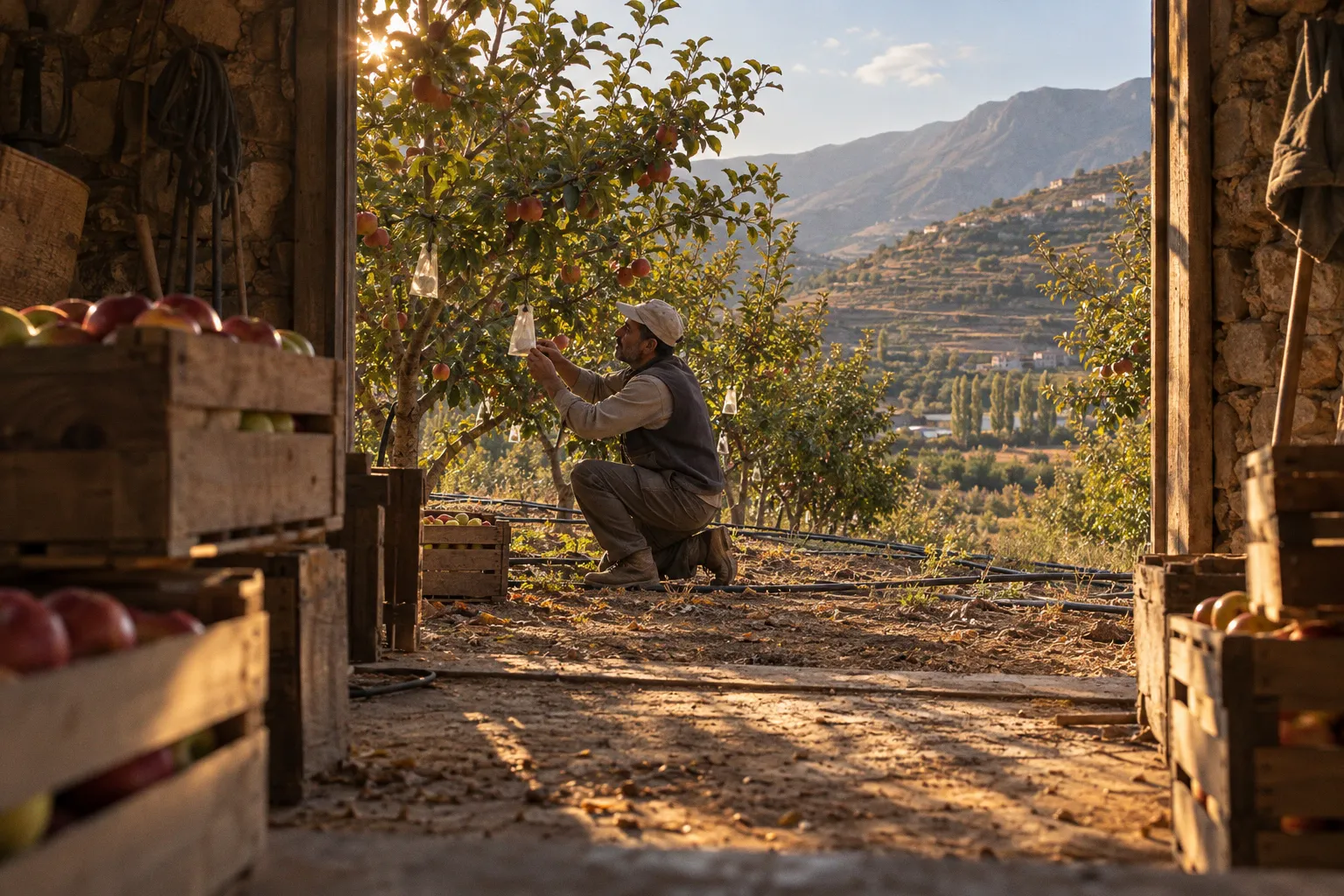
The acrid smell of a recent prophylactic spray drifts across the trellis rows, and the soil beneath your boots — even the crust on the furrows — feels sterile in a way that the original Bekaa loam never was. Lebanese agriculture has historically leaned hard on chemical pesticides, with a national average of roughly 7 kg/ha of pesticide application and 331 kg/ha of synthetic fertilizer use recorded in 2020. That figure places the country among the most input-intensive baselines documented anywhere. It also makes the question of organic pest control methods for Lebanese vegetable gardens less a lifestyle preference than a soil-and-balance-sheet problem.
The farmers I work with in the Bekaa, Akkar, and the coastal greenhouse belt do not romanticize the past — they want functioning rotations. What is changing, slowly, is the toolkit. The five methods below are not theoretical; each has been trialed, in some form, in Lebanese conditions. Together they form the spine of an integrated pest management program any smallholder can begin next season.
The chemical baseline, and why it costs the field more than the bottle
A 7 kg/ha pesticide load does not sound catastrophic on paper. Spread evenly across a hectare, it sounds almost modest. In practice, that average is built on calendar sprays, prophylactic applications, and the broader economics of risk aversion in a country where extension services are stretched thin. Every broad-spectrum chemical that goes out kills beneficials along with the pest it targets. Once the predator base collapses, secondary pests move into the empty niche. You get resistance, and you spray more. It is the textbook IPM curve, and the field replicates it well.
This is why integrated pest management for small farms has become less about ideology and more about rebuilding the predator guild that the spray program wiped out. Once that base recovers, the pesticide spend comes down on its own. That is the operational meaning of natural pesticide alternatives in Lebanon — not "no chemistry," but less of it, applied with timing.
A national average of 7 kg/ha of pesticide and 331 kg/ha of synthetic fertilizer is not just an environmental story. It is a fixed-cost line that squeezes the smallholder every season.
Method 1: Predatory mites as a standing army
The clearest demonstration of biological control in Lebanese conditions comes from greenhouse trials led by the American University of Beirut, published in late 2025. Working on two-spotted spider mite (Tetranychus urticae) in vegetable greenhouses, the research team combined a release of the predatory mite Phytoseiulus persimilis with a local strain of the entomopathogenic fungus Beauveria pseudobassiana. Within three weeks, spider mite populations dropped by 77% to 100%. P. persimilis alone, in earlier greenhouse work, achieved reductions around 59%.
That three-week number deserves attention. Three weeks, and the infestation collapses below the threshold where the farmer would normally reach for an acaricide. The predator does the scouting. The fungus handles the survivors that retreat into leaf axils, the substrate, or the underside of the canopy.
In a separate Byblos greenhouse cucumber trial, a single early-season release of Amblyseius swirskii alongside P. persimilis kept the major pest complex — thrips, whitefly, spider mites — at low levels through most of the cycle, with no insecticide applications. Timed to the first detected hotspots rather than to a calendar, that single release did the work of a conventional multi-spray program.
For a cooperative exporting to buyers who run residue panels, this is not a curiosity. It is a way to keep MRLs (maximum residue limits) clean and the harvest window open. The biologicals arrive in slow-release sachets now, hung on the plant like a pheromone dispenser.
Method 2: Entomopathogenic fungi and microbial biopesticides
Beauveria pseudobassiana is one of several soil-dwelling fungi that infect insects through their cuticle. When a spore lands on a suitable host, it germinates, penetrates, and the insect dies within days — a mummified cadaver that becomes the next round of inoculum.
What the AUB work demonstrated is that pairing a predator with a fungus outperforms either agent alone. The predator suppresses the bulk population quickly; the fungus reaches the refugia where the predator cannot follow. Layered defenses behave differently from a single mode of action, and pest resistance to either agent evolves far more slowly.
The practical constraint in Lebanon is humidity. Beauveria and the related Metarhizium anisopliae need leaf wetness for several hours after application. Dry-season Bekaa summers require evening sprays or irrigation-anchored release. Commercial formulations of these fungi are increasingly available through Lebanese agricultural suppliers and cooperative channels, and application guidance from regional research programs has matured considerably over the past decade.
| Control approach | Time to meaningful suppression | Compatibility with beneficials | Skill level required | Best seasonal window |
|---|---|---|---|---|
| Calendar broad-spectrum spray | Immediate | Poor — kills predators and parasitoids | Low | Any |
| Predatory mites only (P. persimilis) | 2–3 weeks | Good | Moderate | Early season, before peak heat |
| Entomopathogenic fungus only | 7–14 days | Good | Moderate | High humidity (>70%) preferred |
| Combined predator + fungus | 1–3 weeks | Good | Moderate to high | Early to mid-cycle |
Method 3: Companion planting and intercropping
Companion planting in Lebanese market gardens predates the IPM literature. Tomatoes have long been interplanted with basil; aubergines with beans; cucumbers with nasturtiums as a trap crop. What recent trials have done is quantify the mechanism.
Trap cropping works because certain plants — nasturtium for aphids, marigold for whitefly, dill for tomato hornworm — concentrate the pest on a sacrificial border, where it can be spot-treated or hand-removed without contaminating the cash crop. The companion, in turn, hosts nectar and pollen that feed the parasitoid wasps, hoverflies, and tachinid flies that do the rest.
In a Bekaa vegetable rotation, a one- to two-meter strip of flowering herbs along the plot edge — sweet alyssum, coriander, fennel, marigold — supports a measurable parasitoid population. The cost is minimal: seed, a strip of land you would have left fallow, and a season of patience. The effect compounds over years as the beneficial base stabilizes.
For organic farming techniques in the Bekaa Valley, and for the residue and audit requirements of EU and Gulf buyers, documented intercropping and habitat strips count as legitimate IPM measures. They read well on an export file, and they function as a working pest-control system at the same time.
Method 4: Mass trapping with pheromone and sticky lures
Mass trapping is the most underused of the five methods on small Lebanese farms, largely because traps and lures were historically priced for the export-oriented orchardist. That has shifted.
Pheromone-baited delta traps for tomato leafminer (Tuta absoluta), melon fly, and Mediterranean fruit fly are now produced locally at cooperative-friendly price points. The mechanism is straightforward: a synthetic sex pheromone lures males into a sticky trap, mating is disrupted, the next generation fails to launch, and the population curve bends downward over a six-to-ten-week window.
For Lebanese greenhouse tomatoes, T. absoluta has been the single most damaging invasive pest of the past decade. A mass-trapping program of 20 to 30 traps per hectare, deployed at transplant and refreshed monthly, can hold the population below the spray threshold for most of the cycle. Combined with a predatory mite release, it constitutes a credible organic system.
Yellow and blue sticky cards handle the day-to-day scouting work — not for control, but for detection. One card per 100 m² gives a continuous reading of whitefly, thrips, and fungus gnat pressure. The cost is small, and the habit turns the farmer from a reactive sprayer into a manager.
Method 5: Botanical and microbial biopesticides as the last line
The fifth method is the one most often miscategorized as home remedy. Botanical extracts — neem (azadirachtin), pyrethrin, spinosad from Saccharopolyspora spinosa — and microbial biopesticides — Bacillus thuringiensis for caterpillars, Paecilomyces lilacinus for nematodes — are not substitutes for biological control. They are the targeted, short-residual intervention you reach for when scouting shows a threshold breach.
The advantage over broad-spectrum synthetics is selectivity. Bt kurstaki kills caterpillars and almost nothing else. Neem disrupts molting in soft-bodied insects. Parasitoids and predators keep working while the pest population steps back.
The constraint is regulatory. Not every biopesticide formulation is registered for use in Lebanon, and farmers working toward export should verify the active ingredient is on the accepted list of the destination market. The cooperative extension officer in your region is worth calling before you order — they can usually point you to the formulations currently permitted locally and flag which active ingredients the destination market will accept.
Why input reduction is now an economic argument, not just an ecological one
Agriculture accounts for approximately 9% of Lebanon's GDP, and rural zones — Akkar, the Bekaa, the south — feel input cost volatility before anyone else. A reduction from 7 kg/ha of pesticide toward 2 to 3 kg/ha, achievable over two to three seasons with the methods above, is not a marginal improvement. It is the difference between a viable harvest and a written-off one when prices fall.
The compound effect matters. Lower pesticide spend frees cash for compost, for cover crop seed, for the labor of hand-weeding the first season while the rotation stabilizes. The predator base takes roughly a year to recover; the soil microbial community takes longer; the economics, in my experience walking plots in the Bekaa, turn around faster than the ecology. Cooperative accountants notice the change by the second season.
Equally important is the export angle. International buyers increasingly run residue panels, and an audit-ready IPM log — with dates, releases, scouting counts, and intervention thresholds — is what separates a shipment that clears customs from one that does not. Biological pest control in Lebanese crops is, in this sense, a market access tool as much as it is a soil-health practice.
A seasonal calendar for transitioning away from calendar sprays
A practical transition rarely starts with everything at once. The calendar below assumes a Bekaa vegetable plot on a six-month cycle, March through August.
1. Late winter (February–March): Soil test, incorporate compost, order predatory mite sachets and pheromone traps, sow flowering border strips. Apply Beauveria or mycorrhizal seed treatment where available.
2. Transplant (April): Install sticky monitoring cards at one per 100 m², deploy Amblyseius swirskii preventatively in greenhouse crops, hang Tuta absoluta delta traps at 20–30 per hectare.
3. Vegetative growth (May): Scout weekly. If pest pressure exceeds the action threshold, spot-treat with B. thuringiensis (caterpillars) or neem (soft-bodied insects). Reapply Beauveria if humidity allows.
4. Flowering and fruit set (June): Release P. persimilis if spider mite pressure rises. Maintain trap density; rotate pheromone lures on schedule.
5. Harvest (July–August): Continue scouting. Avoid any broad-spectrum spray within the pre-harvest interval. Maintain habitat strips — they will host overwintering beneficials.
6. Post-harvest (September–October): Plant a cover crop mix (vetch, oats, clover). Record observations. Plan next season's rotation based on this season's scouting data.
None of these methods is a package deal. Any one of them, applied consistently, will move a plot off the chemical treadmill. Two or three of them together produce the export-quality residue profile that opens premium markets — and that is what ultimately keeps the cooperative solvent. The shift begins not with a wholesale conversion, but with a sticky card, a flowering border, and a careful read of the scouting data.