Beneficial Insect Hedgerows: A 4-Stage Farm Project
Every season, the same conversation surfaces in our cooperative meetings: how do we keep pests off our orchards without leaning harder on sprays — even organic ones — that eat into margins and raise eyebrows at certification time?
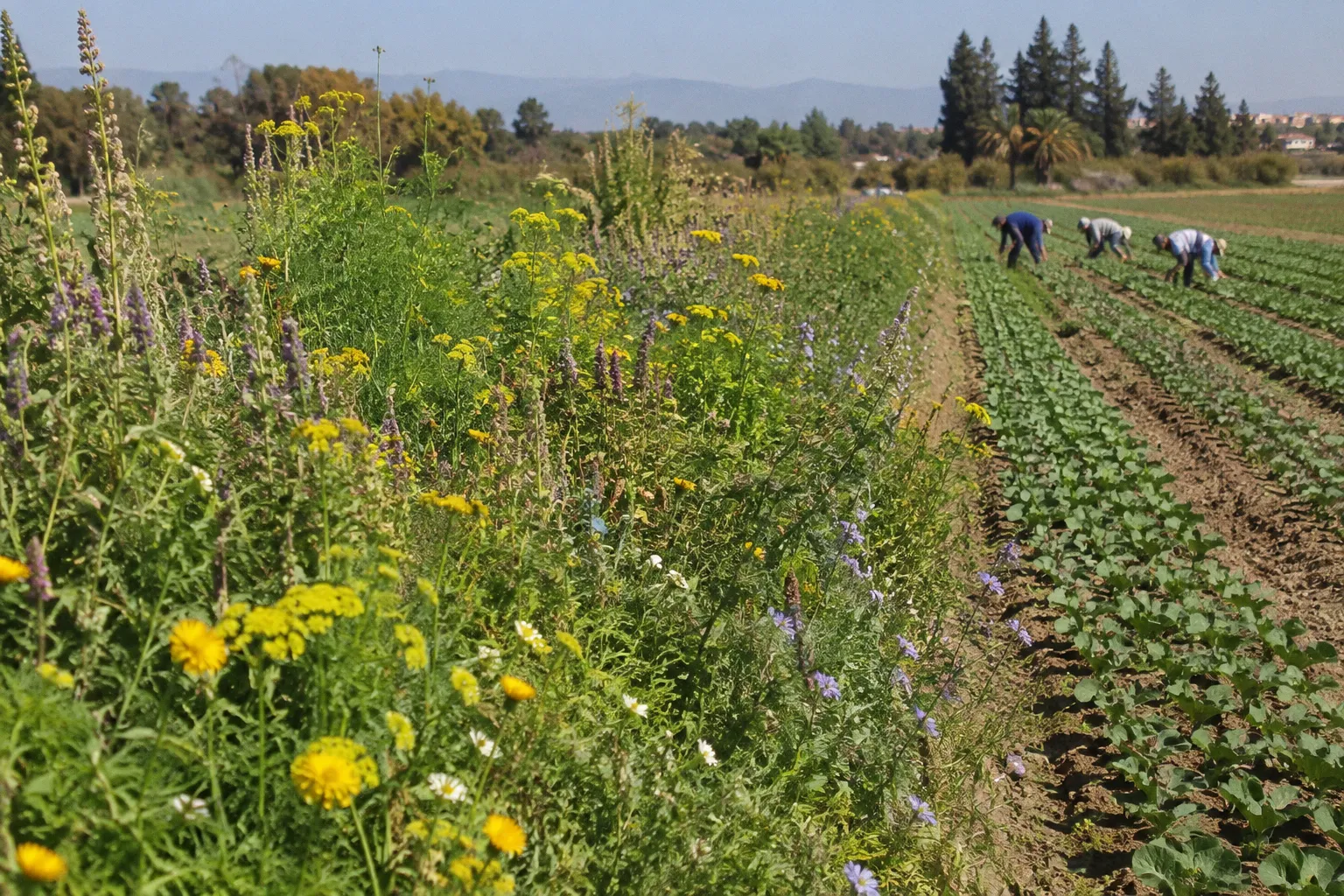
It's a fair question, and it usually arrives right when the first mealybugs show up on the grapes or aphids settle into the stone fruit. We reach for the bottle because it's what we know. But there's a quieter, longer game that works with the landscape instead of against it, and it starts with something as simple as a row of native plants along a field edge.
Beneficial insect hedgerows — dense strips of flowering perennials and aromatic herbs planted on farm borders — create permanent shelter and food for the predators and parasitoid wasps that do our pest control for free. Research on native perennial hedgerows consistently shows that these natural enemies increase sharply near hedgerow plantings, and the biological pest-control benefits extend roughly 100 to 200 meters into adjacent crop fields. That's not a minor boost. For a small cooperative plot in the Bekaa or a terraced orchard in the Mount Lebanon range, a well-designed hedgerow can cover the entire growing area from a single border strip. And Lebanon, with its roughly 2,790 species of vascular plants — including about 92 national endemics — gives us an extraordinary palette to draw from.
What follows is a four-stage implementation plan drawn from field practices that work across Mediterranean climates and adapted for our conditions. It's not a weekend project, but it's deeply manageable when we break it into shared steps — which is, after all, what cooperatives do best.
Strategic Site Selection and Border Design
Before we plant a single cutting, we need to look at where our hedgerow will live for the next decade and beyond. Site selection is the stage most growers rush through, and it's the one that determines whether the whole investment thrives or slowly dries out in a forgotten corner.
Start by walking the perimeter of each plot with three questions in mind. First, where are the prevailing winds? In the Bekaa Valley, summer winds sweep across the flatlands and can carry pest populations between fields. A hedgerow on the windward side doubles as a physical barrier and a habitat corridor. Second, where does the sun track? Most flowering perennials that attract beneficial insects need at least six hours of direct light — planting on the north edge of a plot (in the Northern Hemisphere) means the hedge won't shade the crop rows. Third, what's already growing on the margins? Wild thyme patches, volunteer olive suckers, or spontaneous fennel along a ditch bank are clues. They tell us which native species already find the microclimate hospitable, and that's where our design begins.
Width matters more than most people expect. On smaller vegetable plots, a hedgerow strip of 4 to 8 feet is workable — enough room for two or three staggered rows of plants. On larger orchard farms, we should aim for 25 feet or more if the layout allows it. Wider strips support more complex insect communities, buffer wind more effectively, and give us room to layer plants by height: low-growing aromatic herbs at the crop-facing edge, mid-height flowering perennials in the middle, and taller woody shrubs on the outer border.
A well-sited hedgerow doesn't just protect the rows beside it — its beneficial insects patrol up to 200 meters deep into our fields, turning a single border planting into whole-farm biological pest control.
If our cooperative manages several adjacent plots, we can coordinate hedgerow placement across properties so that strips connect into continuous corridors. That's where collective planning really pays off: one grower's rosemary-and-sage border links to a neighbour's savory-and-oregano strip, and suddenly we've built a habitat network that no single farm could sustain alone.
Soil Preparation and Irrigation Infrastructure
Mediterranean perennials are tough, but they're not invincible — especially in their first two seasons when root systems are still establishing. Getting the soil and water right at the outset saves us from replanting gaps later, which is both costly and demoralizing for growers who've already invested labour.
Begin with a simple soil test along the planned hedgerow line. We're not looking for laboratory-grade analysis; a basic pH and texture reading tells us most of what we need. Mediterranean aromatics — rosemary, sage, oregano, savory — prefer well-drained, slightly alkaline soils. If our border runs along a heavy clay depression that pools water in winter, we'll need to either raise the planting bed by 8 to 12 inches with imported gravelly loam or shift the strip to a better-drained section of the margin. Compacted soil from years of tractor passes along field edges is another common problem. A single deep ripping pass, followed by a generous incorporation of well-aged compost, breaks the hardpan and gives roots a path downward.
Irrigation is where many hedgerow projects stall. The assumption is that native plants don't need water — and that's true once they're established, typically by the third growing season. But during the first 18 to 24 months, especially if we're planting in autumn and facing a dry spring, supplemental irrigation is non-negotiable. The most efficient approach for cooperative-scale hedgerows is a simple drip line run along the base of the planting row. Low-flow emitters at 12-inch intervals deliver water directly to the root zone without wetting foliage (which invites fungal problems in dense plantings). We connect this to the same timer system already serving the crop irrigation, adjusting frequency down as the hedge matures.
Here's a practical breakdown of what soil and irrigation prep typically involves:
1. Soil testing — basic pH and texture analysis along the hedgerow footprint; adjust with lime or sulfur if needed.
2. Deep ripping or broad-forking — break compacted field-edge soil to a depth of 12 to 18 inches.
3. Compost incorporation — spread 2 to 3 inches of aged compost over the ripped strip and lightly till it in.
4. Drip-line installation — lay low-flow drip tubing the full length of the hedgerow row, connected to an existing irrigation timer.
5. Mulching — cover the prepared strip with 3 to 4 inches of straw or wood-chip mulch to suppress weeds and retain moisture through the first summer.
When we share the cost of a bulk compost delivery and a roll of drip tubing across four or five cooperative members, the per-farm expense drops to something most growers can absorb without subsidy. That's the economics of doing this together.
Selecting Native Lebanese Flora
This is the stage that excites people — and rightly so, because plant selection is where our hedgerow gains its personality and its ecological purpose. But it's also where we need discipline. A hedgerow is not a garden border; it's a working habitat. Every species we include should serve at least one of three functions: feeding beneficial insects with nectar or pollen, sheltering predators and parasitoid wasps during non-foraging periods, or providing physical structure that holds the strip together across seasons.
The Lebanese Agricultural Research Institute has been doing valuable work on beneficial insect rearing and distribution — LARI's beneficial insect laboratory distributed nearly 58,000 Cryptolaemus montrouzieri predatory beetles over a recent two-year period to control grape mealybugs in orchards. That program proves the appetite for biological control in our farming communities. Hedgerows complement that work by creating permanent on-farm habitat so that released and wild beneficial populations have somewhere to live, breed, and overwinter between pest outbreaks.
For the crop-facing inner row, Mediterranean aromatic herbs are our strongest foundation. Savory (Satureja species), rosemary, oregano, and sage all produce small, nectar-rich flowers that parasitoid wasps actively forage on. These are plants most of our growers already know — they grow wild on hillsides and in abandoned terraces across Lebanon. We're simply being deliberate about clustering them where they'll do the most functional good.
The middle layer is where we introduce flowering perennials that bloom at different times, extending the nectar calendar from late winter through late autumn. Lebanese native species worth considering include various Centaurea and Salvia cultivars that are adapted to our rainfall patterns and don't require irrigation once established. Eryngium species (sea holly relatives) offer structural seed heads that shelter overwintering insects, and their steel-blue flowers are among the most attractive to predatory flies and parasitoid wasps.
For the outer, taller border row — especially on larger farms where wind protection matters — woody shrubs like Pistacia lentiscus (mastic tree), Rhamnus species, and native Prunus provide dense branching structure. These also produce fruit that feeds insectivorous birds, adding another layer of pest control to the system.
A practical planting palette for a cooperative hedgerow project might look like this:
| Layer | Species | Primary Function | Bloom Period |
|---|---|---|---|
| Inner (low) | Savory, oregano, sage | Nectar for parasitoid wasps | Spring–summer |
| Inner (low) | Rosemary | Early-season nectar, shelter | Late winter–spring |
| Middle | Centaurea spp., Salvia spp. | Extended nectar calendar, pollen | Spring–autumn |
| Middle | Eryngium spp. | Structural seed heads, overwintering shelter | Summer–autumn |
| Outer (tall) | Pistacia lentiscus, Rhamnus spp. | Windbreak, bird habitat, structural density | Year-round foliage |
We don't need all of these. A workable starter strip might combine just three to five species in the inner and middle layers, then add woody shrubs in a later season once the cooperative gains confidence with the system.
Our hedgerow isn't decoration — it's a working colleague on the farm, feeding and sheltering the predators that patrol our orchards every day.
Spacing is straightforward: inner herbs at 18 to 24 inches apart, middle perennials at 24 to 36 inches, outer shrubs at 4 to 6 feet. We plant in staggered rows rather than straight lines, which maximizes canopy density and gives insects more surfaces to explore.
Multi-Year Maintenance for Sustained Pest Control
The temptation with any planting project is to treat installation as the finish line. With hedgerows, it's the starting line. The first year is establishment — watering, weeding, and watching for transplant stress. The second year is where we begin to see insect activity increase and where our maintenance habits lock in the hedge's long-term performance.
Year one demands the most attention. Weeds are the primary threat to young hedgerow plants, especially along field edges where grass encroachment is fierce. Hand-weeding within 6 inches of each new plant, combined with the mulch layer we laid during soil prep, keeps competition manageable. Irrigation continues through the dry months, tapering off as autumn rains return. If we lose individual plants — and we will, typically 10 to 15 percent — we flag them for replacement the following planting season rather than letting gaps expand.
Year two is the adjustment phase. Aromatic herbs should be flowering by now, and we'll start noticing more parasitoid wasps and hoverflies along the hedgerow. This is when we shift maintenance from survival care to shaping. A light pruning of leggy rosemary or sage after their main bloom encourages bushier regrowth and more flowering sites the following year. We avoid heavy cutting during peak bloom, which would remove the very food resources we've worked to provide.
Year three and beyond, the hedge largely sustains itself with seasonal attention:
1. Late-winter structural pruning — cut back woody shrubs by no more than one-third to maintain density without shocking the plant.
2. Post-bloom deadheading of perennials — remove spent flower heads from Salvia and Centaurea to encourage a second flush, or leave select seed heads for overwintering insects.
3. Annual mulch refresh — top up the mulch layer each autumn with 1 to 2 inches of straw or compost to suppress winter weeds and insulate roots.
4. Irrigation audit each spring — check drip lines for clogs or rodent damage before the dry season begins.
5. Monitoring walks — once a month during the growing season, walk the hedgerow with a hand lens and note which beneficial insects are present. This isn't academic exercise; it tells us whether the hedge is functioning as intended and lets us adjust species or management if something's underperforming.
One critical point: we don't spray the hedgerow itself. Even organic-approved pesticides can disrupt the beneficial insect populations we're cultivating. If aphids colonize a sage plant in the hedge, we leave them — they're feeding the lady beetles and lacewing larvae that will later patrol our crop rows. The hedgerow is a sacrifice zone and a nursery rolled into one.
The Cooperative Advantage: Shared Costs, Shared Knowledge
Everything I've described above is achievable on a single farm. But it's dramatically more effective — and more affordable — when we approach it as a cooperative project. Bulk purchasing of nursery stock or seed, shared rental of a subsoiler for bed preparation, and coordinated planting days spread the labour across many hands and turn what could be a lonely weekend chore into a community event with lasting results.
Our growers who've already piloted hedgerow strips report the most unexpected benefit isn't pest reduction — it's knowledge. When you walk a living hedgerow together and spot a parasitoid wasp ovipositing in an aphid colony, you're seeing biological control happen in real time. That observation changes how people think about their whole pest management strategy. The hedge becomes a teaching tool that's always on, always visible, and always reminding us that healthy farms are ecosystems first and production systems second.
Lebanon's agricultural cooperatives have always been strongest when we work the land as a collective rather than as isolated operators fighting the same battles separately. Beneficial insect hedgerows are one of those rare interventions that reward collaboration at every stage — from the planning meeting where we map border strips across adjacent properties, to the shared satisfaction of watching our orchards thrive with fewer inputs and more life buzzing along the edges. Start with one strip. Learn from it together. Then extend the network season by season, until the whole landscape is working for us — quietly, naturally, and permanently.