Olive pomace biochar: a four-stage soil health project
The olive harvest gives our farms something beautiful and something difficult at the same time.
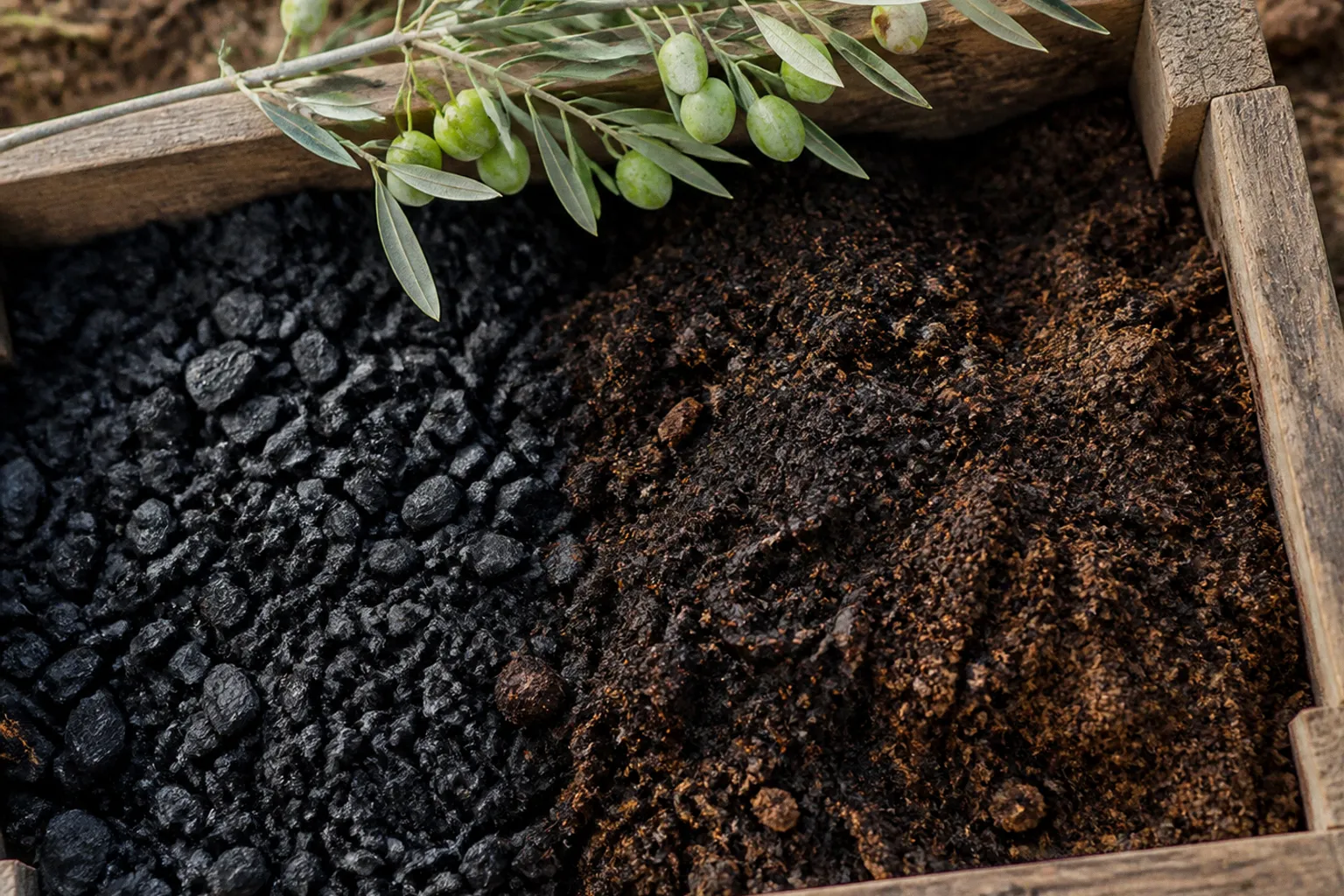
We press the fruit for valuable oil, while leaving behind mountains of olive pomace: wet, acidic, organic-rich material that can become a pollution problem when it is stored carelessly or left to decompose without control.
For Lebanese cooperatives, this waste stream is also an opportunity. With the right processing, olive pomace can become a porous carbon amendment that helps soil hold moisture, improves soil structure, carries nutrients more gradually, and returns part of the olive economy to the fields that support it. This is the promise of olive pomace biochar as a Lebanese soil amendment—not as a miracle input, and not as a material to spread directly from the mill, but as the centre of a carefully managed four-stage soil health project.
The practical question is not simply whether biochar works. It is how our growers can make it safely, apply it at a sensible rate, and measure whether the soil is becoming more resilient rather than merely receiving another fashionable product.
Stage One: Turn a Difficult Waste Stream into a Usable Feedstock
Olive pomace is not one uniform material. Its moisture content, particle size, residual oil, acidity, and proportion of pits and fibre can vary from one mill to another and from one harvest to the next. That variation matters because it affects how the material behaves during pyrolysis and what kind of biochar it produces.
Across the Mediterranean, the olive oil sector generates an estimated 15 million tons of olive pomace waste each year. In Lebanon, where many mills operate close to farming communities and agricultural land, the local handling of this material is not a minor housekeeping issue. Poorly managed pomace can create odour, attract insects, contaminate water, and contribute to methane emissions as it breaks down in oxygen-poor piles.
A cooperative project begins before the kiln or reactor is switched on. Our growers, mill operators, and cooperative managers need a shared intake system that makes the feedstock reasonably consistent.
A workable first-stage process includes:
1. Map the local supply. Record which mills produce pomace, during which weeks, in what approximate quantities, and how far the material must travel to the processing site. Transport can quietly become the largest practical burden if the cooperative collects small quantities from widely scattered mills.
2. Keep batches identifiable. A simple batch number, mill name, harvest period, and approximate moisture condition are enough to begin. The goal is not paperwork for its own sake; it is the ability to understand why one batch produces a crisp, friable biochar while another remains greasy, smoky, or difficult to screen.
3. Remove obvious contaminants. Plastic, metal, treated wood, stones, and other foreign materials do not belong in the feedstock. A covered sorting area, a heavy-duty screen, gloves, shovels, and labelled storage bays can do much of this work without complicated equipment.
4. Manage moisture before processing. Wet pomace requires more energy to heat because part of the process energy is spent evaporating water. Drying may take place through protected air-drying, mechanical drying, or a combination of both, depending on the cooperative’s scale and climate. The material must be protected from rain and runoff during this stage.
5. Store it on an impermeable surface. A compacted or paved working area with drainage control is preferable to an unprotected soil pile. This reduces the chance that acidic liquid or fine organic particles will move into nearby soil and water.
Raw olive pomace should not be treated as a finished soil amendment. Untreated pomace can contain polyphenols and acidity that inhibit soil microbial activity, and its composition is too variable to spread confidently across productive fields. The value comes from controlled conversion.
The first shared responsibility is simple: a cooperative must know what is entering the process before it can promise what is leaving it.
Choosing a cooperative-scale processing model
There is no single correct pyrolysis system for every Lebanese farming group. A small cooperative may work with a central processor or a mobile service, while a larger olive-growing network may eventually justify its own low-oxygen unit. The decision should follow the available feedstock, technical capacity, fire-safety requirements, and expected area of application—not the other way around.
The essential principle is low-oxygen pyrolysis. In this process, organic material is heated with very limited oxygen, encouraging the formation of a stable, porous carbon structure rather than allowing the pomace to burn completely into ash.
For olive pomace biochar production in Lebanon, research has identified approximately 400°C as a useful low-temperature threshold. Biochar produced from exhausted olive pomace at this temperature for about one hour can develop a highly porous carbon structure, which is relevant both for water purification and for soil applications.
A cooperative should plan for:
- a covered feedstock and finished-biochar storage area;
- a processing unit designed for controlled oxygen conditions;
- temperature monitoring rather than visual estimation alone;
- fire prevention and emergency procedures;
- screening equipment to remove oversized particles;
- a clean area for nutrient loading and blending;
- basic testing of pH, electrical conductivity, moisture, and visible contamination.
The word “organic” does not remove the need for process control. A smoky pile is not automatically biochar, and black material is not automatically safe for soil. If pyrolysis is incomplete or poorly controlled, the resulting product may contain unstable residues or behave unpredictably when mixed into the root zone.
Stage Two: Build a Biochar That Can Work with the Soil
Fresh biochar has a large internal surface area and many pores, but that does not mean it immediately behaves like a complete fertiliser. In fact, freshly produced material may temporarily interact with nutrients and water in ways that are unhelpful if it is applied without preparation.
This is where the second stage—conditioning and nutrient loading—becomes important. The cooperative is no longer dealing only with waste conversion. It is designing a soil amendment that can work alongside compost, irrigation, and the crop’s nutrient demand.
Research on olive pomace biochar produced at 400°C and loaded with NPK nutrients found a cumulative nutrient release of approximately 91% in soil. The significance is not that biochar replaces every other fertility input. It is that the porous carbon can act as a carrier, helping nutrients move into the soil more gradually and reducing the tendency for a concentrated dose to disappear quickly through leaching or remain in one intense zone.
A nutrient-loaded blend might be prepared with:
- screened olive pomace biochar;
- mature compost or another approved organic fertility source;
- mineral nutrients where soil testing shows they are needed;
- clean water or diluted organic liquid used to moisten the blend;
- a covered mixing surface and a method for turning the material evenly.
The exact recipe should follow soil analysis and crop needs. A heavy application of nutrients simply because the biochar can carry them is not regenerative agriculture; it is still over-application, only with a more attractive material attached.
Why conditioning changes the result
Biochar acts less like a conventional fertiliser and more like a long-lived structure within the soil. Its pores can retain water and provide surfaces where nutrients and microbial communities interact. But the result depends on the soil around it.
In coarse, drought-prone soil, moisture retention may be the main benefit. In a compacted orchard soil, the improvement in physical structure may matter more. In soil that already has high salinity or excessive alkalinity, the amendment needs greater caution.
Laboratory incubation with 1% biochar derived from olive-processing by-products increased soil pH by up to 1.6 units and electrical conductivity by up to 246%. Those findings are a useful warning as well as an encouragement. Biochar can improve a soil condition, but it can also push pH or salt concentration in the wrong direction if the material and application rate do not suit that field.
Before a broad application, our cooperative teams should test:
- soil pH;
- electrical conductivity;
- organic matter;
- available phosphorus and potassium;
- nitrate or mineral nitrogen where practical;
- texture and visible compaction;
- irrigation water quality;
- the biochar’s own pH, electrical conductivity, moisture, and particle size.
This does not require every grower to become a laboratory technician. A cooperative can organise one shared sampling day, use consistent sampling depths, and send representative samples for analysis. The collective approach is often more affordable and more useful than many isolated guesses.
A practical conditioning period
There is no universal number of days that guarantees a biochar is ready for every crop. Instead, the cooperative should define a consistent preparation window and monitor the material through it.
A sensible sequence is:
1. Produce and cool the biochar completely in a controlled area.
2. Screen it so that very large fragments and foreign materials are removed.
3. Blend it with mature compost or a measured nutrient solution.
4. Moisten it evenly rather than leaving dry pockets and saturated clumps.
5. Keep the mixture covered but ventilated.
6. Turn or remix it periodically so nutrients are distributed through the pores.
7. Test a representative sample before field application.
The final material should be crumbly rather than greasy, free from visible plastics or ash-like excess, and consistent enough that one shovel resembles the next. If strong odour, excessive heat, or unexplained liquid appears in the pile, the batch needs attention before it reaches a field.
Stage Three: Apply the Amendment at a Rate the Field Can Carry
The most discussed field figure in the available research is 40 tonnes per hectare of olive pomace biochar. In Mediterranean olive orchards, that application rate was associated with improved soil moisture retention, lower soil penetrability resistance, and an increase of approximately 15% in olive fruit yield per tree in field trials.
That is a meaningful result, but it is not a universal prescription for every Lebanese farm. A Bekaa vegetable plot, a young olive orchard on shallow soil, and a mature hillside grove do not carry the same risks or have the same machinery access. Soil texture, slope, irrigation method, crop age, rainfall pattern, and the properties of the finished biochar all affect the right rate.
A cooperative can use the 40 t/ha figure as a field-trial reference, not as an instruction to cover every available hectare in one season.
Convert the field rate into a farm decision
For a grower, tonnes per hectare is only useful when translated into an area, a spreading method, and a delivery schedule. The cooperative should decide:
- how many hectares will be included in the first trial;
- whether the biochar will be placed in the full field or only within the tree row;
- whether it will be incorporated shallowly or left as a surface mulch component;
- what equipment can spread the material evenly;
- whether the soil is moist enough for incorporation without compaction;
- how untreated comparison areas will be maintained.
A small demonstration can include adjacent treated and untreated strips, or paired tree rows with similar slope, age, irrigation, and crop history. The comparison area is not a rejection of the project. It is what allows the cooperative to distinguish a real soil improvement from a good rainfall year, an unusually light pest season, or a different pruning schedule.
Where the complete 40 t/ha application is not practical, a staged approach may be wiser. The cooperative might begin with a limited number of plots, learn how the material behaves, and expand only after testing. The best programme is one that our growers can repeat, observe, and improve—not one that looks impressive on paper and becomes impossible to manage after the first delivery.
Orchard application and soil contact
Olive orchards are particularly relevant because the material comes from the same agricultural system. Returning processed pomace to olive soils can close part of the nutrient and carbon loop, provided the product is clean and the application is well matched to the orchard.
For established trees, the amendment should reach the active root zone rather than forming a thick pile against the trunk. It may be incorporated into the upper soil layer where cultivation is already part of the orchard management plan, or placed in a managed band beneath the canopy while avoiding trunk contact. The exact method depends on slope, existing ground cover, root distribution, and erosion risk.
In the Bekaa, where water conservation is a central concern, a biochar project should be designed together with irrigation management. Biochar cannot compensate for broken drip lines, long irrigation intervals that ignore crop demand, or runoff from bare soil. Its value is greater when combined with practices that keep water where roots can use it:
- maintain organic ground cover where it does not compete excessively with the crop;
- repair leaks and blocked emitters before increasing irrigation;
- avoid working wet soil into compacted layers;
- use compost and mulches to protect the surface;
- monitor soil moisture at more than one point in the field;
- schedule irrigation according to crop stage and local conditions.
The amendment is part of a system. Soil structure, plant cover, root activity, compost, irrigation, and biodiversity are working together, even when we measure them separately.
What to measure after application
Yield is important, but it should not be the only outcome. A soil health project needs a small set of observations that growers can actually maintain across a season.
Track the following where possible:
| Field indicator | Why it matters | Practical observation |
|---|---|---|
| Soil moisture | Shows whether water remains available for longer | Compare treated and untreated plots at the same time after irrigation or rainfall |
| Penetrability or compaction | Indicates whether roots can move through the soil | Use a consistent field method or periodic professional measurement |
| Crop vigour | Connects soil changes with plant response | Record canopy condition, shoot growth, leaf colour, and stress symptoms |
| Fruit yield per tree or plot | Measures the production outcome | Weigh harvest from comparable treated and untreated areas |
| Fruit quality | Prevents yield alone from becoming the target | Record size, blemishes, firmness, maturity, and marketable proportion |
| pH and electrical conductivity | Detects unintended chemical shifts | Test before application and at agreed intervals afterward |
| Irrigation requirement | Helps assess water-use efficiency | Compare applied water with soil moisture and crop performance |
The field trial should also record what changed around the amendment: rainfall, fertiliser use, pruning, pest pressure, irrigation duration, and cultivation. Good records do not need to be elaborate. A shared cooperative form, a phone photograph from the same position each month, and a harvest scale can build a surprisingly clear picture over time.
A productive field trial measures more than the harvest basket. It asks whether the soil is easier to work, whether water stays available, and whether the crop remains steady when the season becomes difficult.
Stage Four: Make Circular Agriculture Work Beyond One Harvest
The final stage is where a promising amendment becomes a cooperative practice. Processing olive mill waste is not only a soil input project; it is a coordination project connecting mills, growers, technicians, transporters, and buyers.
The Mediterranean olive sector produces an enormous volume of pomace. If that material is managed as a liability, each mill carries the burden alone. If it is processed through a cooperative framework, the same material can support soil improvement, reduce waste pressure, and create a more credible story for farms working toward organic or regenerative production.
That story must remain grounded. Biochar does not automatically make a farm organic, and it does not erase the need for responsible pest management, clean water, traceable inputs, or careful harvest handling. It is one tool within a broader transition toward climate-resilient agriculture in Lebanon.
Create clear responsibilities
A four-stage project works best when every participant knows what they own.
The mill operators can separate pomace from contaminants, provide basic batch information, and keep the material away from waterways and uncontrolled dumping areas.
The cooperative management team can coordinate collection, storage, processing schedules, testing, and transparent records of where each batch is applied.
The processing team can control temperature and oxygen conditions, maintain equipment, manage fire safety, and prevent cross-contamination between feedstock and finished biochar.
The growers can provide field histories, participate in soil sampling, follow agreed application methods, and record irrigation, crop performance, and harvest results.
The technical advisers or laboratory partners can help interpret pH, electrical conductivity, nutrient behaviour, and changes in soil structure without promising results that the data cannot support.
The buyers and export partners can help define the quality traits that matter at market: clean and blemish-free produce, consistent sizing, sound shelf life, and reliable traceability. Soil improvement is valuable, but our growers still need a crop that can travel well and meet the expectations of a demanding market.
This division of work is not bureaucratic decoration. It protects the project from a familiar failure: one enthusiastic person carries the entire programme until the harvest becomes busy, the records disappear, and the next season begins without learning from the first.
Build a seasonal calendar
The timing of the four stages should follow the olive cycle and the cooperative’s available labour.
| Project period | Main work | Output |
|---|---|---|
| Milling period | Collect, sort, label, and safely store pomace | Traceable, protected feedstock |
| After collection or during planned processing windows | Dry and pyrolyse under controlled conditions | Cooled, screened biochar |
| Before field application | Load nutrients, condition, sample, and approve the batch | Consistent soil amendment |
| Application period | Spread or band material and incorporate where appropriate | Treated plots with recorded rates |
| Growing season | Monitor moisture, crop response, soil chemistry, and irrigation | Comparable field data |
| After harvest | Review yield, quality, costs, labour, and soil results | Decision on expansion or adjustment |
A calendar also makes costs visible without pretending that every cooperative has the same budget. The main cost categories are feedstock transport, drying, processing equipment or service fees, labour, testing, storage, spreading, and record-keeping. Some groups may reduce costs through shared machinery or a central processing site; others may find that contracting pyrolysis is more sensible than owning a unit.
The cooperative should calculate the cost per treated hectare only after estimating these activities locally. There is no reliable universal commercial price for Lebanese olive pomace biochar, and a project that hides transport or labour costs will eventually look more expensive than it really is.
Protect the project from common mistakes
A few errors appear attractive because they save time at the beginning. They usually create more work later.
1. Spreading raw pomace directly on the soil. This confuses an untreated waste material with a processed amendment and can harm soil biological activity.
2. Applying biochar without a baseline. Without pre-application pH, electrical conductivity, moisture, and yield records, the cooperative cannot tell whether the material helped or introduced a new problem.
3. Treating the highest tested rate as a universal target. The 40 t/ha field-trial rate is a valuable reference, but different soils and crops may respond differently.
4. Ignoring salts and pH. Biochar can shift both. A field already affected by salinity or alkaline conditions needs more careful testing and a conservative plan.
5. Loading nutrients by guesswork. The porous structure is useful, but excess nitrogen or phosphorus remains excess nitrogen or phosphorus.
6. Measuring only yield. A heavier harvest is not enough if fruit quality falls, irrigation demand rises, or soil chemistry moves in the wrong direction.
7. Scaling before the cooperative can repeat the process. A clean batch, a consistent application method, and reliable records should come before a large expansion.
What this means for regenerative agriculture in Lebanon
The strongest argument for olive pomace biochar is not that it solves every pressure facing Lebanese agriculture. It is that it connects several problems that are too often managed separately.
Olive mills need a safer destination for organic waste. Growers need soil that can retain moisture and remain workable under hotter, less predictable conditions. Cooperatives need ways to reduce dependence on expensive imported fertilisers and irrigation inputs. Export-oriented farms need production systems that protect both environmental credibility and the crisp, marketable quality of the harvest.
Biochar sits at that intersection.
The research does not justify careless optimism. A 15% increase in olive fruit yield per tree is encouraging, but it came from specific field conditions. A 91% cumulative nutrient release from a loaded biochar product shows the potential of slow-release fertility, but it does not eliminate the need for soil testing. A pH increase of up to 1.6 units in laboratory incubation demonstrates why monitoring matters as much as enthusiasm.
Our task as cooperatives is to turn these findings into local knowledge. We can begin with one mill network, a small set of representative fields, and a season of disciplined observation. We can compare treated and untreated areas, share results openly, and adjust the rate or preparation method when the soil tells us to do so.
That is the difference between adopting an input and building a soil health practice. The first is purchased and applied. The second is learned together.
Olive pomace biochar can help Lebanese farms move toward more circular, climate-resilient production, but only when the full chain is respected: controlled pyrolysis, careful conditioning, field-specific application, and patient measurement. When our growers, mills, and cooperatives hold those responsibilities together, a difficult residue becomes more than a waste-management problem. It becomes a practical investment in living soil, steadier harvests, and the long-term strength of our agricultural communities.