No-till transition in Bekaa: soil health before and after
In the Bekaa Valley, soil degradation is no longer an abstract agronomic concern.
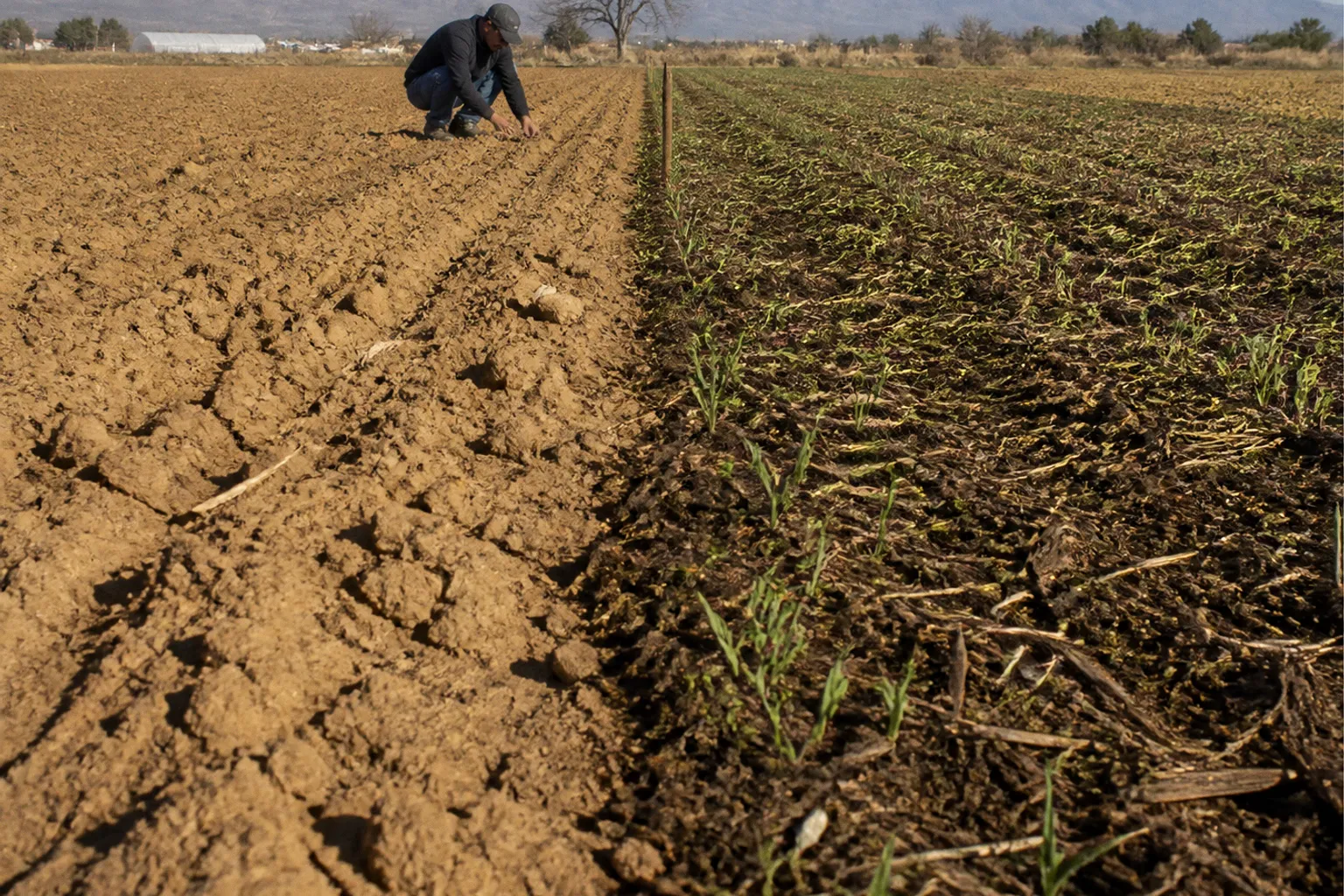
It is visible in the way fields crust after irrigation, how quickly moisture disappears from the root zone, and how much more a farmer must spend to keep the same crop moving toward harvest.
The pressure is concentrated in Lebanon’s agricultural heartland. The Bekaa covers approximately 150,000 hectares, and about 80% of its cultivated land is irrigated for vegetables, cereals, and fruit trees. That irrigation dependence becomes particularly exposed during dry seasons: in one exceptionally dry winter, Zahle received only 268.4 millimeters of rainfall, compared with 741.8 millimeters the previous year and a 30-year seasonal average of 668 millimeters.
The no-till transition in Bekaa Valley farms is therefore not simply a change in machinery. It is a change in how the field is expected to hold water, cycle nutrients, and support a crop between one harvest and the next.
The crisis of conventional tillage in Lebanon’s heartland
Tillage has a practical logic. Turning the soil can break compaction, incorporate residues, prepare a seedbed, and control weeds before planting. In a difficult production environment, those immediate effects are attractive. The problem begins when repeated disturbance becomes the main management system rather than an occasional intervention.
Every pass through a field consumes fuel, takes time, and exposes the soil surface. The deeper agronomic cost is less visible. Intensive tillage can break soil aggregates—the small structural units that create pores for air and water—and accelerate the loss of organic matter when residues are repeatedly incorporated and decomposed under exposed conditions. Once structure declines, irrigation water may move unevenly: some areas remain saturated while others dry quickly. Roots then explore a smaller and less reliable volume of soil.
That matters in the Bekaa because water scarcity and high input costs reinforce each other. A field with weak structure often needs more irrigation to maintain crop growth. A crop with a restricted root system may also appear nutrient-deficient even when fertilizer has been applied, because the issue is not only the amount of nutrient present. It is whether roots, soil organisms, and moisture are working together well enough for the plant to access it.
The conventional response is usually more input: another irrigation cycle, more synthetic fertilizer, more cultivation to correct the surface, or another pass to manage weeds. During an economic crisis, that response becomes increasingly fragile. Purchased inputs are expensive, while their efficiency depends on the very soil functions that have been weakened.
A no-till system approaches the same field from the opposite direction. Instead of using cultivation to create short-term looseness, it aims to build biological structure over time through living roots, retained residues, and reduced disturbance. The soil is not treated as an inert growing medium. It is treated as an ecosystem whose physical condition determines how efficiently every other input performs.
No-till is not the absence of work. It is the decision to spend more management on soil function and less on repeatedly repairing the surface.
This distinction is important for farms considering conservation tillage in the Bekaa. No-till does not automatically mean that a field will produce more in the first season. It means the farmer is changing the mechanism behind productivity: from repeated mechanical correction toward better aggregation, stronger root activity, improved moisture retention, and more stable nutrient cycling.
What changes when the plough leaves the field
The term “no-till” is often used broadly, but the field system is more than a single decision not to plough. Three practices tend to work together:
- Minimal soil disturbance: seeds are placed with as little disruption of the soil profile as possible.
- Cover cropping: living plants protect the soil between cash crops and keep roots active during otherwise bare periods.
- Residue retention and dense planting: crop remains are left on the surface, while a denser plant community reduces the amount of exposed soil.
Each practice solves a different part of the problem.
Surface residues reduce the direct impact of sun, wind, and heavy rain. They can slow evaporation and soften the force of water reaching the soil. Cover-crop roots create channels through the profile, while their decomposition supplies carbon to soil organisms. Dense planting closes gaps in the canopy and reduces the space available for weeds to dominate.
The biological component is easy to underestimate. Soil microbiology is not an optional layer added after the “real” farm work. Bacteria, fungi, earthworms, and other organisms help decompose residues and make nutrients available in forms plants can use. Fungal networks can also extend the effective reach of roots through the soil. The exact response depends on crop, soil texture, irrigation, residue management, and weather, but the direction is clear: soil life needs food, moisture, and habitat. Repeated disturbance removes much of that continuity.
This is why a no-till field should not be judged by its appearance immediately after planting. A cultivated field can look clean and uniform while carrying little biological momentum. A residue-covered field may appear untidy by conventional standards, yet offer better protection against moisture loss and temperature swings.
That does not mean every residue should remain untouched under every condition. Diseased plant material may need management. A poorly selected cover crop can compete for water. Heavy residues can interfere with seed placement if the planter is not suited to them. No-till requires observation and adjustment, not the replacement of one rigid recipe with another.
A practical transition begins with soil information rather than equipment purchases. Biological soil testing, basic fertility analysis, and field-by-field observation can reveal whether the limiting factor is compaction, low organic matter, salinity, poor drainage, uneven irrigation, or an interaction among several of these. Without that diagnosis, no-till can become a label applied to a field that still receives the wrong crop sequence and the wrong irrigation pattern.
Turba Farm and the value of a small pilot
Turba Farm, established in Zahle in April 2021, offers a useful example of how regenerative agriculture in Lebanon can begin at a manageable scale. The farm started on an 8,000-square-metre plot that had previously been covered in winter wheat. Its pilot approach combined no-till, cover cropping, and dense planting.
The significance of this example is not that one farm has solved the Bekaa’s soil problems. It has not, and no single pilot can represent the entire valley. The value lies in the way a small plot can make cause and effect easier to observe.
A farm testing several changes at once still needs to record what is happening. Before the transition, the grower should map soil texture, slope, irrigation zones, weed pressure, and areas where crops repeatedly underperform. During the transition, the same points should be revisited. Useful observations include:
- how long the soil remains moist after irrigation;
- whether water infiltrates evenly or ponds on the surface;
- how quickly residues decompose;
- whether roots penetrate beyond the upper layer;
- whether weeds shift in species and timing;
- how much fuel and labour are spent on field preparation;
- whether crop quality remains consistent across the plot.
These are not decorative sustainability metrics. They show whether the new system is reducing pressure on the farm or merely moving costs from fuel into seed, labour, and management.
Cover crops also need to be chosen for the local water balance. In a wet year, a vigorous cover can produce valuable biomass and protect the soil. In a dry year, the same cover may consume moisture needed by the following crop if it is terminated too late. The question is not whether cover cropping is inherently good. The question is when the cover crop should grow, how much biomass the field can support, and when it must be terminated to conserve water.
This is where the no-till transition becomes distinctly Bekaa-specific. A management plan developed for a humid farming region cannot simply be transferred to an irrigated valley facing severe rainfall variability. The crop calendar, irrigation method, residue load, and termination date must all respond to the season.
What the numbers can—and cannot—tell us
The strongest available evidence from the Bekaa is not a single regional before-and-after soil carbon figure. Broad claims about soil organic matter in the valley would require comparable laboratory measurements across many farms and several years. Those measurements are not available here, so it would be misleading to suggest that the entire region has already achieved a quantified increase in soil organic carbon.
There is, however, a clear example of how improved soil testing and agricultural practices can affect yield. A Bekaa Valley fodder farmer who had previously harvested an average of 600 kilograms of wheat per 1,000 square metres increased production to more than 900 kilograms per 1,000 square metres after receiving technical training in soil testing and good agricultural practices.
That result should not be presented as a guaranteed no-till yield response. The intervention included training and improved practice rather than one isolated change. Yield is shaped by seed quality, planting date, fertility, weed control, pest pressure, irrigation, and weather. The useful lesson is more precise: when a farmer understands the field’s limiting factors and manages them systematically, the land can produce more without assuming that higher fertilizer use is the answer.
The “before” condition is often not one dramatic failure. It is a series of inefficiencies:
1. Soil testing is replaced by a standard fertilizer program.
2. Irrigation is scheduled by habit rather than root-zone moisture.
3. Bare soil is left exposed between crops.
4. Tillage is used repeatedly to manage weeds or repair surface structure.
5. Poor crop performance is interpreted as a need for more inputs.
6. The resulting costs reduce the farmer’s ability to invest in better equipment, seed, or monitoring.
The “after” condition should be measured through several indicators rather than yield alone. A farm may initially maintain the same yield while using less fuel, improving infiltration, reducing irrigation demand, or lowering fertilizer losses. Those changes can strengthen resilience even before the harvest figure moves.
| Field indicator | Under repeated conventional disturbance | During a well-managed no-till transition |
|---|---|---|
| Soil surface | More exposed, vulnerable to crusting and evaporation | Protected by residues and living or recently terminated cover |
| Water movement | Greater risk of runoff, ponding, or uneven infiltration | More opportunity for rainfall and irrigation to enter through soil pores |
| Root environment | Structure may be repeatedly disrupted | Roots and soil organisms gradually rebuild continuity |
| Weed management | Often dependent on cultivation passes | Requires crop competition, timing, residue management, and monitoring |
| Fertility strategy | Frequently centered on purchased inputs | Combines soil testing, residues, biological activity, and targeted inputs |
| Short-term appearance | Clean and mechanically uniform | More residue and less visibly disturbed soil |
| Main management demand | Fuel, machinery time, and repeated passes | Planning, observation, suitable seeding, and timing |
Moisture retention is another area where practical measurement matters. Micro-irrigation systems can reduce irrigation water use by up to 40% compared with less efficient methods, according to the available research. But irrigation efficiency and no-till are not interchangeable. Drip or other micro-irrigation can place water more precisely; no-till and cover cropping can improve the soil’s ability to receive and retain that water. A farm needs both the delivery strategy and the soil conditions to make each unit of water productive.
The economic barrier is not only the price of a drill
Farmers are sometimes told that the solution is to purchase a no-till seeder. Equipment can be part of the transition, but it is rarely the first barrier.
A no-till planter must handle residue and place seed at a consistent depth without excessive soil disturbance. In a region where farms vary in scale and cash flow is constrained, buying specialized equipment may be unrealistic. Cooperative ownership, custom contracting, or shared machinery services can lower the entry barrier, provided planting schedules are coordinated and the equipment is maintained properly.
The less visible investment is technical capacity. A farmer needs to know how to read residue cover, identify compaction, adjust planting depth, terminate cover crops, and distinguish temporary weed pressure from a long-term failure of the system. Those decisions cannot be outsourced entirely to a machine.
Input reduction also does not happen automatically. In the first phase, a farm may spend more on cover-crop seed, monitoring, or training while still using conventional fertilizer and crop protection products. The purpose is to improve the efficiency and resilience of the system, not to force an immediate reduction that leaves the crop underfed or vulnerable.
For farms supplying export markets, this distinction has an additional consequence. Soil restoration must sit alongside good agricultural practices, pesticide records, water management, worker safety, and traceability. Buyers and certification systems generally need evidence that production is controlled, not just a statement that a field is regenerative. A cooperative seeking export access should be able to connect field decisions with harvest records: what was planted, which inputs were applied, when irrigation occurred, and how produce moved after harvest.
That documentation can feel separate from soil health, but it is not. A farm that measures its inputs and field operations is better positioned to see whether the transition is actually reducing waste and improving consistency. The same records can support buyer confidence.
Export readiness begins in the field: a healthy soil system is valuable, but a cooperative must also be able to document how that system is managed.
For Lebanese cooperatives, shared measurement may be as important as shared machinery. Members can agree on a small set of common indicators—fuel use per plot, irrigation hours, planting date, cover-crop termination, fertilizer application, yield, and produce quality. The goal is not to create an elaborate reporting burden. It is to create comparable evidence across farms with different soils and management histories.
Climate adaptation in the Bekaa needs a seasonal sequence
Climate volatility makes the timing of the transition more important than the slogan. A farm should not wait for a perfect year, because a perfect year will not provide the information needed to manage a difficult one. At the same time, the first trial should be small enough that a poor season does not threaten the entire operation.
A practical sequence can look like this.
Late summer: establish the baseline
After harvest, map the field. Mark areas with standing water, weak crop growth, visible erosion, heavy weed pressure, or shallow rooting. Take soil samples from representative zones rather than mixing the whole field into one anonymous result. Record the previous crop, fertilizer applications, irrigation method, and tillage depth.
This baseline is essential for the “before” picture. Without it, farmers often remember the field impression but cannot identify whether soil structure, nutrient availability, or water distribution was responsible for the result.
Autumn: plant protection, not empty ground
Where water availability allows, establish a cover crop suited to the field’s crop rotation and termination window. The cover should protect the surface and keep roots active, but it should not be allowed to become a competing crop that drains the profile before spring planting.
This is also the time to inspect planting equipment. Seed placement is central to no-till success. Uneven depth, poor residue handling, or inadequate soil contact can create establishment problems that are then blamed on the system itself.
Winter: read the field after rain
Rainfall reveals soil structure more clearly than a dry inspection. Look for crusting, runoff paths, ponding, and areas where residue has shifted. In a dry winter like the one recorded in Zahle, the priority may be moisture conservation and careful irrigation planning rather than maximum cover-crop biomass.
The field should be observed after irrigation as well. If water remains concentrated in a few places, changing the schedule alone may not solve the problem. Distribution uniformity, emitter performance, soil compaction, and root depth all need to be considered.
Spring: terminate with the next crop in mind
The cover crop should be terminated early enough to protect the following crop’s water supply. The correct timing depends on rainfall, soil moisture, cover-crop growth, and planting date. Residue should remain where possible, but it must be managed so that the planter can achieve reliable seed placement.
A transition plot can be divided into a no-till strip, a reduced-tillage strip, and a conventional comparison area if space allows. The aim is not to create a scientific trial beyond the farmer’s capacity. It is to compare establishment, moisture, labour, fuel, and yield under the same seasonal conditions.
Summer: measure the crop and the soil
During the growing season, inspect root depth, surface moisture, irrigation intervals, weed shifts, and crop uniformity. At harvest, record yield and quality, but also calculate the costs behind the result. A slightly lower yield with substantially lower fuel and water use may point toward a viable system; a lower yield with higher labour and unresolved weed pressure indicates that the management plan needs adjustment.
Repeat the measurements rather than relying on a single season. Soil organic matter in the Bekaa should be treated as a site-specific, laboratory-measured variable, not a number borrowed from another farm or another climate. Improvements in soil function may appear first through infiltration, rooting, residue persistence, and reduced irrigation stress before they become clear in a regional carbon statistic.
The transition is a farm design problem
The most durable no-till systems in the Bekaa will not be built by copying a branded package. They will be designed around crop rotation, water availability, equipment access, soil texture, labour, and the destination market.
A vegetable farm may need different residue and planting solutions from a wheat or fodder operation. An orchard has a different root environment and traffic pattern from an annual field. A cooperative exporting fresh produce must also protect harvest quality and meet traceability expectations, so weed control and residue management cannot compromise hygiene or post-harvest handling.
The first decision is therefore not whether no-till is good. It is where reduced disturbance can solve a clearly observed problem. On one field, the starting point may be cover cropping. On another, it may be micro-irrigation, because water is being lost before the crop can use it. Elsewhere, the priority may be soil testing that prevents fertilizer from being applied without understanding the constraint.
The phrase “soil health” becomes useful only when it leads to a measurable change in practice. In the Bekaa Valley, that means protecting the surface, keeping roots present for more of the year, reducing unnecessary passes, and using water and nutrients with greater precision. It also means accepting that a living soil is built over seasons, not installed in a single procurement cycle.
The transition from conventional tillage should begin on a manageable plot, be measured against a clear baseline, and be reviewed after each crop. By the end of one season, the farmer should know more about infiltration, rooting, residue, costs, and crop response than at the beginning. By the second and third seasons, those observations can inform a wider rotation or a cooperative-level equipment plan.
That is the practical path from depleted soil to resilience: not a promise that every field will respond identically, but a disciplined sequence of diagnosis, protection, measurement, and adjustment.