Hydroponic fodder system: a four-stage setup guide
In Lebanese livestock areas, the pressure on feed begins before the animals reach the trough.
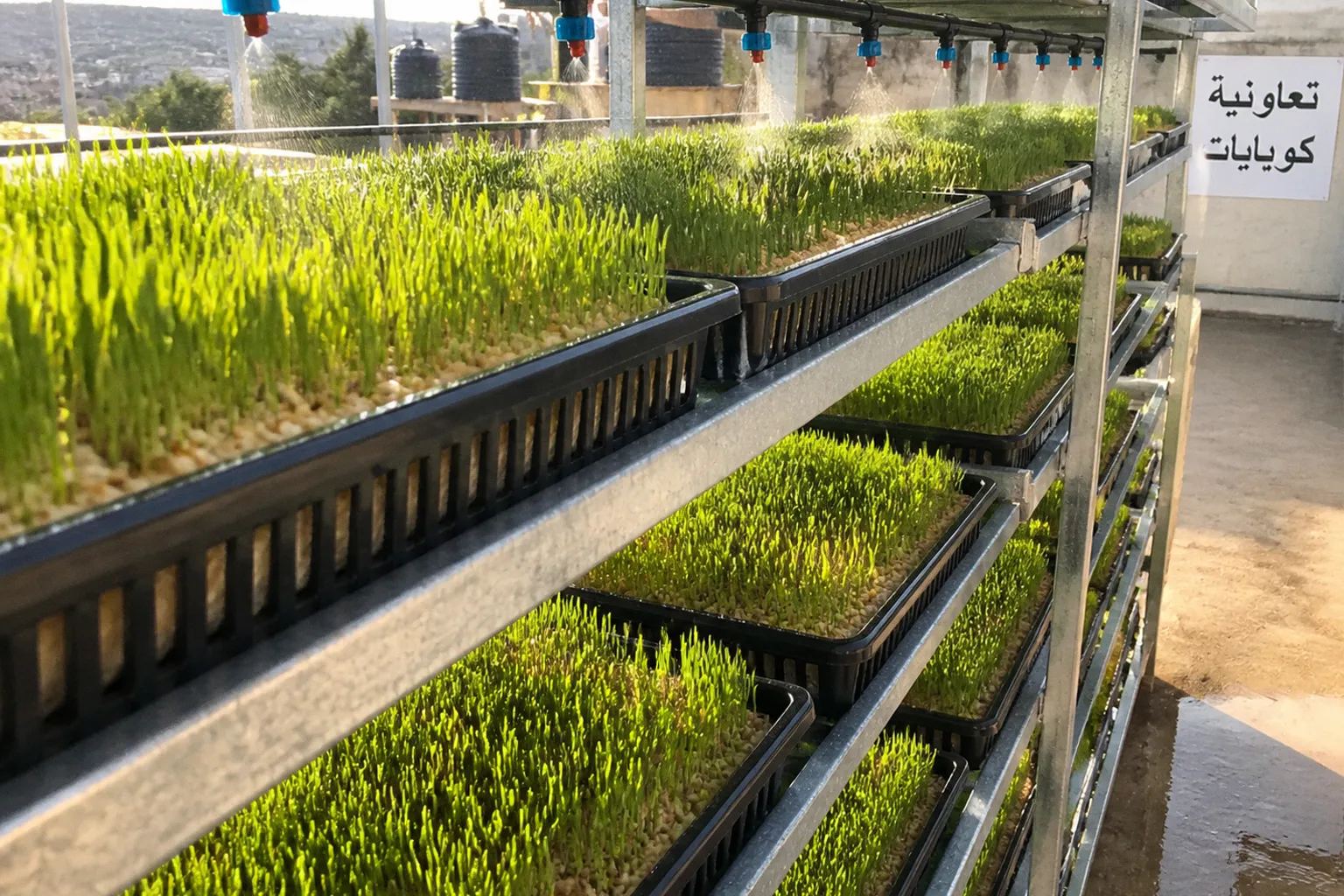
Dry seasons reduce the reliability of locally available forage, imported feed prices move beyond the farmer’s control, and the same irrigation constraints that affect barley and maize for human consumption also shape the economics of animal production. A hydroponic fodder system does not remove those pressures, but it changes one important variable: fresh green feed can be produced indoors, close to the herd, on a short and repeatable cycle.
The method is simple in principle. Grain is cleaned, soaked, spread in shallow trays, and kept moist until it forms a dense mat of roots, shoots, and seed base. In a controlled system, barley, maize, oats, wheat, clover, or alfalfa can reach harvest in seven to eight days. The entire mat is edible and can be fed directly to cattle, sheep, goats, and poultry.
That short cycle is useful only when the system is managed as a piece of infrastructure rather than as a rack with sprinklers. Seed quality, drainage, air movement, water hygiene, electricity, and harvest timing all affect whether the final mat is a dependable feed or a wet mass of spoiled grain.
A hydroponic fodder unit is not a shortcut around agronomy. It is agronomy compressed into eight days, where small management errors become visible very quickly.
The four stages at a glance
A practical hydroponic fodder setup in Lebanon can be organized around four operating stages:
1. Seed preparation: clean and sort the grain before it enters the production room.
2. Soaking and germination: hydrate the seed for 12 to 24 hours, depending on the crop and seed condition.
3. Tray loading and sprouting: distribute the grain evenly and maintain a controlled environment.
4. Misting, monitoring, and harvest: irrigate without waterlogging, then harvest the complete mat on days seven or eight.
The equipment supporting these stages may include food-grade or washable trays, shelving, drainage channels, an overhead misting line, a pump, timers, filters, a water tank, fans, lighting where needed, and a reliable power source. In a Lebanese farm setting, solar power can be particularly valuable for operating pumps and controls, but the system still needs a plan for cloudy days, battery maintenance, and pump failure.
The production room should be treated as a wet agricultural workspace. Surfaces must be washable. Water should move away from the trays rather than collect under them. The floor needs enough fall toward a drain, and the room must allow inspection from both sides of the shelving. A design that looks efficient on paper can become difficult to clean once every tray is full of roots and wet seed.
What the system can and cannot do
Hydroponic green fodder is fresh and highly hydrated, with harvested mats commonly containing about 80% to 85% water. This matters when calculating feed value. A kilogram of fresh mat is not equivalent to a kilogram of dry feed, and the diet must still provide appropriate dry matter, roughage, minerals, and fiber.
The mat can supplement a livestock ration, but it should not be treated as a complete replacement for dry roughage in ruminant diets. Cattle, sheep, and goats still require adequate structural fiber. The feeding plan should be developed with the animal’s species, weight, production stage, and existing ration in mind.
For the farm manager, the main potential benefits are different:
- production is close to the animals, reducing dependence on long supply chains;
- the growing cycle is short enough to schedule daily harvests;
- the crop uses no agricultural soil and does not require pesticides during the normal sprouting cycle;
- water and feed production can be monitored in one controlled room;
- a cooperative can standardize seed, sanitation, and harvest records across participating farms.
Stage one: seed selection and preparation
The first decision is not whether to grow barley fodder hydroponically or use maize. It is whether the seed is suitable for rapid, even germination.
Hydroponic fodder systems expose seed defects that might remain unnoticed in a field. Broken kernels, poor germination, surface contamination, and uneven size all become concentrated across a tray. If part of the tray fails, the problem is not limited to a few plants; it can disrupt the moisture pattern and create a pocket where mold develops.
Barley is commonly used because it germinates quickly and forms a dense mat. Maize, oats, wheat, clover, and alfalfa can also be used, but each crop may behave differently in terms of seed size, water absorption, root formation, and the density of the finished mat. A farm should begin with one crop and one seed supplier rather than changing varieties every few days.
Seed preparation has four practical objectives:
- remove dust, stones, husks, and visibly damaged grain;
- separate moldy or discolored seed before it reaches the soaking tank;
- wash the seed using clean equipment and water;
- keep batches traceable by date, crop, supplier, and intended harvest day.
The last point may sound administrative, but it is part of feed safety and cooperative management. If a batch produces poor germination, an operator needs to know which seed entered which trays. The same records become useful when a cooperative is supplying milk, meat, or animals into a market that expects documented inputs and consistent production practices.
Seed should not be stored in a damp room near the misting system. Moisture, heat, and poor ventilation can affect the grain before it is ever soaked. Bags should be kept off the floor and protected from rodents. A small production room can easily contain several days of seed inventory; that inventory should remain dry until its scheduled batch.
Choosing the tray load
The objective is an even layer, not the maximum possible amount of grain. When seed is packed too densely, the center of the tray holds more moisture and receives less air. Roots become tangled, drainage slows, and the mat may heat up as germination accelerates.
A practical way to establish the loading rate is to run a small calibration batch. Weigh a known amount of seed, distribute it across a tray, and observe whether the resulting mat drains evenly and fills the surface without excessive overlap. The exact loading rate will depend on tray dimensions, seed type, germination rate, and the design of the irrigation system.
The right question is not, “How much seed can fit in one tray?” It is, “How much seed produces a stable mat under this room’s temperature, airflow, and misting pattern?”
Stage two: the 12–24 hour soaking phase
Soaking is where dry grain becomes biologically active. It is also where poor hygiene can enter the process, because the seed remains in contact with water for a prolonged period.
A typical soaking period is 12 to 24 hours. The shorter or longer end of that range may be appropriate depending on the crop, seed dryness, water temperature, and observed germination. The purpose is to hydrate the kernel sufficiently for sprouting without leaving it in stagnant water longer than necessary.
Use a clean tank or food-safe container that can be washed between batches. Do not allow old soaking water to become part of the next batch. Once the seed has absorbed water, it should move promptly to the tray stage.
The soaking phase should be recorded as carefully as the harvest:
- crop and seed lot;
- time the grain entered the tank;
- time it was removed;
- any visible odor, discoloration, or floating material;
- the number of trays loaded after soaking.
If a batch smells sour or shows widespread discoloration, it should not be pushed into production simply because the seed has already been purchased. The cost of discarding a poor batch is smaller than the cost of spreading a contamination problem across a room or feeding compromised material to livestock.
Water quality is part of the feed system
A hydroponic fodder system does not need the same nutrient solution used in hydroponic vegetable production. The seed contains the initial reserves required for sprouting, and the usual seven- to eight-day cycle is based on germination rather than full crop development.
That does not mean water quality is unimportant. Suspended solids can block misting nozzles. Excessive mineral content can leave deposits on equipment. Dirty tanks and stagnant lines create conditions that are difficult to control. In areas where water supply varies seasonally, the farm should monitor the condition of filters, emitters, pumps, and drains rather than waiting for a visible crop failure.
Water should be used to wet the seed and roots, not to flood the tray. The production goal is a moist root zone with regular air exchange. A tray that remains saturated for long periods is not receiving better irrigation; it is losing oxygen around the roots.
Stage three: tray loading and the controlled sprouting environment
After soaking, distribute the seed across the trays in a uniform layer. The tray surface should be covered, but the grain should not be piled into ridges or compressed into a thick bed. Uneven loading creates uneven drying, and uneven drying encourages operators to compensate by increasing irrigation for the entire rack.
The shelves should allow excess water to drain freely. Trays need a slight slope or drainage design that prevents pools from remaining under the developing mat. If the system uses stacked shelves, the upper levels must not drip directly onto the lower crop in an uncontrolled way. Water falling from one tray to another can spread debris and make it difficult to identify where a problem began.
The room itself controls much of the result. A productive environment needs:
- adequate ventilation to remove heat and humidity;
- enough airflow around trays to reduce stagnant pockets;
- protection from direct contamination and pests;
- surfaces that can be cleaned between cycles;
- safe access to pumps, timers, filters, and electrical connections.
Temperature and humidity should be monitored rather than guessed. The ideal setting will vary with the building and season, but the operating principle is stable: warm, wet, poorly ventilated rooms are more vulnerable to fungal growth and off-odors. In a Lebanese summer, the room may need more active ventilation or cooling; in winter, the main issue may be slower germination and condensation.
This is where a low-cost system can become more expensive than expected. The trays and shelving are visible at purchase, while ventilation, drainage, filters, backup power, and cleaning time are easy to underestimate. A reliable system is not necessarily the one with the most automation. It is the one an operator can inspect, clean, repair, and restart without losing an entire week’s production.
A simple daily inspection
The operator should inspect the room at least once during each production day, preferably at the same time. The inspection is not a ceremonial walk past the shelves. It should answer specific questions:
- Are all nozzles producing a similar spray pattern?
- Is water reaching the corners of each tray?
- Are drains clear?
- Is any tray noticeably warmer, wetter, or drier than its neighbors?
- Are roots white or cream-colored, or is there unusual discoloration?
- Is there a sour or musty smell?
- Are pumps, timers, and solar or battery components operating normally?
The advantage of a short crop cycle is that the response can also be short. A blocked nozzle found on day two may be corrected before harvest. The same blockage discovered on day seven has already affected the feed mat and the next production decision.
The most useful automation is not the one that removes the operator. It is the one that makes a small failure visible before it becomes a full-tray failure.
Stage four: misting, monitoring, and the seven-day harvest cycle
Once the seed is loaded, the system moves into repeated misting or light irrigation until harvest. A typical crop reaches a usable green mat in seven to eight days. During this period, the operator is managing a balance between moisture, oxygen, temperature, and airflow.
Misting intervals should be adjusted to the actual room rather than copied blindly from another farm. A schedule that works in a cool, well-ventilated room may leave trays too dry in one building and too wet in another. The correct schedule is the one that keeps the root zone moist while allowing drainage and air exchange.
Automated controls can handle repeated irrigation, but they do not replace observation. A timer cannot see that one nozzle is blocked. A pump cannot know that a drain is clogged. A solar-powered system can reduce dependence on grid electricity, but it still requires battery checks, electrical protection, and a manual backup procedure.
Harvest timing should be consistent. If some trays are harvested on day seven and others remain until day ten, the farm no longer has a uniform feed product. Longer growth may increase the height of the shoots, but it also changes the moisture balance, root density, and handling characteristics. The seven- to eight-day cycle is valuable because it gives the farm a predictable rhythm: one group of trays enters while another group is harvested.
A weekly production rhythm
For a continuous system, divide the rack capacity into daily or near-daily batches. The number of trays harvested each day should match the amount the livestock can consume without extended storage.
A simplified cycle looks like this:
1. Day 0: clean and soak the seed.
2. Day 1: load the trays after soaking.
3. Days 2–6: monitor germination, misting, drainage, airflow, and root development.
4. Days 7–8: harvest the complete green mat and begin the next batch.
The mat can be removed from the tray and fed whole, including shoots, roots, and the seed base. Handling should be gentle enough to avoid unnecessary contamination from floors, boots, or dirty equipment. If the mat is visibly spoiled, slimy, or strongly off-smelling, it should not be mixed into the ration to avoid waste.
Fresh fodder is highly perishable. Harvest planning therefore needs to follow the feeding schedule, not merely the capacity of the growing room. Producing more than the herd can consume promptly may turn a water-saving system into a source of avoidable feed loss.
Calculating capacity: from a rack to a farm service
Reported production figures for hydroponic maize fodder can reach approximately 600 to 1,000 kilograms per day from a footprint of about 45 to 50 square metres, depending on system design and operating conditions. These figures should be treated as a planning range, not a guarantee. Seed quality, tray density, harvest age, climate control, water distribution, and labor all affect output.
The footprint also needs to include more than the shelves. A working farm requires space for:
- seed storage;
- cleaning and soaking;
- tray washing;
- drainage and water treatment;
- harvest handling;
- equipment maintenance;
- safe movement around the racks.
This distinction matters when a cooperative is considering a shared fodder unit. The productive rack area may fit within a modest building, but the supporting operations determine whether the unit can run every day.
The most useful capacity calculation begins with livestock demand. Estimate how much fresh mat can be consumed daily, then work backward to the number of trays that must be harvested and loaded. Avoid designing the room around a headline output figure before confirming the herd’s ration and the labor available to operate the system.
Fresh weight is not dry matter
Because harvested mats contain roughly 80% to 85% water, fresh kilograms can create a misleading impression of feed quantity. The farm should compare the hydroponic mat with the ration on a dry-matter basis and preserve adequate fiber for ruminants.
This is also why a lower feed-cost figure must be interpreted carefully. The Kobayat Cooperative in Lebanon developed a solar-powered, water-preserving hydroponic animal fodder system reported to reduce cattle fodder costs for farmers by up to 65%. That result is significant, but it belongs to a particular operating model with its own seed sourcing, energy conditions, herd requirements, and labor structure. It should encourage careful local calculation rather than promise the same reduction to every farm.
A farm-level calculation should include:
- seed cost and germination losses;
- electricity or solar-system maintenance;
- water pumping and filtration;
- trays, racks, and replacement parts;
- labor for cleaning, loading, monitoring, and harvesting;
- rejected batches;
- the value of the dry feed and roughage that remain necessary in the ration.
The absence of pesticide and fertilizer inputs during the short sprouting cycle is not the same as the absence of operating costs. Sanitation, water management, and equipment reliability are the main inputs of this system.
What the Kobayat model suggests for Lebanese cooperatives
The Kobayat Cooperative model is useful because it places hydroponic fodder inside a broader agricultural service, rather than treating it as a novelty unit for one farm. In 2022, the cooperative launched a solar-powered system designed to preserve water and reduce cattle fodder costs. The important lesson is not simply that solar power can run a pump. It is that energy, feed, water, and cooperative purchasing can be planned together.
A shared unit can improve consistency in several ways. The cooperative can purchase seed in larger lots, establish one cleaning protocol, train operators, and maintain production records in a common format. It can also coordinate harvest with the feeding needs of several livestock farmers rather than asking every farm to build a complete system independently.
That model brings its own management questions:
- Who owns the equipment and schedules access?
- Who pays for failed batches?
- How are seed and water costs allocated?
- Who is responsible for cleaning trays after each cycle?
- What happens when solar storage is low or the pump fails?
- How will the cooperative document inputs and batch dates for buyers?
These questions connect fodder production to the wider export pipeline. Even when the fodder itself is not an export product, dairy, meat, and animal health records may influence the credibility of a cooperative supplying formal markets. Clean water, controlled inputs, batch traceability, and consistent feed management are not decorative sustainability claims. They are evidence that the production system can be understood and audited.
For cooperatives already working with fresh produce, the same discipline can support greenhouse and packhouse operations. A farm that records water use, seed lots, crop cycles, and equipment maintenance for fodder is building habits that also matter when buyers ask how irrigation, fertilizer supply, residue control, or post-harvest handling are managed.
Troubleshooting the common failures
Most hydroponic fodder problems are not mysterious. They usually follow from an imbalance that can be traced through the four stages.
Mold or sour odor
This often points to contaminated seed, excessive moisture, poor airflow, or delayed cleaning. Increasing irrigation will not solve it. Remove the affected material, clean the tray and surrounding surfaces, inspect the drainage path, and review the soaking and misting records.
Uneven germination
Look first at seed quality and tray loading. If some areas are thick and others are thin, water will not behave evenly across the surface. Uneven germination can also result from incomplete soaking or a seed lot with poor viability.
Dry corners
Dry corners commonly indicate a blocked nozzle, poor spray overlap, a tilted shelf, or excessive airflow in one part of the room. Check the distribution pattern before changing the entire irrigation schedule.
Yellow or weak shoots
Weak growth can be linked to poor seed, insufficient light, excess heat, or an inconsistent moisture pattern. The answer is not automatically fertilizer. A seven- to eight-day sprouting system should first be corrected through seed preparation, water delivery, ventilation, and timing.
Mats that fall apart
A loose mat may result from low germination, insufficient root development, overloading problems, or harvesting too early. If the crop is otherwise healthy, adjust the seed density and compare results across several batches instead of changing multiple variables at once.
Equipment failure
Keep a manual watering method available, along with spare nozzles, filters, pump components, and a way to protect the crop during short power interruptions. Solar-powered irrigation improves resilience, but only when the system includes storage and a maintenance routine. A pump that stops on day three can damage a week of production quickly.
A seasonal transition plan
The safest way to introduce a hydroponic fodder system is to build it in stages, beginning with the production rhythm rather than the largest possible rack.
Weeks 1–2: establish the baseline
Record the current livestock ration, daily feed demand, roughage availability, seed prices, water access, and power reliability. Decide which animal group will receive the first batches. Choose one grain, preferably a locally available seed with a reliable germination history.
At this stage, inspect the proposed room during the hottest and most humid part of the day. A room that appears suitable in the morning may have poor airflow by afternoon.
Weeks 3–4: run a small pilot
Install a limited number of trays and focus on repeatability. Measure seed input, harvest weight, rejected material, water interruptions, and labor time. Do not judge the system from one successful batch. Run enough cycles to expose changes in room conditions and operator routine.
Use the pilot to set cleaning procedures. Tray washing should be planned as a daily task, not postponed until the rack is empty.
Month 2: match output to the herd
Increase the number of batches only after the farm can manage the first production rhythm without missed irrigation or delayed cleaning. Compare fresh-mat use with the complete ration, including dry fiber and mineral supplementation. Adjust feeding under professional livestock guidance where necessary.
This is also the point to calculate the real hydroponic green fodder cost. Include failed trays and maintenance, not only seed and water.
Month 3 and after: add resilience
If the system is stable, consider solar-powered pumping, battery storage, additional racks, or a cooperative-scale unit. Solar equipment should be sized around the pump, controls, fans, and storage requirements, with a clear plan for maintenance.
For a cooperative, standardize batch labels, seed records, cleaning logs, harvest dates, and distribution schedules. These records make the system easier to manage and give buyers greater confidence in the agricultural chain behind the final product.
The seasonal timetable should remain flexible. In summer, ventilation and water temperature may become central constraints. In winter, slower growth and condensation may require a different misting rhythm. The system should follow the crop’s actual response, not a fixed schedule copied from another climate.
The practical position
A hydroponic fodder system setup in Lebanon makes the most sense where feed costs, water limitations, and power reliability can be managed as one connected problem. The seven- to eight-day cycle is attractive, but speed alone does not create resilience. Resilience comes from clean seed, measured water use, dependable drainage, a workable energy plan, and a ration that respects what fresh fodder cannot provide.
The Kobayat Cooperative shows that solar-powered hydroponic fodder can become a useful agricultural service rather than an isolated technology demonstration. For other Lebanese farms and cooperatives, the next step is not to copy a headline saving or install the largest available unit. It is to run a controlled pilot, document every batch, and expand only when the daily work fits the people, animals, building, and season.
The strongest system is the one that still makes sense on an ordinary day: when the seed lot is imperfect, the weather changes, the pump needs cleaning, and the animals still need to be fed before sunset.