Clay pot irrigation: easy water saving for Bekaa farms
In the Bekaa Valley, where annual rainfall swings from roughly 700 mm near Qaraoun Lake down toward 250 mm on the Hermel–Kaa fringe, every irrigation decision is a calculation against a closing margin.
Agriculture is estimated to draw 55–60% of Lebanon's utilized water, and irrigation already covers close to half of cultivated land — about 113,000 of 231,000 hectares. With those numbers behind the field walk, anything that can deliver moisture directly to the root zone without pressurized infrastructure deserves a serious look.
That is the quiet appeal of buried clay pot irrigation, sometimes called olla irrigation: porous, unglazed clay vessels sunk into the soil, filled by hand or gravity, and allowed to weep water into the rhizosphere on demand. It is ancient, low-input, and asks for nothing more than the right clay, a shovel, and a planting pattern that matches how far each pot can actually wet.
The Mechanics of Subsurface Clay Pot Irrigation
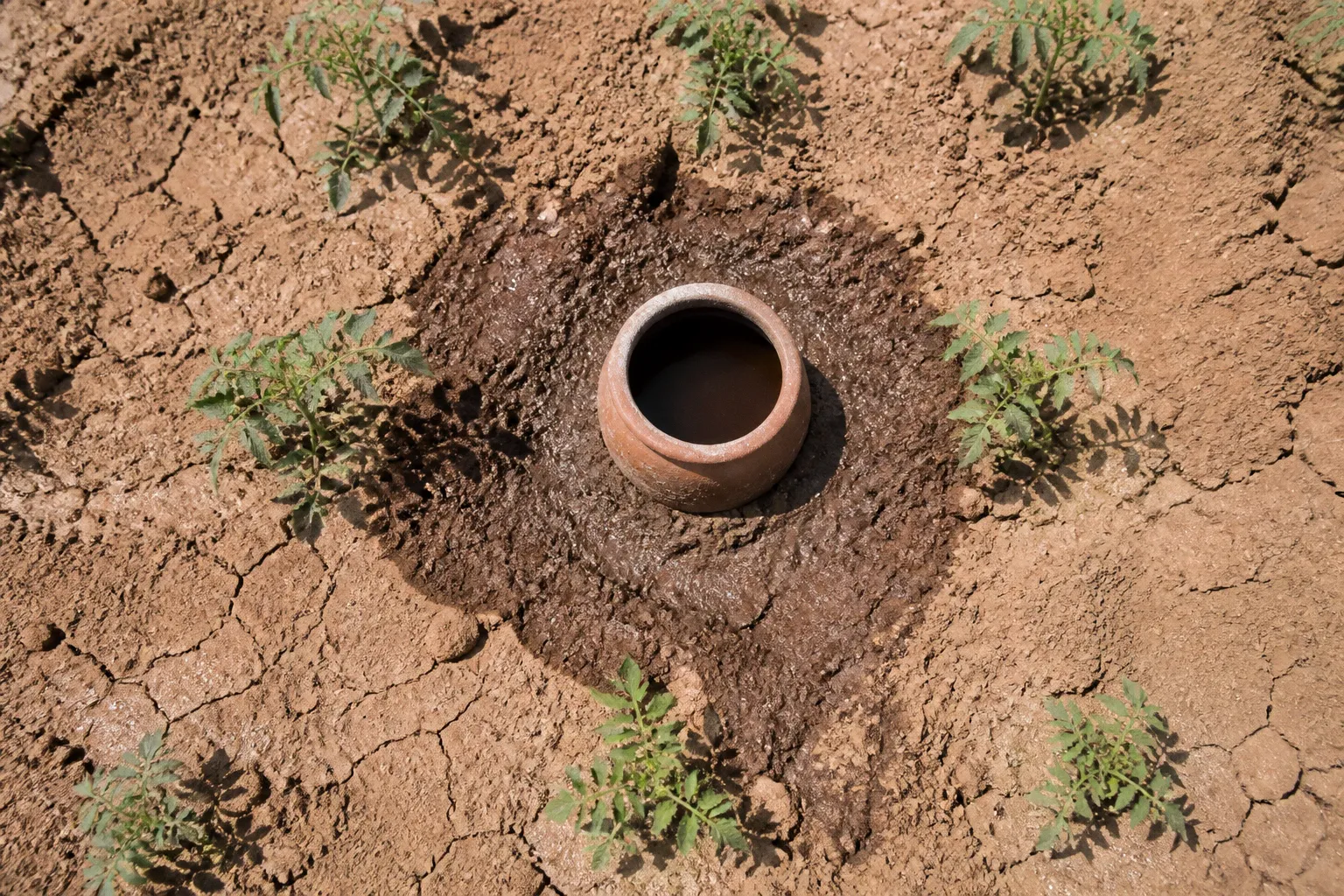
The principle is straightforward enough to hold in one sentence: water leaves the pot only when the soil around it is dry enough to pull it. Each olla is an unglazed, porous clay vessel — usually rounded, sometimes jar-shaped — buried so that its neck sits roughly at or just below the soil surface. Once filled and capped with a clay saucer, a flat stone, or a simple lid, it begins a slow, soil-driven exchange.
The wall of the pot behaves like a controlled membrane. When the soil in contact with the pot is saturated, at or beyond field capacity, there is little moisture tension to speak of, and the seepage slows to a trickle. As plant roots draw water away and the soil dries, tension rises, and water moves through the wall faster, in response to that demand. In effect, the crop regulates its own supply by how hard it pulls. That is why an olla system can place water right where it matters, with minimal loss to evaporation or wind drift.
A few consequences flow from that design. Because water stays below the surface, foliage stays drier — which can reduce the leaf-surface humidity that drives fungal pressure in dense plantings. Because the wetted zone is tight and shallow, weeds between plants get less of the free surface moisture that germination depends on. And because refill intervals depend on soil texture, weather, and crop demand, the farmer's daily attention turns into a learning loop: lift the cap, look at the waterline, refill when the rhythm suggests.
The materials list is short. Traditional ollas are unglazed terracotta — low-fired clay with just enough porosity to pass water at useful rates. Glazed pots and high-fired ceramics do not weep. Wall thickness matters more than shape; thin walls deliver water faster and crack faster; thick walls slow the seepage and last longer in the ground. A flat-bottomed, slightly tapered pot is easier to seat, and easier to dig back up at season's end.
An olla doesn't push water at the soil. The soil pulls water from the olla — and the plant drives that pull. The efficiency comes from the geometry, not the pressure.
Water Efficiency and Performance in Semi-Arid Climates
The efficiency case for ollas rests on three claims often heard in the field — and each needs careful framing before it lands on a Bekaa balance sheet.
The first comes from extension work at the University of Arizona, which has documented clay pot irrigation on backyard and small-farm scales for years. That guidance reports potential water savings of roughly 60–70% compared with conventional watering-can irrigation, and performance that can equal or slightly exceed drip systems — depending on how the drip system is being used. The figure is compelling, but it is a comparison against hand-watering with a can, not against a well-managed drip line running on a pressurized schedule. In a Bekaa context, where drip is already common, the relevant benchmark is drip — and the case becomes one of trade-offs, not raw savings.
A second thread of evidence comes from peer-reviewed field research. A study published in Agricultural Water Management describes buried clay pot irrigation as potentially more efficient than drip, and substantially more efficient than conventional surface irrigation — in some trial conditions, by a factor of up to ten. The same literature emphasizes that those gains depend heavily on soil texture, crop, microclimate, weed pressure, and operator skill. Treat the headline number as the upper bound of a range, not a guarantee.
A third data point sharpens the picture. In a 2009–10 tomato trial in a semi-arid part of Ethiopia, clay pot irrigation used about 143.7 mm of seasonal water against 485.5 mm under furrow, and produced water-use efficiency of roughly 33.6 kg per cubic meter against 6.7 kg per cubic meter under furrow. Those numbers are striking, but they belong to a specific crop, soil, and climate. They offer a sense of what ollas can do under the right combination of factors; they do not transfer wholesale to Bekaa soils, Bekaa varieties, or Bekaa economics.
A simple comparison helps frame the choice at the cooperative level:
| Method | Where the water ends up | Efficiency headline | Best-fit scale in the Bekaa |
|---|---|---|---|
| Buried clay pot (olla) | Root zone only, demand-driven | Reported savings of ~60–70% vs watering-can; comparable to well-managed drip in some trials; up to ~10× more efficient than surface in published studies | Small to mid-scale high-value beds, cooperative demonstration plots |
| Drip, well-managed | Root zone, scheduled intervals | A strong benchmark; performance varies with design and upkeep | Mid- to large-scale vegetable blocks, orchards |
| Surface (furrow) | Whole field, much lost to evaporation and deep percolation | Used as the baseline in irrigation research | Field crops where infrastructure capital is the binding constraint |
The honest read for a Bekaa farmer is straightforward: ollas are most attractive where the crop is high-value and water-sensitive enough that per-plant savings compound, the soil texture supports a healthy wetted bulb, and the labor of refilling — by hand or by gravity feed — is sustainable across the season. In those contexts, savings in the tens of percent are plausible; guarantees are not.
Adapting Olla Systems to Bekaa Valley Soil and Crop Profiles
The Bekaa is not one farming environment. It runs from the higher, better-watered plateaus around Qaraoun to the drier Hermel–Kaa fringe, with annual rainfall sliding from roughly 700 mm down to about 250 mm across that gradient. Soils shift from heavier clay-loam pockets in the central plain to lighter, rockier ground on the slopes. That variability is exactly the variable that decides how an olla system will perform.
In heavier soils with a meaningful clay fraction, the wetted bulb around each pot spreads wider and holds longer, because small pores hold water against gravity. A single well-seated pot can water a noticeably larger footprint. In lighter, sandier soils, the bulb narrows; water reaches the crop faster, but less is held in reserve, and refill frequency climbs. There is no single "Bekaa soil recipe" — pilot a few pots, watch how far the dark, moist zone extends after a refill, and adjust spacing before scaling.
Crop choice matters as much as soil. Vegetables with compact, fibrous root systems — tomatoes, peppers, leafy greens, herbs — sit comfortably inside a pot's wetted footprint. Sprawling vines like zucchini or melon can perform at tighter spacing but draw from a larger volume than a leafy green. Fruit trees and woody shrubs are a different category: their roots grow into the pot wall and, over time, crack the clay. Treat trees as a separate design problem — or skip ollas entirely for that block.
Climate dictates cadence. In a hot, dry stretch, especially toward Hermel–Kaa, an olla in sandy soil may need refilling daily. In the cooler shoulder seasons near Qaraoun, the same pot may hold for several days. Hand refilling is the traditional method and the simplest for a small plot. For a larger block, a header tank set slightly above the bed, connected by thin tubing to each pot, can keep multiple ollas topped up by gravity — a useful step when daily watering starts crowding out the rest of the field work.
Two practical sizing rules help. First, the wetted bulb's diameter scales roughly with the pot's diameter — wider pot, wider bulb. Second, planting density should match how far each pot reliably wets. Research on ideal spacing is limited; one maize trial has suggested 20–30 cm as workable under some conditions. Treat that range as a starting point, not a standard — every soil will ask for its own adjustment.
Operational Realities: Refilling, Maintenance, and Scaling
The first honest conversation about ollas is about labor. They are not maintenance-free; they trade water for time. Hand refilling is simple and visible — you can see when the waterline drops and exactly how much each plant is drinking. That visibility is part of the value. But on a commercial block, the labor math has to balance. Estimate the minutes per refill, multiply by the number of refills per week, and compare against water savings and yield quality before assuming an olla system saves labor.
Salt is the second honest conversation. Mineralized irrigation water leaves residues in the porous wall as it evaporates from the outer surface of the pot. Over time, those residues clog the pores and slow the seepage. In areas with hard, alkaline groundwater — common in parts of the Bekaa where wells pick up mineral load — that slowdown can arrive faster than the catalog years imply. Periodic flushing, an overnight soak in clean water, and rotating pots out at season's end for a thorough rinse are the basic countermeasures. Where water quality is poor, working life is shorter than the brochure suggests.
Establishment is the third. A small seedling with a short root cannot reach into an olla's wetted bulb right away. In the first weeks after transplant, supplemental surface watering — by drip or by can — is almost always necessary. Once the roots reach the bulb, the olla takes over. Plant too deep, transplant too late, or skip supplemental watering, and the crop will stall before the system has had a chance to work.
Scaling is the fourth. Olla systems work best where the layout is regular, the crop set is uniform, and the farmer can commit to a weekly rhythm of checking waterlines. They are less suited to broadcast crops, heavy mechanization, or mixed-age plantings that demand different watering at once. At cooperative scale, the most useful framing is an "irrigation module": identical beds, identical pots, identical refill schedule. That uniformity is what makes the system transferable across co-op members, training, and quality control — and what makes an olla block legible to a buyer looking for documented water practice.
A short operational checklist for a season:
- Document pot diameter, wall thickness, and source for every block
- Log refill volume and time per visit for the first four weeks
- Track salt residue at the pot rim monthly; flush if flow visibly slows
- Plan a pot rotation at season's end; rinse and dry in shade before storage
- Keep one drip-equipped bed beside the olla block as a side-by-side comparison
Integrating Clay Pots with Modern Water-Conservation Practices
Ollas work best as one tool in a conservation kit, not as a standalone answer. Lebanon's Ministry of Agriculture, in its April 2025 irrigation campaign, urged farmers to match water to crop, soil, and climate — a principle ollas were designed around. The campaign's other recommendations pair naturally with a pot-based system: drip or modern irrigation where it fits, mulch and organic matter to keep the surface cooler and the bulb stable, no-till practices that protect soil structure, early morning or late evening irrigation timing, and a clear eye on fertilizer rates that the soil can actually absorb.
In practice, the layering looks like this. Olla necks sit just below grade, so mulch above them keeps the topmost soil from crusting and slows evaporation from the immediate surface. Organic matter — compost, well-rotted manure, cover-crop residues — increases the soil's water-holding capacity, so the wetted bulb stays useful for longer between refills. No-till preserves the pore network that water moves through; tillage collapses it. Together, these practices let the olla do more work per refill.
Well-matched additions for an olla block:
- Mulch (straw, chopped stalks, weed-free hay) 5–10 cm deep over the wetted zone
- Compost incorporated at planting or top-dressed early in the season
- Cover crops in the off-season to protect soil structure and feed organic matter
- Drip line as a backup during establishment and during heat waves
- A header tank with thin tubing for gravity-fed refills across the block
- A water meter at the source to track actual use and verify the savings
Tracking is the link from the field to the export conversation. A Bekaa cooperative that can document its water consumption — in cubic meters per hectare per season — is several steps closer to the sustainability metrics that EU and Gulf buyers increasingly ask for. Olla blocks can be the demonstrable unit inside that documentation: a defined area, a defined number of pots, a measured refill volume. Combined with mulching and organic amendments, the block becomes a living trial of low-input, soil-first farming that holds up under buyer scrutiny.
What ollas are not, just as clearly: they are not certification in themselves, not a guarantee of organic status, and not a replacement for the soil-building practices that organic and regenerative standards actually reward. Used alongside those practices, they make the case visible and measurable. Used alone, they are just clever clay.
The pot is the speaker. The soil is the wire. The plant is the listener. Build the system around how all three actually behave — not around the catalog.
A Practical Path for the Coming Season
If you want to test clay pot irrigation on a Bekaa block, treat it as a season-long pilot rather than a leap of faith. Start with one bed of high-value, water-sensitive vegetables in soil that holds moisture reasonably well — a tomato or pepper block in the central plain is a typical good fit. Bury four to eight pots, document the soil texture and the planting spacing, and refill by hand for the first two weeks to learn the rhythm. Layer in mulch and compost at the same time.
By mid-season you will know whether the bulb is wide enough for your spacing, how often refills fall in your heat, and whether the labor matches the savings. If the pilot holds, scale one bed at a time and introduce gravity-fed refilling where the layout allows. Watch the pores for salt buildup, plan to rotate pots at season's end, and keep a simple log of refill volume, labor minutes, and yield. The numbers that come out of that log — done over one season — are worth more than any brochure. They are the numbers your cooperative can put beside an export contract and have it hold.
Buried clay pot irrigation, used carefully, is not a return to the past dressed up as innovation. It is a tool that asks the soil and the plant to drive the water budget — and that question is exactly the right one for a Bekaa season that is not getting any wetter.