Citrus mold prevention: the quick baking soda dip
There's a particular smell that fills a citrus packinghouse the morning after a heavy haul from the orchard — sweet, faintly herbal, with an edge that turns sharp as soon as it meets the cold floor. That second note is green mold making itself at home.
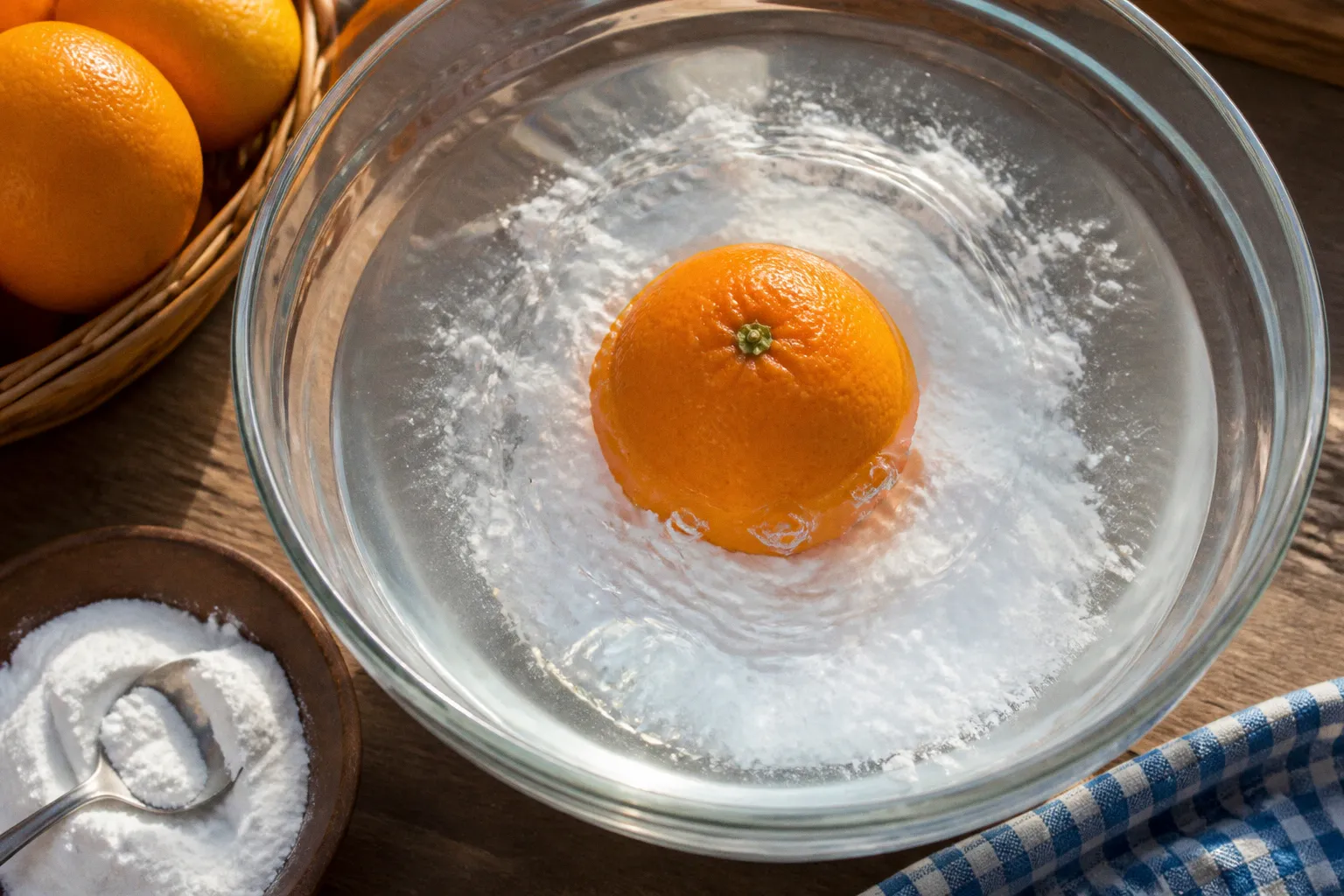
In Lebanon's coastal and inland citrus belts, where Navel and Valencia oranges move from the tree to the sorting line in a matter of hours, the window between harvest and decay is brutal. Penicillium digitatum — the fungus responsible for that olive-green fuzz — can colonize a wounded fruit in roughly 48 hours under ambient conditions, and from there it spreads through a bin like rumor in a crowded souk. One infected orange touching its neighbors is enough to start an outbreak that costs a cooperative its premium export grade.
The pressure is real for any Lebanese cooperative shipping to Gulf, European, or Russian buyers where cosmetic standards are unforgiving. Synthetic fungicides like imazalil have been the default defense for decades, but residue limits are tightening and consumer demand for "clean label" produce keeps rising. That is the world in which a humble pantry ingredient — sodium bicarbonate, the same compound that leavens bread — has earned a serious second look among postharvest researchers.
Baking soda does not kill fungal spores outright. It stalls them — and that pause is often all a good cold chain needs to get fruit to market sound.
The Science of Sodium Bicarbonate as a Fungistatic Agent
The first thing to get straight about sodium bicarbonate is the word fungistatic. The compound inhibits fungal growth; it does not sterilize. Researchers describe the mode of action as a disruption of spore internal pH balance and an interference with the enzymatic machinery the spore uses to germinate and produce the germ tube that physically penetrates the fruit rind. The spore sits there, dormant, waiting for conditions to turn favorable again. That distinction matters for anyone writing a packing protocol — the wash buys time, it does not give immunity.
Laboratory work dating to the late 1990s and early 2000s, much of it compiled in Plant Disease and revisited in subsequent applied research, has quantified just how much "buying time" is on the table. In vitro assays place the effective dose for inhibiting half of P. digitatum spore germination at 14.1 millimolar — roughly equivalent to a 0.12% solution. Move up the concentration curve and the inhibition gets dramatic: at 3,000 µg per milliliter (0.3% by weight), mycelial growth in culture drops by around 87%. Even at that level the spores remain viable; they simply lack the runway to take hold before the fruit is consumed or processed.
The field reading is straightforward. Sodium bicarbonate is best understood as a fungistatic partner in an integrated program — a way to lower the infectious load on the fruit surface so that cold storage, careful handling, and rapid logistics can finish the job. Used alone it is not a silver bullet. Used thoughtfully inside a sanitation routine, it is remarkably useful.
Optimal Concentration and Immersion Timing for Citrus
Walk into any postharvest laboratory with a citrus dipping question and the answer lands in a narrow band: between 2% and 4% weight-per-volume sodium bicarbonate, with an immersion time of roughly 150 seconds. Below 2% the effect falls off fast — a 1% solution has been shown to deliver no meaningful reduction in blue mold incidence on oranges at room temperature. Push past 4% and two practical problems emerge: alkalinity damage to the fruit peel, and waste of material without a corresponding gain in disease suppression.
The 2% to 4% window, with two and a half minutes of contact, has been validated across multiple trials. At the lower end of that range, blue mold (caused by the sibling species Penicillium italicum) is reduced by more than half on inoculated oranges held at ambient temperature. At the upper end — 3.4% specifically — the protocol tracks closely with 0.1% imazalil, the long-time industry standard, on green mold control.
For a Lebanese cooperative translating lab data to the packing line, the practical read comes down to a short list of moving parts:
- Concentration: 20 to 40 grams of food-grade sodium bicarbonate per liter of clean water, targeting the 2% to 4% wt/vol band. A 3% solution is 30 grams per liter.
- Immersion time: 150 seconds — long enough for surface contact without saturating the rind.
- Water temperature: Ambient, around 20–25°C. Avoid hot baths (heat injury) and cold baths (worker discomfort without efficacy gain).
- Bath turnover: Replace the solution every few hundred kilograms of fruit. Bicarbonate efficacy drops as pH drifts and as organic load accumulates in the water.
- Fruit condition: Cool, recently sorted, unwaxed before dipping. Wax applied afterward will seal the treatment onto the surface rather than washing it off.
The 1% solution is essentially decorative. If the bath cannot justify its concentration, do not run the bath.
Comparing Baking Soda Efficacy to Synthetic Fungicides
The honest comparison, drawn from peer-reviewed work and field trials, looks like this: a 3.4% sodium bicarbonate wash tracks 0.1% imazalil for green mold control on inoculated oranges. That match is a genuine win for a low-cost, food-grade compound — but the comparison also reveals where baking soda gives ground.
| Aspect | 3.4% Sodium Bicarbonate | 0.1% Imazalil |
|---|---|---|
| Green mold (P. digitatum) | Comparable in head-to-head trials | Industry benchmark for decades |
| Blue mold (P. italicum) | >50% reduction at 2% and above | Strong systemic control |
| Stem-end rot (Diplodia natalensis) | Not suppressed | Not assessed in cited trials |
| Residue profile | Food-grade; widely accepted | Within regulatory limits but tightening |
| Mode of action | Surface fungistatic; raises pH, delays germination | Systemic; penetrates rind and stem tissues |
| Cold-chain dependence | High | Lower |
| Cost | Very low; available in bulk | Higher; subject to regulatory access |
The systemic character of imazalil and its peers is the structural advantage. They reach into lenticels and stem-end tissues where infection can begin before visible symptoms appear. Sodium bicarbonate sits on the surface and creates a hostile environment for spores that land there. If the fungus has already established a foothold inside the fruit — through a stem-end scar, a microcrack, or an open button — the dip will not reach it. This is why integration matters: surface sanitation handles the spores that arrive from adjacent fruit, from the picking bin, and from the sorting line, while other layers of the program handle what is already inside.
There is also a question of consistency. Synthetic fungicides, applied correctly, deliver a known level of control with predictable residue profiles within legal limits. Sodium bicarbonate is more forgiving in some ways — it is food-grade, cheap, and easy to source — but its performance is sensitive to bath quality, contact time, and storage conditions downstream. A cooperative that switches entirely to bicarbonate without addressing its cold chain, fruit handling, or sorting hygiene will see disappointing results. A cooperative that adds bicarbonate to an existing sanitation program will almost always see marginal gains.
Synergistic Approaches: Combining Dips with Biological Antagonists
Yeast-based biocontrol is not alternative-agriculture folklore. It is a serious, peer-reviewed branch of postharvest science, and it pairs especially well with bicarbonate because the two operate through different mechanisms. The yeasts colonize wound sites on the fruit surface and outcompete pathogenic fungi for nutrients and space; they can also trigger host defense responses. Bicarbonate raises surface pH and disrupts spore germination. Stack them, and a wound that might have been colonized within 48 hours becomes a much harder target.
In published trials where Navel oranges were first dipped in 2% to 5% sodium bicarbonate and then treated with an antagonist yeast such as Rhodosporidium paludigenum or Cryptococcus laurentii, the resulting reduction in green mold incidence ran parallel to that achieved by a 500 ppm Fungaflor dip. That is a result worth paying attention to: low-residue, food-grade inputs, and disease control in the same range as a synthetic benchmark — once the antagonist is correctly propagated and applied.
Practical implementation note: antagonist yeasts are living organisms. They need a clean water source, a stable temperature in the suspension tank, and a use window measured in hours rather than days. Most cooperatives that have taken this route partner with a research station or a regional biocontrol supplier that provides fresh, viable cultures on demand. In-house propagation is possible but adds a layer of quality control that smaller operations sometimes struggle with.
For a cooperative without antagonist access yet, a stepwise introduction is reasonable. Start with the bicarbonate dip alone, measure decay rates over a representative storage window, and only then evaluate whether adding a biological layer pencils out economically. The data suggest it usually does, but the economics of any new input depend on local labor costs, availability of cultures, and the price premium that clean-label certification can command in the target market.
Limitations in Postharvest Decay Control
It is worth naming openly what sodium bicarbonate does not do. The compound has documented activity against green mold and blue mold, the two Penicillium species that drive most postharvest decay in stored citrus. It does not, however, suppress stem-end rot caused by Diplodia natalensis — a separate fungal pathogen that enters through the abscission zone at the stem. If a cooperative is fighting a stem-end rot problem, swapping imazalil for bicarbonate without adding a complementary treatment is likely to make things worse, not better. The cited research simply does not evaluate imazalil's performance against Diplodia either, so the honest answer is that stem-end rot management requires a dedicated assessment beyond what the bicarbonate-versus-imazalil trials address.
Bicarbonate also does not replace cold-chain management. The dip performs best when fruit enters a controlled-atmosphere or refrigerated storage regime within hours of treatment. If fruit sits in ambient conditions for a day or more before cooling, surface sanitation is only one piece of a much larger puzzle, and the marginal value of any dip begins to shrink.
There is a regulatory dimension worth flagging too. Sodium bicarbonate is classified as food-grade in most jurisdictions, which is part of why it appeals to cooperatives chasing clean-label markets — but "food-grade" does not mean "no rules." Some destination countries have specific labeling requirements for postharvest treatments, and some buyer contracts spell out what can and cannot appear on a certificate of analysis. Before committing to a protocol switch, a cooperative should confirm that bicarbonate treatment sits comfortably inside the residue and labeling rules of every market it ships to.
Seasonal Planning for the Citrus Harvest
Lebanon's citrus harvest follows a rhythm that determines when these protocols earn their keep. Early varieties come off the trees in the south and along the coast in late September, with the bulk of the Navel and Valencia crop running from October through January. The first weeks of the harvest — when temperatures are still warm, fruit maturity is uneven, and sorting lines are working at full pace — are when sanitation investments pay back fastest. Once fruit moves into the cooler months and into proper cold storage, decay pressure eases, but the export calendar runs the other direction: peak citrus exports land in November and December, just as Gulf and European buyers build inventory for the holiday season.
A practical seasonal routine, scaled to a small-to-mid-sized packinghouse, might look like this:
Late September — preharvest prep. Audit sorting lines, picking bins, and storage rooms. Calibrate dip bath concentration with a simple pH meter and a kitchen scale, not a guess. Confirm supply of food-grade bicarbonate; order in bulk before the harvest starts and prices rise.
October — first flush. Run a 3% bicarbonate dip in parallel with the existing fungicide protocol on a sample lot. Track decay rates over 21 days at 10°C and at ambient. Build a baseline for comparison.
November — decision point. If decay reduction lands in the 40–60% range — typical for the protocol — consider expanding the dip to the full packing line. If outcomes are weak, troubleshoot bath turnover, contact time, and water quality before changing concentration.
December — peak export. Run the integrated program at full scale. Document treatment logs carefully — buyers and certifiers will ask.
January — closeout. End-of-season review: what worked, what did not, where to invest for next year. This is also the moment to evaluate adding a biological antagonist step for the following season.
A dip is a tool, not a strategy. The strategy is the whole pipeline — picking hygiene, sorting discipline, bath consistency, cold-chain integrity, and residue documentation. Take any one of those out, and the protocol gives back less than it cost.
Closing Position
The case for sodium bicarbonate in a Lebanese citrus operation is not about replacing synthetic fungicides wholesale, and it is not about "going natural" as a marketing badge. It is about adding a low-cost, food-grade, well-characterized layer to an integrated postharvest program that already has to manage green mold, blue mold, and stem-end rot under mounting pressure from buyers and regulators. In the lab, bicarbonate tracks imazalil at the right concentration. In the bath, it outperforms anything else in its cost bracket. In the cold room, it works best when it is not asked to do the work alone.
For cooperatives weighing their options this coming season, the smart move is the modest one: run the dip on a representative lot, measure decay, and let the data — not the marketing — answer whether bicarbonate earns a permanent spot in the packinghouse. The science behind it is solid. The implementation is straightforward. The rest is good postharvest practice that any operation should be doing whether or not bicarbonate is in the bath.