Citrus degreening in Lebanon: before and after results
In Lebanon’s coastal citrus belt, the colour of a fruit can determine whether a mature harvest is accepted by a buyer or left to lose value in storage.
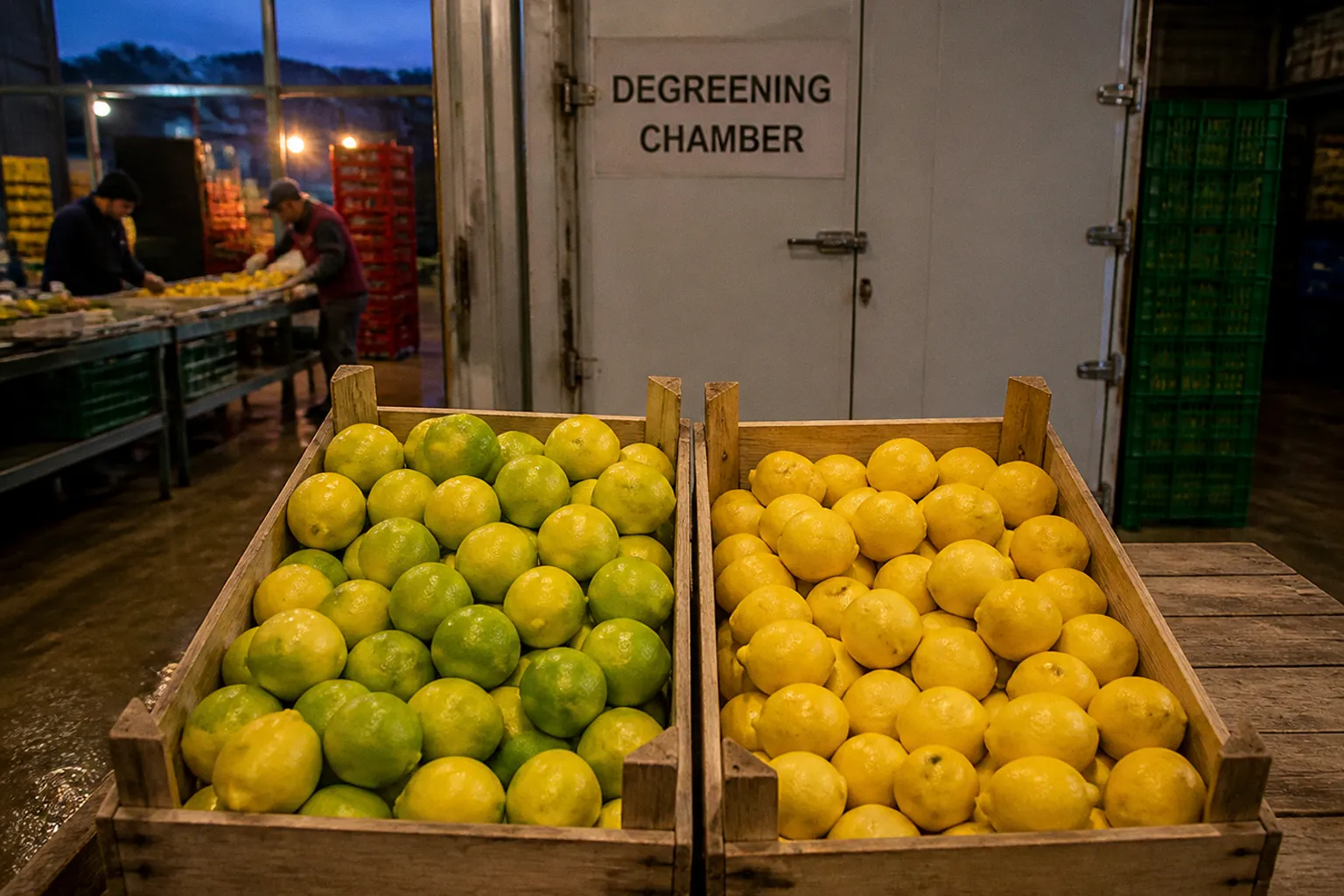
This creates a practical tension for growers: the pulp may have reached commercial maturity while the peel remains green because of harvest timing, temperature, or seasonal conditions.
The Lebanese citrus degreening process addresses that external colour problem after harvest. It does not ripen immature fruit from the inside, increase sweetness, or improve juice content. Instead, controlled exposure to ethylene breaks down green chlorophyll in the peel and encourages the development of yellow or orange pigments. The result is more uniform-looking citrus—but only when the fruit was already harvested at the correct internal maturity and the packinghouse can control temperature, humidity, ventilation, and handling.
That distinction matters. Degreening is a postharvest finishing operation, not a substitute for sound orchard management.
Why green citrus is not always unripe
Citrus maturity has two separate visual and biological components. The first is internal development: sugar accumulation, juice ratio, acidity, and the general eating quality of the fruit. The second is the colour of the rind, which depends heavily on chlorophyll breakdown and carotenoid expression.
These processes do not always move at the same speed.
Warm conditions can keep chlorophyll active in the peel even when the pulp has reached an acceptable stage for harvest. A fruit may therefore remain green on the outside while its internal quality is already suitable for a particular market. This is especially relevant in Mediterranean production, where autumn temperatures can remain high and coastal orchards may experience conditions that delay natural colour change.
In Lebanon, citrus production is concentrated along the coastal plains, including Akkar and the areas around Tripoli in the north, as well as Saida and Tyre in the south. The country’s citrus cultivation area was recorded at approximately 6,878 hectares in 2021. Across these growing zones, the same broad postharvest question appears in different forms: should the grower wait for the peel to colour naturally, or harvest mature fruit earlier and use controlled degreening?
The answer depends on the intended market, cultivar, storage capacity, and the condition of the packinghouse. Early harvest can protect fruit from some orchard risks, but it also brings greater responsibility after picking. If the internal maturity is insufficient, no degreening chamber can correct it.
A green peel is a colour problem only when the inside of the fruit is ready. If the pulp is immature, ethylene can change the appearance without creating eating quality.
Citrus is not ripened like a banana
Citrus is generally treated as non-climacteric fruit. In practical terms, it does not continue developing the same internal eating quality after harvest in the way climacteric fruits such as bananas or pears do. Ethylene can stimulate colour change in the rind, but it does not transform an immature citrus fruit into a sweet, juicy one.
This is the central safeguard in any citrus ripening room in Lebanon: the chamber should receive fruit that has already met the grower’s internal maturity requirements. Degreening then improves visual uniformity for distribution and sale.
The distinction also affects export preparation. Buyers may specify colour ranges and external appearance, while food-safety and quality systems require traceability back to the orchard, harvest date, treatment conditions, and packing line. A uniform orange peel may help a consignment meet a visual specification, but it cannot compensate for weak records, decay, poor sizing, or inadequate cold-chain management.
How the Lebanese citrus degreening process works
Degreening uses externally supplied ethylene gas at a controlled concentration. The gas activates physiological processes in the rind: chlorophyll breaks down, while yellow and orange carotenoid pigments become more visible.
Typical operating parameters fall within these ranges:
| Parameter | Practical range | Why it matters |
|---|---|---|
| Ethylene concentration | 1–10 ppm | Stimulates rind colour change without being used to increase internal maturity |
| Chamber temperature | 20°C–30°C | Supports the degreening response; protocols may use approximately 20°C–25°C or warmer conditions |
| Relative humidity | About 90%–95% | Reduces moisture loss and helps limit peel stress |
| Treatment duration | 24–72 hours | Allows time for colour development, depending on cultivar and starting condition |
| Air movement and ventilation | Controlled throughout treatment | Distributes gas and prevents carbon dioxide, heat, or moisture problems |
The operating window is deliberately narrow. Ethylene alone is not the whole process. Temperature affects the speed and quality of colour development; humidity affects water loss and peel condition; ventilation affects the chamber atmosphere and helps prevent the accumulation of carbon dioxide.
A well-managed room therefore behaves less like a simple storage space and more like a controlled biological environment. The operator must know what enters the chamber, how mature it is, how much heat the fruit carries from the field, and how the atmosphere changes during treatment.
What happens before the fruit enters the chamber
The quality of degreening begins in the orchard and continues at the receiving dock. Fruit should not be placed immediately into treatment simply because the peel is green. The packinghouse needs to separate unsuitable lots before treatment, including fruit with visible decay, severe mechanical damage, or evidence of poor handling.
Several decisions have an outsized effect on the final result:
- Harvest maturity: Internal maturity must be assessed before relying on peel colour as the main signal.
- Picking technique: Torn stems, punctured skin, and rough handling create entry points for decay organisms.
- Field heat: Fruit arriving warm can respond unevenly and may place extra stress on the chamber system.
- Lot separation: Different cultivars, maturity stages, and orchard blocks may not respond at the same rate.
- Cleaning and sanitation: Degreening cannot repair contamination or eliminate decay already established in damaged fruit.
This is where the science meets farm logistics. The best chamber cannot overcome a mixed load containing fruit at several maturity stages, different sizes, and different levels of peel injury. Uniform input produces a more predictable output.
Before and after: what a successful treatment actually changes
The visible before-and-after result is usually straightforward. Before treatment, mature citrus may have a predominantly green rind, sometimes with uneven yellowing. After controlled ethylene exposure, the same lot can show a more consistent yellow or orange colour suitable for market presentation.
The important word is external.
Degreening changes the appearance of the rind. It does not necessarily change the internal sugar content, juice ratio, or acidity in a commercially meaningful way. A fruit that was bland before treatment will not become properly flavoured because its peel has turned orange.
The transformation can be understood in three stages:
1. Green starting stage: The rind contains substantial chlorophyll, even though the internal tissues may already have reached the required maturity.
2. Controlled exposure: Ethylene is introduced under managed temperature and humidity conditions. Chlorophyll degradation begins, and carotenoid pigments become more visible.
3. Market-ready colour: The peel becomes more uniform, reducing the visual variation within a crate or shipment.
Colour uniformity has commercial value because buyers often assess a consignment quickly. Mixed green, yellow, and orange fruit can appear inconsistent even when internal quality is acceptable. For export-oriented cooperatives, that inconsistency may complicate grading, pricing, and negotiations with wholesale buyers.
But the visual result should be judged alongside other indicators. A lot with attractive colour but high decay, shrivel, stem-end damage, or poor traceability is not a successful postharvest lot. Appearance opens the conversation with the buyer; it does not finish it.
Degreening improves the signal buyers see on the outside. It does not rewrite the biological history of the fruit inside.
A useful comparison: natural colouring versus controlled degreening
| Feature | Natural colour development on the tree | Controlled postharvest degreening |
|---|---|---|
| Main driver | Seasonal temperature and orchard conditions | Ethylene exposure with controlled chamber conditions |
| Timing | Requires fruit to remain in the orchard longer | Can be carried out after harvest when internal maturity is adequate |
| Colour uniformity | May vary across trees, blocks, and harvest dates | More uniform when lots are well sorted |
| Orchard exposure | Fruit remains exposed to weather, pests, wind, and delayed harvest risks | Fruit leaves the orchard earlier, but handling risk shifts to the packinghouse |
| Internal quality | Continues under orchard conditions | Is not created by the treatment; it must already be sufficient |
| Infrastructure need | Lower chamber requirement | Requires suitable rooms, monitoring, ventilation, and trained operators |
| Main risk | Overlong field holding or uneven seasonal colour | Peel injury, decay, or shortened shelf life from poor control |
Neither approach is automatically superior. Natural colouring may be appropriate where the market accepts seasonal variation and the orchard can hold the fruit safely. Controlled degreening becomes more useful when market timing and external uniformity have a clear commercial benefit.
The risks hidden behind an attractive orange peel
The most common mistake is to treat the chamber as a forgiving space. It is not. Excessive ethylene concentration, poor ventilation, high carbon dioxide, low humidity, or excessive temperature can damage the rind and shorten shelf life.
Potential disorders include stem-end rot, zebra-like skin markings, brown rind blemishes, and other peel injuries. These defects may become more visible after treatment or develop during subsequent storage. A lot can leave the chamber looking brighter and arrive at the buyer in weaker condition if the treatment has accelerated moisture loss or exposed existing damage.
Temperature deserves particular attention. Operating within the broad 20°C–30°C range does not mean every setting in that range is equally appropriate for every cultivar or lot. Warmer protocols may speed the response, but additional heat can also increase physiological stress. Lower temperatures may support a gentler process but require more time or produce slower colour development.
Humidity is equally practical. Relative humidity around 90%–95% helps limit water loss during treatment. If the chamber is too dry, the rind can lose firmness and become more vulnerable to shrivel. If condensation and sanitation are poorly managed, however, excessive moisture can contribute to decay problems. The objective is not simply to add humidity; it is to control the entire atmosphere.
Ventilation must also be designed around the load. Ethylene needs to reach the fruit evenly, while carbon dioxide and excess heat need to be managed. A sealed room with no effective circulation may produce different results at different pallet positions. Fruit near an air inlet can respond differently from fruit in a stagnant corner.
The five practical failure points
1. Harvesting by colour alone
If workers wait for the peel to turn fully orange, they may leave commercially mature fruit exposed to orchard losses. If they harvest too early simply because a chamber is available, the treatment may produce a misleading appearance.
2. Mixing lots with different maturity levels
A chamber works more predictably when the load is reasonably uniform. Fruit from different cultivars or orchard blocks may need different treatment decisions.
3. Treating damaged fruit as if it were sound fruit
Ethylene does not repair punctures, torn stems, bruising, or decay. Damaged fruit can become a source of loss for the whole consignment.
4. Ignoring chamber atmosphere
Temperature, humidity, carbon dioxide, and air movement interact. Focusing only on the ethylene reading leaves the most important part of the system unmonitored.
5. Stopping at colour inspection
The lot should be checked after treatment and again during holding. A peel that looks satisfactory immediately after degreening is not proof of good shelf life.
These are not merely technical details. Lebanon’s citrus sector already faces postharvest losses estimated at 5% to 15%, with inadequate packinghouses, handling gaps, and limited cold-storage capacity contributing to the problem. In that setting, a degreening room can either protect value or add another point of loss, depending on how it is integrated into the wider postharvest chain.
Degreening and export readiness
For Lebanese cooperatives, the strongest case for degreening is not cosmetic. It is coordination.
A cooperative that aggregates fruit from several small farms needs a system for receiving, grading, treating, packing, and dispatching produce with consistent records. The chamber can support that system by making external colour more uniform, but it must sit inside a documented workflow.
A buyer or certification process may require evidence of:
- the orchard or cooperative lot from which the fruit came;
- harvest and receiving dates;
- treatment conditions and duration;
- sanitation procedures;
- grading and rejection decisions;
- packing materials and labelling;
- storage and transport conditions.
The exact requirements vary by market and buyer, but the underlying principle is stable: postharvest treatment must be traceable and repeatable. A cooperative should be able to explain not only that fruit was degreened, but also which lot was treated, under what conditions, and what happened afterward.
This is particularly important when serving export markets. Colour uniformity can help a shipment present well, yet international buyers also look for reliable sizing, low decay, residue compliance, packaging consistency, and delivery performance. Degreening becomes commercially useful when it supports those standards rather than distracting from them.
There is also a resource question. Ethylene treatment requires a functioning chamber, temperature control, ventilation, monitoring, and trained labour. Under Lebanese electrical-grid conditions, the precise cost per box will depend on equipment, energy reliability, load size, treatment time, and whether the facility already has suitable infrastructure. There is no single universal cost figure that can be responsibly applied across packinghouses.
For a cooperative considering investment, the first calculation should therefore be operational rather than promotional:
- How many tonnes can be received during the peak citrus harvest?
- Can the facility separate cultivars and maturity groups?
- Is there enough ventilation and monitoring capacity?
- Can treated fruit be moved into suitable storage or dispatch quickly?
- Will buyers pay for the improved uniformity?
- What percentage of rejected or decayed fruit is currently leaving the farm or packinghouse?
- Can the cooperative maintain treatment records lot by lot?
If these questions have no practical answer, installing a chamber may create a new bottleneck rather than solve the old one.
A seasonal way to introduce the process
The safest transition is gradual. Degreening should be developed as part of the citrus harvest calendar, not introduced as an isolated piece of equipment in the middle of a busy season.
Before harvest: prepare the biological and logistical baseline
During the weeks before picking, growers and cooperative managers should identify the cultivars and orchard blocks most likely to benefit from controlled colour development. Internal maturity should guide the harvest decision. Peel colour can be recorded as one observation, but it should not carry the entire decision.
At the same time, the cooperative can prepare receiving procedures, crate handling, lot identification, sanitation, and staff training. This is when gaps are easiest to fix. Once harvest begins, the packinghouse is dealing with fruit flow, labour pressure, and market deadlines.
Early harvest window: run a controlled pilot
A small, clearly identified lot is more useful than a full-season guess. The pilot should include fruit with a consistent maturity profile and minimal damage. Record the starting colour, receiving temperature where possible, treatment duration, chamber conditions, and the appearance of the fruit after treatment.
The purpose is not to produce a dramatic colour change at any cost. It is to learn how the cooperative’s cultivars, equipment, and handling system respond together.
During the main harvest: separate rather than average
As volumes increase, it may be tempting to fill the chamber with whatever fruit is available. That can make the result less predictable. Keep lots separated when they differ significantly in cultivar, maturity, orchard origin, or condition.
A simple lot code on crates and treatment records can provide more value than a complicated system that workers cannot maintain during peak harvest. Traceability must function under pressure, not only in a planning meeting.
After treatment: assess shelf life, not just colour
Inspect fruit after degreening and again during storage or dispatch. Look for peel blemishes, stem-end decay, shrivel, odour, uneven colour, and damage that was hidden at receiving.
The critical question is whether the treatment has improved saleable output after the full handling period. If fruit looks better for one day but deteriorates rapidly afterward, the process needs adjustment. The most useful measurement is not the brightest peel; it is the proportion of fruit that reaches the buyer in acceptable condition.
Between seasons: adjust the system
After the harvest, compare lots and treatment records. Which cultivars coloured evenly? Which lots developed peel disorders? Did damage begin in the orchard, at picking, during transport, or inside the chamber? Were there delays before cooling or dispatch?
This review links postharvest performance back to farm practice. Soil health, irrigation balance, crop load, pest management, and harvest handling all influence the condition of fruit entering the packinghouse. A chamber cannot be separated from the production system that feeds it.
The practical position for Lebanese growers
Citrus degreening can help Lebanese producers manage the difference between internal maturity and external colour. It may support earlier, more coordinated harvests and create a more consistent presentation for wholesale and export buyers. The process is scientifically established: controlled ethylene exposure at approximately 1–10 ppm, with suitable temperature and humidity, can shift a mature green peel toward yellow or orange over roughly one to three days.
But the before-and-after image can be deceptive if it is treated as the whole story. A green fruit that is internally mature may become more marketable after treatment. An immature fruit may simply become a better-coloured version of an inferior product. Poorly managed chambers can introduce peel damage and reduce shelf life. And without reliable packinghouse records, colour improvement does little to strengthen export readiness.
For Lebanese citrus cooperatives, the sensible path is to begin with maturity sorting, careful handling, and a small seasonal pilot. Build the chamber around the fruit—not the other way around. Measure the result through saleable quality, shelf life, buyer acceptance, and reduced loss, then expand only when the process is repeatable.
The most valuable colour change is not the one that looks strongest under packinghouse lights. It is the one that survives the journey from Lebanon’s coastal orchards to the customer’s crate.