Citrus degreening: export quality before and after
A citrus fruit can be physiologically mature while its peel is still green. That distinction matters along Lebanon’s coast, where oranges, mandarins, and clementines may reach acceptable internal…
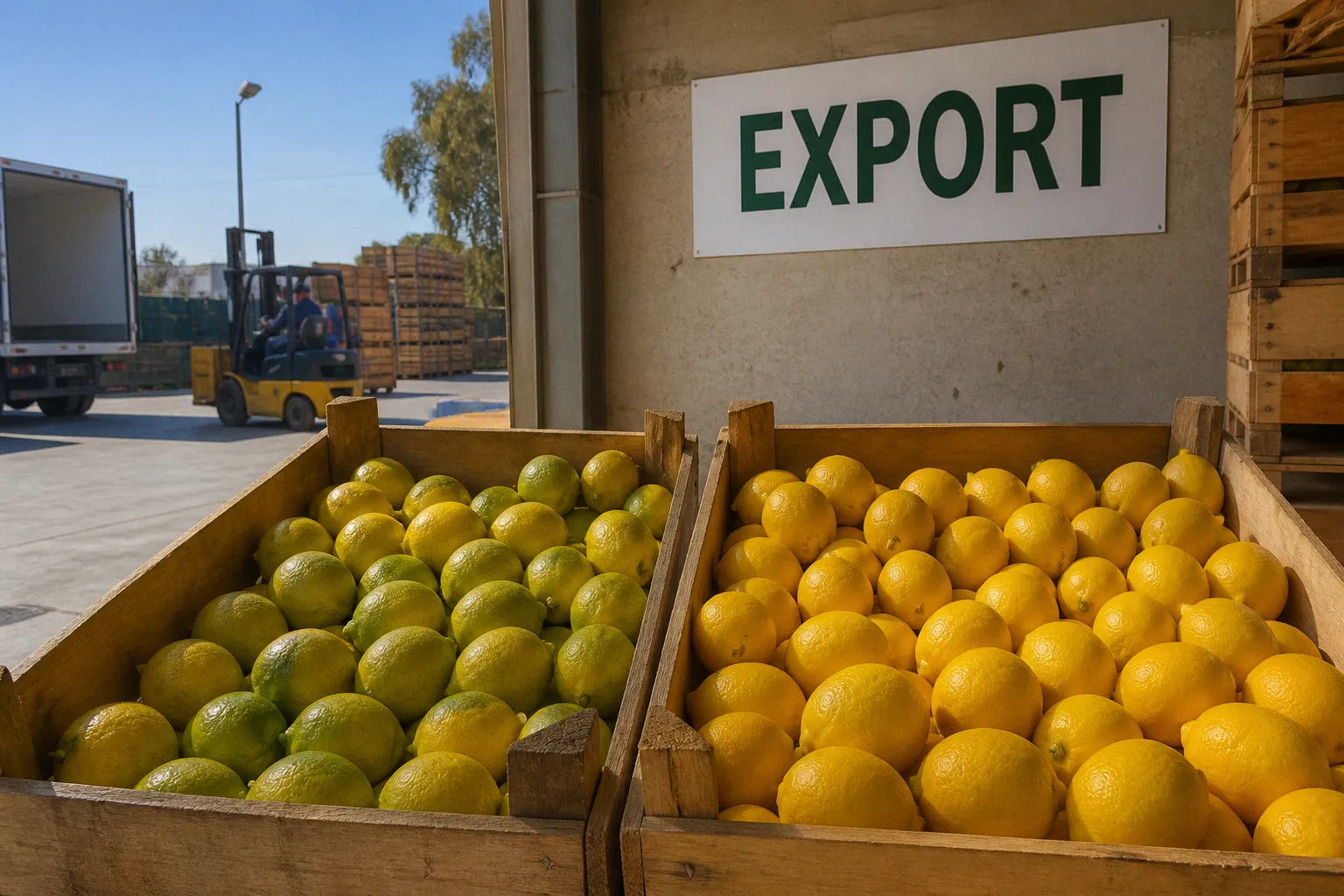
A citrus fruit can be physiologically mature while its peel is still green. That distinction matters along Lebanon’s coast, where oranges, mandarins, and clementines may reach acceptable internal maturity before the flavedo—the outer colored layer of the peel—has developed the uniform orange or yellow appearance expected by regional buyers.
This is where citrus degreening enters the export chain. In a controlled chamber, a carefully measured dose of ethylene breaks down the green chlorophyll in the peel and exposes carotenoid pigments that are already present. The fruit looks more mature from the outside, but the treatment does not create sweetness, juice, or internal maturity. It changes color. Nothing more—and that boundary is where good postharvest practice begins.
For Lebanese cooperatives selling into markets such as Iraq, Qatar, the United Arab Emirates, and Oman, appearance can influence how quickly a consignment is accepted, displayed, and sold. Yet a bright peel cannot compensate for poor maturity, decay, dehydration, or weak cold-chain management. The useful comparison is therefore not simply green fruit before treatment and orange fruit after it. It is the difference between a controlled presentation step and an attempt to disguise fruit that was harvested too early.
The science of color: what changes before and after ethylene
In the field, peel color is an imperfect maturity indicator. Chlorophyll can remain in the flavedo after the fruit has developed sufficient soluble solids and juice content for its intended market. Temperature also affects the process. Citrus grown and harvested under warm conditions may retain a green appearance for longer, even when the internal quality is progressing normally.
Inside a degreening chamber, exogenous ethylene activates the natural response of the peel. Chlorophyll is degraded, and the yellow or orange carotenoids underneath become visible. The treatment does not manufacture those pigments and does not make an immature fruit mature from the inside.
That is the first point to establish when discussing Lebanese citrus degreening before and after: the visible change is real, but it is limited.
Before treatment, fruit may show:
- A green or green-yellow flavedo, sometimes with uneven color between individual fruits in the same lot.
- Acceptable internal quality despite an exterior that appears too green for the target market.
- Greater variation in appearance, particularly where orchards, cultivars, harvest dates, or exposure to temperature differ.
- A higher risk that buyers judge the lot by its surface color rather than by its internal measurements.
After correctly managed treatment, the same fruit may show:
- A more uniform orange or yellow peel.
- Reduced green coloration in the flavedo.
- Better visual consistency across cartons and pallets.
- No intended change in sweetness, juice content, total soluble solids, or titratable acidity.
The last point is often lost in commercial language. Degreening can improve the way citrus communicates its maturity to a buyer, but it does not improve the fruit’s eating quality. If a grower sends fruit into a chamber before it has reached the internal standard required for the destination, ethylene will reveal a better color on a fruit that is still poor to eat.
Degreening can reveal maturity that is already present; it cannot create the maturity that harvest missed.
A practical before-and-after comparison
| Parameter | Before degreening | After controlled degreening |
|---|---|---|
| Peel color | Green, green-yellow, or uneven | More uniform yellow or orange |
| Chlorophyll in flavedo | Still visible | Reduced through ethylene response |
| Carotenoid pigments | Present but masked | Exposed visually |
| Sweetness and juice content | Determined by harvest maturity | Intended to remain unchanged |
| Total soluble solids and acidity | Existing internal values | Not increased by the treatment |
| Export presentation | May appear inconsistent | Usually more visually consistent |
| Main quality risk | Buyer concern over green color | Decay, peel browning, or stem-end rot if conditions are excessive |
This is why the chamber should be treated as part of a quality system, not as a cosmetic rescue operation. Harvest timing, field maturity, handling, sanitation, packing, and temperature management still determine whether the fruit can withstand the export journey.
What a citrus degreening chamber in Lebanon must control
A degreening chamber is not simply a warm room into which fruit is placed with an ethylene source. The response depends on several linked variables: ethylene concentration, temperature, relative humidity, exposure time, and carbon dioxide removal. A weakness in any one of these can turn a useful color-management step into a source of postharvest loss.
Commercial conditions commonly fall within these ranges:
- Ethylene: 1 to 10 parts per million
- Temperature: 20°C to 29°C, depending on cultivar and local operating conditions
- Relative humidity: 90% to 95%
- Exposure time: 24 to 72 hours, with longer exposure—up to approximately 96 hours—as an upper limit rather than a routine target
- Carbon dioxide: below 0.1%
These are operating ranges, not a recipe that can be applied without adjustment. Mandarins, clementines, and oranges do not always respond at the same speed. Fruit maturity, peel condition, loading density, chamber airflow, and the temperature of the fruit at entry all influence the result.
A cooperative packinghouse should therefore record the treatment as a process with inputs and outputs. At minimum, the batch record should connect:
1. Orchard and harvest information
Identify the grower, block, cultivar, harvest date, and lot. This makes it possible to compare chamber behavior with field maturity and later investigate problems.
2. Pre-treatment condition
Fruit should be inspected for cuts, abrasions, bruising, calyx damage, visible mold, and signs of dehydration. Ethylene does not repair damaged peel. It may make the damage more difficult to see until decay develops.
3. Chamber conditions
Record the temperature, relative humidity, ethylene concentration, ventilation pattern, and treatment duration. A chamber display is not enough if it does not represent conditions throughout the load.
4. Post-treatment assessment
Check color uniformity, firmness, weight loss, calyx condition, peel browning, and early signs of decay before packing or dispatch.
The practical question is not whether fruit has become orange. It is whether the fruit became orange without paying for that color with reduced shelf life.
Temperature is not a shortcut
The temperature range is broad because citrus cultivars and facilities differ, but higher is not automatically faster or better. Warmer conditions can intensify the ethylene response, yet they may also increase moisture loss and accelerate physiological deterioration. The chamber must be warm enough for the peel to respond while remaining within a controlled environment that does not drive the fruit toward decay.
Fruit entering the chamber at uneven temperatures can also produce an uneven result. One section of a pallet may respond quickly while another remains green, particularly if air movement is poor. The temptation is then to extend the treatment. That can expose already responsive fruit to unnecessary stress while the slowest fruit still fails to meet the desired color.
This is a distribution problem, not simply a time problem. Better airflow, more uniform loading, and more consistent fruit temperature may do more than adding ethylene or extending the cycle.
Humidity protects appearance, but excess moisture has consequences
Relative humidity between 90% and 95% helps reduce water loss during treatment. Citrus loses weight through its peel, and dehydration can leave fruit less resilient during storage and transport. However, a humid chamber also demands strong sanitation and air management.
High humidity on its own is not a substitute for clean handling. Wet surfaces, contaminated equipment, damaged fruit, and poor circulation can create conditions in which green mold and other decay organisms spread rapidly. A chamber that preserves turgidity but neglects hygiene is not protecting quality; it is preserving the conditions for a larger problem.
Carbon dioxide and ventilation: the quiet controls behind uniform color
Ethylene is usually the visible headline in a degreening discussion. Carbon dioxide is the quieter variable, but it can determine whether the treatment works consistently.
As fruit respires in an enclosed chamber, carbon dioxide accumulates. Concentrations should remain below 0.1%, because elevated carbon dioxide inhibits the biological response of the citrus peel to ethylene. If ventilation is poorly controlled, operators may respond to slow degreening by increasing the ethylene dose or extending the exposure period. That treats the symptom and worsens the risk.
A well-managed chamber balances two needs:
- It retains enough ethylene for the peel to respond.
- It removes excess carbon dioxide and manages heat without stripping the chamber of humidity or causing abrupt temperature changes.
This requires controlled ventilation rather than simply leaving a door open or running an extraction fan continuously. Uncontrolled air exchange can create concentration gradients, dry the fruit, and make conditions differ sharply between the centre and edges of the load.
For a Lebanese cooperative working with mixed volumes from several farms, chamber loading deserves particular attention. A smaller load may respond differently from a tightly packed commercial load. Pallets can obstruct airflow, and cartons can create sheltered zones where color development lags. If the same programme is applied to every load regardless of density and cultivar, the results will eventually show up as patchy color, excessive exposure, or both.
Useful observations during and after a cycle include:
- Whether the peel color is changing evenly across the chamber, not only on the outer cartons.
- Whether fruit near fans or vents is drying faster than fruit in the centre.
- Whether calyxes are browning or appearing unusually dry.
- Whether condensation is forming on surfaces or fruit.
- Whether the CO₂ level is rising during the cycle.
- Whether the lot needs more time because it is genuinely slow to respond, or because air exchange and loading are poorly balanced.
These observations are basic, but they connect chamber science to the physical realities of a packinghouse. The best equipment cannot compensate for a process that is not being observed.
The common failure: treating green fruit as unfinished fruit
The most serious misconception is that ethylene can turn early-harvested green citrus into fully mature export fruit. It cannot.
An early harvest may produce fruit with insufficient soluble solids, unsuitable acidity, lower juice content, weak eating quality, or poor storage performance. Degreening can remove the green appearance while leaving those internal limitations unchanged. The result is a consignment that looks ready at the receiving dock but disappoints once opened.
This creates a particular risk for exporters responding to narrow market windows. A buyer may request a certain external color by a certain shipping date. The commercial pressure is understandable: fruit that remains visibly green may be harder to position, even when the orchard has produced a sound crop. But shortening the harvest decision to match a color target moves the problem from the field into the supply chain.
The correct sequence is the reverse:
1. Establish that the fruit has reached the internal maturity required for its destination.
2. Harvest and handle it carefully enough to preserve peel and calyx condition.
3. Use degreening only to manage external color where the cultivar and market justify it.
4. Pack and ship under conditions that protect the resulting quality.
The chamber is a finishing tool. It is not a substitute for orchard maturity testing.
Why too much ethylene causes damage
More ethylene does not necessarily mean better or faster degreening. Exposing citrus to concentrations above the recommended range, or holding fruit too long, increases the risk of:
- Stem-end rot.
- Green mold caused by Penicillium digitatum.
- Peel browning.
- Calyx senescence and browning.
- Accelerated weight loss.
- Faster general decay.
The danger is that the first visual result may look successful. The fruit becomes more orange, and the operation appears to have worked. Damage may emerge later, during storage, transport, or at the destination market. A treatment that produces attractive color for the first inspection but reduces shelf life is not a successful treatment for export.
This is where postharvest records become commercially useful. A cooperative should compare not only color scores but also arrival condition. If a lot consistently shows browning or stem-end rot after aggressive treatment, the remedy is not automatically another chemical or a longer chamber cycle. The investigation should return to harvest maturity, sanitation, ethylene level, temperature, exposure duration, humidity, ventilation, and transit time.
From peel color to export quality
Lebanese citrus exports primarily move toward regional Middle Eastern and Gulf markets, where oranges, mandarins, and clementines are important products from the coastal production areas. Each buyer may describe appearance expectations differently, but color uniformity is usually judged alongside fruit size, freedom from defects, firmness, packaging, traceability, and arrival condition.
That broader context matters because an attractive peel is only one part of export quality. A cooperative trying to meet market expectations should connect degreening to the full export pipeline:
- Harvest maturity: Internal quality must be established before treatment.
- Lot consistency: Mixed cultivars or harvest dates can produce uneven chamber responses.
- Sanitation: Clean bins, tools, water systems, and chamber surfaces reduce decay pressure.
- Traceability: Treatment records should remain linked to farm and harvest lots.
- Packaging: Cartons and pallet configuration should allow stable handling and adequate airflow.
- Temperature management: Degreening conditions are not the same as long-term storage conditions.
- Destination requirements: Buyer specifications should be confirmed before harvest rather than after packing.
- Arrival feedback: Complaints about green shoulders, browning, decay, or dehydration should be analysed by lot and treatment history.
Export certification is not simply a document added at the end of the process. It reflects whether the operation can demonstrate control over production, handling, treatment, and traceability. A chamber log will not solve a food-safety gap, but a missing chamber record can make it harder to explain how a lot was managed when quality problems arise.
For cooperatives, the advantage of a shared degreening facility is not only access to equipment. It is the possibility of standardising practice across growers. That requires a common intake procedure, defined maturity checks, cleaning schedules, operator training, and an agreed response when fruit does not behave as expected.
A small producer may not need a fully automated system to begin improving results. The more important early investment is measurement: reliable temperature and humidity monitoring, accurate ethylene control, CO₂ measurement, documented loading patterns, and consistent inspection after treatment. Automation is valuable when it improves repeatability. It is not valuable merely because it makes the chamber look modern.
The export standard is not orange peel at the chamber door. It is sound fruit that remains sound when the buyer opens the carton.
A seasonal transition plan for Lebanese citrus cooperatives
Degreening improvements are easiest to implement before the main harvest pressure arrives. A cooperative can use the season as a sequence of decisions rather than waiting for a single equipment upgrade.
Before harvest: establish what the market is asking for
Several weeks before the expected harvest window, speak with buyers about acceptable color, cultivar preferences, size range, packaging, and likely shipping schedule. Do not reduce the conversation to one phrase such as “fully orange.” Translate the request into measurable handling targets and confirm which characteristics are assessed on arrival.
At the same time:
- Separate cultivars and orchard blocks in the harvest plan.
- Review last season’s records for decay, dehydration, calyx browning, and color inconsistency.
- Inspect the chamber, sensors, ventilation, seals, fans, and cleaning procedures.
- Calibrate monitoring equipment before fruit begins entering the facility.
- Agree on who can change ethylene, temperature, or exposure settings.
At harvest: protect the peel before it reaches the chamber
Harvest crews should handle citrus as a living product, not as a durable object. Cuts, punctures, torn calyxes, and rough drops create entry points for decay. Fruit that arrives damaged will not become safer because its peel is later degreened.
Keep lots identifiable from the orchard through receiving, treatment, packing, and dispatch. If fruit from several growers is mixed before its condition is assessed, the cooperative loses the ability to see which harvest practices are driving later losses.
During degreening: control the process, not just the outcome
Use the established operating range as a starting point, then adjust only when observations justify it. Maintain ethylene within the controlled range, keep temperature appropriate for the cultivar and facility, preserve high relative humidity without creating wet conditions, and monitor CO₂ so that it remains below 0.1%.
Avoid extending a cycle simply because some fruit remains green. First ask whether the load is mixed, the fruit temperature is uneven, the chamber is overloaded, or ventilation is failing. A longer exposure may harm the fruit that has already responded.
After treatment: inspect for more than color
Before packing, assess whether the fruit is merely attractive or genuinely ready for shipment. Look for uniformity, firmness, dehydration, peel injury, calyx condition, and early decay. Keep treated lots separate when their histories or chamber conditions differ.
If the destination market allows it, retain a small representative sample for observation through the expected transport period. The purpose is not to create a laboratory study for its own sake. It is to learn whether the selected treatment protects quality after the fruit leaves Lebanon.
After the season: make the next cycle more predictable
Review the data while the details are still fresh. Which cultivars responded quickly? Which lots needed longer exposure? Where did browning or decay begin? Did problems cluster around a particular orchard, harvest date, loading pattern, or destination?
The answers should feed into the next season’s harvest plan and chamber programme. Over time, a cooperative can build cultivar-specific and lot-specific guidance based on its own conditions rather than copying a programme designed for another region, facility, or market.
Citrus degreening is a narrow intervention, but it sits at the intersection of field maturity, peel physiology, chamber engineering, and export presentation. Managed carefully, it can help Lebanese citrus reach regional buyers with a more consistent appearance. Managed carelessly, it can hide an early harvest and accelerate the very losses the treatment was meant to prevent.
The practical line is clear: harvest for internal quality, degreen for external uniformity, and judge success by the condition of the fruit at arrival—not by the color it shows when the chamber door opens.