Biochar Production: A Low-Cost Farm Implementation Plan
In Lebanese agriculture, a substantial share of farm biomass is treated as a disposal problem: orchard prunings are burned, crop residues are left to decompose unmanaged, and olive pomace accumulates near processing sites.
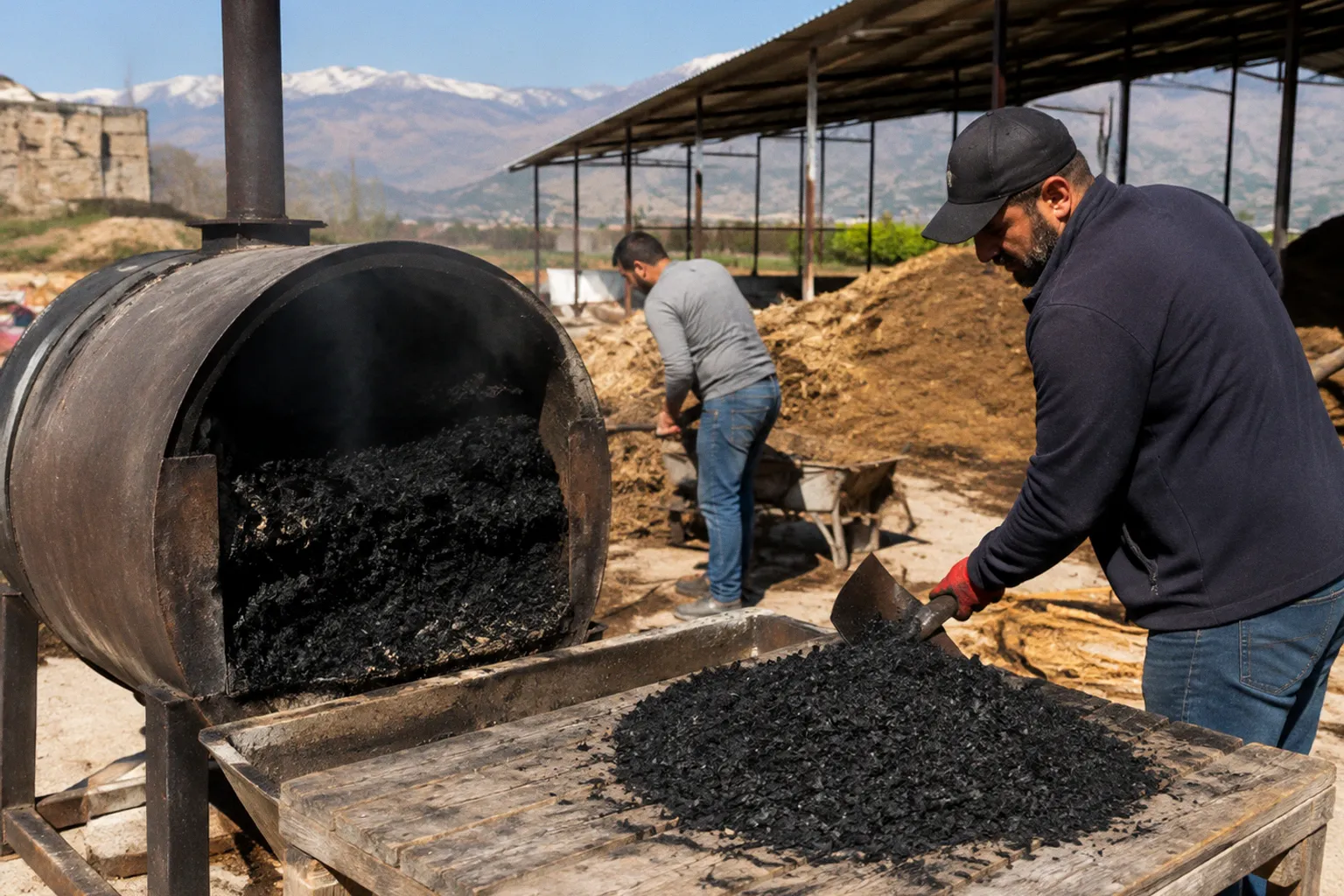
The alternative is not necessarily an industrial pyrolysis plant. For many small and medium-sized farms, on-farm biochar production can be implemented with a low-technology kiln, controlled feedstock preparation, and a soil application protocol that treats biochar as a carbon matrix rather than a substitute for fertilizer.
The technical case is straightforward. Pyrolysis converts dry biomass into a stable, carbon-rich material by heating it with limited oxygen. Depending on the feedstock, kiln design, process temperature, and residence time, the dry-weight yield is typically between 15% and 40%. The operational case is more conditional: wet biomass increases methane emissions, uncontrolled combustion destroys the carbon-management benefit, and raw biochar applied without nutrients may produce little immediate agronomic value.
For Lebanese cooperatives, particularly in the Bekaa Valley and other intensive agricultural regions, the correct question is not whether biochar is beneficial in the abstract. It is whether the farm can produce a consistent material, document its properties, and apply it at a rate compatible with soil, crop, and water-management objectives.
Turning Agricultural Residues into Stable Carbon
Biochar is produced through pyrolysis, the thermal decomposition of biomass in an oxygen-limited environment. Orchard prunings, wheat straw, corn cobs, stalks, potato or soy hay, and similar residues can serve as feedstock. The process removes many volatile compounds and leaves a stable carbon structure.
This distinguishes biochar from several materials that are often grouped together under the vague category of organic amendments:
- Compost is biologically decomposed organic matter containing active microbial populations and readily available nutrients.
- Ash is the mineral residue left after more complete combustion, with a very different chemical profile.
- Charcoal is a fuel-oriented carbon product and is not automatically suitable for soil application.
- Biochar is a soil amendment whose value depends on its porosity, stability, ash content, pH, nutrient condition, and interaction with the receiving soil.
The distinction matters because the farm’s objective may be different from the kiln’s output. If the goal is to reduce fertilizer purchases, the biochar must be charged with nutrients before application. If the goal is to reduce herbicide movement, the relevant property is sorption capacity. If the goal is carbon storage, stability and process control are more important than short-term nutrient release.
Research associated with the Lebanese University Faculty of Agriculture has examined the conversion of local organic waste into biochar as a way to reduce dependence on imported chemical fertilizers during Lebanon’s economic crisis. That work is relevant because it treats residue management and soil management as one system rather than as separate projects.
The available feedstock is also geographically practical. Lebanese orchards generate recurring volumes of prunings, while cereal and vegetable production produces stalks and other dry residues. Olive-processing waste adds another potential input, although its moisture, ash, and chemical characteristics require separate handling from dry wood residues.
Biochar is not a fertilizer product by default. It is a stable carbon framework that must be matched to a defined soil and nutrient-management objective.
A cooperative should therefore begin with a material-flow estimate rather than a kiln purchase. The first measurement is the annual dry mass of residues available within a realistic collection radius. The second is the fraction that can be collected without removing too much organic matter from the field. The third is the expected biochar yield. With yields commonly ranging from 15% to 40% of dry feedstock mass, a small farm should not assume that every tonne of residue becomes a tonne of soil amendment.
Technical Requirements for Efficient Pyrolysis
The most important operational variable is feedstock moisture. Flame-curtain kilns and conical soil pits can operate with relatively simple equipment because the rising pyrolysis gases burn in a flame curtain above the biomass. This reduces emissions compared with open residue burning when the feedstock is sufficiently dry and the operator maintains the process correctly.
The threshold is not cosmetic. Feedstock below 15% moisture is associated with substantially better combustion performance in flame-curtain systems. When moisture exceeds 40%, methane emissions can rise above 500 grams per kilogram of biochar. At that point, the kiln may still produce a black carbonaceous material, but its environmental balance is materially worse.
Drying therefore belongs in the production design, not in the category of optional preparation.
Feedstock preparation
A practical preparation sequence has five stages:
1. Separate the material by type. Keep woody prunings, straw, green residues, treated timber, plastics, and contaminated waste out of the same batch. The kiln should process known agricultural biomass, not an unsorted waste stream.
2. Reduce particle size where necessary. Large branches burn unevenly and create voids that interfere with heat transfer. Smaller, reasonably uniform pieces produce a more predictable batch, although excessive chipping adds energy and equipment requirements.
3. Dry the feedstock under cover or in a well-ventilated area. The objective is to reduce moisture while preventing rain reabsorption. A covered drying floor, raised platform, or ventilated shelter can be more valuable than a larger kiln.
4. Measure moisture consistently. A cooperative does not need laboratory instrumentation for every load, but it does need a repeatable method. Moisture readings should be recorded by feedstock category and linked to batch performance.
5. Exclude treated or contaminated materials. Painted wood, plastics, synthetic packaging, and residues contaminated with unknown chemicals should not enter a soil-amendment process.
The main capital expenditure is not always the kiln. Depending on the farm, it may be the drying area, chopping equipment, protective equipment, covered storage, or a simple weighing and record-keeping system. Ignoring these components produces a kiln that is technically functional but operationally underused.
Choosing the process
For smallholders, the main low-cost options are Kon-Tiki flame-curtain kilns and conical soil pits. Both rely on a controlled burn front and the combustion of pyrolysis gases. Their attraction is structural simplicity: they do not require a high-pressure reactor, complex gas-cleaning train, or continuous electrical supply.
They are not interchangeable in all circumstances.
| Parameter | Kon-Tiki flame-curtain kiln | Conical soil pit |
|---|---|---|
| Construction | Usually fabricated as a durable metal cone or similar vessel | Excavated directly into suitable ground |
| Mobility | Can be moved between farms or cooperative sites | Fixed to one location |
| Capital requirement | Requires fabrication or acquisition of the vessel | Lower cash requirement if excavation is feasible |
| Batch control | Easier to standardize between operators | More dependent on pit geometry and soil conditions |
| Site constraints | Needs a stable, level, non-combustible work area | Requires suitable soil, drainage, and safe access |
| Cooperative use | Better suited to shared scheduling and documented batches | Suitable for a permanent farm or collection point |
| Main operational risk | Poor loading sequence or wet feedstock | Moisture ingress, uneven airflow, and difficult batch retrieval |
The best choice depends on residue logistics. A mobile cooperative kiln has a stronger case where farms are dispersed and transport costs are significant. A pit may be rational where residues are concentrated at one permanent location and the site can be separated from buildings, irrigation equipment, and stored materials.
Building and Operating a Cooperative Kiln
A biochar kiln setup for Lebanese orchards should be designed as a controlled process area, not simply as a container in which agricultural waste is burned. The site needs a defined loading zone, a drying area, an extinguishing and cooling area, and covered storage for the finished material.
A practical implementation can be divided into four phases.
Phase one: establish the baseline
Before construction, record the current residue pathway for at least one production cycle:
- types and approximate quantities of residue generated;
- seasonal timing of pruning and harvest waste;
- current disposal method;
- fuel, labor, or transport used for disposal;
- fields where the finished biochar might be applied;
- soil constraints already identified through farm records or soil testing.
This baseline allows the cooperative to evaluate more than production volume. It can compare avoided residue handling, reduced open burning, fertilizer substitution after charging, and changes in irrigation response or soil chemical behavior.
The baseline should also identify whether residue removal could reduce soil cover or nutrient return. Not all biomass should leave the field. A farm that exports every residue to a kiln may produce biochar while weakening soil structure elsewhere.
Phase two: construct the process
The kiln should be placed on stable ground away from buildings, fuel storage, dry vegetation, and overhead obstructions. The operating area should allow the operator to load material without standing over an unstable flame front. Fire-control equipment and water should be available, but water should be used deliberately: the objective is to terminate the batch and cool the char, not to create uncontrolled runoff carrying ash and fine particles into drainage channels.
The kiln geometry must support the flame curtain. In practice, this means loading dry biomass in layers rather than dumping a heterogeneous pile into the vessel. Each layer should be allowed to establish combustion before the next layer is added. The operator’s task is to maintain a controlled combustion surface while limiting oxygen penetration into the lower material.
The process is complete when the available feedstock has been converted and the batch is quenched or otherwise cooled under controlled conditions. Uncontrolled exposure of hot char to air can convert the desired product into ash.
Phase three: document each batch
A cooperative needs batch records if it intends to supply more than one farm or connect biochar production to an export-oriented sustainability program. At minimum, record:
- feedstock type and estimated dry mass;
- measured or estimated moisture content;
- kiln type and batch date;
- operating duration;
- approximate biochar yield;
- visible contamination or abnormal ash formation;
- cooling method;
- storage location;
- field and application purpose.
The record does not need to resemble a laboratory report. Its purpose is traceability. If crop performance changes, the cooperative must know whether the change followed a different feedstock, a wetter batch, a new operator, or a different application rate.
Phase four: evaluate the soil response
Do not judge the project solely by the quantity of char produced. The relevant metrics are defined before application:
- soil moisture retention under comparable irrigation;
- fertilizer requirement for the same crop and yield target;
- herbicide movement or persistence where monitoring is available;
- soil pH and electrical conductivity;
- crop establishment and root-zone condition;
- labor and fuel used per batch;
- proportion of residue diverted from open burning.
The evaluation period should cover more than one irrigation event or harvest observation. Biochar interacts with soil texture, organic matter, pH, salinity, and existing nutrient status. A result from a sandy, low-organic-matter plot should not be generalized to a heavier soil without testing.
Charging Biochar Before Soil Application
Freshly produced biochar is not automatically agronomically active. Its porous structure can adsorb nutrients and dissolved compounds. If the material is applied raw and un-inoculated, it may temporarily compete with plants for access to some nutrients or simply remain chemically underutilized.
Charging, or inoculating, the biochar means loading it with nutrients and biological activity before incorporation. The method can involve mixing it with mature compost, compost extract, manure that has been properly handled, or another locally appropriate organic nutrient source. The purpose is not to turn biochar into a universal fertilizer. It is to prevent the amendment from entering the soil as an empty adsorption surface.
The correct charging method depends on the intended use:
- For fertility management, combine the char with compost or another nutrient-bearing organic material before application.
- For water-retention trials, use a consistent charged material across treated plots so that the effect of the carbon structure can be evaluated separately from the nutrient input.
- For herbicide-sorption objectives, document the amendment composition carefully because added organic matter can influence sorption independently of biochar.
- For orchard applications, keep the amendment out of direct contact with trunks and apply it within a defined root-zone management plan.
Application should be conservative during the first season. A cooperative can establish small comparison plots rather than treating an entire orchard. Use treated and untreated areas with similar irrigation, crop variety, and management. This is not a substitute for a replicated agronomic trial, but it is enough to detect whether the material creates an obvious pH, salinity, establishment, or irrigation problem before the program expands.
Biochar and agrochemical movement
The environmental value of biochar is not limited to carbon storage. Studies in the Litani River Basin have shown that adding biochar to soils and sediments can significantly increase sorption capacity for herbicides including Fluazifop, Terbuthylazine, and Triclopyr. In practical terms, a soil amended with suitable biochar may retain a larger share of these compounds rather than allowing them to move rapidly with water.
That result should be interpreted narrowly. Increased sorption is not the same as chemical destruction, and it does not remove the need for responsible herbicide selection, application timing, buffer management, and irrigation control. A compound retained in soil may remain biologically active for a different period. The farm should therefore treat biochar as one component of pesticide-loss reduction, not as a replacement for application discipline.
For farms in the Bekaa, this distinction is particularly relevant because irrigation, drainage, and river-basin connectivity make the movement of agrochemicals a landscape-level issue. The amendment can improve the soil’s retention capacity, but the farm still controls the loading rate.
Environmental Risks and Carbon Balance
Open residue burning is a poor benchmark, but it is still the benchmark against which many farms compare the kiln. Flame-curtain pyrolysis can reduce emissions relative to open burning when feedstock is dry and the operator maintains the process. Reported comparisons indicate reductions of approximately 35% in carbon monoxide emissions and 36% in methane emissions for Kon-Tiki kilns compared with open residue burning under the relevant operating conditions.
Those figures do not make the process zero-emission. The methane result is especially sensitive to moisture. Feedstock above 40% moisture can generate methane emissions exceeding 500 grams per kilogram of biochar. A cooperative that stores wet prunings in a compact pile and feeds them directly into the kiln may therefore undermine its own carbon objective.
The main controls are operational:
1. Dry the feedstock before pyrolysis. Moisture below 15% is the relevant target for low-methane operation in flame-curtain systems.
2. Avoid mixed loads with radically different moisture levels. Wet green material can destabilize a batch dominated by dry wood.
3. Do not treat smoke as a process metric. Visible smoke may indicate incomplete combustion, insufficient heat, poor loading, or wet feedstock.
4. Prevent post-process combustion. Hot char exposed to oxygen can become ash, reducing carbon retention.
5. Store the finished product under dry, covered conditions. Rain can alter the material and wash soluble ash components into the surrounding soil.
6. Keep fine particles out of waterways. Handling and quenching should not create sediment or ash runoff.
Carbon stability can also be evaluated through the hydrogen-to-carbon molar ratio. A target below 0.7 is used in carbon-stability standards, while flame-curtain kilns often produce material below 0.4 under suitable conditions. This is not a complete quality assessment, but it provides a useful indicator that the process has produced a relatively stable carbon structure rather than a lightly charred, unstable residue.
What the Investment Should Measure
The phrase “low-cost” describes the kiln concept, not the total system cost. A serious farm implementation includes labor, residue transport, drying space, maintenance, protective equipment, storage, soil testing, and record keeping. The capital expenditure may remain modest, but the operating discipline is not optional.
A cooperative should calculate the following before expanding beyond pilot scale:
- cost per dry tonne of feedstock processed;
- labor hours per batch;
- usable biochar yield;
- transport distance from farms to the kiln;
- percentage of batches meeting the moisture target;
- cost of charging materials;
- application labor and transport to fields;
- avoided residue disposal or burning costs;
- change in fertilizer requirement after charging;
- change in irrigation requirement or soil moisture behavior;
- cost per hectare treated.
The return on investment may come from several sources rather than one. A farm may receive a direct benefit from lower fertilizer use, a compliance benefit from reduced open burning, a soil-management benefit from improved water retention, and a watershed benefit from greater herbicide sorption. These benefits should not be combined into a single optimistic figure without measurement. If no baseline exists, the project has no defensible ROI calculation.
For cooperative management, a shared kiln is most rational when three conditions are present:
- residues are available in predictable seasonal volumes;
- several farms can coordinate drying, transport, and application;
- the cooperative can maintain a consistent batch record and quality protocol.
If those conditions are absent, a mobile or farm-scale process may still work, but the unit cost will be more sensitive to transport and labor. The lowest equipment price does not necessarily produce the lowest cost per tonne of usable amendment.
A Controlled Starting Point for Lebanese Farms
The most defensible starting model is a pilot covering a limited number of fields and one or two feedstock categories. Orchard prunings are generally easier to characterize than mixed vegetable residues, while olive pomace may require a separate drying and processing protocol. A pilot should not combine all available biomass simply because the kiln can accept it.
The sequence is clear:
1. Map residue availability and identify which material can be removed without damaging field nutrient cycling.
2. Build or select a Kon-Tiki kiln or conical pit according to site mobility, safety, and collection distance.
3. Create a drying and storage area before the first production batch.
4. Establish a moisture target and reject wet loads from standard production.
5. Record feedstock, process conditions, yield, and visible quality for every batch.
6. Charge the biochar before soil application rather than applying raw material as a fertilizer substitute.
7. Test the amendment on comparison plots with defined soil and irrigation measurements.
8. Expand only when the cooperative can demonstrate repeatable production and a measurable field response.
This approach is less impressive than installing a large reactor or claiming a rapid transition to regenerative agriculture. It is also more likely to survive the constraints of Lebanese farm infrastructure, imported-input costs, variable residue supply, and inconsistent water availability.
The numerical verdict is conditional but useful. A dry-feedstock flame-curtain system can convert approximately 15% to 40% of the original dry biomass into stable biochar, while operating below 15% moisture materially improves the emissions profile. With wet feedstock above 40%, methane emissions can exceed 500 grams per kilogram of biochar, which can reverse the environmental logic of the process. The investment therefore pays when the cooperative controls drying, records batch performance, charges the material correctly, and measures field outcomes.
Biochar production is not a shortcut around agronomy. It is a residue-to-soil infrastructure project. Its value in Lebanon will be determined less by the kiln’s purchase price than by whether the entire chain—from orchard pruning to documented soil application—operates with measurable control.