Beirut port agricultural cargo: 5 ways to prevent delays
A fresh-produce container does not become safe simply because customs has cleared it.
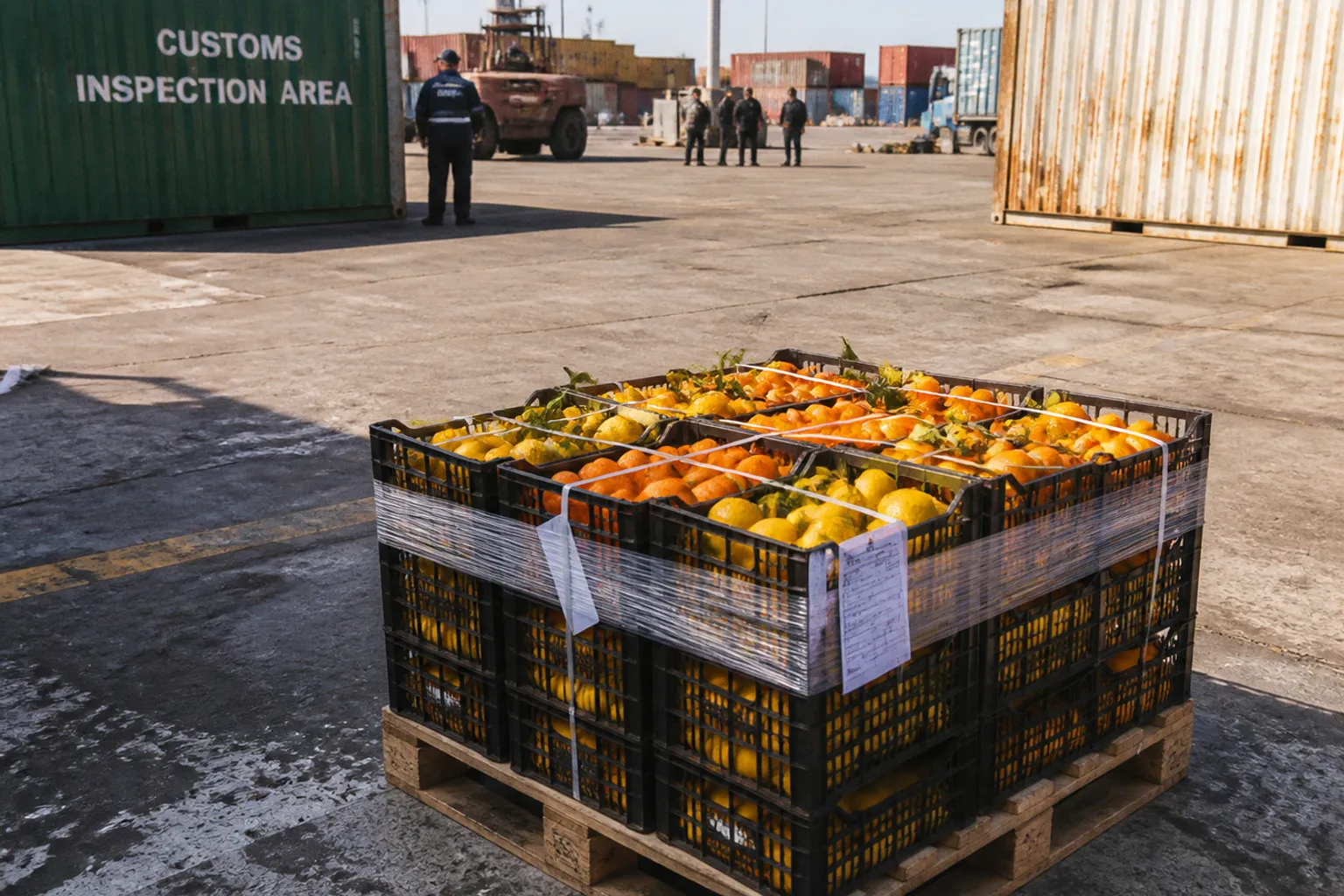
The critical handoff comes after clearance: the reefer still has to move through the terminal, meet the vessel cut-off, and remain within the temperature and quality limits agreed with the buyer. For a cooperative shipping on a narrow margin, a few hours of administrative delay can matter as much as the cost of the freight itself.
The route decision adds another layer. The land corridor through Masnaa and the sea route from Beirut serve different cargo profiles, transit times, and risk tolerances. But whichever lane an exporter chooses, the first operational question remains the same: can the documents, inspections, equipment, and transport be ready when the shipment reaches the port?
The answer is usually determined before the truck leaves the packing house.
1. File the pre-arrival customs declaration before the truck rolls
The Lebanese Customs Pre-Arrival Declaration system allows registered companies with the required Privilege certificate to submit documentation before the container physically reaches the terminal. An authorized customs clearance agent or licensed forwarder can file the Single Customs Declaration and begin the administrative process while the reefer is still moving toward Beirut.
That can reduce avoidable waiting, but it is not an automatic pass through the inspection yard. Customs may still request clarification, examine the cargo, or hold the file if the declaration does not match the shipment. Pre-arrival filing changes the timing of the paperwork; it does not remove the underlying customs requirements.
The practical objective is to make the file complete enough that the authorities can review it before the container arrives, while leaving room for any questions that arise during processing.
What the exporter should prepare
- Confirm that the cooperative or exporting company holds a valid Privilege certificate and that its customs registration details are current. If the certificate or authorization needs renewal, do not wait until harvest week.
- Use a licensed forwarder or customs clearance agent familiar with the Beirut terminal and the relevant agricultural documents. The agent should know who is responsible for each attachment and how corrections are handled.
- Prepare the Single Customs Declaration, commercial invoice, packing list, certificate of origin, transport document, and any required agricultural or health certificates as one coordinated file.
- Check the HS classification for each product before submission. Fresh produce can include several varieties, grades, or forms of presentation, and the classification should reflect what is actually being shipped.
- Keep the declaration, invoice, packing list, and certificates aligned on product description, quantities, consignee, country of origin, and packaging.
- Ask the forwarder to confirm the status of the pre-arrival file and identify any outstanding question before the truck is dispatched.
The timing of submission should be coordinated with the shipping line, terminal, and forwarder rather than treated as a fixed universal window. Processing times may vary according to workload, inspection requirements, system availability, and the completeness of the file. A pre-filed declaration is useful precisely because it gives the authorities time to work on the documents; it should not be presented as a guaranteed way to bypass a queue.
Pre-arrival filing can move administrative work forward. It cannot make an incomplete declaration complete, and it cannot replace an inspection when customs requires one.
A good forwarder will also distinguish between a file that has been submitted and a file that has been accepted for processing. Those are not necessarily the same status. The exporter needs to know whether customs has received the declaration, whether the attachments are readable and complete, and whether any amendment has been requested.
2. Coordinate phytosanitary compliance with LARI testing
Agricultural cargo often loses time before it reaches the port because certification and laboratory work were treated as final paperwork rather than as part of the production schedule.
For consignments that require a phytosanitary certificate, the certificate issued by the Ministry of Agriculture must correspond to the actual lot being exported. LARI testing may support the certification process through residue, pesticide, or other relevant analyses. The exact documents and tests depend on the commodity, the destination market, and the applicable import requirements, so the exporter should confirm the required sequence with the Ministry of Agriculture, LARI, and the destination-side buyer or broker.
The important point is coordination. A certificate cannot solve a sampling problem, and a laboratory result cannot repair a shipment whose lot identity has become unclear.
Build the laboratory step into the harvest plan
Start by confirming the required tests and sampling procedure before the harvest date is fixed. The cooperative should know:
- which lots will be sampled;
- who is authorized to take or submit the samples;
- how the samples will be identified;
- which records must accompany them;
- what result or certificate is required for the destination;
- how long the process may take under current laboratory and inspection conditions.
Do not assume that all products follow the same path. Stone fruit, citrus, leafy vegetables, and other categories may face different buyer specifications and destination-country controls. A timetable that works for one crop may be unsuitable for another.
Pre-harvest coordination with the Ministry of Agriculture can also prevent a late request for an inspection. If an inspection or field report is part of the certification process, schedule it early enough to leave time for corrections, additional sampling, or a change in the shipping plan. The exporter should not discover at the packing house that the certificate requires information no one collected in the field.
Keep lot identity intact
The link between the laboratory result and the exported consignment must be clear. Use the same lot codes across the farm or cooperative records, sample submission, packing-house records, laboratory report, phytosanitary application, invoice, and packing list. If fruit from several growers is consolidated, document how those lots were combined and how the final shipment can be traced back to them.
This is more useful than relying on a single reference number printed on one certificate. The available requirements may call for consistency between the certificate and the LARI results, but that does not by itself establish that a laboratory reference must be printed on the phytosanitary certificate or that officers routinely cross-check it in a particular format. The safer approach is to keep the complete supporting file available and make sure the identifiers used by the authorities are consistent.
If a test result raises a question, the exporter should be able to show the sampling record, treatment history, lot composition, and correspondence with the relevant authority. That does not guarantee release, but it gives the authorities a usable record instead of forcing them to reconstruct the shipment from disconnected documents.
Leave room between certification and loading
A certificate issued immediately before loading may be valid, but it leaves little room for a correction, an amended destination, a delayed truck, or a change in vessel booking. Plan the certification and loading sequence with a practical buffer where the commodity and destination rules allow it. The right buffer is not a universal number; it depends on certificate validity, testing requirements, crop life, vessel schedule, and the time needed to deliver the original or accepted electronic documents.
The decision should be made with the forwarder and the agricultural authority, not by copying a fixed number of hours from another shipment.
3. Prepare for NAJM and CAMA disruptions without treating them as the plan
Digital systems have made customs and port coordination more manageable, but they have also concentrated the workflow in a small number of platforms. When a customs database or port portal is unavailable, a shipment may be fully compliant and still unable to progress through the normal sequence.
NAJM and CAMA are therefore part of the operational risk map for Beirut cargo. A system outage, degraded connection, login problem, or delay in transmitting an attachment can affect the relationship between the customs declaration, the terminal record, the forwarder, and the cargo release.
The sensible response is not to assume that every outage will last a particular number of hours. It is to prepare a documented fallback procedure.
Keep a usable paper and digital duplicate
For every shipment, the forwarder and exporter should hold the same current document set, including:
- the customs declaration and submission record;
- commercial invoice and packing list;
- transport and booking documents;
- certificate of origin;
- phytosanitary or health documentation, where required;
- LARI reports and supporting lot records;
- contact details for the cooperative, forwarder, driver, shipping line, and relevant authorities.
The duplicate should be easy to print and easy to identify. A folder of scans with inconsistent file names is not a contingency system. Use a clear shipment reference and keep the latest amended versions together. If the normal platform becomes unavailable, the forwarder can then present a coherent file and ask which alternative process the authorities are accepting.
That alternative process must come from customs or the port operator. A paper copy does not authorize an exporter to bypass the digital procedure, and an informal workaround may create a second documentation problem.
Build contingency into the booking decision
A contingency buffer is valuable, but it should be designed around the product rather than applied mechanically. A day of additional terminal or reefer exposure may be tolerable for one commodity and commercially destructive for another. Before booking, compare:
- the vessel cut-off and next available sailing;
- the reefer’s safe holding conditions;
- the terminal’s storage and plug-in arrangements;
- the buyer’s quality tolerance;
- the cost of rebooking or missed loading;
- the availability of an alternative land route.
The forwarder should explain what happens if the system is unavailable during submission, inspection, payment, or release. Those are different failure points and may have different responses.
A fallback file is not a substitute for the customs system. It is what lets the exporter respond quickly when the normal route is interrupted.
Do not rely only on public reports to understand the status of a shipment. The exporter needs a named contact who can confirm whether the problem affects the declaration, the terminal release, the inspection record, or the vessel booking. That distinction determines the next action.
4. Protect the post-clearance loading window
For shipments subject to a 24-hour post-clearance loading requirement or operating window, the clock should be treated as a coordination problem, not as spare time. Customs clearance is only one event in the sequence. The reefer may still need to move from the inspection or storage area, receive terminal handling, connect to a plug, pass the relevant gate, and meet the carrier’s cut-off.
The exact timing of these steps can vary. The exporter should confirm the applicable rule and the booking conditions for the specific shipment rather than assume that every agricultural container is governed by an identical 24-hour rule. Where the window applies, the plan should be built backwards from the vessel cut-off.
Align the physical and administrative handoffs
Before dispatch, confirm:
- the vessel name, voyage, booking number, and cargo cut-off;
- the latest time by which customs clearance must be complete;
- the route from the packing house to the port;
- the truck and driver details;
- the terminal receiving instructions;
- the reefer plug-in or cold-storage arrangement;
- the person authorized to make decisions if the vessel schedule changes.
The reefer should arrive with the cargo already at the required pulp temperature for the product and destination. Pre-cooling at the port is not a reliable substitute for managing field heat and packing-house temperature before dispatch. The forwarder should also confirm how temperature records will be collected and who receives them if the container is inspected or held.
A booking is not fully protected merely because space has been reserved. The exporter needs to know the carrier’s documentation cut-off, terminal cut-off, and procedures for a late customs release. These may not be identical.
Treat terminal handling as a timed handoff
Ask the forwarder to map the movement after release: who collects the container, when the truck is called, where the reefer remains connected, and how the container reaches the loading point. If the plan depends on a cold-storage plug, confirm its availability rather than assuming that space will be found on arrival.
The same applies to inspection. If the cargo is selected for examination, the exporter needs a plan for opening, resealing, temperature protection, and document presentation. The objective is not to avoid a lawful inspection. It is to prevent an inspection from becoming an unplanned break in the cold chain.
Choose the route according to the product
The land route through Masnaa and the sea route from Beirut are not interchangeable. The 2026 routing picture described in the draft gives Lebanese exporters a choice between a shorter overland movement into Gulf markets and a longer sea movement with different handling and cost characteristics. The precise feasibility of either route depends on border conditions, destination requirements, carrier availability, and the commodity’s shelf life.
| Parameter | Sea route from Beirut | Land route through Masnaa |
|---|---|---|
| Transit profile | Longer movement with port and vessel handling | Shorter overland movement with border and inland handling |
| Main exposure | Vessel schedule, terminal dwell, weather, and port-system disruption | Border inspection, crossing conditions, and inland transport continuity |
| Documentation focus | Beirut customs, shipping line, terminal, and destination-port documents | Export documents, border formalities, vehicle documents, and destination controls |
| Better suited to | Cargo that can tolerate longer transit or benefits from consolidated sea freight | Time-sensitive or higher-value produce when the border route is operating reliably |
| Planning question | Can the shipment meet the vessel cut-off after clearance? | Can the truck and cargo complete the border sequence without damaging the cold chain? |
The draft’s six-day land and approximately fourteen-day sea comparisons should be treated as route assumptions, not guarantees for every shipment. They describe the planning difference between the lanes; they do not eliminate border closures, congestion, inspection, weather, or destination-side delays.
For premium stone fruit or other highly perishable cargo, the shorter route may protect value if it is available and properly documented. For regular consolidated citrus volumes, sea freight may remain the more practical option. The correct comparison is not transit time alone. It is transit time plus the probability and cost of an interruption.
5. Standardize the document set before customs sees it
A customs file can be delayed by a substantive compliance issue, but it can also be sent back for a discrepancy that should have been caught at the packing house. Product descriptions, quantities, consignee details, origin information, weights, and transport references must tell the same story across the file.
The basic set for an agricultural export may include:
- a commercial invoice with the product description, quantities, unit values, and agreed valuation terms;
- a detailed packing list showing cartons, pallets, net and gross weights, and lot identifiers;
- a bill of lading or land transport document with the consignee and shipment details;
- a certificate of origin issued by the appropriate chamber or authority;
- a phytosanitary or health certificate where required by the commodity and destination;
- LARI laboratory results and supporting records where they form part of the certification file;
- the Single Customs Declaration filed by the authorized agent;
- any permits, inspection records, or destination-specific documents requested for the shipment.
The exact set should be confirmed for the product and destination. A sea export and a land export will not always use identical transport documents, and an importing country may request documents beyond those needed for Lebanese export clearance.
Run one cross-check, not five separate reviews
Before dispatch, compare the documents line by line. At minimum, verify:
- exporter and consignee names;
- product name, variety, grade, and presentation;
- number of packages and pallets;
- net and gross weight;
- country of origin;
- lot or container references;
- HS classification;
- invoice value and stated delivery terms;
- certificate dates and validity;
- transport and booking references.
If the commercial invoice says one number of cartons and the packing list says another, the issue is not solved by having both documents. The file needs a controlled correction, with the amended version distributed to everyone using the earlier copy.
Photographing or scanning the final document set is sensible, particularly when multiple parties handle the shipment. Keep a record of the version submitted, the submission time, and any later amendment. That record helps the forwarder explain what changed if a system displays an older attachment.
Handle VAT and valuation as separate questions
Lebanon’s standard VAT rate is 11%, but that rate should not be placed on an agricultural export invoice automatically. The treatment of exports depends on the applicable Lebanese tax rules, the transaction structure, the destination, and the evidence required to support the treatment. Exporters should confirm the correct position with their customs agent and tax adviser before issuing the invoice.
This is separate from declaring the shipment value and the terms used for customs purposes. If the customs file requires a particular valuation basis, the exporter should provide the information in the format requested by Lebanese Customs and ensure that freight, insurance, and other relevant components are treated consistently. Do not use the standard VAT rate as a shortcut for deciding how an export invoice should be taxed.
A discrepancy in tax treatment or valuation may lead to a request for clarification, but it should not be described as an established or routinely frequent trigger for secondary inspection without supporting evidence. The practical rule is simpler: do not guess. Resolve the treatment before filing, document the advice received, and make sure the invoice and declaration use compatible information.
Keep certification references consistent, without inventing a format
LARI results, phytosanitary documents, lot records, and the customs declaration should be traceable to the same cargo. That does not mean an exporter should add a laboratory reference number to the phytosanitary certificate unless the issuing authority requires it. It means the exporter should retain the report, use the identifiers requested by the Ministry of Agriculture, and ensure that the documents cannot reasonably be mistaken for documents covering another lot.
If the certificate and laboratory report use different identifiers, ask the issuing authority or the clearance agent how the relationship should be recorded. Do not alter an official certificate yourself or add a reference merely because another exporter uses that format.
Make the five controls work as one process
The five measures are most effective when they are connected. A pre-arrival declaration cannot compensate for an unresolved phytosanitary requirement. A laboratory result cannot protect a shipment if the packing list identifies a different lot. A paper duplicate cannot create terminal capacity during a system outage. And a booked vessel is irrelevant if the reefer reaches the port after the relevant cut-off.
For each shipment, assign ownership before harvest:
1. Customs file: the clearance agent confirms the Privilege certificate, declaration status, HS classification, and outstanding questions.
2. Agricultural compliance: the cooperative confirms sampling, LARI documentation, Ministry of Agriculture requirements, and lot traceability.
3. Transport: the forwarder confirms the truck, route, terminal instructions, vessel or border cut-off, and contingency contacts.
4. Cold chain: the packing house confirms pulp temperature, reefer readiness, temperature records, and plug-in arrangements.
5. Document control: one person keeps the final submitted versions and records every amendment.
That is not a bureaucratic extra. It prevents the common failure in which each party has part of the file but nobody owns the complete shipment.
The most useful question before dispatch is not whether the cargo is technically ready. It is whether every handoff has a named person, a confirmed time, and a documented fallback. If the answer is no, the shipment is still exposed even when the produce is packed, the truck is booked, and the vessel space is reserved.
Beirut agricultural cargo moves on coordination. File early where the system allows it, but do not confuse early filing with guaranteed release. Arrange testing and certification around the harvest rather than after it. Keep a usable duplicate for system disruption. Work backwards from the applicable post-clearance and carrier cut-offs. Treat VAT, valuation, and certificate references as matters to confirm—not assumptions to copy into every invoice.
The cooperative that does this consistently is not relying on a lucky inspection day. It is reducing the number of unanswered questions that can stop a reefer between the packing house and the vessel.