Air freight logistics: 6 ways to secure Lebanese produce exports
anon's air cargo throughput contracted to 34 million ton-km in 2023, down 5.56% from the year before.
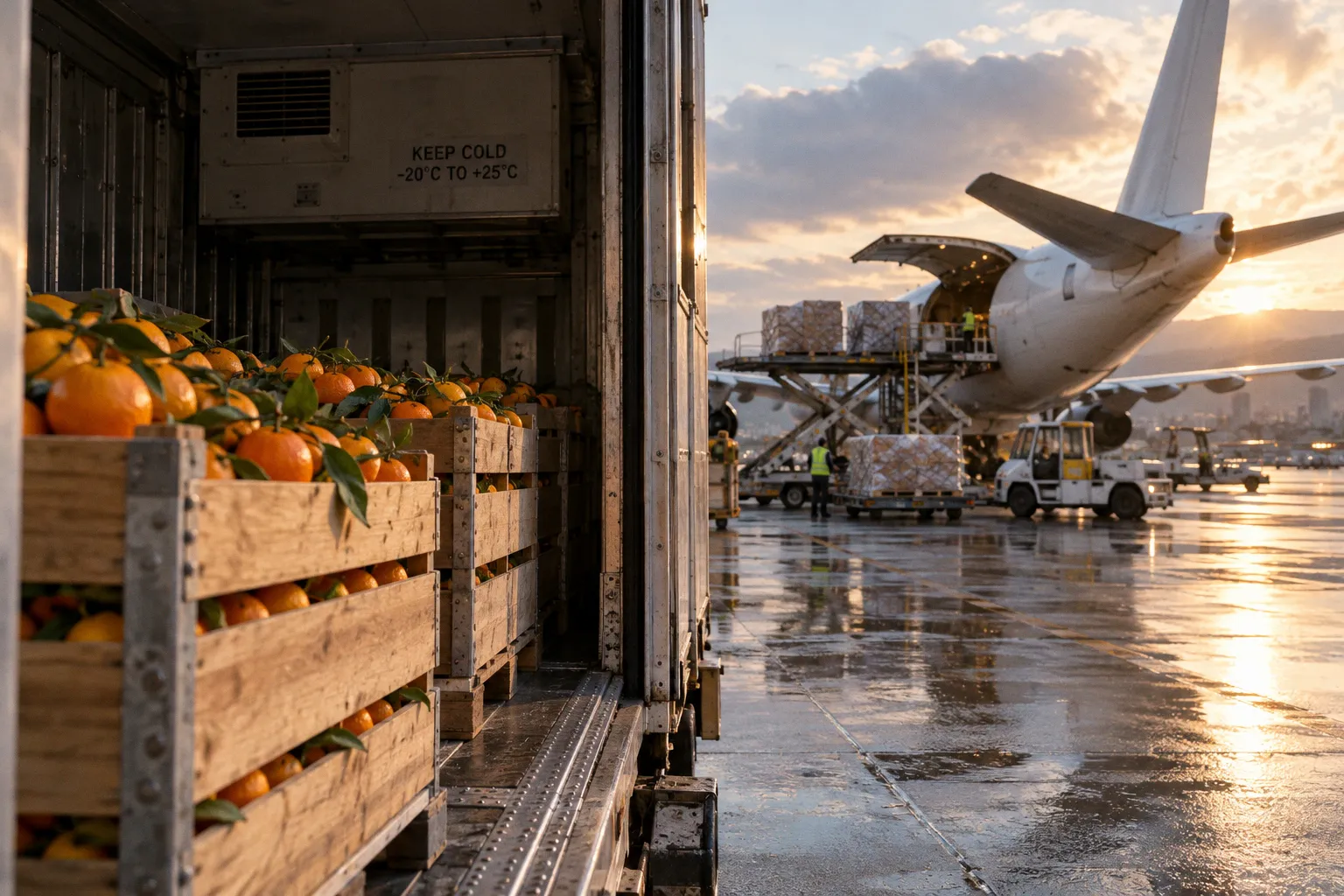
That contraction sits directly on top of an export pipeline moving roughly 500,000 tonnes of fresh fruit and vegetables annually — a category with zero tolerance for delayed slots or broken cold chain. If you move cherries, table grapes, avocados, or stone fruit out of Beirut, you are already operating in a tighter window than you were two seasons ago. The exporters who hold their margins are the ones who treat documentation, temperature control, and slot procurement as one integrated protocol — not three separate tasks.
This guide breaks down six operational moves that turn air freight from a recurring cost center into a reliable revenue channel for Lebanese perishable exports. No theory, no regional hand-waving. Six concrete actions you can run this season.
Lock Down Regulatory Standing Before You Move a Single Pallet
Air freight clears faster when the paperwork is already bulletproof. Two documents are non-negotiable on every Lebanese fresh produce shipment, and if either is missing your cargo sits on the tarmac until it is resolved — and your cold chain degrades by the hour.
- Phytosanitary Certificate: Issued by the Ministry of Agriculture after inspection of your consignment. Request it at least 72 hours before scheduled uplift. The certificate confirms your produce meets the importing country's plant health requirements — and for GCC destinations like Saudi Arabia and the UAE, this is your primary gate-pass.
- Certificate of Origin: Issued by your regional Chamber of Commerce, Industry and Agriculture. Customs uses this to confirm Lebanese origin, which matters for tariff treatment and preferential trade access under any bilateral framework.
Beyond these two, your operation needs a valid LIBNOR compliance posture. The Lebanese Standards Institution sets the national quality benchmarks your packhouse and grading line must meet. If you are shipping to premium buyers in Europe or the Gulf, LIBNOR alignment is not optional — it is the floor.
Treat documentation as a pre-flight checklist, not a customs afterthought. The hour your cargo sits in a hold awaiting a missing certificate is the hour your cold chain bleeds margin.
Health registration numbers, issued by the relevant ministry for agricultural and food products, must appear on your export packet. If you cannot produce the registration number on demand, you are not ready to ship.
Engineer the Cold Chain from Packhouse to Belly Hold
The validated refrigerated transport fleet operating in Lebanon covers a -20°C to +25°C window. That is your operational envelope, and it gives you flexibility — but flexibility without protocol is how cargo arrives soft at the destination dock.
Here is the sequence you need to enforce end-to-end:
1. Pre-cool immediately after harvest. Field heat is your worst enemy. Pull fruit core temperature down to target within four hours of picking. Anything longer starts the clock on remaining shelf life.
2. Load into validated reefer trucks at the packhouse. Do not break the chain at the farm gate. The truck that picks up your pallets must already be at operating temperature, not cooling down to setpoint in transit.
3. Transit to BEY under continuous temperature logging. Modern reefers carry data loggers. Pull the report at handover to your freight forwarder — that report is your insurance if a quality claim arises at destination.
4. Hand off at the airport cold store within the agreed slot window. BEY's perishable handling area runs on tight cut-off times. Miss your window and your pallets sit in ambient conditions while the next flight queues ahead of you.
The standard to hit: zero break in the temperature record between packhouse and aircraft hold. Anything beyond a minor, logged deviation is a quality risk you cannot pass downstream to a Gulf retailer or a European specialty buyer.
Stack Certifications That Open Premium Markets
LIBNOR gets you through Lebanese borders. GlobalGAP and ISO 22000 get you into the buyers who pay the premium rates.
- GlobalGAP is the certification GCC retailers and European importers increasingly require. It covers food safety, traceability, environmental management, and worker welfare across your production chain. Adoption among Lebanese exporters has accelerated specifically because Gulf buyers — particularly in Saudi Arabia and the UAE — filter their supplier lists on it.
- ISO 22000 is the food safety management system standard. It maps your HACCP protocols onto an internationally recognized framework. For buyers running their own audits, ISO 22000 shortens the supplier onboarding cycle and removes one more gate from your sales motion.
If you ship to both GCC and European destinations, the math on certification cost amortizes quickly. Two certifications, one audit cycle if you stage them properly, and you unlock buyer lists that un-certified competitors cannot reach.
Premium market access is not won at the trade show. It is won in the audit trail your packhouse produces every week of the season.
Run BEY Like a Scheduled Operation, Not a Hope
Beirut Rafic Hariri International Airport handles your air export lift, and it operates on airline-defined cut-off times that compress as flight schedules tighten. The 5.56% contraction in air cargo volume means slots are contested. Your operational discipline on the ground determines whether you make the flight or burn money on re-routing.
Operational protocol for BEY perishable export:
- Book cargo slots 48–72 hours ahead. Walk-up slots exist, but they cost a premium and they vanish during peak produce season when capacity is constrained.
- Pre-stage documentation with your nominated freight forwarder. The forwarder files your phytosanitary certificate, certificate of origin, and commercial invoice into the airline cargo system before your truck arrives at the airport gate.
- Use the airport's dedicated cold store for perishables. This facility exists specifically to maintain temperature integrity between landside handover and aircraft loading — bypass it and you are gambling your shipment's shelf life on ambient conditions.
- Confirm ULD assignment in advance. Whether your forwarder loads onto a standard air-freight pallet or into a refrigerated ULD (Unit Load Device), confirm the equipment is pre-conditioned to your target temperature before your cargo arrives for build-up.
If you treat BEY as a place where you drop off cargo and hope, you will pay for it in re-icing fees, rejected consignments, and lost buyer confidence.
Match Air Freight to the Cargo That Earns the Premium
This is where many Lebanese exporters make the structural mistake. Air freight is not a default mode — it is a strategic mode for cargo where the margin justifies the cost.
Ship by air when:
- Shelf life at destination is under 14 days from harvest. Cherries, certain berries, and high-end stone fruit qualify.
- The buyer pays a landed price that absorbs freight cost and still leaves margin. Premium Gulf retailers and European specialty distributors typically do.
- Volume per shipment is small enough that sea freight consolidation does not make economic sense. Under roughly 5 tonnes per consignment, air often wins on total landed cost once you factor in cold storage at destination ports.
Ship by sea or land transit when:
- Shelf life exceeds 21 days. Apples, potatoes, citrus — these move by reefer container via Mediterranean or Gulf ports.
- Volume justifies FCL (Full Container Load) consolidation. At 20+ tonnes per buyer, sea freight per kilo drops below air by an order of magnitude.
- The buyer contract does not require arrival within 72 hours of harvest.
The mistake to avoid: pushing low-margin, long-shelf-life cargo onto aircraft because the exporter does not have a working sea freight relationship. That is a margin leak disguised as a logistics decision.
Build the Cost Discipline That Holds Through Peak Season
Air freight rates fluctuate. Capacity is contracted. Your job is to control the variables you actually own.
| Cost Lever | Operational Action | Margin Impact |
|---|---|---|
| Documentation delays | Pre-stage all certificates before truck arrives at BEY | Eliminates per-hour demurrage and cold store holding fees |
| Cold chain breaks | Enforce packhouse-to-hold temperature logging | Reduces rejection rates and destination claims |
| Slot booking | Reserve 48–72 hours ahead through nominated forwarder | Locks in standard rates, avoids peak-season premiums |
| Certification stack | GlobalGAP + ISO 22000 audited in the same cycle | Opens premium buyer lists and amortizes audit cost |
| Mode selection | Match air freight to perishables under 14-day shelf life | Preserves margin on high-value cargo, routes low-value to sea |
Exports of fresh produce are generally zero-rated for VAT, which gives you a clean cost line on the customs side — but only if your documentation supports that zero-rating on file. Treat the export paperwork as part of your margin structure, not as a back-office task that gets handled after the truck is already moving.
Compliance Checklist Before Every Shipment
This is the operational floor. Run through it on every consignment, every time:
- Phytosanitary certificate requested from Ministry of Agriculture (minimum 72 hours pre-uplift)
- Certificate of Origin secured from regional Chamber of Commerce
- LIBNOR compliance documentation on file and current
- Health registration number confirmed and present on export packet
- GlobalGAP and ISO 22000 certificates current (if shipping to premium markets)
- Pre-cool cycle complete and core temperature logged
- Validated reefer truck dispatched at operating temperature
- Continuous temperature log report ready at BEY handover
- Cargo slot confirmed with airline 48–72 hours ahead
- ULD pre-conditioned to target temperature
- Cold store booking at BEY confirmed
- Commercial invoice and packing list aligned line-for-line with phytosanitary certificate
- Mode selection reviewed against shelf life and margin economics
Run the list. File the documentation. Lock the slot. Then ship.
The Lebanese fresh produce export pipeline runs on operational precision, not on optimism. Air freight is the mode for cargo that earns its place in the hold — and the exporters who treat every shipment as a protocol, not a project, are the ones still moving volume two seasons from now.