Phytosanitary certificates: a fast track for Lebanese exports
Lebanon produces roughly 180,000–200,000 metric tons of apples annually, with about 70% directed to export markets. At that scale, phytosanitary readiness is not paperwork finished after loading.
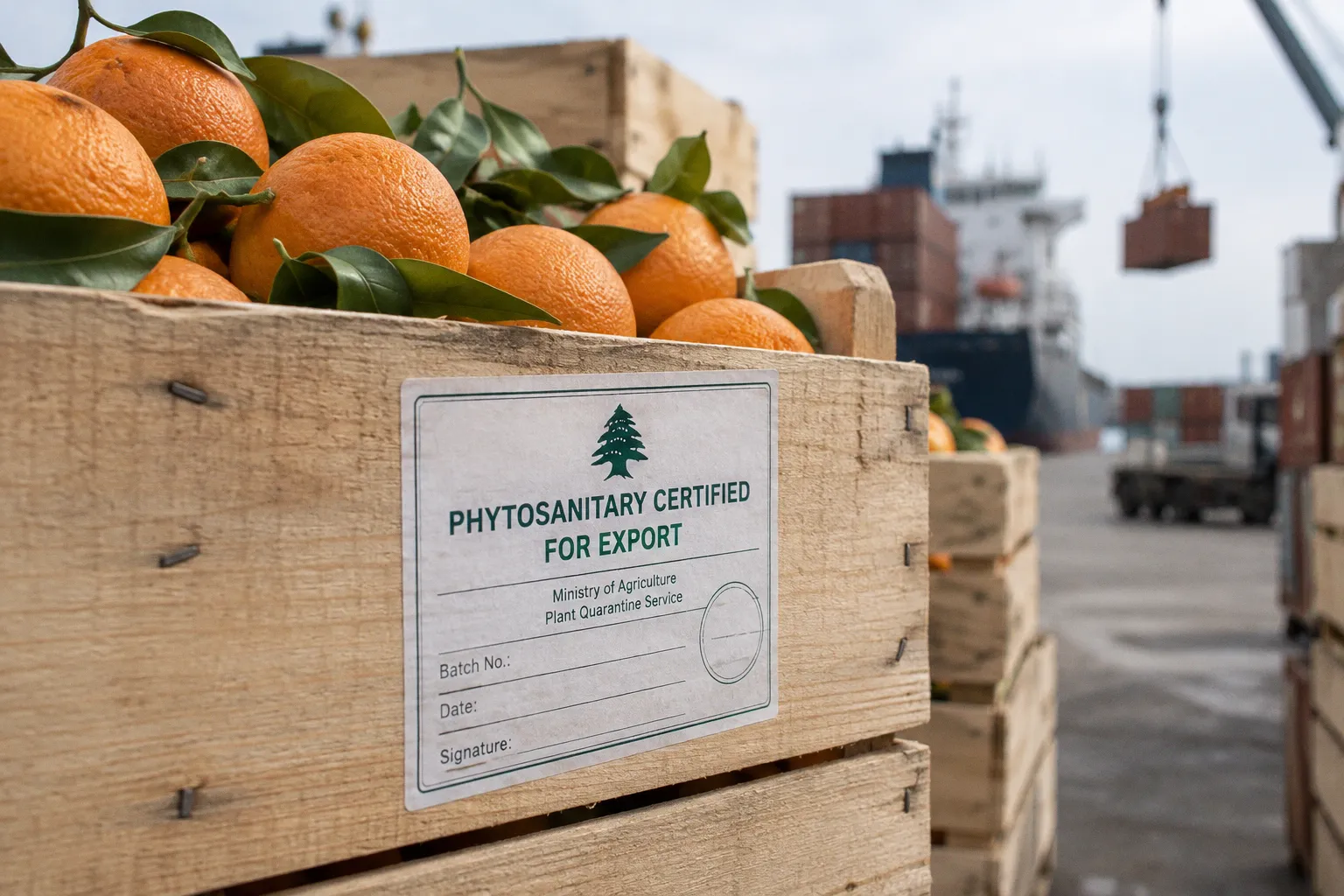
It is a production control that starts in the orchard and ends only when the shipment clears its destination.
The fastest exporters understand the sequence: identify the destination’s plant-health requirements, control the orchard, test the correct batch, pass physical inspection, and submit matching export documents. Skip one layer and the entire route slows down.
Fast-track compliance is not a shortcut. It is an evidence chain completed before the cargo reaches port.
1. Build the Multi-Stage Path to Phytosanitary Compliance
A phytosanitary certificate confirms that plant produce has been inspected and tested against applicable phytosanitary requirements. In Lebanon, the certificate is issued by the Ministry of Agriculture’s Import, Export and Plant Quarantine Service after the required inspection and laboratory work.
That sequence rules out a same-day workaround at the Port of Beirut. The certificate follows controls already completed upstream.
Build every shipment around this chain:
| Control point | Required action | Evidence carried into export file |
|---|---|---|
| Destination profile | Confirm the importing country’s requirements for the product, treatment, pests and testing | Destination-specific compliance sheet |
| Orchard control | Complete pest surveillance and manage crop inputs | Field logs, treatment records, input invoices |
| Batch identification | Fix the production batch, harvest dates, orchard and packhouse | Unique batch number and lot master |
| Laboratory testing | Submit the correct samples to LARI or another accredited national laboratory | Test report linked to that batch |
| Official inspection | Present the shipment for the physical inspection required for certification | Inspection clearance and consignment details |
| Documentation | Complete the phytosanitary and supporting export documents | Certificate set with matched references |
| Customs release | Present a consistent file to Lebanese Customs and port operators | Release-ready commercial and regulatory data |
The destination comes first. Do not begin with a generic certificate application and then ask the lab or inspector to reconstruct the shipment’s market requirements.
Your destination sheet should identify, at minimum:
- Importing country and final destination.
- Product, variety and intended use.
- Orchard or production area.
- Required pest surveillance.
- Applicable chemical and MRL controls.
- Sampling and testing requirements.
- Treatment or inspection conditions.
- Certificate and supporting-document requirements.
- Buyer-specific cut-off dates.
This sheet becomes the operational specification for the lot. If a requirement changes, trace the change back to the orchard, batch and shipment. Do not quietly carry an old requirement into a new booking.
Work backward from the transit window
Testing and certification must fit around the vessel, airline or land-transit cut-off. Because the cited rules do not provide one standard LARI turnaround time for every product, use the current service schedule confirmed directly with LARI and the Ministry of Agriculture. Do not build the export calendar around an assumed 24- or 48-hour laboratory result.
Use this decision rule:
- If testing, corrective action, inspection and certification fit before the transport cut-off: keep the lot on schedule.
- If they do not fit: move the booking or hold the lot. Do not manufacture a paper deadline that the evidence cannot meet.
- If a test or document fails: isolate the affected batch. Investigate before another sample is considered.
- If the destination changes: reopen the requirements check. The original export file may no longer match the new market.
A TEU slot, favorable freight rate or available reefer equipment has limited value if the cargo cannot obtain the required phytosanitary clearance. Book logistics around compliance cut-offs, not the reverse.
2. Start Orchard-Level Surveillance and Pest Management Early
The certificate is finished at the ministry or port, but the decision to release a lot begins with pest pressure in the field.
Lebanese fruit exporters must manage quarantine pests before harvest. Cherries bound for the EU, for example, require orchard monitoring for cherry fly infestation for three months before export. Apples headed into other destination programs also require pest surveillance and input controls matched to the applicable import requirements.
That monitoring period must be treated as an operational protocol, not a note added to the dossier when the shipment is nearly ready.
Use one orchard-to-packhouse control file
Create a master record for every production batch. It should connect:
- Grower and cooperative.
- Orchard and mapped production blocks.
- Planting and harvest dates.
- Crop treatments.
- Fertilizer and plant-protection products.
- Product names, active ingredients and application rates.
- Pre-harvest intervals.
- Pest scouting observations.
- Sampling dates.
- Harvest crews and collection records.
- Packhouse intake.
- Carton, pallet and container identities.
Use batch numbers that remain consistent from the field through laboratory testing, certification and shipment. If the number changes at the packhouse, the traceability chain breaks.
Do not wait for a laboratory result to start input control. A compliant post-harvest test cannot compensate for an orchard history that was never documented, and a late sample cannot establish that surveillance was completed across the required production period.
Run the orchard process as a fixed protocol
1. Lock the destination. Confirm the product-specific pest and testing rules before the monitoring calendar is set.
2. Assign orchard responsibility. Give one named team control of scouting records, treatments and exceptions.
3. Map the production area. Link each block to a grower, harvest period and batch identifier.
4. Record every input. Keep invoices, product labels, application dates, rates and operator details.
5. Review exceptions immediately. Investigate pest detections, missed applications and incorrect product use.
6. Harvest against the batch record. Prevent fruit from unregistered or unmonitored blocks entering the export lot.
7. Transfer the record to the packhouse. The receiving team should reject any intake without a valid lot identity.
Apply strict if-then controls:
- If a pest trigger is recorded: quarantine the affected block and follow the prescribed response before harvest.
- If a treatment record is missing: do not place that fruit into an export batch.
- If the three-month cherry monitoring requirement is not complete: do not position the cherries for EU export.
- If harvesting starts before the control window closes: change the lot status or shipment plan. Do not backdate field records.
- If the batch changes after testing: obtain a new control decision. Never transfer a pass from one production identity to another.
The practical objective is simple: when the inspector asks where the fruit came from and how it was controlled, you can produce the answer immediately.
3. Navigate LARI Laboratory Testing and MRL Standards
Laboratory testing is the bridge between orchard management and phytosanitary certification. The Lebanese Agricultural Research Institute, or LARI, conducts export-related laboratory analysis for chemical residues, microbial content and quarantine pests, as required for the product and destination.
Submitting a sample is not enough. The lab must test the correct material, and the result must remain linked to the same batch that will be presented for export.
| Test family | What it controls | Operational response |
|---|---|---|
| Chemical deposits and MRLs | Residues from crop-protection products and other inputs | Compare the result with the applicable destination requirement |
| Microbial content | Microbiological condition relevant to the shipment | Hold the lot if testing identifies a compliance issue |
| Quarantine pests | Plant pests of phytosanitary concern to the importing market | Prevent export until the prescribed control or disposition is completed |
MRL compliance starts with the destination
An MRL result is not a universal clearance. Use the limits and conditions applicable to the importing jurisdiction and the intended use of the produce. Keep the laboratory report, sampling record and destination requirement in the same file.
Before releasing a result into the shipment workflow, verify:
- Product and variety match the export product.
- Sample identifier matches the production batch.
- Orchard and production area match the field record.
- Harvest date falls within the tested batch.
- Destination and intended use are correct.
- Test date remains valid for the planned shipment.
- Packaging or treatment has not changed the batch identity.
If the report is clean but those identifiers do not match, the report does not control the cargo in your hand.
Use a direct laboratory-to-inspection handoff
The laboratory result should feed directly into the phytosanitary application. The same batch number, commodity description, grower details and shipment information must appear in the lab file, inspection record, certificate application and transport documentation.
Avoid data recycling across lots. Copying an orchard name or certificate reference from a previous consignment is faster than rebuilding the file, but it creates the exact mismatch inspectors and customs officers are trained to detect.
For problem results, follow a controlled sequence:
- If an MRL or other result is outside the applicable requirement: stop release, isolate the lot and investigate the source of the issue.
- If the investigation requires corrective action: document the action and wait for the appropriate new sample or new-batch decision.
- If the result identifies a quarantine pest: follow the Ministry of Agriculture’s prescribed treatment, segregation or disposal route. Do not relabel affected fruit as a different lot.
- If the lab report is incomplete: keep the consignment on hold until the result is formally complete and linked to the batch.
- If the lot passes: proceed to official inspection, but do not treat the lab result as a substitute for that inspection.
The Ministry of Agriculture issues the phytosanitary certificate following inspection and laboratory testing; the lab report is not the certificate itself.
Budget carefully around this stage. The cited decision does not establish a standard certificate fee or one universal LARI turnaround time for all fresh produce. Obtain current charges and service timing before fixing the shipment date. Exact fees and laboratory capacity can change; an exporter’s cut-off should not.
4. Turn Batch Traceability into Three Months of Shipment Control
Lebanese Ministry of Agriculture Decision No. 1/255 creates a useful operational advantage: laboratory analysis reports for plant produce from one batch can remain valid for multiple exported shipments carrying the same batch number for up to three months.
That rule can reduce repeated testing only when the exporter controls the batch correctly. It is not a company-wide or annual testing exemption.
| Decision No. 1/255 element | What it means operationally |
|---|---|
| One production batch | The report remains tied to the batch from which the tested sample was drawn |
| Same batch number | Every shipment relying on the report must carry the matching production identity |
| Up to three months | The report may be reused within the permitted period, subject to the decision and shipment controls |
| Multiple shipments | Split consignments may draw on the same report when the batch identity remains valid |
| Not exporter-wide | Results cannot be applied across all farms, orchards or annual production |
| Not a permanent clearance | Each shipment must still satisfy the required inspection and documentation process |
Build a batch master before loading
Use one control sheet with the following fields:
- Batch number.
- Product and variety.
- Grower and cooperative.
- Orchard or production area.
- Planting and harvest dates.
- Treatment history.
- Packhouse.
- Intake and packing dates.
- LARI sample number.
- Laboratory report number and date.
- Quantity originally tested.
- Quantity packed.
- Carton and pallet range.
- Shipment or consignment number.
- Phytosanitary certificate number.
- Remaining quantity after each shipment.
This turns “three months of validity” into a live inventory control. You can see what the report covers, how much remains and whether another shipment is still tied to the same batch.
Do not overextend the report
The three-month period is a ceiling, not a reason to wait until the final days before shipment. Reuse saves time only when the record remains clean and current.
- If the batch number matches: confirm quantity, timing and shipment identity.
- If a new harvest begins: open a new batch control. Do not attach it to the earlier report.
- If the fruit moves to a different packhouse: verify whether the change affects batch identity. Default to a fresh control decision.
- If a new treatment is applied: review whether a new sample, waiting period or official approval is required.
- If the original lot is mixed with another lot: stop. Mixed produce needs a defined batch and testing position.
- If a portion is rejected or disposed of: update the quantity balance. Do not keep shipping against the original quantity.
- If the report reaches three months: close the reuse cycle. No automatic extension should be assumed.
The trap is treating the laboratory report as if it belongs to the exporter rather than the production batch. It belongs to the batch. Keep that distinction visible in every document, spreadsheet and packhouse label.
5. Complete the Documentation Beyond the Phytosanitary Certificate
The phytosanitary certificate is essential, but it is not the only document in the clearance file. A complete Lebanese agricultural export requires multiple records, and their data must align.
| Document or registration | Primary function | Control point |
|---|---|---|
| Phytosanitary Certificate | Confirms the plant consignment meets the applicable phytosanitary conditions | Issued by the Ministry of Agriculture’s Import, Export and Plant Quarantine Service after inspection and testing |
| Certificate of Origin | Establishes the origin of the goods | Issued or certified through the Regional Agricultural Service or Lebanese Customs, as applicable |
| Ministry of Health Registration number | Places the exporter or product within the required health-registration control | Confirm the correct number and authorized entity |
| Destination-specific health or free-sale certificate | Meets additional destination or buyer requirements | Confirm before shipment; requirements vary by market |
| Commercial invoice | Supports the transaction, product description and value | Match seller, buyer, quantity, weight and product description |
| Packing list | Identifies cartons, pallets, net and gross weights | Match the physical load and batch references |
| Transport document | Connects the cargo to the booking and route | Keep vessel, container, seal and consignment details consistent |
Do not treat every supporting document as identical in status. The phytosanitary certificate, certificate of origin and health-registration requirement serve different controls. The destination health or free-sale certificate belongs to the market profile. Commercial and transport records complete the operational chain.
Run customs clearance as a data-matching exercise
Lebanese Customs and port operators need a coherent consignment file. Errors create delay even when the underlying fruit is healthy.
Before submission, match these fields across the file:
- Exporter and grower names.
- Product and variety.
- Batch and laboratory report numbers.
- Quantity and unit.
- Net and gross weights.
- Number and type of packages.
- Origin.
- Destination.
- Transport reference.
- Container and seal numbers.
- Phytosanitary certificate details.
- Invoice value and currency.
- Health-registration number.
Use the following release sequence:
1. Pre-file the complete document set. Do not wait for the truck or container to reach the port.
2. Reconcile the physical load. Confirm carton counts, batch allocation and pallet identities.
3. Complete official inspection. Ensure the consignment presented matches the certificate application.
4. Obtain the phytosanitary certificate. Confirm that the certificate carries the correct batch, quantity and destination details.
5. Clear Customs and port controls. Keep the commercial, transport and regulatory files linked.
6. Archive the closed record. Retain the inspection, test, certificate and shipment evidence for the next batch review.
The Port of Beirut remains the downstream handoff, not the place to repair missing upstream evidence. A phytosanitary certificate cannot be treated as an instant port formality when the required orchard control, LARI analysis or inspection has not already been completed.
Keep LIBNOR and phytosanitary approval separate
LIBNOR standards may support product quality, grading or broader conformity controls. They do not automatically grant phytosanitary clearance. Sanitary and phytosanitary approval remains under the authority of the relevant Lebanese control process.
A practical exporter should run two parallel but non-interchangeable tracks:
- Quality and standards track: Verify applicable LIBNOR or buyer specifications, grades, packaging and labeling.
- Phytosanitary track: Verify destination pest controls, MRL requirements, LARI testing, official inspection and certification.
If the quality file passes but the phytosanitary file fails, the shipment is not export-ready. If the phytosanitary file passes but the product misses the buyer’s grade or packaging requirement, the commercial transaction is not secure. Both tracks need a green light.
The zero-surprise release gate
Every item below must be green before the consignment moves:
- Destination requirements are confirmed for the exact product and market.
- The production batch is unique, closed and traceable.
- Orchard surveillance and pest monitoring are complete.
- Treatment and input records match the batch.
- LARI analysis covers the correct sample and production batch.
- The result satisfies the applicable destination requirement.
- The laboratory report remains within its permitted period.
- The lot passes the required official inspection.
- The phytosanitary certificate matches the shipment.
- The Certificate of Origin and health-registration details are valid.
- Destination-specific health or free-sale documents are present.
- Invoice, packing list, transport record and customs data match.
- LIBNOR or buyer quality checks are complete separately.
- The reefer and transit plan is ready without weakening the compliance cut-off.
- Any exception has a documented Ministry of Agriculture, LARI or Customs disposition.
Do not load a shipment that cannot answer one question instantly: which exact batch do these lab results and certificates control?
The phytosanitary certificate is the final official output of a much larger control system. Start before harvest, test the correct batch, use Decision No. 1/255 within its limits, and keep every document tied to the same production identity.
Move fast on preparation. Hold the line on evidence. That is how Lebanese produce exporters turn phytosanitary compliance from a port bottleneck into a reliable route to market.