Compost tea brewing: a setup plan for Bekaa farms
A failed compost tea batch does not merely waste water and compost. It can turn into an anaerobic liquid with the wrong microbial profile, a food-safety liability, and a missed application window.
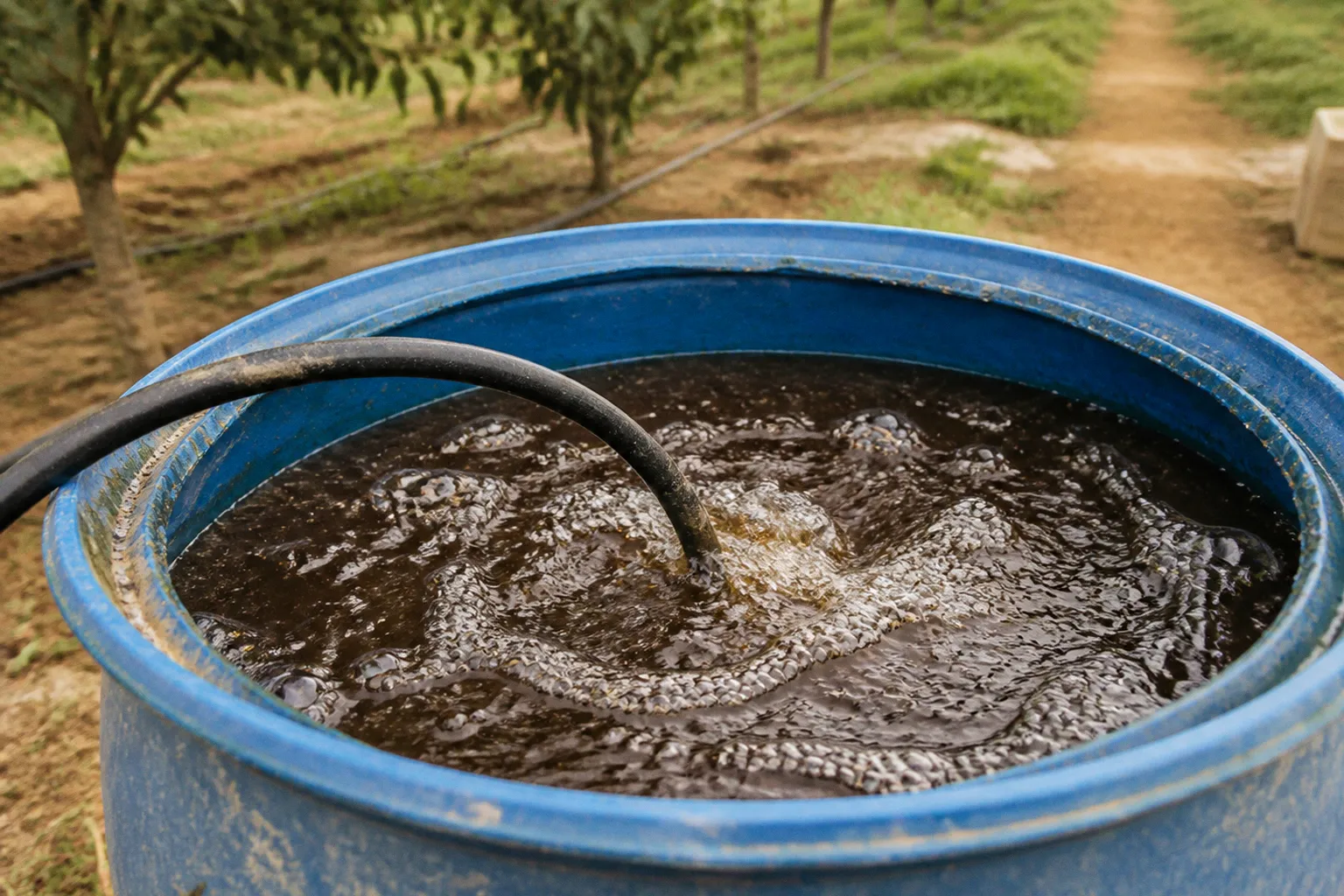
In the Bekaa Valley, where farms are already managing groundwater pressure and soil degradation across roughly 150,000 hectares, an aerated compost tea system must be run as a controlled biological process—not as a bucket with an air stone dropped into it.
The operating target is clear: keep dissolved oxygen above 6.0 ppm, brew for 24–48 hours, and apply the finished tea within four hours after aeration stops. Miss those windows and the system moves from useful aerobic biology toward an unstable, oxygen-depleted brew.
This is the operating plan for an organic compost tea brewer setup in Lebanon: equipment, water, compost, oxygen, food sources, application timing, and the controls that keep the batch usable.
Start with the batch requirement, not the brewer
The first mistake is buying equipment before deciding what the tea has to cover. A small nursery, a market garden, and a cooperative growing multiple hectares do not need the same batch architecture.
Build the system around three questions:
- Where will the tea go? Foliar application, soil drench, transplant establishment, or a combination?
- How much can the farm apply within four hours? The finished brew should not sit in a sealed tank waiting for the next workday.
- Can the farm supply clean, non-chlorinated water and finished compost for every batch?
If the answer to the second question is no, increase field labor and application capacity before increasing brew volume. A larger tank is not automatically a better system. It can simply produce more liquid that loses aerobic viability before it reaches the crop.
For a cooperative, the practical model is usually a shared brewing station with scheduled batch slots. One operator manages water and compost loading. A second team handles immediate application. If several member farms draw from the same batch, they need a dispatch plan: field order, tank or sprayer capacity, travel time, and the four-hour application window.
The correct brewer is the one that finishes a batch inside the farm’s application window. Everything else is equipment theatre.
The minimum viable system
An aerated compost tea system in the Bekaa needs:
1. A clean brewing vessel
Use a container that can be washed thoroughly and does not release residues into the water. The vessel needs enough access for loading compost, checking the liquid, cleaning the interior, and removing the finished tea.
2. Continuous aeration
The air pump must run throughout the 24–48-hour brewing cycle. The diffuser or air distribution system should keep the entire liquid volume moving and oxygenated rather than creating one strongly bubbling zone while the rest remains stagnant.
3. A dissolved oxygen measurement method
Bubble size is not a reliable oxygen reading. A brewer can look active while oxygen levels fall below the required threshold. The control point is dissolved oxygen above 6.0 ppm.
4. A finished compost or vermicompost source
The biological input must be mature and finished. Raw, un-composted animal manure does not belong in the system because of serious food-safety risks.
5. A clean transfer and application route
Hoses, pumps, strainers, sprayer tanks, and nozzles must not become bottlenecks after brewing. If the liquid cannot move quickly from vessel to field, the batch clock keeps running while the biology declines.
6. A wash-down area and drainage plan
This is agricultural equipment, not a decorative garden barrel. The work area needs to support repeatable cleaning without contaminating wells, packing zones, or produce-handling surfaces.
The equipment can be simple. The process cannot be casual.
Water quality controls the biology
Water is the first input to test because it determines whether the microbial population can develop under aerobic conditions. Use clean, non-chlorinated water. Chlorinated water can suppress the biological activity the brewer is meant to multiply.
If the farm relies on municipal supply, do not assume the water is ready simply because it is clear. Confirm whether residual disinfectants are present and establish a repeatable treatment or holding protocol before the water enters the brewer. If the farm uses groundwater, document the source and monitor changes rather than treating every batch as identical. The exact chemical profile can vary across Bekaa sub-districts, and there is no universal water recipe that substitutes for local testing.
The water protocol should be written on the tank:
- Source of water
- Date and time loaded
- Any dechlorination or conditioning step
- Starting water temperature, if monitored
- Batch volume
- Operator responsible for the batch
This is not bureaucratic overhead. It is the minimum traceability needed when one batch performs differently from the previous one.
Do not overload the brew with food
The food source is where many DIY compost tea brewer agriculture setups fail. Operators add more molasses because they expect more food to produce more microbes. The result can be the opposite.
Unsulfured molasses is commonly used as a microbial food source. A baseline ratio is 1–2 tablespoons per 5 gallons of water. Treat that as a starting point, not an invitation to increase the dose whenever the brew looks quiet.
Excessive food creates a rapid bacterial spike. That population consumes oxygen faster than the aeration system can replace it. Dissolved oxygen then falls, and the brew can move into anaerobic conditions before application.
Use an if-then protocol:
- If dissolved oxygen remains above 6.0 ppm, continue the scheduled brew and monitor the batch.
- If oxygen begins to fall, stop adding food. Check the pump, diffuser, air lines, and compost load before doing anything else.
- If aeration cannot restore oxygen, do not treat the batch as a successful AACT batch. Investigate, record, and clean the system before the next run.
- If the brew smells putrid, sulfurous, or strongly anaerobic, do not apply it to edible crops as though it were a compliant aerobic tea.
The operator should control the food input with a measured scoop. No free-pouring. No undocumented additions halfway through the cycle.
Compost quality is the second control point
Aeration will not rescue poor compost. The brewer multiplies organisms already present in the input; it does not convert raw material into finished compost.
Use high-quality finished compost or vermicompost with a stable structure and no visible raw manure. It should be mature enough to serve as a biological inoculum, not as an unresolved waste stream. Keep batches of compost identified by source and production date where possible. If several cooperative members contribute compost, do not mix all sources without a record. A poor batch can contaminate the operating baseline for everyone.
For a cooperative system, create an input acceptance rule:
- Reject raw or partially composted animal manure.
- Reject material with a strong putrefactive odor.
- Reject compost contaminated with plastic, chemical packaging, or unknown residues.
- Keep finished compost dry enough to handle and consistent enough to load.
- Record the source before it enters the brewer.
The goal is not to chase a laboratory-perfect microbial profile on every farm. The goal is to remove uncontrolled variables that make the batch impossible to interpret.
Use a removable compost chamber where possible
A removable mesh bag or compost basket simplifies loading and cleaning. The material must remain in contact with moving, oxygenated water, but the finished liquid should be transferable without carrying large solids into pumps and sprayers.
A coarse, washable mesh is more operationally useful than a fine bag that blocks flow. If the system clogs, aeration becomes uneven and downstream equipment fails. The compost chamber should be easy to lift, rinse, inspect, and return to service.
Do not design the system around a permanent layer of sediment at the bottom. That material becomes a cleaning problem and a potential anaerobic pocket.
The 24–48-hour brewing protocol
A reliable batch follows a fixed sequence. Do not improvise based on color, foam, or smell alone.
1. Clean before filling
Wash the vessel, compost chamber, hoses, diffuser, pump connections, and transfer equipment. Remove old residue. Organic material left from the previous batch can decompose in low-oxygen zones and distort the next run.
Cleaning is especially important when the same equipment serves both foliar applications and soil drenches. It is also essential when the farm supplies produce for export, where input records and food-safety controls must align with the rest of the production system.
2. Load non-chlorinated water
Fill the vessel with clean water. Leave enough operating space for agitation and the compost load. Avoid filling to the rim, where bubbling and transfer can create spills and uncontrolled contamination.
Start aeration before adding the biological inputs. Confirm that air reaches the full vessel rather than only one corner.
3. Add finished compost
Place the finished compost or vermicompost into the basket or mesh chamber. Keep the loading rate consistent from batch to batch. A cooperative should define its own standard loading procedure rather than letting each operator estimate by eye.
Record the compost source and the time it enters the water.
4. Add the food source carefully
Add the baseline molasses quantity only after measuring the water volume. Keep the process conservative. The system needs enough food to support microbial multiplication, not enough to create an oxygen crash.
Stir or distribute the input according to the equipment design, but do not stop aeration during the active cycle.
5. Brew under continuous aeration
Run the aeration continuously for 24–48 hours. Check the system at scheduled intervals:
- Dissolved oxygen
- Pump operation
- Airflow through the diffuser
- Water movement
- Foam or surface accumulation
- Odor
- Temperature, if the farm monitors it
- Any blockage in hoses or mesh
The decisive metric is dissolved oxygen. Keep it above 6.0 ppm. If the reading drops, treat that as a process failure signal, not a cosmetic variation.
6. Stop only when the batch is ready to deploy
Once aeration stops, the farm has approximately four hours to apply the tea. Do not switch off the pump at the end of the day and leave the sealed liquid for the next morning. Closed-container storage rapidly destroys the living aerobic microbial population.
Plan the field route before stopping aeration. The sprayer, tractor, labor, and destination fields should already be ready.
Foliar application and soil use require different logistics
The same batch may be used for foliar application and soil application, but the handling requirements are not identical.
Foliar application needs clean transfer, suitable filtration for the spray equipment, and timing that protects living microbes from direct ultraviolet exposure. Apply during early morning or evening. Midday application increases exposure to direct UV light and can reduce the living microbial population on the leaf surface.
For soil application, the delivery system may tolerate more suspended material, but that does not justify poor filtration or dirty equipment. Sediment can block pumps and nozzles, while uneven application creates inconsistent field results.
If the farm is using a backpack sprayer, a small cooperative sprayer, or a tractor-mounted tank, match the tea’s final filtration to the narrowest passage in the system. A brew that leaves the tank but blocks the nozzle is not operationally finished.
Application planning by field priority
When the brew volume is limited, use a priority sequence instead of spreading a weak dose across every field:
1. Newly transplanted crops where establishment is the immediate constraint.
2. Fields with visible soil structure or biological activity problems.
3. High-value crops with a defined foliar or soil application schedule.
4. Remaining acreage once the core treatment areas are covered.
Do not describe this as a replacement for irrigation, fertility management, or pest control. Compost tea is one biological input in a broader soil-health program. The agronomic result still depends on water management, compost quality, crop rotation, organic matter, and reduced disturbance.
For Bekaa farms facing groundwater over-extraction, the brewing program should sit beside moisture monitoring—not replace it. A tea application cannot compensate for irrigation that repeatedly exceeds crop demand.
Build the brewer for maintenance, not just for brewing
Most systems fail at the edges: clogged diffusers, dirty transfer lines, inaccessible tank bottoms, and operators who cannot see or measure what is happening inside the vessel.
The layout should make the correct action the easiest action.
Practical design requirements
- Put the brewing vessel close to the water source and the application equipment.
- Keep electrical connections protected from splash and standing water.
- Mount the air pump above the wet zone where possible.
- Make air lines short, visible, and easy to disconnect.
- Use hose diameters that do not create an unnecessary restriction between the tank and sprayer.
- Provide a drain or transfer point that allows the vessel to be emptied completely.
- Keep the wash-down area separate from produce washing and packing.
- Label the water, compost, molasses, and finished-batch tools.
- Store the dissolved oxygen meter and cleaning tools where the operator will use them, not in a locked office across the farm.
A cooperative should also keep one replacement diffuser, spare hose sections, clamps, and basic pump parts on hand. If the only diffuser fails during a 36-hour brew, the batch may be lost before a replacement arrives.
Batch records that actually matter
The record does not need to become a research paper. It needs to answer the questions that determine whether the batch was controlled:
| Parameter | Record for every batch | Why it matters |
|---|---|---|
| Water source | Source and treatment status | Chlorinated or inconsistent water can suppress activity |
| Batch volume | Actual volume loaded | Determines food ratio and application planning |
| Compost input | Source, type, and approximate load | Links performance to the biological input |
| Food source | Product and measured quantity | Excess food can trigger oxygen depletion |
| Brew duration | Start and stop time | Confirms the 24–48-hour cycle |
| Dissolved oxygen | Readings during the cycle | Confirms aerobic conditions above 6.0 ppm |
| Equipment status | Pump, diffuser, hoses, transfer route | Identifies mechanical causes of failure |
| Application | Field, crop, start time, finish time | Confirms use within four hours after aeration |
The four-hour rule is particularly important. Write the aeration stop time on a visible card attached to the tank. Write the application finish time when the batch is complete. If the batch cannot be applied within that window, redesign the operation before producing a larger volume.
Brew time is only half the schedule. The real deadline starts when aeration stops.
If-then controls for common failures
A practical system needs decisions that an operator can make without waiting for a consultant.
If the brew has little foam
Do not add more molasses automatically. Foam is not a validated measure of microbial quality. Check airflow, diffuser position, water condition, compost source, and dissolved oxygen. A visually quiet batch can still be oxygenated; a highly foamy batch can still be unstable.
If dissolved oxygen falls below 6.0 ppm
Stop treating the batch as compliant aerobic tea until the cause is identified. Inspect the pump and air distribution first. Then check whether too much food was added or the compost load is excessive for the vessel and aeration capacity.
If oxygen cannot be restored promptly, do not force the batch into the field. Record it as a failed or questionable batch, drain it according to the farm’s waste-management procedure, and clean the system.
If the brew smells sour or putrid
That is a red flag for anaerobic activity. Do not attempt to correct it by adding more air at the last minute and applying it to edible crops without a controlled assessment. The product is not equivalent to properly aerated compost tea.
If the sprayer clogs
Stop transfer. Do not increase pump pressure blindly. Check the compost mesh, sediment, hose, filter, and nozzle. Improve filtration and clean the application system before restarting. Repeated clogging usually indicates a design or loading problem, not bad luck.
If the farm misses the four-hour application window
Do not store the brew in a closed container and market it as biologically active aerobic tea. The aerobic microbial population declines rapidly under those conditions. The process needs a scheduling correction: start brewing earlier, reduce batch volume, add application capacity, or divide the farm route.
If results vary between fields
Check irrigation timing, soil moisture, crop stage, application coverage, compost source, and batch records before changing the recipe. Soil health restoration in Lebanon is not controlled by one liquid input. The tea can only perform within the conditions created by the broader farm system.
Scaling from one farm to a cooperative
A cooperative can lower equipment costs by sharing the brewer, but it cannot share responsibility without sharing records.
Set the station up like a small production line:
- One person controls water and batch loading.
- One person verifies dissolved oxygen and equipment operation.
- One person coordinates field application.
- Each member farm receives a batch allocation and records its field use.
- The station has a fixed cleaning and inspection procedure before the next batch.
Do not allow member farms to add their own molasses, compost, or amendments after the batch leaves the station. That destroys traceability and makes performance comparisons meaningless.
For organic fertilizer production on Lebanese farms, the cooperative should also separate production claims from agronomic claims. A batch can be made with organic inputs without proving that every crop response is caused by the tea. Keep the language precise in internal records and external trade documentation.
If the cooperative exports produce, connect the brew log to the farm’s crop and harvest records. Record which fields received the application, when it happened, and which compost source was used. This supports traceability alongside irrigation, pesticide-reduction, harvest, and packing records. It does not replace phytosanitary documentation or destination-market requirements.
A sensible scale-up sequence
1. Run a controlled pilot on one or two fields.
2. Stabilize the water, compost, food, aeration, and application procedures.
3. Track dissolved oxygen and application timing for every batch.
4. Identify the real labor and transfer bottlenecks.
5. Add volume only when the existing batch can be applied within four hours.
6. Add a second vessel only when demand exceeds the first vessel’s schedule.
7. Keep the same operating recipe and records across both units.
The temptation is to scale the tank first. Resist it. Scale measurement, cleaning, transfer capacity, and operator discipline first.
The operating position
An actively aerated compost tea brewer is not a substitute for compost, irrigation control, crop rotation, or soil-cover management. It is a biological production tool with a narrow operating envelope.
For Bekaa farms, the strongest case is operational: use finished compost, clean non-chlorinated water, continuous aeration, measured food inputs, dissolved oxygen above 6.0 ppm, a 24–48-hour brew cycle, and immediate application after aeration stops. Keep the batch traceable. Keep raw manure out. Keep the application team ready before the pump goes off.
Final compliance checklist
Before releasing any batch to the field, confirm:
- The water is clean and non-chlorinated.
- The compost is finished compost or vermicompost, not raw manure.
- The vessel, diffuser, hoses, and transfer equipment are clean.
- Aeration has been continuous through the brewing cycle.
- Dissolved oxygen has stayed above 6.0 ppm.
- The brew has run for the planned 24–48 hours.
- Molasses or another food source was measured, not free-poured.
- The application route and field team are ready.
- Foliar application is scheduled for early morning or evening.
- The batch will be applied within four hours after aeration stops.
- The batch record identifies water, compost, timing, oxygen readings, and fields treated.
- Any failed or questionable batch is held back rather than applied by default.
The setup is simple enough for a farm-built station, but the controls are non-negotiable. In sustainable farming, repeatability beats novelty. A smaller brewer that produces a controlled batch and applies it on time will outperform a larger system that cannot measure oxygen, clean its lines, or meet the four-hour deadline.