Cold chain protocol for fresh herb export shipments
Up to twenty-five percent of perishable cargo can disappear from a Lebanese cold-storage operation before it ever reaches a reefer container.
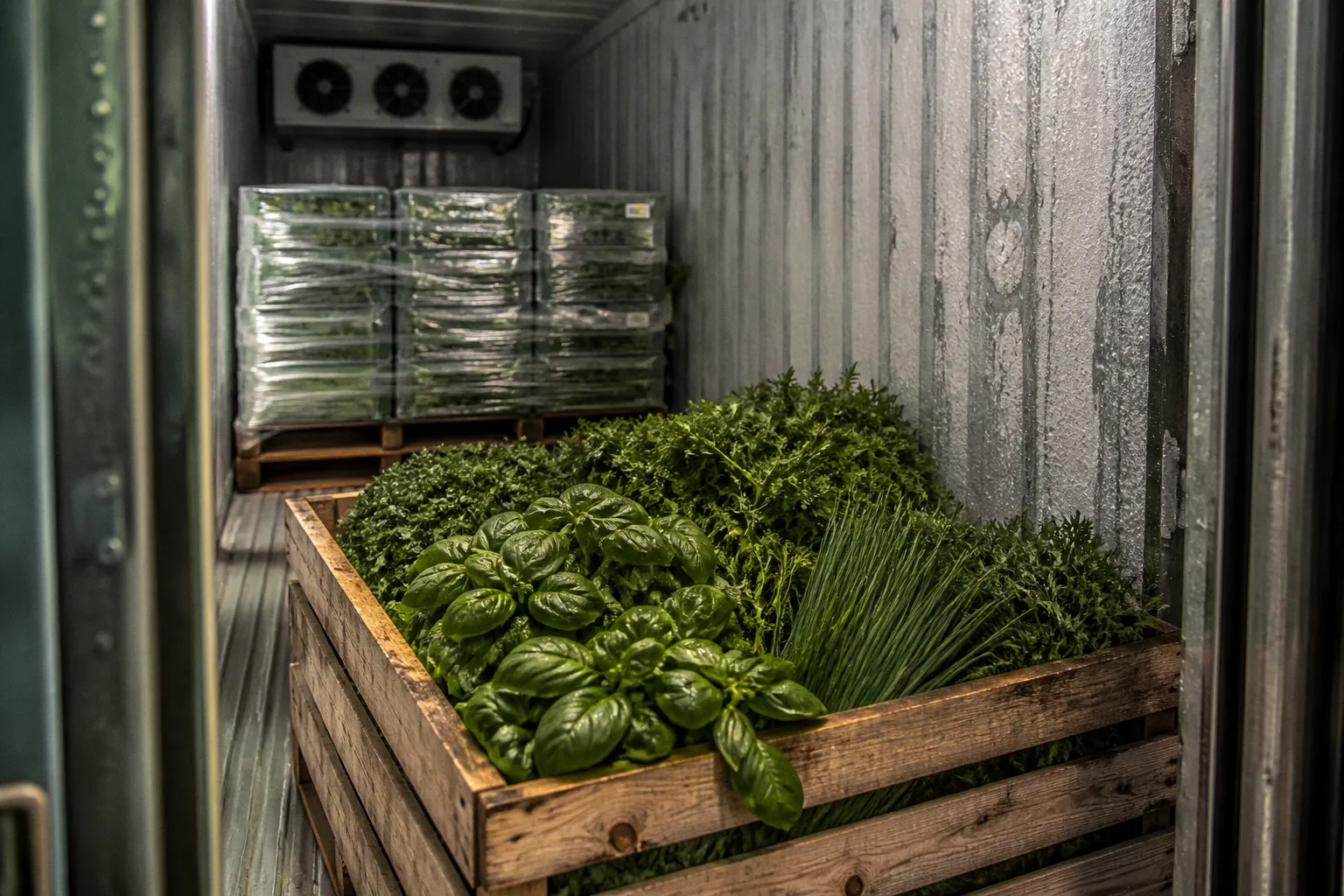
Power disruptions, diesel-generator gaps, weak pre-cooling, and sloppy temperature records compound into one outcome: rejected pallets at the destination.
For exporters moving herbs out of Beirut, Sidon, or the Bekaa, the cold chain is not a support function. It is part of the product. Basil, thyme, mint, oregano, parsley, rosemary, and chives may leave the farm in excellent condition, yet arrive with wilted leaves, blackened tissue, yellowing, or evidence of temperature abuse. By then, the shipment has already failed.
A workable fresh herb cold chain protocol for Lebanon starts before the truck reaches the packhouse. It continues through cooling, packing, documentation, port handling, and reefer monitoring. The objective is not simply to keep a thermostat at one number. It is to stabilize the crop quickly, match each herb to its safe temperature band, and preserve enough evidence to show the buyer what happened during the journey.
Regulatory Compliance and LIBNOR Standards for Export Facilities
Before a single kilo leaves the warehouse, the facility has to be legally and operationally ready. Lebanese export operations sit on two regulatory pillars: LIBNOR standards for food safety and Ministry of Agriculture Decision No 1/87 for cold-storage operations.
LIBNOR Standard 656 establishes the general food-safety baseline for an agri-food facility handling export-bound produce. That baseline covers hygiene, sanitation, personnel practices, premises, and the handling environment. LIBNOR Standard 605 adds the HACCP system: hazard analysis, critical control points, monitoring procedures, corrective actions, verification, and record-keeping.
For an exporter, these are not abstract standards kept in a binder for an audit. They determine whether the facility can demonstrate control over the product from receipt to release. Customs authorities, overseas buyers, freight forwarders, and inspection teams may all ask for evidence that the operation is registered and that its food-safety system is active rather than merely written.
Decision No 1/87 governs cold-storage warehouses holding fresh agricultural products in Lebanon. The practical requirements include prior registration with the Ministry and an identification card attached to every external container passing through the facility. That card is the traceability backbone. It connects the cargo to the storage operation, the handling process, and its origin.
A cold room is not export-ready because it is cold. It is export-ready when the facility, the product, and the records can be connected without gaps.
What the registration card must show
The exact format should follow the applicable Ministry requirements and the facility’s approved procedure, but the operational information should cover:
- Facility name and registration number
- Storage temperature capability and the product temperature class
- Date and time of receipt and release
- Product description and lot identifier
- Origin farm or cooperative
- Handling or release information, including the responsible signature
The card matters when a phytosanitary certificate is questioned, when a buyer challenges the condition of a pallet, or when a container has to be traced back to a specific cooperative collection point. If the card is incomplete, the exporter loses time precisely when the shipment is under scrutiny.
Compliance is also not a one-time event. Surveillance audits and periodic reviews expose the difference between a functioning HACCP system and a certification file that was updated only before the last inspection. Common weak points include:
- Corrective-action records that stop after the problem is identified
- Missing calibration records for thermometers and data loggers
- Cleaning schedules that no longer match the actual workflow
- Incomplete receiving records for produce arriving from different farms
- No documented decision on what happens to a lot after a temperature excursion
The most useful system is the one warehouse staff can operate during a busy harvest day. If a supervisor cannot identify the lot, its arrival time, its cooling status, and its release decision from the records, the facility does not have traceability in practice.
The 1–3°C Standard: Rapid Cooling and Biological Stabilization
For most fresh culinary herbs, the default cold-chain target is 1–3°C. This is the operating band commonly used for thyme, mint, oregano, parsley, sage, and rosemary, provided the crop, packaging, and buyer specification support it.
The fresh herb cold chain protocol for Lebanese export shipments should begin with one simple principle: field heat must be removed before the product is expected to survive a long journey. Herbs harvested in the Bekaa or coastal plains may enter the collection process well above their final storage temperature. The longer they remain warm, the more shelf life is consumed before packing is complete.
Rapid cooling serves three purposes.
1. It suppresses respiration. Freshly cut herbs continue to respire. At elevated temperatures, they use their reserves more quickly and move faster toward wilting and senescence. Lowering the temperature slows that biological activity.
2. It limits moisture loss. Warm product transpires for longer. Leaves lose turgor, bunches become limp, and the cargo reaches the packing line in weaker condition.
3. It reduces the opportunity for microbial growth. Cooling does not make contaminated produce safe, but it reduces the time available for microorganisms to multiply while the product is still warm.
The chain normally has four linked stages: field or collection-point pre-cooling, refrigerated transport to the packhouse, final cooling in the packhouse, and loading into a reefer container that has already been brought to the required operating condition.
Field pre-cooling: what actually works
Lebanese cooperatives and smaller exporters usually work with two practical cooling approaches.
Hydro-cooling removes field heat quickly by bringing cold water into contact with the harvested product. It can work well for more robust herbs such as thyme and rosemary when the water quality, sanitation, contact time, and drainage are controlled. It is less forgiving with basil and other tender-leaf varieties. Excess moisture, bruising, or poor drainage can create additional decay risk.
Forced-air cooling draws chilled air through palletized or packed product. It is slower than a well-designed hydro-cooling operation, but it is gentler on delicate leaves and does not add free surface moisture. The effectiveness depends on airflow paths: cartons or crates packed too tightly, blocked vents, and uneven pallet wrapping leave the centre of the load warm.
The common mistake is to skip pre-cooling and treat the refrigerated truck as the cooling system. A refrigerated vehicle is primarily designed to maintain the temperature of cargo that is already cold. It is not a substitute for removing field heat from warm bunches.
If herbs are loaded into the truck warm, they may arrive at the packhouse warm. The vehicle can run continuously while the product in the middle of the pallet remains above target. That is lost shelf life without any obvious failure on the truck’s display.
The receiving team should therefore record more than the room temperature. At minimum, it should distinguish:
- Product temperature at receipt
- Time of harvest or collection, where available
- Time the lot entered cooling
- Temperature at the end of cooling
- Any lot held back because it did not reach the target range
Cooling targets by herb class
| Herb | Typical target range | Main risk | Operational note |
|---|---|---|---|
| Thyme | 1–3°C | Relatively low chilling risk | Suitable for the standard cold chain when packed dry and clean |
| Mint | 1–3°C | Moisture loss and decay if handling is poor | Maintain high humidity without allowing condensation |
| Oregano | 1–3°C | Wilting and quality loss after warm holding | Cool promptly after harvest |
| Parsley | 1–3°C | Dehydration and yellowing | Protect from airflow that is excessively dry |
| Sage | 1–3°C | Wilting and mechanical damage | Avoid over-compression in cartons |
| Rosemary | 1–3°C | Mechanical damage and moisture imbalance | Can tolerate standard cooling when product is sound |
| Sweet basil | Approximately 10–13°C | Chilling injury below its safe range | Do not place in a standard 1–3°C herb load |
| Chives | Approximately 1–4°C | Yellowing, softening, and decay if too warm | Keep the range narrow and monitor closely |
These ranges are operating guidance, not permission to ignore the buyer’s specification. Cultivar, maturity, packaging, humidity, route duration, and the condition of the crop at loading all matter. The reefer should be set according to the most temperature-sensitive product in a dedicated load, not according to a default number used for every herb.
The temperature of the air leaving the evaporator is also not the same as the temperature at the centre of a pallet. A probe placed beside a carton may show that the room is cold while the product remains warm. Sampling should include representative locations, especially the middle of a pallet and the warmest expected loading position.
Managing Chilling Sensitivity: The Basil and Chives Exception
The 1–3°C standard works for much of the herb catalogue, but sweet basil is the exception that causes the most expensive mistakes.
Basil is highly sensitive to chilling. Exposure below its safe range can lead to leaf necrosis, blackening, loss of firmness, and a rapid decline in visual quality. A basil load placed in a reefer set for thyme or mint can be damaged before the container has travelled very far.
The safe operating band for fresh sweet basil is generally warmer, around 10–13°C, subject to the buyer’s specification and the exact product condition. That creates a basic segregation rule:
- Basil requires a warmer, dedicated temperature programme.
- Thyme, mint, oregano, parsley, sage, and rosemary can normally follow the 1–3°C programme.
- Chives need a narrow, carefully monitored band around 1–4°C.
Basil and standard-temperature herbs should not be treated as interchangeable cargo. A mixed shipment may require separate compartments, separate vehicles, or separate containers. If that is not commercially practical, the exporter has to decide whether the order can be fulfilled without compromising one of the products. Loading everything at a compromise temperature is usually the least defensible option.
Basil is not a high-ethylene cargo. It is an ethylene-sensitive cargo that also cannot tolerate the standard low-temperature regime used for thyme and mint.
Why ethylene management matters alongside temperature
Ethylene control is often described too loosely in herb-export conversations. Basil is generally a low ethylene producer, but it is highly sensitive to ethylene exposure. That distinction matters. The risk is not that basil automatically fills a sealed reefer with large quantities of ethylene. The risk is that basil may deteriorate when exposed to ethylene coming from other produce, damaged plant material, or poorly ventilated cargo.
Ventilation settings should therefore be based on the cargo mix, the packaging system, the reefer manufacturer’s instructions, and the buyer’s specification. There is no universal ventilation number that can safely be applied to every herb shipment.
For mixed loads, the exporter should consider:
- Whether basil is being shipped with ethylene-producing fruit or vegetables
- Whether damaged or overripe produce is present in the same transport system
- Whether packaging restricts air movement around the cartons
- Whether the reefer’s fresh-air exchange is compatible with the route and humidity conditions
- Whether the ventilation setting could increase dehydration or introduce warm, humid air that condenses on the product
MAP liners may help in some supply chains, but they are not a substitute for correct temperature control, sound produce, or an appropriate ventilation programme. A liner that is sealed around warm herbs can preserve the wrong atmosphere. It can also trap condensation if the product was packed before it had stabilized.
For basil-only shipments, the starting point is a dedicated temperature regime, high relative humidity, gentle handling, and ventilation configured for the specific reefer and packaging. The exporter should not make the setting simply because a previous load used it. The cargo specification governs.
Chives need precision, not improvisation
Chives are more fragile than their appearance suggests. They can yellow, soften, and lose saleable quality when the temperature rises above the intended range or when the product remains wet after washing. At the same time, excessive cold or direct exposure to dry evaporator air can damage the leaves.
For chives-heavy orders:
- Cool the product promptly, without leaving bunches in the warm receiving area.
- Remove free surface water before packing.
- Avoid crushing the long leaves under excessive carton pressure.
- Keep pallets stable so that air can move through the load.
- Confirm that the reefer can hold the narrow target range throughout loading and port transfer.
- Review the temperature record immediately after loading rather than waiting for the destination claim.
If-then protocol for herb segregation
- If a shipment combines basil with thyme, mint, or other standard-temperature herbs, then separate the basil before loading and use a dedicated temperature programme.
- If the shipment contains basil alongside ethylene-sensitive products, then review the cargo mix, packaging, and ventilation settings rather than assuming that basil itself is generating high ethylene levels.
- If the shipment is basil-only, then maintain the warmer target range, verify humidity, and configure fresh-air exchange according to the reefer and cargo specifications.
- If the order is chives-heavy, then keep the temperature band narrow, control surface moisture, and inspect the refrigeration unit and generator before the doors are sealed.
- If a buyer provides a product-specific temperature or ventilation instruction, then that instruction should be reconciled with the reefer specification and recorded as part of the loading procedure.
Mitigating Infrastructure Risks: Overcoming Power Instability
The hardest variable in Lebanese herb exports is often not the buyer or the freight rate. It is electricity.
Power instability and dependence on diesel generators expose cold rooms to temperature fluctuations. A room that rises from the intended range during an outage does not necessarily recover simply because the compressor restarts. Warm product continues to respire, and the refrigeration unit may need considerable time to bring the entire load back under control.
The risk is particularly serious during the period between receiving and loading. A generator fails overnight, the cold room warms, and the morning team discovers the problem only when the first pallets are moved. By then, the temperature history may be unclear and the buyer may question the entire lot.
A cold-chain failure is not limited to visible spoilage. It can also create a documentation problem. If the exporter cannot show when the excursion began, how long it lasted, and what corrective action was taken, the buyer may treat the unknown period as uncontrolled.
The Beirut port adds a separate handling risk. Reefer plugs and terminal handling capacity must be confirmed as part of the shipment plan. If a container waits without active power, it is exposed to temperature drift regardless of how well the product was cooled at the packhouse. Port dwell time should therefore be treated as a cold-chain variable, not as an issue belonging only to the freight forwarder.
Power risk mitigation playbook
- Automatic transfer switching: An automatic transfer switch can move the cold room or packhouse supply to the generator without waiting for manual intervention. The system still requires testing, maintenance, and enough fuel.
- Redundancy for critical equipment: A single genset is a single point of failure. Where the facility handles high-value export cargo, backup capacity should be planned around the refrigeration load, not just the lighting and office equipment.
- Temperature monitoring in every cold room: Use calibrated data loggers with local alarms and, where the network allows it, remote notifications. The record should show the actual product environment, not only the set point on the controller.
- Pre-cooling buffers: Bring the reefer to the required condition at the packhouse before loading. Do not rely on the port to perform the final cooling step.
- Fuel planning: Track fuel against expected runtime and keep a documented reserve during peak harvest and export periods. A generator without fuel is not a contingency plan.
- Maintenance before peak season: Test batteries, starter systems, coolant, belts, transfer switches, alarms, and refrigeration components before the export window begins.
- Port coordination: Confirm plug availability, gate timing, terminal procedures, and the handover point for the powered container. A reefer that is fully charged thermally but left disconnected for an unknown period is still at risk.
- Contingency for rejected lots: Define in advance who can authorize a hold, reinspection, repacking, or disposal when a temperature excursion occurs. Staff should not improvise a release decision under shipping pressure.
Loading is part of temperature control
The loading bay can undo good cooling work. Doors left open, pallets waiting in direct sun, or a congested staging area allow warm air to enter the reefer and raise the product temperature.
The loading sequence should be short and controlled:
1. Confirm that the container is clean, dry, odor-free, and operating at the required pre-cooling condition.
2. Check that air channels and return-air paths will not be blocked by cartons or pallet wrap.
3. Load only product that has reached its assigned temperature class.
4. Keep the doors closed between loading movements wherever possible.
5. Place the data logger according to the monitoring plan, including a position likely to represent the warmest part of the load.
6. Record the container number, seal number, loading time, product temperature, reefer set point, and ventilation setting.
7. Seal the container only after the responsible supervisor reviews the loading record.
A set point is not a guarantee. The reefer must have airflow, a stable power source, and cargo that was already cooled. Refrigeration equipment maintains a load; it does not repair a weak loading process.
Traceability and Documentation Under Ministry Decision No 1/87
Decision No 1/87 is more than a registration card. It is part of the traceability framework that links the shipment to its origin, storage history, and release process.
Every container leaving the facility should be traceable back to the farm or cooperative, the relevant harvest or collection lot, the cooling record, the packing operation, and the final loading decision. When a buyer makes a quality claim, the first question is rarely only whether the herbs look poor. The question is where the failure entered the chain.
The documentation stack may include:
1. Phytosanitary certificate issued by the Lebanese Ministry of Agriculture.
2. Health registration documentation connected to the applicable LIBNOR food-safety and HACCP requirements.
3. Cold-storage registration information under Decision No 1/87, including the identification card attached to the external container.
4. Commercial invoice with the appropriate product descriptions and HS codes.
5. Packing list showing lot numbers, weights, carton counts, and temperature class.
6. Certificate of origin, where required for the destination and any applicable trade arrangement.
7. Pre-cooling and loading record showing that the reefer reached the required condition before loading.
8. Temperature data from the cold room, loading process, and reefer journey where available.
The records have to agree with one another. If the phytosanitary certificate identifies one lot while the packing list uses another identifier, customs may hold the container for clarification. If the cold-storage card is incomplete, the exporter may have difficulty proving where the product was handled. If the data logger has a gap, the buyer’s quality team may ask whether the missing period included a temperature excursion.
Common documentation failures
Lot-number mismatch: A farm or cooperative may use its internal lot code while the packhouse assigns a different code for export. That is manageable only if the relationship between the two codes is recorded. Use one controlled identifier across the phytosanitary documentation, packing list, carton labels, and warehouse release record.
Incomplete registration card: Missing receipt time, release time, origin, or signature weakens the document’s value. The card should be completed as part of the physical handling process, not reconstructed after the container has departed.
Temperature log gaps: Data loggers fail because of dead batteries, incorrect start times, full memory, poor placement, or accidental deactivation. Check the logger before loading, start it at the correct time, verify that it is recording, and retain a backup record where practical.
Unrecorded corrective action: If a pallet arrives warm or a cold room exceeds its limit, record the decision. Was the lot cooled again, inspected, downgraded, repacked, or rejected? An unexplained correction looks like concealment even when the product was ultimately acceptable.
Confusion between set point and product temperature: The reefer set point may be correct while the herbs are still warm. Record both values separately. The loading release should be based on product temperature, not only on the controller display.
If-then documentation scenarios
- If the destination authority requires a specific temperature treatment or transport record, then confirm in advance that the logger can produce a readable file, such as CSV or PDF, rather than a format that requires unavailable vendor software.
- If the buyer issues a quality claim on arrival, then compare the claim with the farm lot, cooling record, loading temperatures, reefer data, and port handover time before accepting or rejecting responsibility.
- If customs holds the container for phytosanitary inspection, then the identification card and consistent lot records should allow the origin and handling history to be verified quickly.
- If a logger shows an unexplained gap, then do not silently replace the missing data. Record the gap, investigate the cause, and document the corrective action.
- If a mixed shipment contains more than one temperature class, then identify the temperature class on the packing list and loading plan so that the reefer setting and segregation decision can be reviewed later.
Beirut Port Herb Cargo Handling: The Handover Matters
A well-managed packhouse can still lose control at the port handover. The exporter should treat the movement from facility to terminal as a defined step in the protocol, with a responsible party and a recorded time.
The truck departure should be coordinated with the container booking and terminal instructions. Delays create two problems at once: the reefer remains in operation longer than planned, and the container may spend more time in an uncontrolled staging area. The driver and freight forwarder should know whether the unit must remain powered, where the handover occurs, and what to do if the terminal refuses or delays the container.
For Beirut port herb cargo handling, the basic questions are practical:
- Was the container pre-cooled before leaving the packhouse?
- Was the genset operating during the road transfer where required?
- Was the container accepted promptly at the terminal?
- Was a powered reefer connection available after handover?
- Were the container number and seal number checked against the documents?
- Is the handover time recorded?
- Who is notified if the container is rolled, delayed, or disconnected?
These points do not replace the work of the freight forwarder or terminal operator. They prevent the exporter from discovering a break in the chain only after the buyer has opened the doors.
The same principle applies to export scheduling. A shipment that leaves the packhouse late on a weekend or before a holiday may face a longer administrative and port dwell period than the plan suggests. The produce does not care whether the delay is caused by customs, a missed cut-off, or a document correction. It experiences only time and temperature.
Final Word: The Cold Chain Is Your Margin
The Lebanese herb export business runs on three linked variables: temperature, transit time, and traceability. Freight rates, currency movements, buyer negotiations, and port congestion all matter, but none of them can rescue a load that was warm at packing, chilled incorrectly, or released without records.
The standard 1–3°C regime is a strong operating base for thyme, mint, oregano, parsley, sage, and rosemary. It is not a universal setting. Basil belongs in a warmer range because it is chilling-sensitive, not because it is a high ethylene producer. Chives require a narrow band and careful moisture control. Ventilation must be configured for the actual cargo and reefer specifications, with particular attention to ethylene exposure and dehydration risk.
The infrastructure is equally important. Automatic transfer systems, maintained generators, fuel planning, calibrated data loggers, pre-cooled reefers, and a controlled Beirut port handover are not luxury upgrades when the shipment is perishable. They are the operating conditions that make an export promise credible.
A cold chain failure is never confined to one pallet. It affects the buyer relationship, the cooperative that supplied the crop, the freight account, the next booking, and the exporter’s ability to defend a quality claim. The strongest operators understand this early: refrigeration is not simply an expense attached to the shipment. It is the mechanism that preserves the value created in the field.