IFFCO and NongHyup Explore Strategic Alliances to Bolster Farmer Cooperative Networks
According to AgroSpectrum Asia, India’s Indian Farmers Fertiliser Cooperative, or IFFCO, and South Korea’s NongHyup, the National Agricultural Cooperative Federation, have held talks on new partnership opportunities.
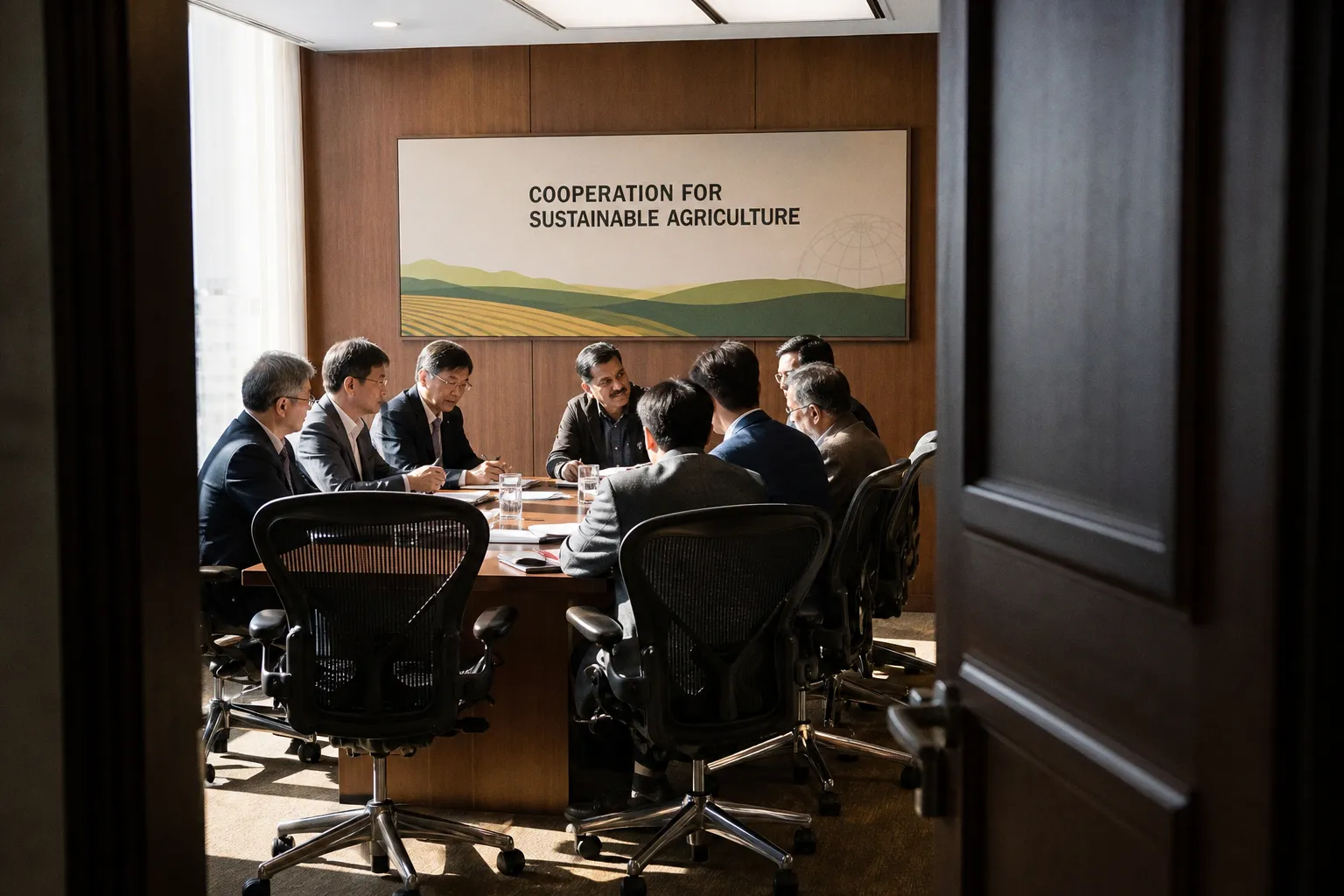
IFFCO and NongHyup Explore New Paths for Farmer-Focused Cooperation
For farmer groups, one familiar hurdle is turning a promising conversation into a working structure that improves daily farm life. According to AgroSpectrum Asia, India’s Indian Farmers Fertiliser Cooperative, or IFFCO, and South Korea’s NongHyup, the National Agricultural Cooperative Federation, have held talks on new partnership opportunities. The significance for cooperatives is not a completed deal yet, but the shared direction: creating more value for agricultural communities through stronger, farmer-focused cooperation.
From a meeting to a cooperative model
The reported discussions are still at the opportunity stage, so there is no confirmed programme, investment, timeline or operating plan to put into practice. That distinction matters for our growers and cooperative boards: a partnership announcement becomes meaningful only when it can be connected to a clear service, a defined group of members and a way to measure results.
The practical question is therefore not simply whether IFFCO and NongHyup will work together. It is what kind of support could eventually move through the cooperative system, and whether that support would reach farms in a form they can use.
For Lebanese agricultural cooperatives, this is a useful framework for reviewing any future international partnership. Before celebrating a new link, members can ask:
- Which farmer problem is being addressed first?
- Will the arrangement improve access to inputs, technology, finance or markets?
- Who will manage delivery and member support?
- What will growers contribute, and what will they receive?
- How will the cooperative report results back to its members?
These questions help keep the centre of gravity where it belongs: with the growers, their harvests and the quality of the services available to them.
Why the wider cooperative ecosystem matters
The IFFCO–NongHyup talks point to a broader idea: agricultural cooperation can be strengthened when organisations look beyond a single product or transaction and build connections across the farming community. That may create space for shared services, new business models or exchanges of practical experience—but those possibilities should be treated as areas to watch, not as outcomes already agreed.
The news also comes alongside a separate report from Seoul Economic Daily that NongHyup plans an emergency damage recovery fund of up to 50 billion won, or $36 million, for farmers and residents in South Gyeongsang Province affected by torrential rains. The fund is intended to address crop damage and restore farming infrastructure. This is not presented as part of the IFFCO discussions, but it offers a timely reminder of the role cooperative institutions can play when farming communities face disruption.
For Lebanese cooperatives working with fresh produce, resilience is not an abstract word. It is visible in whether a group can maintain supply, protect quality and keep members connected when conditions become difficult. Any future cooperation should therefore be assessed not only by its headline value, but by its ability to strengthen those everyday functions.
What to track next
The next useful signals would be concrete: an announced agreement, a named pilot, a defined service or a public explanation of how farmers would benefit. Without those details, the safest reading is that IFFCO and NongHyup are exploring possibilities rather than launching a confirmed joint programme.
Our cooperatives can still learn from the moment. Strong partnerships begin with a shared purpose, but they grow through small, accountable steps: identifying a common need, assigning responsibility, testing the service with members and improving it through feedback. That is how a promising international conversation can eventually become something more valuable than a headline—a practical channel for stronger farms, clearer standards and a more connected agricultural community.