Cooperative seedling nursery: from site prep to distribution
A cooperative seedling nursery solves one of the most persistent problems in Lebanese agriculture: many growers need healthy, uniform plants, but the land, capital, water, and technical knowledge are spread across small holdings.
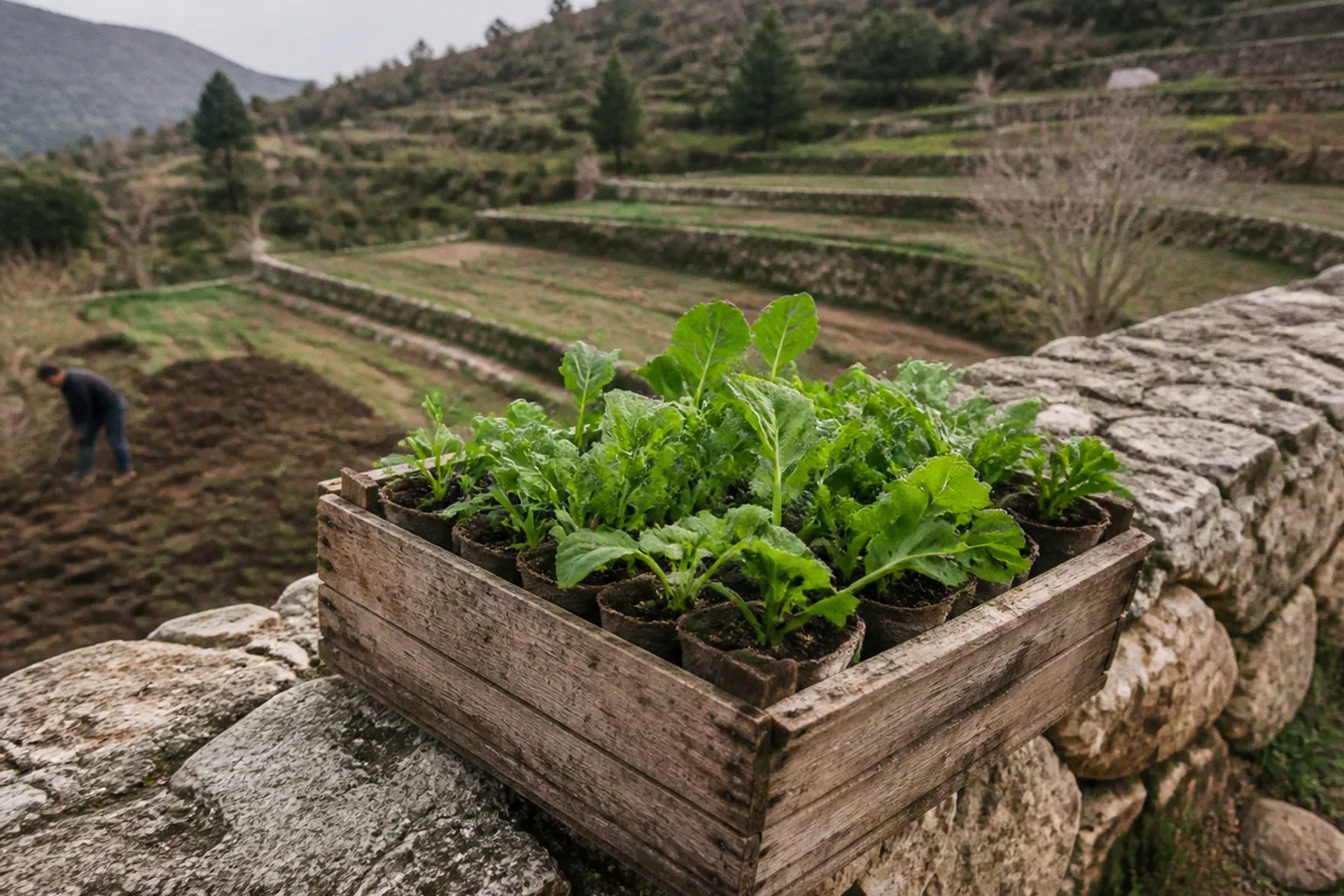
When half of cultivated plots are smaller than 5 dunums and only a small share of agricultural holdings exceeds 4 hectares, individual farmers rarely have the scale to run a reliable propagation operation on their own.
The nursery changes that equation. Instead of every grower sourcing seedlings separately, a group can coordinate seed selection, propagation, hardening, quality control, transport, and planting dates. The result is not simply a greenhouse filled with trays. It is a shared agricultural service—one that can protect crop survival, make harvests more predictable, and help Lebanese cooperatives meet the consistency expected by larger buyers and export markets.
A successful cooperative seedling nursery setup in Lebanon begins long before the first seed is sown. It starts with a clear agreement about who the nursery serves, what it will produce, how quality will be measured, and how responsibilities will be shared when the season becomes busy.
Begin with the farming map, not the greenhouse
The most common organizational mistake is to choose a structure before understanding the growers’ actual planting needs. A cooperative may build a greenhouse with an impressive capacity, only to discover that members need different crops, different planting windows, and different seedling ages.
The first task is therefore a seasonal production map. It should bring together:
- The crops members intend to plant, from vegetable varieties to native trees and shrubs.
- The approximate number of seedlings needed by crop and by planting date.
- The elevations and microclimates where those seedlings will be planted.
- The seed varieties preferred by growers and buyers.
- The expected delivery points and transport distances.
- The proportion of production reserved for replacement plants and germination losses.
This planning stage is especially important in Lebanon, where growing conditions shift sharply between the coast, the Bekaa Valley, Akkar, Mount Lebanon, and higher-elevation communities. A seedling that is ready for transplanting in one area may be too young, too mature, or simply poorly matched to another.
The cooperative should also separate demand into two categories. The first is committed demand: seedlings that members have formally requested and agreed to collect. The second is flexible production: a smaller reserve for replacement planting, new members, or seasonal opportunities. Without this distinction, nurseries can overproduce slow-moving varieties while running short of the crisp, vigorous vegetable plants that growers need at the start of a narrow planting window.
A simple member order form can capture most of the information. It does not need to be complicated, but it should record the farmer, location, crop, variety, quantity, preferred delivery date, and whether the order is for open-field or protected cultivation. That record becomes the basis for sowing schedules, tray allocation, and distribution routes.
A cooperative nursery is not successful because it grows the most seedlings; it is successful because it grows the right seedlings, at the right stage, for growers who are ready to plant them.
Choosing the site and preparing the nursery
A nursery site must be judged as a working agricultural facility, not simply as an available piece of land. The most attractive plot is not always the most useful one. A lower-cost site may become expensive if water must be hauled, roads become impassable, or trays need to travel long distances before planting.
The site assessment should cover several practical questions:
- Is there a dependable water source throughout the production season?
- Can the site drain quickly after heavy rainfall?
- Is there safe vehicle access for seed, trays, growing media, and outgoing plants?
- Is the location exposed to strong winds or prolonged cold?
- Can the nursery be expanded if the cooperative gains more members?
- Is there enough room for work areas, storage, compost or media handling, and loading?
- Can the cooperative secure the land through ownership, lease, or a documented community arrangement?
Water deserves particular attention. Seedlings need consistency more than abundance: a reliable supply, clean distribution lines, and a system that allows the nursery team to apply water evenly. Uneven irrigation produces uneven plants, and uneven plants are difficult to distribute fairly among members. If one grower receives sturdy, well-rooted plugs while another receives stretched or stressed plants, the cooperative’s trust can weaken quickly.
The production area should be divided into clear zones. Even a modest nursery benefits from separating:
1. Seed and input storage, protected from moisture, heat, pests, and accidental mixing.
2. Germination space, where temperature, humidity, and cleanliness can be managed closely.
3. Early growth space, for young plants that require careful irrigation and monitoring.
4. Hardening space, where seedlings gradually adapt to field conditions.
5. Dispatch and holding space, where orders are counted, labeled, and loaded.
6. Waste and sanitation areas, kept away from clean trays and new planting material.
This division is not decorative. It reduces movement, confusion, and cross-contamination. It also makes it easier for different cooperative members to take responsibility for defined tasks.
The physical design will vary according to crop, elevation, budget, and intended scale. Some projects may use simple protected structures, while others need dedicated greenhouses and germination rooms. In December 2024, TİKA expanded nursery infrastructure in the Danniyeh region by adding two seedling greenhouses and a germination room. The lesson is not that every cooperative needs the same facility, but that propagation space and germination control should be planned as separate operational needs where local conditions justify them.
Technical standards matter, but they should be translated into actions the team can follow. The cooperative should agree on acceptable tray condition, growing-medium quality, labeling, watering frequency, pest monitoring, and the minimum size or root development required before distribution. Exact procedures will depend on the crop and local conditions; what matters first is that the standard is written down and applied to every member’s order.
Build collective seedling propagation around shared roles
A nursery cannot be managed by a committee alone. It needs a small operational team with clear authority for daily decisions, supported by the cooperative’s elected leadership.
A workable division of responsibilities might look like this:
| Nursery responsibility | Primary task | Cooperative benefit |
|---|---|---|
| Production planning | Converts member orders into sowing and delivery schedules | Prevents overproduction and missed planting windows |
| Seed and input manager | Receives, labels, stores, and records seed and growing materials | Protects traceability and reduces accidental mixing |
| Nursery technician | Supervises germination, irrigation, nutrition, sanitation, and pest observation | Keeps quality consistent across batches |
| Member liaison | Confirms orders, communicates delays, and coordinates collection | Maintains trust between the nursery and growers |
| Distribution coordinator | Groups deliveries by area and planting date | Reduces transport waste and handling damage |
| Finance and records officer | Tracks production batches, payments, losses, and outstanding orders | Shows whether the service is becoming financially sustainable |
The same person may hold more than one role in a small cooperative, but the responsibilities should still be separated on paper. When no one is clearly responsible for inventory, seed lots disappear into memory. When no one owns the dispatch process, healthy seedlings can sit too long before collection.
Recordkeeping is one of the least glamorous and most valuable parts of collective seedling propagation. Each batch should have a basic identity: crop, variety, seed source, sowing date, tray count, germination observations, and planned distribution date. This does not require expensive software. A shared register, carefully maintained, can provide enough visibility for a growing operation.
The cooperative should also create a decision rule for shortages. If germination is poor or a disease event affects one crop, who receives the remaining plants? A transparent approach may prioritize members according to confirmed orders, planting urgency, or the date of request. The rule should be agreed before a difficult season, not invented when several growers are already waiting.
A similar principle applies to labor. Seedling production has peaks: sowing, transplanting, grading, hardening, and dispatch may all require more hands than routine maintenance. The cooperative can organize rotating member workdays, but those arrangements need coordination. Shared labor is strongest when tasks are specific—filling trays, labeling batches, moving plants, cleaning benches—rather than framed as a general request for help.
Seed sourcing and quality control
Smallholder farmer seed sourcing in Lebanon is often treated as a purchasing question, but it is really a production and market question. The cheapest seed is not necessarily the least expensive option if it produces weak germination, mixed maturity, poor uniformity, or fruit that buyers reject.
The cooperative should define its seed policy around four practical considerations:
- Suitability: Does the variety perform in the elevation, soil, season, and cultivation system where members will plant it?
- Market fit: Will the resulting produce meet the size, color, firmness, shelf-life, and appearance expected by local buyers or export channels?
- Traceability: Can the cooperative identify the supplier, lot, crop, and date of purchase?
- Member acceptance: Have growers agreed that the variety matches their experience and selling arrangements?
For native trees, the questions are different but equally important. The Cooperative of Native Tree Producers in Lebanon was officially recognized in September 2013 with support from the Lebanon Reforestation Initiative. Its purpose included bringing native tree nurseries together and standardizing seedling quality. That model shows how cooperation can address a problem that individual nurseries may struggle to solve alone: maintaining reliable identity and quality across multiple propagation sites.
Vegetable seedlings also need a clear grading system. A plant should not be judged only by height. A tall, thin seedling may be less useful than a shorter plant with a strong stem and a well-developed root system. The cooperative can classify plants as ready, hold for further growth, or reject and replace. This is better than sending every tray out simply because the delivery date has arrived.
Quality control should happen at several points:
1. On receipt of seed, confirm the crop, variety, supplier, lot, and quantity.
2. After germination, record emergence and identify weak or irregular trays.
3. During growth, watch for uneven irrigation, nutrient stress, disease symptoms, and pest pressure.
4. Before hardening, remove plants that will not establish well in the field.
5. Before dispatch, count, label, grade, and confirm the member order.
6. After distribution, collect feedback on survival, vigor, and field performance.
The final step turns the nursery into a learning system. If a variety repeatedly struggles at a certain elevation, the cooperative should know before the next season. If a particular tray format makes transport easier or reduces root damage, that detail belongs in the shared operating record.
Hardening, packing, and distribution
A seedling can be healthy inside the nursery and still fail after delivery if it has not been prepared for field conditions. Hardening is the bridge between protected propagation and the grower’s field. It usually involves gradually adjusting plants to stronger light, greater air movement, and less sheltered conditions, according to the crop and season.
The timing of hardening should be linked to the actual planting schedule. Beginning too early can slow young plants; delaying it can leave them vulnerable when they leave the greenhouse. This is where communication between the nursery technician and member liaison becomes essential. The nursery must know not only when seedlings are technically mature, but when fields will be prepared and when farmers can realistically collect or receive them.
Distribution should be organized by geography whenever possible. A cooperative serving several villages can group orders by route and planting date instead of sending small, urgent deliveries in every direction. This lowers handling time and helps preserve plant quality. It also gives members a predictable collection rhythm.
Every outgoing batch should carry a clear label with at least:
- Crop and variety
- Quantity
- Batch or sowing date
- Nursery identification
- Basic planting guidance
- Contact person for reporting problems
The plants should be counted before loading and again at delivery. If substitutions are necessary, the member should be informed before the order leaves the nursery. Quiet substitutions may seem efficient in the moment, but they create confusion in the field and undermine confidence in the shared service.
A distribution register can also record the condition of the batch at handover. This is not about shifting blame. It helps the cooperative distinguish between nursery issues, transport damage, and field conditions. When several growers report the same problem, the team can investigate the batch rather than treating each complaint as an isolated event.
Lebanon already has examples of nursery production at substantial scale. The Ministry of Agriculture, working with UNDP and funded by Germany’s KfW Development Bank, initiated a project to produce and distribute 1.5 million vegetable seedlings to farmers registered in the National Farmers Registry. The first phase produced 500,000 seedlings at the Abdeh nursery in Akkar for farmers operating above 500 meters. These figures show the value of coordinated propagation, but they also underline the need for registration, allocation, and logistics systems capable of handling volume.
Large public and institutional programs do not replace local cooperative work. They can, however, provide useful models for how eligibility, production targets, nursery records, and distribution channels can be organized.
The financial model should protect access and discipline
A cooperative nursery must be affordable for smallholders without pretending that propagation has no cost. Seeds, trays, growing media, water, labor, structure maintenance, transport, replacement production, and technical supervision all need to be accounted for.
Because standardized per-seedling production costs are not available across all Lebanese cooperative settings, each group should calculate its own cost from actual records rather than borrowing a figure from another region. A simple internal calculation can include:
- Direct inputs used for each crop and batch
- Paid labor and agreed value of member labor
- Water, electricity, and routine maintenance
- Greenhouse depreciation or lease costs
- Packaging and transport
- A modest reserve for germination failure and infrastructure repair
The cooperative can then choose whether members pay per seedling, per tray, or through a seasonal production commitment. Each method has advantages. Per-seedling pricing is easy to understand. Per-tray pricing simplifies counting and dispatch. A seasonal commitment helps the nursery plan production but requires stronger trust and recordkeeping.
Some seedlings may be distributed through public programs or donor-funded initiatives, while others may be sold through the cooperative’s own service. These streams should be recorded separately. Mixing funded and paid production without clear accounting can make it difficult to understand who is subsidizing whom.
The purpose of the financial model is not to turn the nursery into a cold commercial unit. It is to keep the service available. If the cooperative does not recover enough to replace damaged trays, maintain irrigation, and retain competent technical support, the nursery will gradually lose quality—and the members who depend on it will carry the cost in the field.
Shared infrastructure only remains shared when the books are clear, the labor is visible, and every grower understands what the service can sustainably provide.
What can go wrong—and how the cooperative can respond
Nursery projects are exposed to risks that begin outside the greenhouse. A late seed shipment can disrupt the planting calendar. A water interruption can affect an entire batch. Poor labeling can turn a technical problem into a market problem months later.
The most useful response is to identify risks early and assign an owner to each one:
- Unclear demand: collect member orders before purchasing seed and set a closing date for seasonal requests.
- Uneven quality: use one written production standard and one grading process across all batches.
- Water interruptions: identify a backup source or emergency storage plan that matches the nursery’s scale.
- Disease or pest pressure: isolate affected trays, sanitize reusable equipment, and keep nursery traffic controlled.
- Transport damage: dispatch during suitable hours, avoid overstacking, and group deliveries by route.
- Member disputes: publish allocation rules and document substitutions, shortages, and replacements.
- Overexpansion: increase production only when the cooperative has the staff, records, water, and distribution capacity to support it.
- Weak participation: connect access to the nursery with timely orders, collection commitments, or agreed cooperative duties.
A nursery can also become too dependent on one institution, donor, or buyer. Partnerships with ministries, development agencies, NGOs, and international funders can provide infrastructure and technical support, but the cooperative should continue building its own production records, member relationships, and decision-making capacity. External support is most useful when it strengthens local control rather than replacing it.
A practical launch sequence
For a cooperative beginning from the ground up, the work can be organized into a sequence that keeps decisions manageable.
1. Confirm the member base
List participating growers, their locations, crops, planting dates, and expected quantities. Distinguish firm orders from general interest.
2. Choose the first production season
Start with crops and quantities the cooperative can supervise well. A smaller, crisp, blemish-free batch is more valuable than a large volume that cannot be graded or delivered properly.
3. Assess the site
Document water access, drainage, road conditions, available electricity, wind exposure, storage, and room for expansion. Secure the land arrangement before investing in permanent improvements.
4. Establish the operating standard
Write down the seed-recording process, tray handling, irrigation responsibilities, batch labeling, grading rules, and dispatch procedure. Keep the language practical enough for every worker to use.
5. Assign daily ownership
Name the person responsible for production, records, member communication, and distribution. A cooperative structure should broaden responsibility, not blur it.
6. Run a measured pilot
Record the number of trays sown, germination results, losses, labor hours, delivery condition, and farmer feedback. The pilot is not a test of whether cooperation works; it is a way to improve the system before scaling it.
7. Review the season collectively
Bring growers, nursery staff, and cooperative leadership together after planting. Discuss survival, vigor, variety performance, timing, and transport. Carry the lessons into the next sowing calendar.
A nursery can become the cooperative’s market bridge
The strongest Lebanese agricultural cooperatives do more than combine purchasing power. They create a dependable link between scattered farms and the standards of larger markets. Uniform seedlings are the first step toward more uniform fields; more uniform fields make harvest planning easier; better planning supports grading, packing, and collective sales.
That progression does not happen automatically. It depends on patient coordination, accurate records, and a willingness to treat small operational details as part of rural development. A tray label, a delivery route, or a shared germination record may seem modest beside the larger pressures facing the Lebanese agro-food sector. Yet these are the working pieces from which resilience is built.
A cooperative seedling nursery should therefore be designed as both a production site and a community institution. It should help growers access suitable planting material, but it should also teach the cooperative how to plan together, manage quality together, and respond to markets without leaving smaller farmers behind.
When the first seedlings leave the nursery, the real measure is not only whether they are green and vigorous. It is whether the growers know what they are receiving, when to plant it, how it was produced, and whom to call when the season changes. That shared confidence is what turns collective propagation into collective progress.