Community-supported agriculture: a Lebanese cooperative guide
A community-supported agriculture project in Lebanon can begin with a subscription box, but it cannot become a legally reliable agricultural enterprise on subscriptions alone.
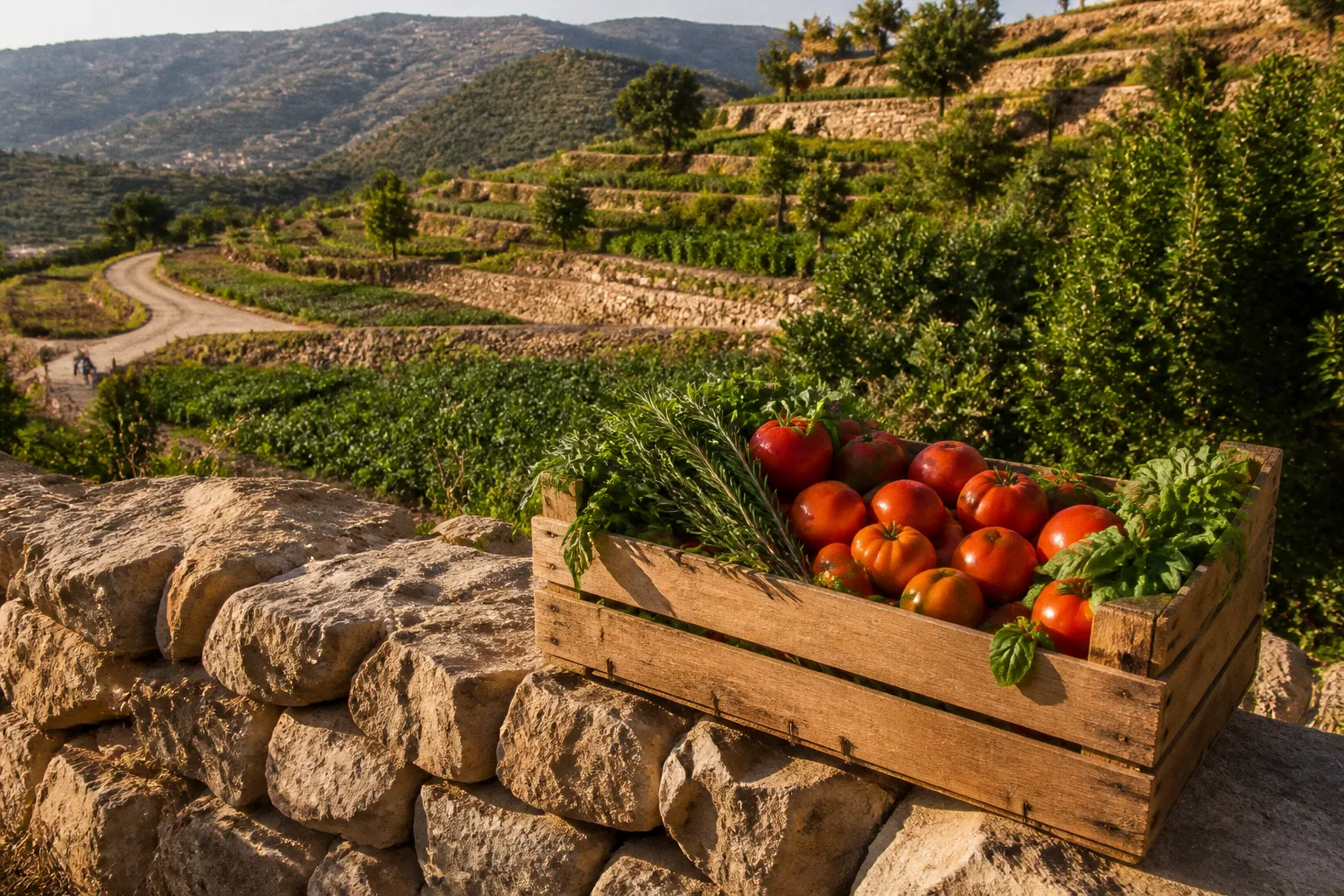
The operational system requires three separate layers: a registered cooperative or other compliant entity, a production network capable of delivering a defined seasonal volume, and a distribution model that converts fragmented smallholder output into predictable orders.
That distinction matters because Lebanon’s agricultural structure is unusually fragmented. Half of cultivated plots are smaller than 5 dunums, or 5,000 square meters, while only 5% of agricultural holdings exceed 4 hectares. A CSA model can therefore solve a real logistics problem: it can aggregate supply without requiring every farmer to consolidate land. It does not, however, remove the legal, governance, traceability, or capital requirements attached to collective agricultural activity.
For anyone considering a community supported agriculture Lebanon cooperative setup, the correct sequence is not “find customers, then improvise the organization.” It is to establish the legal base, define member rights, map production capacity, build compliance records, and only then scale the subscription model.
The legal foundation: two decrees, one registration pathway
Lebanese cooperatives are governed primarily by Decree No. 17199 of 1964, amended in 1983, and Executive Decree No. 2989 of 1972, amended in 1977. The legal definition is important operationally: a cooperative is a non-profit association with variable capital, established to improve the socio-economic conditions of its members.
That status is different from a conventional private company. The cooperative is not designed simply to collect producer equity and distribute returns according to capital ownership. Its structure is based on member participation, shared economic activity, and democratic control. Any business plan that treats the cooperative as a normal investor-owned company will eventually produce a governance conflict, even if the initial registration is completed.
The General Directorate of Cooperatives is the central registration authority. A group seeking to establish an agricultural cooperative must meet several baseline conditions:
- At least 10 members must be engaged in the same activity and located within the same geographic area.
- The founding group must submit an economic feasibility study.
- The cooperative must secure the capital required for registration and initial operation.
- The cooperative must complete the relevant registration process with the General Directorate of Cooperatives.
The 10-member requirement is not a symbolic threshold. It determines whether the proposed organization has a viable membership base under the cooperative framework. A group of ten farmers who grow unrelated products in disconnected locations may satisfy the numerical condition but still lack a coherent operating model. A stronger founding group would be organized around a defined production territory, a common crop portfolio, and a shared sales or processing function.
The feasibility study should therefore be treated as an operating document rather than a registration formality. It needs to explain:
1. What products members will supply and during which months.
2. Which activities will be centralized, such as washing, grading, packing, cold storage, transport, or sales.
3. How member payments will be calculated.
4. Which costs will be paid collectively and which remain with individual farms.
5. How subscription customers, restaurants, wholesalers, or institutional buyers will be served.
6. What happens when production falls below the committed volume.
7. How the cooperative will finance equipment and working capital.
The final point is often underestimated. Agricultural income arrives in cycles, while packaging, transport, labor, and customer service generate costs continuously. A cooperative can be legally established and still fail because its working-capital model is incomplete.
A cooperative is not a shortcut around agricultural economics. It is a mechanism for making fragmented economics visible, measurable, and collectively manageable.
Membership and democratic governance are operating variables
Lebanese cooperative law requires a “one member, one vote” structure regardless of the number of shares held. It also restricts any single member from owning more than one-fifth, or 20%, of the total shares.
These rules affect how the cooperative should be capitalized. A member who contributes more equipment, land, or cash cannot automatically acquire proportionally greater control over the organization. The cooperative must separate at least three different concepts:
- Membership, which creates voting and governance rights.
- Share ownership, which contributes to the cooperative’s capital structure within the legal limits.
- Operational contribution, which measures the volume or value of products and services supplied by each member.
If these categories are mixed together, disputes are predictable. A farmer who supplies 30% of the vegetables may expect 30% of the votes. A member who funded the packing room may expect a permanent management role. Neither expectation follows automatically from the cooperative model.
A practical internal structure should define the following before commercial operations begin:
| Operating question | Recommended cooperative rule |
|---|---|
| Voting power | One member, one vote, independent of share ownership |
| Product acceptance | Written quality and delivery specifications for each crop |
| Member payment | Formula based on accepted volume, grade, timing, and agreed price |
| Shared costs | Transparent allocation for packing, transport, storage, and administration |
| Production failure | Predefined process for substitutions, refunds, or box adjustments |
| New members | Geographic, technical, and capacity requirements documented in advance |
| Equipment use | Booking, maintenance, depreciation, and repair responsibilities recorded |
| Exit from the cooperative | Notice period and treatment of outstanding payments or obligations |
The payment formula is especially important for a CSA subscription box in Lebanon. A simple equal distribution of revenue may appear cooperative, but it can punish members who meet quality and delivery commitments while rewarding inconsistent supply. The opposite model—paying only for volume—can encourage oversupply, weak grading, and the displacement of smaller producers.
A more robust formula can combine accepted quantity, quality grade, seasonal scarcity, and delivery reliability. It does not need to be mathematically elaborate. It needs to be documented, applied consistently, and approved through the cooperative’s governance process.
The same principle applies to management. The board should govern strategy, capital expenditure, member policy, and risk. Day-to-day functions—procurement, box assembly, sales, route planning, and customer communication—should be assigned to accountable operators. Democratic governance does not mean that every member participates in every operational decision. It means that authority is defined and ultimately answerable to the membership.
Land fragmentation makes aggregation the core business
The small size of Lebanese agricultural plots changes the technical design of a cooperative. A CSA model cannot assume that one farm will provide the complete product range required by subscribers. It must aggregate production across multiple farms while preserving a reliable specification for the customer.
This creates a planning problem with three variables:
- Demand volume: the number of subscribed households or institutional buyers.
- Production capacity: the quantity each member can realistically deliver by crop and week.
- Fulfillment tolerance: the degree to which the box can change when weather, irrigation, pests, or harvest timing disrupt the plan.
A cooperative operating in the Bekaa Valley, for example, may have strong seasonal production capacity but still need a crop calendar that accounts for maturity windows, water availability, and transport scheduling. The phrase “community supported agriculture Bekaa Valley” describes a location and model, not a standardized supply chain. Each cooperative must construct its own baseline.
The first useful document is a member production map. It should record:
- Farm location and cultivated area.
- Crop, variety, and expected harvest window.
- Estimated weekly volume under normal conditions.
- Minimum deliverable volume.
- Current irrigation and post-harvest facilities.
- Harvest and packing labor available.
- Existing certifications or traceability records.
- Distance to the cooperative’s collection point.
- Known production risks.
The purpose is not to create a speculative forecast with false precision. It is to establish a baseline against which actual deliveries can be measured. After one season, the cooperative should compare planned versus delivered volume by member and crop. That variance is more valuable than a broad claim that the supply network is “strong.”
The box itself should be engineered around the weakest predictable point in the supply chain. If a cooperative can reliably source seven products but routinely fails on three others, the subscription should not promise ten fixed items every week. It can use a core basket with a controlled substitution range, or it can offer a seasonal schedule that reflects actual production.
A useful operating distinction is between fixed commitments and flexible contents:
- Fixed commitments include delivery day, box size, customer price, payment cycle, and minimum quality.
- Flexible contents include crop selection, quantity within a defined range, and substitutions caused by seasonal conditions.
This structure protects both sides. Customers receive a predictable service, while farmers are not forced to produce outside the agronomic limits of the region.
Direct sales require more than a digital order form
A Lebanese cooperative direct sales channel usually combines several functions that are invisible to the customer:
1. Demand collection: subscriptions, pre-orders, restaurant orders, or institutional contracts.
2. Production coordination: confirming quantities with members before harvest.
3. Harvest scheduling: aligning picking with collection and delivery routes.
4. Post-harvest handling: removing damaged produce, grading, weighing, and packing.
5. Customer fulfillment: assembling boxes accurately and managing substitutions.
6. Payment reconciliation: matching customer receipts to member deliveries and shared costs.
7. Traceability: recording which member supplied each lot.
The technology required at the beginning is not necessarily sophisticated. A controlled spreadsheet, standardized delivery forms, lot labels, and a single order database may produce more value than an expensive platform with no reliable production data. The critical asset is not the interface. It is the integrity of the underlying records.
A cooperative should establish baseline metrics from the first commercial cycle:
- Fulfillment rate by box and delivery date.
- Product rejection rate at collection.
- Average time between harvest and customer delivery.
- Percentage of orders delivered within the planned time window.
- Packaging cost per box.
- Transport cost per delivery route.
- Revenue retained after direct fulfillment costs.
- Member payment delay.
- Customer renewal rate after the first subscription cycle.
These metrics determine whether the CSA model is improving the system or merely moving the same inefficiencies into a more attractive sales channel.
The Farmers Registry is a compliance and planning instrument
The Ministry of Agriculture, in partnership with the FAO and with funding from the European Union, launched the national Farmers Registry in March 2023. By December 12, 2025, it recorded 70,521 farmers nationwide.
For cooperatives, the registry should be understood as part of the sector’s formal information infrastructure. It does not replace cooperative registration, and inclusion in the registry should not be presented as equivalent to legal recognition of a cooperative. Its value lies in improving the visibility of producers, supporting program eligibility, and creating a more reliable basis for agricultural planning.
A cooperative should align its internal member database with the information that public programs and funders are likely to require. At minimum, this means maintaining current records on:
- Member identity and contact information.
- Farm location and production activity.
- Cultivated area and principal crops.
- Ownership or use arrangement where relevant.
- Delivery and payment history.
- Equipment and infrastructure needs.
- Participation in training or support programs.
Data quality has a direct financial effect. A cooperative that cannot establish who produced a specific lot, when it was harvested, or how much was delivered will face difficulties in quality disputes, buyer negotiations, grant applications, and internal payment reconciliation.
The registry also changes the scale at which cooperatives can be analyzed. The 70,521 registered farmers represent a national producer database, not a ready-made national CSA network. Lebanon does not have a single unified structure of community-supported agriculture initiatives operating under one common brand or management system. Existing projects have been varied and, in many cases, pilot-based.
That distinction prevents a common analytical error: confusing the existence of farmer registration with the existence of coordinated market access. Registration improves visibility. It does not create aggregation, cold-chain capacity, customer demand, or export compliance.
CSA models tested in Lebanon remain operational experiments
Community-supported agriculture in Lebanon has appeared through several forms of pre-commitment and seasonal purchasing. Jibal operated a pilot CSA program from June 16 to September 16, 2023. The American University of Beirut’s “Healthy Basket” program used a seasonal or monthly commitment structure. These examples demonstrate that consumers can be organized around recurring access to local produce, but they do not establish a single national operating template.
For a cooperative, there are three practical CSA structures to consider.
Seasonal subscription
Customers commit for a defined growing season and receive a box at a regular interval. This gives the cooperative the strongest demand signal and the best basis for production planning. It also transfers some production risk to the customer, who must accept seasonal variation.
This model works best when the cooperative can publish a crop calendar and explain substitutions before enrollment. It is less suitable when the producer network has weak records or highly unstable output.
Monthly rolling subscription
Customers renew each month rather than committing for an entire season. The cooperative receives less predictable demand but can adjust its offering as production data improves. This structure may reduce the barrier to trial, although it increases customer acquisition and payment-processing work.
The financial model must account for the higher churn risk. A monthly customer who leaves after one delivery may not cover the cooperative’s acquisition, packing, and route-planning costs.
Pre-order or harvest-window model
Customers select from an announced weekly or biweekly harvest list. The cooperative aggregates orders only after confirming available supply. This is closer to a direct-sales platform than a classic CSA, but it can be an efficient transitional model for a newly organized group.
It places more work on order management and may produce less stable revenue. In return, it reduces the risk of promising a fixed box before the cooperative has reliable production data.
| CSA structure | Main advantage | Main operational risk | Best use case |
|---|---|---|---|
| Seasonal subscription | Strong demand visibility and working-capital signal | Customers must accept seasonal variation | Mature cooperative with a defined crop calendar |
| Monthly subscription | Lower entry barrier for customers | Higher churn and weaker forecasting | Pilot phase with improving production records |
| Pre-order model | Lower inventory and substitution risk | More administrative work per order | Early-stage network testing direct sales |
The subscription price should not be calculated by adding the estimated farm-gate value of produce and a nominal delivery fee. The cooperative must include packing labor, rejected product, transport, payment collection, customer support, software, storage, and administrative time. If these items are omitted, the model may show positive gross sales while producing negative operating cash flow.
Scaling through grants and climate-smart investment
International funding can accelerate cooperative infrastructure, but only when the project is specified at the level of equipment, utilization, and measurable outcomes. The UNDP’s GATE project has offered grants of up to USD 35,000 to registered agricultural cooperatives in Lebanon for climate-smart investments. Eligibility requires registration with the General Directorate of Cooperatives and the Ministry of Finance.
A grant of that size is material for a small cooperative, but it is not enough to finance an undefined modernization program. The cooperative must choose investments that remove a documented bottleneck.
Potential categories include:
- Efficient irrigation equipment and monitoring.
- Solar or energy-saving systems for essential farm operations.
- Basic cold-storage or post-harvest handling infrastructure.
- Sorting, weighing, washing, and packing equipment.
- Reusable crates and standardized packaging.
- Digital inventory, traceability, and order-management systems.
- Shared transport assets where route density justifies ownership.
The capital expenditure decision should follow a simple calculation:
Annual operating benefit = avoided cost + additional sellable output + reduced rejection losses
This benefit must then be compared with the full investment burden, including installation, maintenance, training, replacement parts, energy, and the cost of staff time. A cold room that is used only during two harvest peaks may have a lower return than improved collection scheduling and reusable crates. Conversely, if produce is consistently rejected because of heat exposure between harvest and delivery, cold-chain investment may have a measurable payback.
The correct sequence is diagnostic:
1. Measure current losses and service failures.
2. Identify the bottleneck with the largest recurring cost.
3. Specify the equipment or process change that addresses it.
4. Estimate utilization across the production calendar.
5. Assign maintenance and operating responsibility.
6. Define the metric that will prove the investment worked.
A grant should not be used to purchase assets simply because they are available under a funding window. Idle equipment is not productive infrastructure. It is depreciating capital with an administrative history attached.
A practical implementation sequence
A cooperative planning to launch a CSA subscription box should divide the work into phases rather than attempting registration, production coordination, branding, and delivery simultaneously.
Phase one: establish the founding group
Confirm the minimum 10-member base and verify that the members share a sufficiently coherent agricultural activity and geographic area. Collect production data before discussing customer volume. If the group cannot estimate its own supply, it cannot responsibly promise a subscription.
At this stage, the key output is a member production map and a preliminary governance agreement.
Phase two: prepare the feasibility study and registration file
Develop the economic feasibility study around actual operations: member supply, collection points, equipment needs, labor, expected sales channels, and working capital. Prepare the documents required for registration with the General Directorate of Cooperatives and secure the required capital.
The feasibility study should include downside conditions. A plan that models only full harvests and complete customer renewal is not a feasibility study; it is a sales forecast.
Phase three: define standards and payment rules
Before the first order, document product grades, acceptable defects, delivery windows, packaging formats, weighing procedures, and member payment calculations. The cooperative should also define the process for rejected produce and late deliveries.
This phase has low capital expenditure but high governance value. Ambiguity at this stage becomes a dispute during the first poor harvest.
Phase four: run a controlled pilot
Start with a limited number of boxes, a narrow delivery area, and a crop range that the cooperative can measure. The pilot should generate baseline metrics rather than maximize reach.
Track fulfillment, rejection, labor time, route cost, customer complaints, substitution frequency, and the interval between harvest and delivery. A pilot is successful when it produces decision-quality data, not merely when all boxes are sold.
Phase five: invest against measured constraints
Only after the pilot should the cooperative select major equipment or apply for climate-smart funding. The application should connect each requested asset to a baseline problem and a target outcome.
For example, a packing station may be justified by reduced handling time and lower rejection rates. A digital traceability system may be justified by lot-level records required for institutional or export-oriented buyers. The claim must be measurable.
Phase six: scale demand at the speed of supply reliability
Customer acquisition should follow fulfillment capacity. If the cooperative expands subscriptions faster than its production and delivery systems, service failures will damage the market channel before the cooperative has enough data to correct them.
Scale should therefore be released in controlled increments: additional subscribers, additional delivery routes, or additional crop categories, but not all three at once.
The decisive metric is not subscriber count
The strongest Lebanese cooperative is not necessarily the one with the largest social-media audience or the widest product list. It is the one that can demonstrate stable fulfillment, transparent member payments, controlled post-harvest losses, and positive contribution margin after direct delivery costs.
The legal structure provides the framework: at least 10 members, registration with the General Directorate of Cooperatives, democratic voting, and a 20% maximum shareholding limit for any one member. The agricultural data explains why aggregation is necessary: 50% of cultivated plots are below 5 dunums, and only 5% exceed 4 hectares. The Farmers Registry offers a growing national information base, reaching 70,521 registered farmers by December 12, 2025. Funding programs can supply up to USD 35,000 for eligible climate-smart investments, but only to organizations with a defined compliance and operating structure.
The CSA model becomes viable when these elements are treated as one system rather than separate initiatives. Legal registration without production data creates an empty institution. Subscription sales without governance create payment disputes. Equipment without utilization creates stranded capital. A cooperative that integrates all three can turn fragmented farms into a measurable supply network.
The numbers support a cautious conclusion: start with the legal minimum, operate below the theoretical maximum, measure every failure, and invest only where the baseline demonstrates a recurring loss. In Lebanese agricultural cooperatives, disciplined aggregation is not an administrative detail. It is the business model.