Deep-Earth Farming: Can Abandoned Mines Solve Global Food Insecurity?
According to The Guardian, a research partnership between the University of Sheffield and the socially conscious food producer Farm Urban is running crop trials more than 1,000 metres below the…
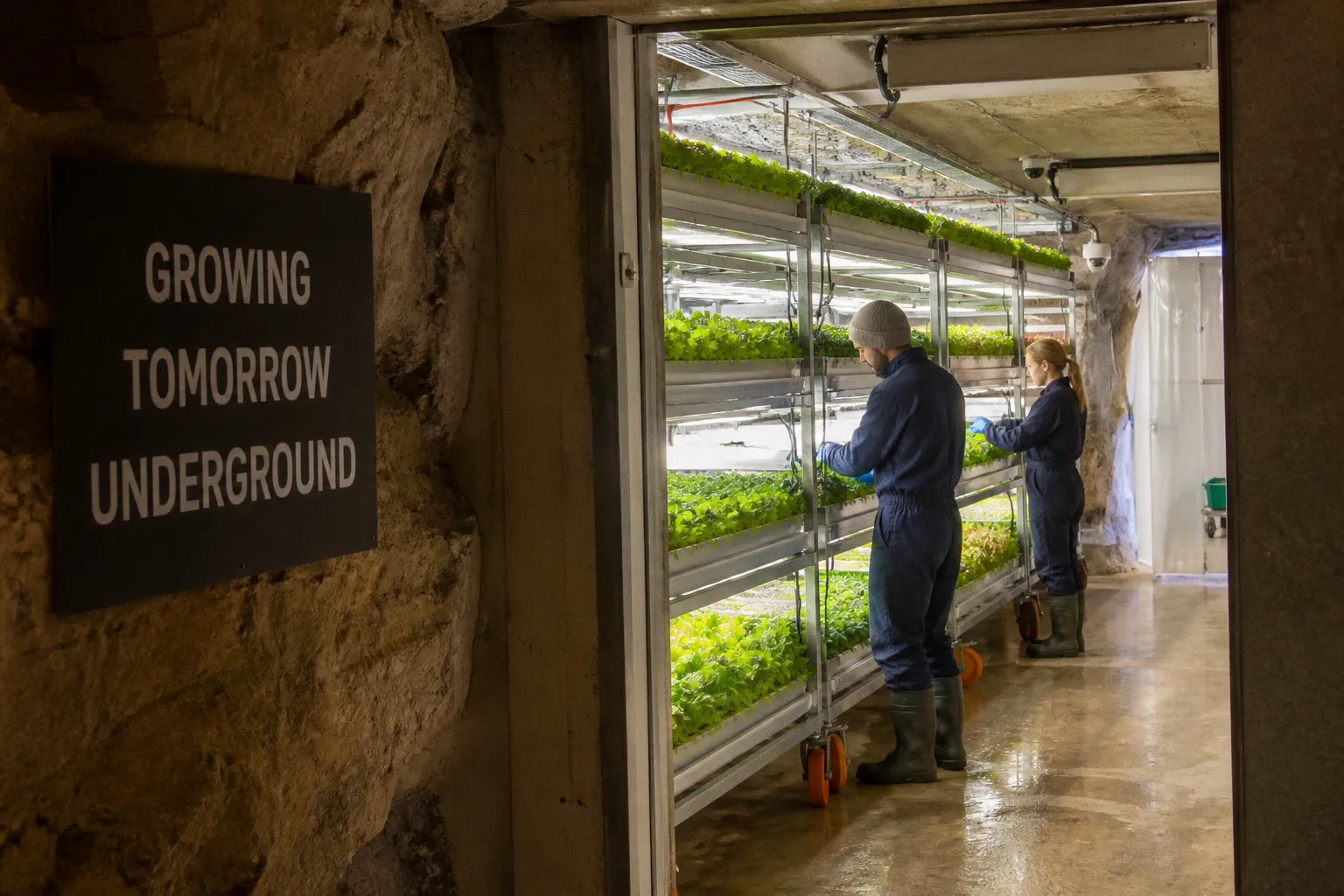
According to The Guardian, a research partnership between the University of Sheffield and the socially conscious food producer Farm Urban is running crop trials more than 1,000 metres below the surface of North Yorkshire, in what the team describes as the world's deepest underground farm. Located at the Boulby mine science facility, the project is testing whether disused subterranean spaces can offset the capital and energy overhead that has limited conventional vertical farming to niche leafy-green production. The data, when it arrives, will speak to a question facing food systems from the Mediterranean to the Levant: how to keep fresh-produce output stable when surface conditions stop cooperating.
The engineering case for going under
Vertical farms already exist; the energy bill is what constrains them. Lighting, climate control, and HVAC typically account for the bulk of operating cost in stacked-growth facilities, and that cost structure has kept the model from scaling into staple crops. The Boulby experiment, led by University of Sheffield research fellow Jacob Nickles, targets exactly that constraint. The mine offers a stable ambient temperature roughly 1.1 kilometres below the surface, reducing the heating and cooling load that above-ground controlled environment agriculture operators must engineer against. Existing mine infrastructure — lifts, tunnels, power distribution — replaces the greenfield capital expenditure a new vertical farm would require. During a visit this week, the team harvested pak choi and lettuce from vertical towers in the salty tunnels and in an air-conditioned lab space. Results were uneven. Some heads of lettuce came out larger than a human head; others underperformed on uniformity. Nickles frames the inconsistencies as engineering, not biological. The point of the harvest is the data.
What it means for climate-stressed production
The headline argument is straightforward: global food production must roughly double by 2050 to feed a projected population approaching 10 billion. This year in England, a dry, hot summer pushed livestock onto winter feed and killed off field crops — a preview of the volatility surface agriculture faces as climate patterns shift. For Mediterranean and Levantine cooperatives exporting fresh produce, the same volatility shows up as heat stress, water rationing, and shrinking harvest windows. Underground controlled environment agriculture does not solve those export pipelines directly, but it isolates one variable — the growing environment — from the climate that is making surface yields less predictable. Boulby is the first attempt to generate baseline metrics on crop uniformity, growth rate, and input energy per kilogram from a subterranean setting. The project's governance is also worth noting. It pairs an academic institution with a mission-driven producer and runs inside a UK government-funded science facility hosted by ICL-UK, the commercial operator of the Boulby mine and the world's only commercial producer of polyhalite, a fertiliser. For cooperatives weighing whether to invest in CEA capacity, the Boulby setup suggests a capital-light path: the infrastructure sits with the mine operator, the science with the university, the production expertise with the social enterprise.
Metrics to track
Two outputs from Boulby will determine whether the model is worth following further: energy cost per kilogram of harvested crop compared to a surface vertical farm at the same scale, and consistency of marketable yield across multiple harvest cycles. The team has not yet published peer-reviewed data; the August trial was a technical run, not a benchmark. For cooperatives evaluating controlled environment agriculture as a resilience layer, the Boulby results will be the first credible baseline from a subterranean setting. If the energy delta holds — and early indications suggest it might — the next question is whether disused mines exist in regions that matter for the fresh-produce export chain.